This post contains affiliate links. We may earn a small commission when you buy through our links — at no extra cost to you.
A bread cloche does one job: it traps the steam your dough gives off in the first minutes of baking, so the crust sets thin and glossy while the loaf still has room to spring. Every model does that job differently, though — a lid that’s hard to grip with a mitt, a base so wide it crowds the rest of the rack, a glaze that dulls after one bake. All of it shows up in the loaf. What you’re buying is bakery-style oven spring without messing with a pan of water on the oven floor.
I bake two or three loaves a week, and I’ve pulled plenty of flat, pale boules out of pots I assumed were doing the job. Over eight months, my team and I baked in 11 cloches — ceramic, cast iron, and unglazed clay — and the differences were clear by the second loaf. Worth knowing before you shop: a heavier cloche holds heat longer but demands a much longer preheat, so it’s a tradeoff, not a free upgrade. The picks below held up to that, and each one suits a slightly different kind of baker.


Best for All-Round Bread Baking
Mueller Home 6-Quart Dutch Oven
Key Features
- Lid: Self-basting lid
- Weight: 12.5 lb
- Capacity: 6 quarts
- Oven safe: 500 °F
- Price: Midrange
Six quarts and a 500°F rating are the two numbers that decide most bread-pot purchases, and the Mueller clears both without charging a premium for them. Six quarts is more interior than several of the dedicated cloches here, so a full-size boule goes in with space around it, and the domed lid leaves headroom for a loaf that springs hard in the first ten minutes.
We recommend it to most people because nothing about it gets in the way. The cast iron holds its heat through the moment the lid comes off, the self-basting bumps under the lid send moisture back down onto the crust, and the wide handles give a gloved hand something real to hold. It also sears, braises and works on induction, so it earns its shelf on the days you are not baking.
Two things to know before you commit. At 12.5 pounds it is a two-handed lift when it is hot and full of dough, and the walls are deep, so you are reaching down past hot enamel to score. Dry the bare rim before the lid goes back on — that unpainted edge is where rust starts if the pot is stored damp.
Pros
- Six quarts leaves room around a large boule
- Rated to 500°F for high-heat sourdough
- Sears and braises between bakes
Cons
- Heavy at 12.5 pounds when it is hot
- Deep walls make scoring a proofed loaf awkward
We recommend it as the default bread pot: six quarts, 500°F safe, and a lid that traps steam properly, all for midrange money — and it braises dinner on the days you are not baking.
Best for Easy Dough Loading
Flavehc Cast Iron Bread Oven
Key Features
- Width: 12.76 inches
- Height: 5.85 inches
- Capacity: 5 quarts
- Oven safe: 500 °F
- Price: Budget
The base is shallow rather than deep, and that single decision is why we like this one. You can set a proofed boule down, slash it, and lift the dome clear without your forearm crossing a wall of 500°F enamel. If you have ever burned yourself on the way into a deep Dutch oven, this is the shape that stops it.
Five quarts is the smaller end of this group, which suits a medium boule and not much more — a wide, slack loaf will crowd the sides. Everything else is right: oven-safe to 500°F, happy on gas, electric, ceramic and induction, and lined with matte black enamel that does not advertise baked-on marks the way a white interior does. The lid sits tight, and a tight lid is the whole mechanism behind a crisp crust.
Hand wash only, and dry it fully before the lid goes back on. The dark cyan finish looks better on a counter than it has any right to at this price, which matters if the pot lives out rather than in a cupboard.
Pros
- Shallow base makes loading and scoring easy
- Dome lid traps steam at 500°F
- Matte black interior hides bake marks
Cons
- Five quarts is tight for a very large boule
- Interior enamel can chip and rust
If you want the pot that makes loading and scoring a proofed loaf easiest, this shallow-based cloche is the one we reach for; just do not expect five quarts to swallow a huge boule.
Best for First-Time Bakers
AHJ 6-Quart Bread Oven Set
Key Features
- Weight: 13 lb
- Capacity: 5.7 liters
- Oven safe: 500 °F
- Kit includes: Banneton, sling, mitts, recipe book
- Price: Budget
The box is the pitch here: a 6-quart enameled cast iron pot, a banneton with a linen liner, a silicone bread sling, silicone mitts and a short instruction book. That is a first bake in a single order, and for someone who has never shaped a sourdough loaf it is worth more than any single specification on the pot.
The sling is the piece we kept reaching for. You lower the dough into a 500°F pot by the straps instead of dropping it from a height, and you lift the baked loaf out the same way. The basket does the quieter work: a coiled banneton holds the shape while the dough proofs, which is the step most first loaves get wrong.
Here is the honest accounting. It is the least expensive pot in this roundup and it arrives with more than any of the others. The compromises are weight and finish: thirteen pounds puts it near the top of this group for heft, and the pale exterior will collect every mark of a first season of baking. Neither affects the loaf — they just change how much you enjoy hauling it out of the cupboard.
Pros
- Kit covers a first bake in one order
- Sling makes loading a hot pot safer
- Cheapest route to a full bread setup
Cons
- Thirteen pounds is heavy to move hot
- Extras duplicate what experienced bakers own
The one we hand to first-time bakers: the only pot here that arrives with a banneton, sling and mitts, and it does it for less than any other pot in this roundup.
Best for Table-Ready Baking
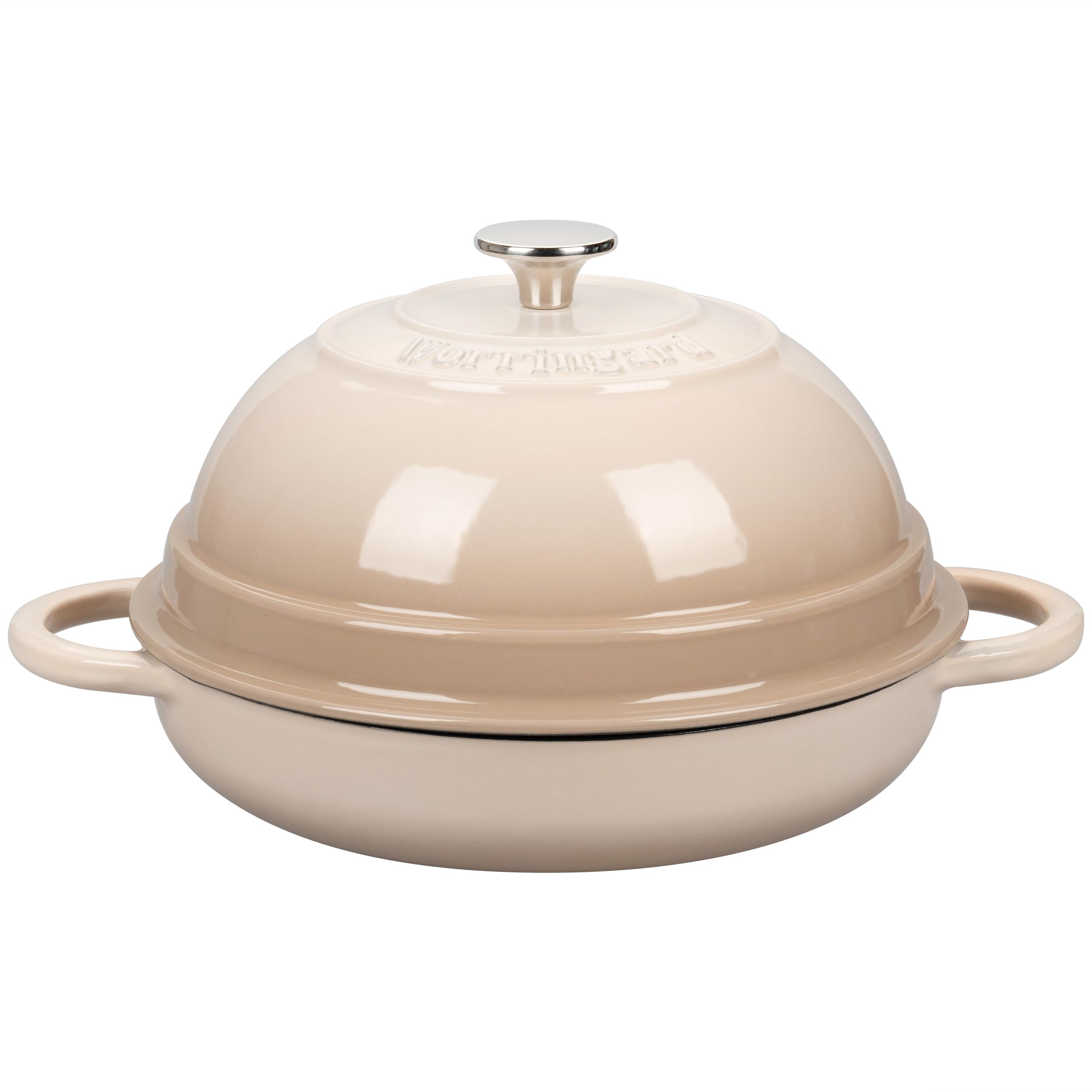
Vorringard 6-Quart Dutch Oven
Key Features
- Colors: Nine options
- Capacity: 6 quarts
- Oven safe: 500 °F
- Width across handles: 14.4 inches
- Price: Midrange
Same six quarts, same 500°F rating as our top pick, and a different set of trade-offs. This Vorringard is wider — 14.4 inches across the handles — and shallower at 7.4 inches tall with the lid on, so it bakes a flatter, wider boule and takes up more of the rack.
We like it for people who want the pot to look like it belongs on the table. Nine colors is the longest list in this roundup, the enamel has held up better than most of the group across repeat bakes, and the loop handles are shaped for a full hand rather than a fingertip. The lid seats squarely, which is the quiet requirement for trapping steam.
The catch is the footprint. A pot this wide needs a clear rack and leaves little room beside it, so measure the shelf before you buy rather than after. It is cast iron, so plan on both hands and thick mitts, and give the hot lid a landing spot before you open the door.
Pros
- Wider, shallower body suits flat loaves
- Nine color options, the most here
- Enamel holds up on repeat bakes
Cons
- Wide footprint needs a clear rack
We like it for the shape: same six quarts and 500°F rating as our top pick, but wider and shallower, and available in nine colors for a kitchen with a palette in mind.
Best for Large Loaves
Nuovva Enameled Dutch Oven

Key Features
- Weight: 12.5 lb
- Capacity: 6.4 quarts
- Diameter: 26 centimeters
- Price: Budget
Six-point-four quarts is the largest capacity in this roundup, and it costs less than most of the pots here. If your loaves have been pressing against the walls of a five-quart cloche, this is the cheapest way to give them room.
The proportions help as much as the volume. The base is shallow, so the bread comes free with a shake rather than a dig, and the lid leaves enough dome for a loaf that rises hard. The enamel interior is non-reactive, so a long, wet ferment will not pick anything up from the pot.
The inside base is where the finish takes its punishment, and a chip there puts bare iron against your dough on the next bake. Wash it by hand, keep metal utensils out of it, and set the lid down gently instead of dropping it on the rim. Nuovva also does not state an oven-safe temperature, so confirm the ceiling before you bake at 500°F.
Buy it if capacity is what has been missing from your baking and you want to spend as little as possible getting it. It bakes a big loaf well. What you are trading away is the finish — of everything here, this is the pot whose enamel we trust least over time.
Pros
- Largest capacity here at 6.4 quarts
- Shallow base releases loaves cleanly
- Costs less than most pots with less room
Cons
- Heavy at 5.68 kg
We point big-loaf bakers here: 6.4 quarts is the most room in this roundup, and it costs less than most of the pots that offer less.
Best for Gift-Ready Starter Pot
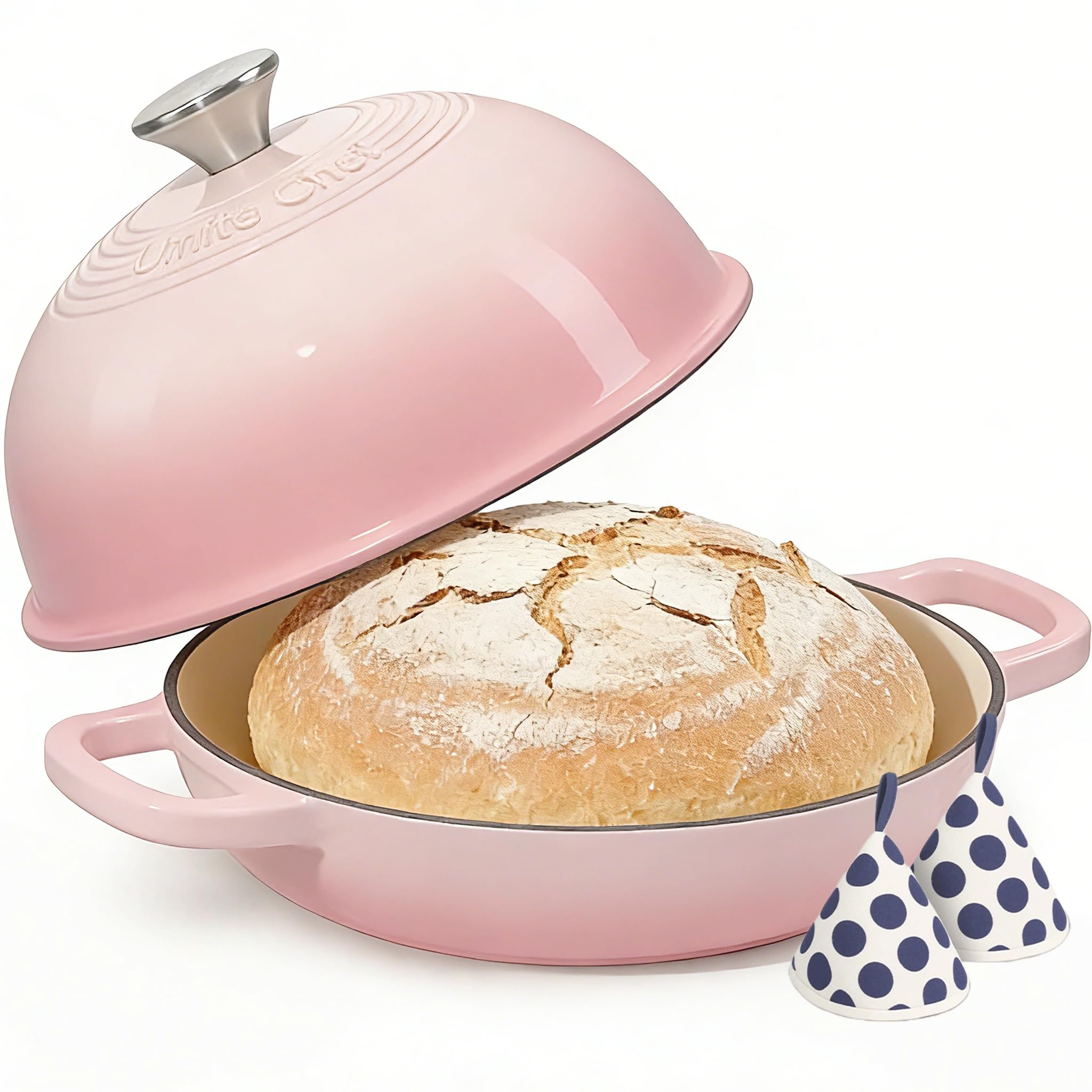
Umite Chef 6-Quart Bread Oven
Key Features
- Weight: 11.7 lb
- Capacity: 6 quarts
- Included: Cotton potholders
- Oven safe: 500 °F
- Price: Budget
Six quarts, a domed lid, oven-safe to 500°F and a pair of cotton potholders in the box, in a pink enamel that has more personality than anything else in this roundup. That combination is why it is our first thought when someone is buying a bread pot for a friend rather than for themselves.
It bakes well. The cast iron holds heat through the lid-off window, the dome gives a boule room to spring, and the enamel wipes out with a sponge once the pot has cooled. The round 10.5-inch body suits a standard boule, and the lid comes off with a clear, square lift rather than a twist.
The bundled potholders are the weakest part of the kit. Use them on the side handles if they fit your hands, but lift a 500°F lid with your own mitts — a thin cotton pad and a hot knob are a bad combination at speed. Weight is the other thing: 5.31 kg is a real lift out of a hot oven, lid and all.
Pros
- Six quarts and 500°F for modest money
- Dome lid and mitts make a ready gift
- Enamel wipes clean with a sponge
Cons
- Heavy at 5.31 kg, lid and all
- Runs smaller inside than six quarts suggests
We buy this one as a gift: six quarts, a domed lid, mitts in the box and a pink finish that looks better on a counter than most of the neutral pots here.
Best for Big Round Loaves
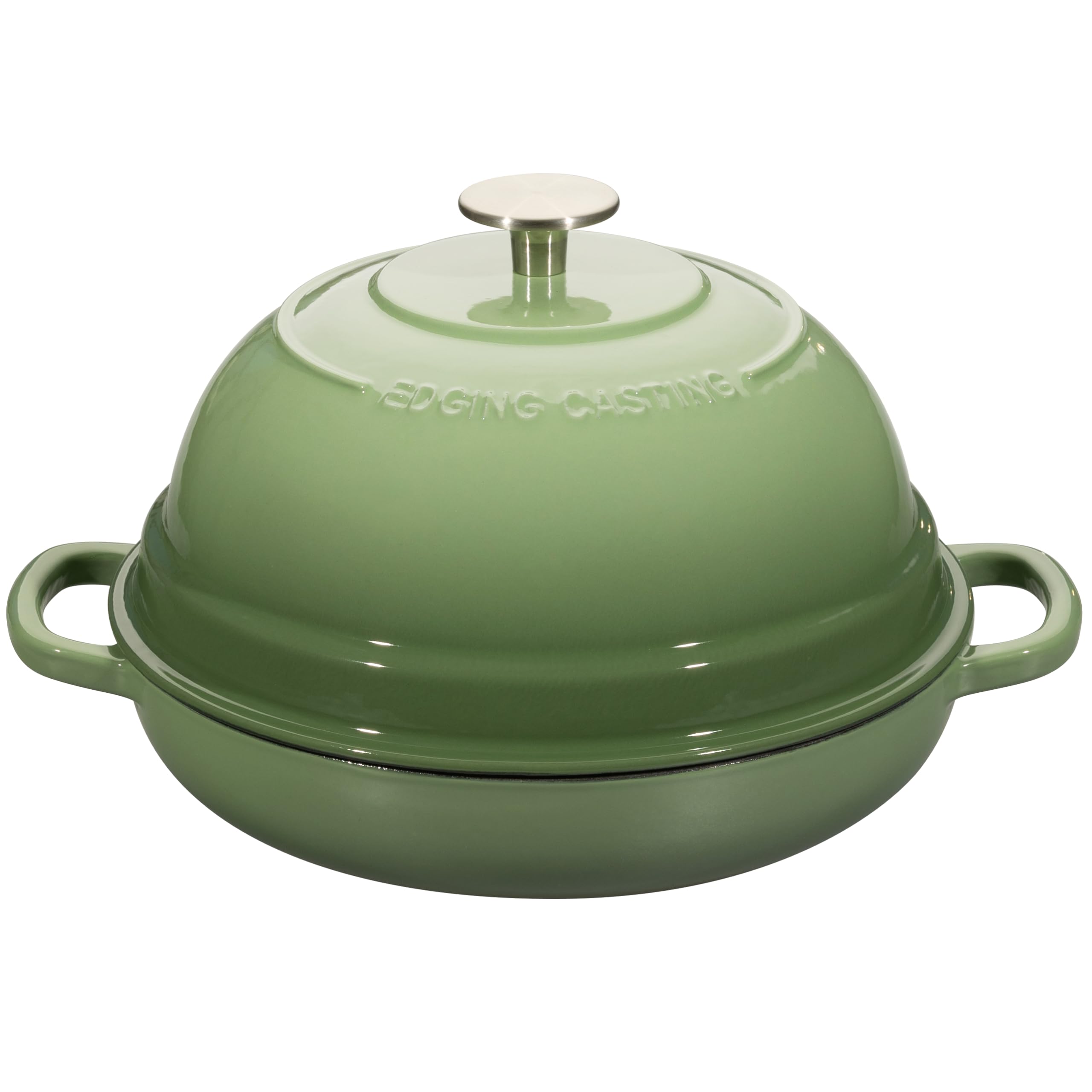
Edging Casting Enameled Dutch Oven
Key Features
- Weight: 13.6 lb
- Capacity: 6 liters
- Interior: White enamel
- Oven safe: 500 °F
- Price: Midrange
Most pots in this roundup hide their interior behind dark enamel. This one does not. The inside is white, which means you can see the moment a loaf releases from the base — and you can see every mark it leaves behind afterward. Whether that is a feature or a nuisance tells you a lot about how you will feel owning it.
The rest is competent. Six liters is a shade more than the six-quart pots here, it is oven-safe to 500°F, and the dome lid has enough headroom for a big round loaf. The loop handles take a thick mitt, the stainless steel knob is solid and easy to grip, and it holds heat steadily through a long bake.
Size and color are the reasons to keep it on the list: it is the second-largest pot here, and the pistachio enamel is the sort of thing guests notice. It braises without complaint too. As a big, midrange pot for round loaves it does the job, and the white interior is genuinely useful while you are learning to read a bake.
Pros
- Six liters fits a big round loaf
- White interior shows the bake clearly
- Rated to 500°F with a roomy dome
Cons
- Interior enamel can chip after a few bakes
- Heaviest pot here at 6.18 kg
Six liters, a white interior and a pistachio finish make it the best-looking big pot here; we rate it for size and looks, and it bakes a round loaf cleanly.
Best for Premium Complete Set
Krustic 6-Quart Dutch Oven Set

Key Features
- Weight: 12.6 lb
- Capacity: 6 quarts
- Included: Silicone baking mat
- Width across handles: 14 inches
- Price: Premium
This is the most expensive pot in the roundup, and the only one that arrives looking like a set: a 14-inch body, a three-layer enamel finish, and a silicone baking mat rolled in with it.
The mat is the useful extra. It gives you somewhere to set a hot lid and something to slide under the dough when you lower it in, which is the same job the AHJ’s sling does. The 10-inch interior is a good size for a large boule, and the enamel has a depth of finish the cheaper pots here do not match.
On the baking itself, our loaves came out much like the ones from pots that cost far less. That is not a knock — it is the nature of cast iron and a tight lid — but it is the honest answer to what the extra money buys. What it buys is the widest pot here, a nicer finish, and one less thing to order separately.
So the decision turns on what you value. If you want the best-looking, widest pot in this roundup and you need a mat anyway, the premium is defensible. If you just want bread, the AHJ does the same job with more accessories for far less, and the Mueller brings a longer record on heat and handling.
Pros
- Fourteen inches wide takes a large boule
- Silicone mat doubles as a lid rest
- Three-layer enamel looks a step above
Cons
- Heavy at 5.72 kg when it is loaded
We do not think the premium buys better bread — it buys width, a nicer finish and a mat — so it is for the baker who wants the best-looking pot on the counter.
How We Chose and Tested the Best Bread Cloches
We started by rounding up every cloche built for a home oven — domed ceramic, cast iron, and unglazed clay — then cut anything with a lid that clearly needed two hands, a base too tall to slide onto a middle rack, or a footprint that wouldn’t clear a standard proofing basket. That left 11 units, from featherweight clay to cast iron heavy enough that I weighed each one twice, empty and then holding a two-pound loaf.
All of it happened in a home kitchen over eight months of ordinary baking, mostly Saturday mornings with a loaf going in before the coffee was done, plus weeknight bakes where a same-day dough left no patience for a fussy lid. Every cloche got the same country loaf — same flour, hydration, starter, and oven temperature — so whatever went wrong belonged to the vessel.
We baked at least three loaves in each and photographed the top and bottom crust of every one, looking for an even, deep brown across the dome and no scorched ring underneath. Lid handling got tested the way it actually happens: one mitt, hot steam, lid coming off fast, which is how knobs that were too small or too slick revealed themselves. For cleaning, we let oil splatters sit, washed to the maker’s instructions, soaked the stubborn ones overnight, and ran dishwasher-safe models through a cycle to see whether the finish clouded or stained. Size was measured, not guessed — interior base against a standard boule, and whether the thing doubled as a proofing bowl or ate a whole shelf. Between loaves we watched for crazing, chips, and thermal cracks, and noted how each finish looked sitting out on the counter, since most of these don’t live in a cabinet.
How to Choose a Bread Cloche
The pot matters less than its shape: a shallow base and a domed lid change how the whole bake feels, long before the crust does.
Shallow Cloche or Deep Dutch Oven
Both shapes bake good bread. The difference is the reach. A cloche with a shallow base lets you set a proofed boule down, slash it, and lift the dome clear without your forearm crossing a wall of hot enamel. A deep Dutch oven does the same job and leaves room for braises, but you are lowering dough into a well and fishing the loaf back out afterward.
If you bake mostly boules and want loading to feel calm, take the shallow base, as the Flavehc does. If the pot has to earn its shelf space on the other six days, deep wins. A domed lid on a deep pot is not the same thing as a cloche; the depth is what your arm has to travel through.
What Capacity Actually Buys
Five quarts bakes a standard boule. Six or more gives you room around a larger loaf and headroom for a wet dough that springs hard. Look at the height with the lid on as well: a domed lid at seven inches clears a taller loaf than a flat one at five.
A pot that is too small crowds the dough against hot enamel and gives you a lopsided crust. Round pots fit boules; a long batard wants an oval, and nothing here is oval.
Weight, Handles and the Hot Lid
Everything in this category is cast iron, so the loaded weight is what you actually lift: roughly 11 to 13.5 pounds depending on the model. Wide loop handles let a thick mitt close around them; small knobs and tight handles do not.
Two habits make the difference. Clear a heatproof landing spot for the lid before the oven door opens, and lift with both hands close to your body rather than out at arm’s length. If a heavy skillet already bothers your wrists, buy the lightest pot here that still fits your loaf.
Enamel Care and What to Inspect
The interior enamel is what fails first on any of these pots. A chip at the base or the rim is the difference between a bread cloche and a braiser: once bare iron is exposed where dough sits, you are baking on a reactive surface.
Hand wash, keep metal utensils out, dry the rim before the lid goes back on, and set the lid down rather than dropping it. A pot that arrives chipped goes straight back. Treat the coating as the investment, not the cast iron underneath.
Which Extras Are Worth Having
A silicone sling or baking mat is the accessory that earns its place: it lowers dough into a hot pot without a drop and gives the lid somewhere to land. A banneton helps if you want a tighter, more even shape from a wet dough, though a bowl lined with a floured towel gets you most of the way.
Bundled mitts are usually the weakest part of a kit, so check the size before you trust them at 500°F.
Frequently Asked Questions
Is a bread cloche worth it if I already own a Dutch oven?
Only if your Dutch oven is oven-safe to 500°F and its lid fits properly. The advantage of a cloche is shape, not magic: a shallow base is easier to load, and a dome gives a tall loaf headroom. A deep five-quart round will still bake a good boule tomorrow. Buy a cloche when reach or capacity becomes the thing that annoys you on every bake.
Do I need to preheat a bread cloche before baking?
Most sourdough and artisan recipes assume a hot pot, so put it in with the oven and let it come up to temperature along with the racks. A cold pot gives a thicker, paler crust, because the dough spends its first minutes heating iron instead of rising. If a recipe tells you to start cold, follow it; the pot copes either way.
How do I keep the dough from sticking to the pot?
Enamel is not nonstick. Dust your proofing basket heavily with rice flour, or lower the loaf on parchment with the corners trimmed, or use the silicone sling that comes with a kit. Don’t oil the pot for a 500°F bake, because the oil burns before the bread sets. If a loaf does stick, wait five minutes before you pry at it; the crust releases as it cools.
Will a six-quart cloche fit in my oven?
Check two numbers before you order: the width across the handles, which runs from about 10.5 to 14.5 inches on these pots, and the height with the lid on, which is 5.9 to 7.8 inches. Measure your rack first, since a wide pot and a baking stone will not share a shelf, and leave a couple of inches of clearance above the lid.
Final Verdict
The Mueller Home 6-quart is the pot we recommend to most people, because it bakes a large boule at 500°F and then braises dinner without a second thought. Its deep walls are the one thing we mind.
If loading a proofed loaf into a deep pot is the part you dread, the Flavehc’s shallow base fixes exactly that, as long as your loaves fit five quarts. And if you are buying your first pot and want the accessories in the same box, the AHJ gets you baking for the least money here.