This post contains affiliate links. We may earn a small commission when you buy through our links — at no extra cost to you.
Many anti-fatigue mats look great online but slide on tile or feel too thin to help tired feet. The real issue isn’t just cushioning—it’s matching mat dimensions to your space and floor type.
The most common regret is choosing a mat that’s too narrow (17.3 inches) or too thin (under half an inch). A mat that fits your body and absorbs shock without creeping across the floor makes the difference between relief and annoyance.
This guide focuses on mats that deliver on thickness, width, and grip—so you get actual comfort without the false economy of cheap, narrow mats.


Best for General Kitchen Use
ComfiLife 20×32 Mat
Key Features
- Thickness: 0.75 in
- Width: 20 in
- Material & Construction: Memory foam + rubber
- Non-Slip Backing: Rubber backing
- Price: Mid-Range
The 0.75-inch memory foam layer provides noticeable relief during extended standing, while the 20×32 size covers typical kitchen or desk work zones without feeling oversized. The rubber backing grips well on most floors, though on very smooth or wet surfaces it may shift – a tradeoff buyers with tile or hardwood floors should factor in.
This mat suits home and office users who prioritize comfort and value over absolute non-slip performance. It works best on carpet, vinyl, or dry, textured hard floors. If your floor is polished or frequently wet, consider a model with a ridged bottom instead.
Pros
- High-density memory foam cushions feet and legs during hours of standing
- Durable construction that resists flattening and maintains support over time
- Stain-resistant surface wipes clean with a damp cloth
Cons
- On polished tile or wet floors, the backing can lose grip and allow the mat to shift – less of an issue on carpet or textured surfaces
For most home and office standing areas, this mat offers a strong blend of comfort, build quality, and mid-range pricing – provided your floor type doesn’t demand maximum non-slip performance.
Best for Kitchen, Desk Use
Ophanie 20×32 Mat
Key Features
- Thickness: 0.75 in
- Width: 20 in
- Material & Construction: PU recycled foam + PVC
- Non-Slip Backing: Ridged bottom
- Price: Mid-Range
The Ophanie mat stays firmly in place on tile, wood, and laminate thanks to its ridged PVC bottom, a clear advantage over the top pick that some find slides on smooth floors. The 0.75-inch high-density recycled foam provides cushioning that absorbs shock without bottoming out, and the PVC leather top resists stains and scuffs. This size (20×32) fits standard sink and stove areas but won’t cover long counters or large workspaces — if you need a runner or a bigger surface, the single size is a hard boundary.
Pros
- Exceptional comfort and support for all-day standing.
- High-quality construction with durable, stain-resistant top layer.
Cons
- Available only in 20×32 — no runner or extra-long options for larger spaces.
If your priority is a mat that won’t budge on hard floors and you’re fine with a single 20×32 size, Ophanie delivers grip and comfort that rivals pricier mats.
Best for Standing Desk Users
Ergodriven Topo Mat
Key Features
- Thickness: 2.7 in
- Width: 29 in
- Material & Construction: PU foam
- Non-Slip Backing: Textured base
- Price: Premium
The Topo’s 3D terrain map is designed to nudge you into natural weight shifts and stretches, reducing joint stiffness during extended standing. This mat is built for dedicated desk workers who stand 4+ hours daily – its 2.7-inch polyurethane foam provides substantial cushioning without bottoming out. The thick profile and premium price mean it’s not a casual kitchen mat; it requires ample desk clearance and a budget comfortable with a significant ergonomic investment.
Pros
- Three-dimensional terrain encourages micro-movements that reduce stiffness
- Thick foam supports legs and feet during long standing sessions
- Durable build backed by a 7-year warranty
Cons
- Premium price tag makes it a significant investment compared to flat mats
- 2.7-inch thickness may not clear low-clearance desks
For the dedicated stander who wants an active, ergonomic surface that fights fatigue, the Topo is a purpose-built solution – just confirm your desk height and budget first.
Best for Kitchen or Desk
FEATOL 0.9" Thick Mat
Key Features
- Thickness: 0.9 in
- Width: 20 in
- Material & Construction: Memory foam + PU leather
- Non-Slip Backing: Ridged bottom
- Price: Mid-Range
At 0.9 inches thick, the FEATOL mat delivers the deepest cushion among mid-range options — high-density memory foam that resists bottoming out even under sustained pressure. This firm support reduces fatigue during long standing sessions without the unstable squish of softer mats.
Best for heavy individuals or anyone who prefers a stable, supportive surface underfoot. The firm feel may not suit those who want a plush, cloud-like sensation — this mat stands firm, not soft.
Pros
- Extra thick 0.9-inch cushioning absorbs shock without bottoming out
- Comfortable for long standing periods — helps reduce back and foot fatigue
- Durable build holds up to daily heavy use
Cons
- Firm surface may not appeal to those who prefer a soft, squishy feel underfoot
Delivers maximum thickness at a reasonable price — ideal for users who want firm, supportive cushioning rather than plush comfort.
Best for Light Kitchen Use
KIMODE 2-Pack Mats
Key Features
- Thickness: 0.47 in
- Width: 17.3 in
- Material & Construction: PVC
- Non-Slip Backing: Non-skid bottom
- Price: Budget
The KIMODE 2-Pack Mats bring a printed farmhouse look to kitchen and laundry at a budget price, offering two sizes (47” and 29”) for sink and stove coverage. Compared to the thinner 0.4” alternative in this set, it provides notably better cushioning and a design that blends with decor.
Ideal for decor-conscious buyers who stand for short periods — the 0.47-inch thickness and 17.3-inch width limit relief for all-day tasks or larger feet. The non-slip backing works on most floors but may shift on very smooth surfaces; a rug pad resolves that concern.
Pros
- Cushioned surface reduces foot fatigue during short tasks
- Attractive farmhouse print complements kitchen or laundry decor
- Strong build quality at a low price for a two-mat set
Cons
- Non-slip grip may be inconsistent on polished floors
A cost-effective style upgrade for light kitchen duty — pair with a rug pad if your floor is slick.
Best for Carpeted Floors
KANGAROO 20×32 Mat
Key Features
- Thickness: 0.75 in
- Width: 20 in
- Material & Construction: High density foam
- Non-Slip Backing: Textured (not slip-resistant)
- Price: Mid-Range
0.75 inches of high-density foam makes the KANGAROO mat noticeably softer underfoot than many mid-range options – a clear benefit for anyone standing for extended periods. The tradeoff: this mat slides on tile, hardwood, and laminate because the manufacturer designed it without slip-resistant backing. It’s best suited for carpeted floors where the fibers grip the texture, or for users willing to add adhesive tape or a rug pad.
Someone who prioritizes cushioning over convenience and has a carpeted workspace or kitchen will get the most from this mat. On smooth surfaces, sliding is a real limitation – plan accordingly.
Pros
- Very comfortable and supportive – helps with back and leg pain
- Waterproof surface is easy to clean
- Well-padded construction holds its shape over time
Cons
- Slides on smooth floors; manufacturer warns it’s not slip-resistant – requires carpet or added grip
A comfortable choice for carpeted areas or users who don’t mind securing the mat; skip it for tile or hardwood unless you plan to add grip.
Best for Narrow Counter Use
KMAT 17×60 Runner
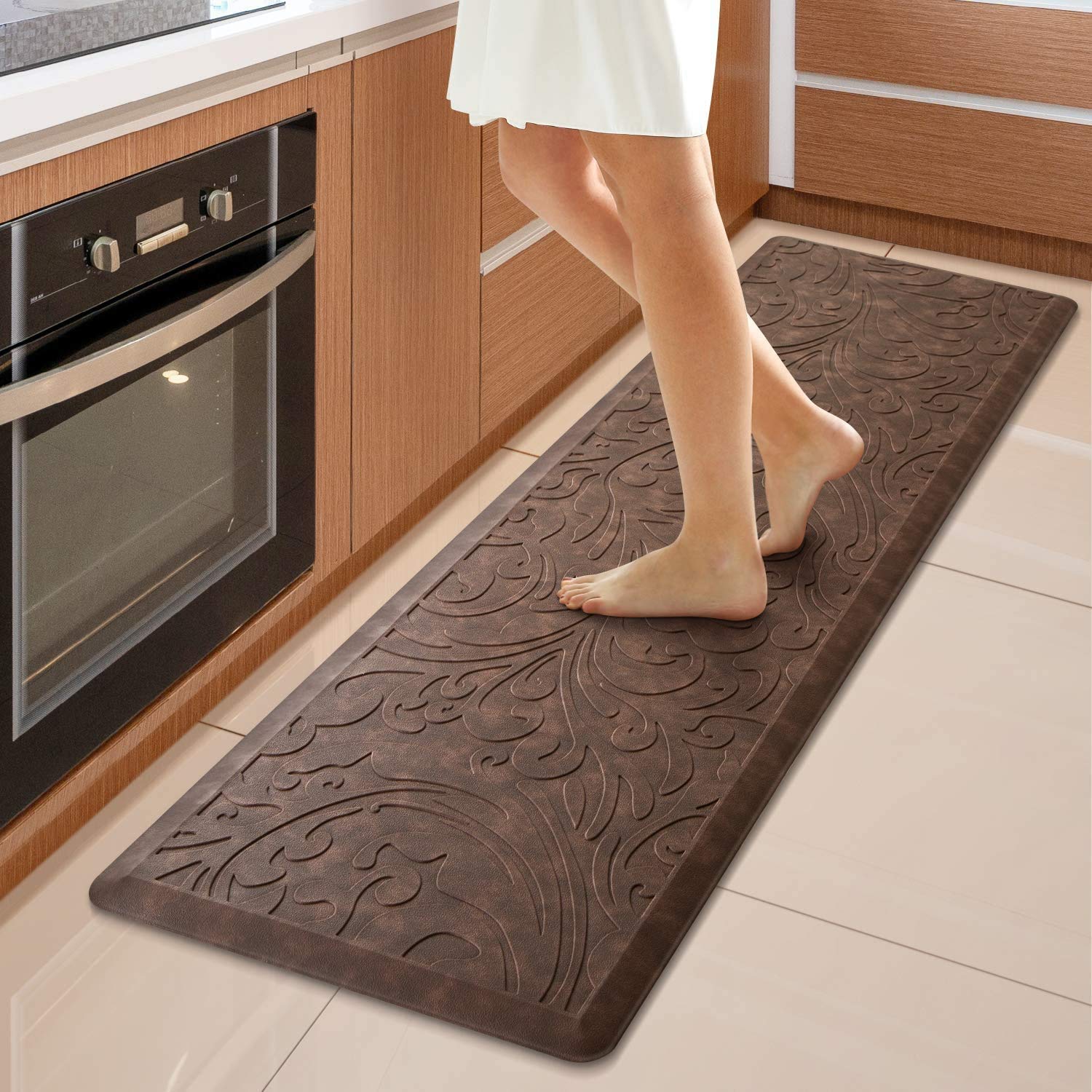
Key Features
- Thickness: 0.5 in
- Width: 17.3 in
- Material & Construction: PVC foam
- Non-Slip Backing: Non-slip backing
- Price: Budget
The KMAT runner’s main draw is its length — 60 inches spans most countertops without needing a second mat. The floral pattern looks pricier than the cost suggests, and spills wipe off easily. But at 17.3 inches wide and half an inch thick, shifting your stance feels tight and shock absorption is minimal. This works for quick meal prep or standing under an hour, not full workdays.
Pros
- Easy to clean – spills wipe off effortlessly
- Attractive floral pattern that looks more expensive than the price
Cons
- Narrow 17.3-inch width may feel restrictive when shifting weight
Fits narrow kitchen layouts where length matters more than width, and for budget buyers who only need occasional standing relief.
Best for Budget Low-Traffic
WISELIFE 17×28 Mat

Key Features
- Thickness: 0.47 in
- Width: 17.3 in
- Material & Construction: PVC
- Non-Slip Backing: Non-slip bottom
- Price: Budget
At under $13, the WISELIFE mat feels soft and comfortable out of the box. It wipes clean easily and looks nice. However, its thin 0.47-inch padding provides limited fatigue relief, and the top surface may crack after months. This makes it suitable only for light, temporary use in low-traffic areas.
Pros
- Soft, cushiony feel that rivals pricier mats.
- Wipes clean quickly — stains don’t set on the surface.
Cons
- Top layer may crack or peel after several months of use.
Best for temporary setups or spare kitchens where budget is the primary concern — but not for daily cooking or standing.
Best for Sink and Stove
SoftDuo 2-Pack Mats

Key Features
- Thickness: 0.47 in
- Width: 17.3 in
- Material & Construction: PVC
- Non-Slip Backing: Non-skid
- Price: Budget
The two-pack covers sink and stove areas cost-effectively. Its 0.47-inch thickness provides some cushion for short kitchen tasks but insufficient for prolonged standing. Durability over months has been noted as a concern; if you need lasting support, consider thicker options like KIMODE.
Pros
- Reduces foot fatigue during short kitchen tasks
- Spills wipe off easily – easy to clean
Cons
- Thin padding (0.47") may not support all-day standing
A budget-friendly option if you need two mats for light kitchen use and can accept thin cushioning.
Best for Light Duty Areas
KMAT 2-Pack Set

Key Features
- Thickness: 0.4 in
- Width: 17.3 in
- Material & Construction: PVC
- Non-Slip Backing: Non-slip backing
- Price: Budget
This two-pack is easy to clean and looks attractive, making it a decent option for light kitchen tasks. However, the 0.4-inch thickness and 17.3-inch width provide minimal support – it is only for very light use, not for prolonged standing.
Pros
- Easy to clean – highly stain-resistant, wipes off easily
- Attractive appearance and color options
Cons
- Thin 0.4-inch padding provides minimal shock absorption – may not relieve fatigue for extended standing
Best for budget buyers who need two mats for light use in a rental or temporary space – not for daily standing.
Best for Small Kitchens
GORILLA GRIP 17×24

Key Features
- Thickness: 0.75 in
- Width: 17 in
- Material & Construction: High density foam + rubber
- Non-Slip Backing: Rubber backing
- Price: Mid-Range
The Gorilla Grip offers genuine 0.75-inch cushioning that reduces fatigue during meal prep, and the waterproof surface wipes clean easily. However, its 17-by-24-inch footprint feels tight for anyone with larger feet, and the rubber backing can shift on smooth floors unless secured with double-sided tape. These tradeoffs keep it from competing with wider, more stable mats like the ComfiLife.
Pros
- Thick 0.75-inch foam provides solid comfort for short standing tasks.
- Waterproof, easy-to-clean surface resists spills and stains.
Cons
- Slides on smooth floors without adhesive – best suited for carpet or taped placement.
A reasonable pick for tight counter spaces if you’re willing to tape it down, but not for wide stances or non-carpet floors.
Best for Light Kitchen Use
StepRite 2-Pack

Key Features
- Thickness: 0.4 in
- Width: 17.3 in
- Material & Construction: PVC
- Non-Slip Backing: Non-slip backing
- Price: Budget
The StepRite two-pack offers a budget-friendly way to cover both sink and stove areas with a clean khaki finish that wipes down easily. However, the thin 0.4-inch padding and narrow 17.3-inch width limit its effectiveness for prolonged standing, and occasional quality issues like creases may appear.
Pros
- Good value for a two-pack set
- Easy to clean with a quick wipe-down
Cons
- Thin padding (0.4") may not relieve foot fatigue during extended standing
This two-pack suits a backup kitchen or rental where low cost and appearance matter more than cushioning for long hours.
Best for Occasional Use
KitchenClouds 17×28

Key Features
- Thickness: 0.5 in
- Width: 17.3 in
- Material & Construction: PVC
- Non-Slip Backing: Diamond non-slip
- Price: Budget
The KitchenClouds mat provides decent cushioning for short tasks like waiting for the kettle or standing at the sink, and its surface wipes clean without absorbing spills. At 0.5 inches thick and 17.3 inches wide, the padding and footprint are too limited for prolonged standing or full fatigue relief. This mat suits buyers who need a budget-friendly option for light, temporary use in small kitchens or as a quick pad on a hard floor.
Pros
- Cushioning relieves pressure during quick kitchen tasks
- Spills and stains wipe off without absorbing
Cons
- 0.5-inch padding may not provide enough support for longer standing
Best suited for occasional standing in front of a sink or coffee station – not intended for extended kitchen prep or all-day use.
Best for Compact Desk
Ergodriven Topo Mini

Key Features
- Thickness: ~2.5 in
- Width: 19.2 in
- Material & Construction: PU foam
- Non-Slip Backing: Textured base
- Price: Premium
The Topo Mini delivers the same 3D terrain and durability as the full-size Topo in a 25×19 inch footprint, making it a good fit for cramped cubicles and small home offices. However, the firm foam may feel too hard for barefoot use, and the premium price for this small area means most buyers get better value from the larger version. Check desk clearance before buying – the mat’s thickness may push under low desks.
Pros
- Compact footprint fits small workspaces and tight corners
- 3D terrain encourages micro-movements and calf stretching
Cons
- Firm cushioning can feel too hard for barefoot use – best worn with shoes
The Topo Mini is suited for those needing a compact ergonomic mat for a small space, but most buyers will get better value and softer feel from the full-size Topo.
Best for Low-Traffic Areas
HappyTrends 17×28 Mat

Key Features
- Thickness: 0.47 in
- Width: 17.3 in
- Material & Construction: PVC
- Non-Slip Backing: Non-slip PVC
- Price: Budget
At the lowest price in the category, this mat delivers basic cushioning for short tasks in low-traffic areas. The 0.47-inch thickness and compact 17.3×28-inch footprint provide temporary relief but fall short for daily standing. Some units develop creases or wrinkles with regular use, limiting its lifespan for anything beyond guest or temporary setups.
Pros
- Very affordable entry point for a cushioned mat
- Comfortable for short to medium standing periods
Cons
- The 0.47-inch cushion may feel insufficient for extended standing
Best suited for occasional guest use or temporary setups where any cushion is better than none.
How to Choose
The most common mistake buyers make is underestimating the importance of mat width and thickness—most regret choosing narrow, thin mats that don’t provide real relief.
Thickness
Thicker mats (0.75 to 0.9 inches) absorb more shock and reduce fatigue for long standing sessions. Mats under half an inch may feel acceptable at first but quickly bottom out, transferring pressure to your joints.
However, thickness alone isn’t enough—the foam density matters. A firm 0.9-inch mat can feel less plush than a soft 0.75-inch one. Look for high-density memory foam or polyurethane for the best balance of cushion and support.
Width
Width is the most overlooked spec. A 20-inch-wide mat lets you shift weight naturally without stepping off the edge. Narrow 17.3-inch mats force you to stand in one spot, which limits movement and increases stiffness.
If you have larger feet or tend to pace while working, opt for at least 20 inches. The extra width also reduces the risk of tripping compared to a thin, narrow runner.
Material & Construction
Memory foam and PU foam offer better long-term durability and cushioning than standard PVC, which can crack or flatten over time. PVC mats are cheaper but often sacrifice support and longevity.
The top layer also matters: PU leather or waterproof fabric resists stains and is easy to wipe clean. Avoid mats with a fabric top in kitchens—they absorb spills and are harder to maintain.
Non-Slip Backing
A textured rubber backing or ridged bottom grips smooth floors much better than plain PVC. Many budget mats claim to be non-slip, but on tile or hardwood, they still slide—especially when wet.
If your floor is polished or you’ve had slipping issues, consider a mat with a dense rubber base or plan to add double-sided tape. A mat that moves while you stand is not just annoying—it can be a safety hazard.
FAQ
Why does my anti-fatigue mat slide on hardwood floors?
Most budget mats use a smooth PVC bottom that lacks grip on polished surfaces. Even some mats with rubber backing can slide if the rubber is too soft or the floor is dusty. To fix this, use double-sided carpet tape or a non-slip rug pad underneath. If sliding is a dealbreaker, choose a mat with a textured ridged rubber bottom, like the Ophanie, which has far fewer sliding complaints.
How thick should an anti-fatigue mat be for kitchen use?
For regular kitchen use (30 minutes to a few hours), aim for at least 0.75 inches of high-density foam. Mats thinner than 0.5 inches provide minimal shock absorption and will leave you with sore feet. Thicker mats (0.9 inches) offer more cushion but may feel firmer if the foam is dense. A 0.75-inch memory foam mat is the sweet spot for most home cooks.
Can anti-fatigue mats be used on carpet?
Yes, but not all mats work well on carpet. Mats with a smooth PVC bottom may shift on low-pile carpet. A textured rubber or ridged backing holds better. However, on deep plush carpet, thick mats can sink and become unstable. If your kitchen is carpeted, consider a mat like the Kangaroo, which is comfortable on carpet but note that it slides on hard floors.
Do anti-fatigue mats cause tripping?
A properly placed mat with beveled edges is unlikely to trip you. But thin, curling edges or mats that slide underfoot increase tripping risk. Avoid mats that curl at the corners after unpacking—this indicates poor quality. Also, ensure the mat is large enough that you don’t constantly step on the edge. A 20×32 inch mat gives enough room to move without hitting the border.