This post contains affiliate links. We may earn a small commission when you buy through our links — at no extra cost to you.
A Saturday night service exposes bad shoes fast: the floor by the dish pit goes slick, you pivot with a sheet pan, and the wrong sole slides out from under you. Kitchen floors are greasy, wet, and unforgiving, and your feet are on them for ten, twelve, sometimes fourteen hours. Good chef shoes fix both halves of that problem — traction you trust on a wet tile line and cushioning that hasn’t flattened by the dinner rush — and they look presentable enough that you’re not hiding your feet when you walk through the dining room.
I’ve worn my share of clogs through double shifts, and over the past eight months my team and I put 12 pairs through working kitchens. The surprise was how much the outsole compound matters — a soft rubber that grips wet tile usually beats a hard sole with deep grooves that goes slick the second grease hits it. Support is the other trap: shoes that feel great on day one and like concrete by week six. Sizing runs all over the map too, and a pair that survives a year is cheaper per shift than the bargain ones you replace twice.



Best for Wet Kitchen Floors
Crocs Bistro Work Clog
Key Features
- Sole: Slip-resistant
- Style: Work clog
- Toe coverage: Enclosed
- Price: Budget
The mop bucket tips, the line goes down, and everyone finds out what their soles are worth. That is the moment the Crocs Bistro is built for: a closed-toe work clog with a slip-resistant outsole and a body that wipes clean instead of soaking up the mess. It is the pair we recommend first for most kitchen jobs because it handles the two things a chef shoe has to get right, staying upright and surviving a shift, without asking for much money.
We also appreciate the small practical details. The heel strap can sit forward or back, so the clog works as a true slip-on when you are moving fast and as a more secure fit when you are carrying a stockpot. The enclosed upper keeps splashes off the toes, and the whole shoe dries quickly after a wash-down. For a busy line, that easy-clean surface matters as much as cushioning; this one just gets hosed off.
The Bistro is not a support shoe in disguise. If you need a pronounced arch or a plush insole for a long shift, the Dansko XP 2.0 is the better conversation. The Bistro is the low-fuss option: comfortable enough for a long service, secure on wet tile, and easy to replace when the tread finally goes. We keep it as the default because it makes the daily routine simpler, not because it is the plushest shoe here.
Pros
- Reliable grip on wet floors
- Enclosed toe wipes clean
- Heel strap works front or back
- Low-cost workhorse
Cons
- Whole sizes only; fit runs roomy
- Enclosed upper traps heat and sweat
We make the Bistro our default chef shoe: closed-toe protection, dependable wet-floor grip, and a wipe-clean body with almost no fuss.
Best for Quick Shift Changes
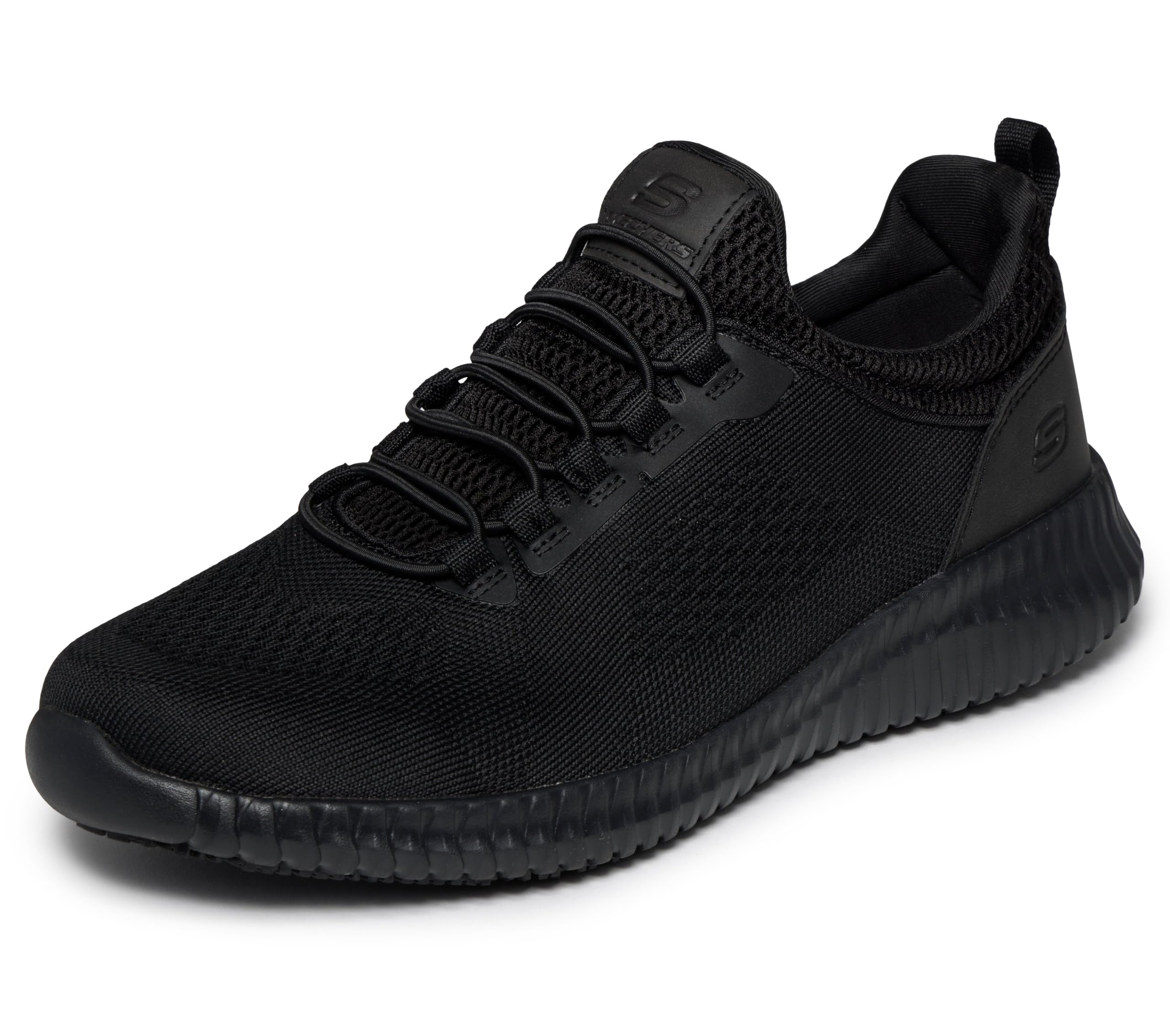
Skechers Cessnock Slip-On
Key Features
- Sole: Slip-resistant
- Style: Work sneaker
- Closure: Bungee slip-on
- Price: Midrange
When both hands are full, the bungee laces on the Skechers Cessnock earn their keep: you step in, pull the collar, and get moving. That convenience is why we place it near the top of this group for front-of-house and quick-change kitchens. It looks like a normal black work sneaker, not a medical clog, and the slip-resistant sole gives you a sensible grip on wet tile.
The Cessnock is at its best on a long shift that keeps you walking, whether that is bar service, prep, or running food, rather than standing in one spot for hours. The cushioning is soft enough to take the edge off concrete, and the upper is easy to wipe when a bottle spills. Traction is good on wet floors, but the tread is not as aggressive as the Bistro’s; if the floor is visibly greasy, that clog is the safer pick.
The Cessnock breathes better than a closed clog, but it gives up some splash protection around the instep. In a kitchen where the floor is the main hazard rather than the fryer, that is a fair trade; in a dish pit, the Bistro’s higher coverage is the one we take.
Pros
- Bungee slip-on is quick
- Comfortable for walking shifts
- Grip on wet tile
- Looks like a regular sneaker
Cons
- Fit runs wide and large
- Durability can be inconsistent
The Cessnock is our pick for cooks who want a normal-looking work sneaker they can step into with full hands.
Best for Arch Support
Dansko XP 2.0
Key Features
- Style: Clog
- Footbed: Contoured arch support
- Department: Adults, unisex
- Price: Premium
The Dansko XP 2.0 is the arch-support specialist in this group. It pairs a roomy toe box with a contoured footbed designed around support, and the closed clog shape gives your foot more to sit in than a flat slip-on.
What we appreciate most is the support under the arch. It is the difference between a shoe that merely cushions and one that gives your foot a place to sit, and for cooks with plantar fasciitis or a long standing station, that is the feature worth paying for. The XP 2.0 also has a roomy toe box, so toes do not feel packed in after a double.
The trade-off is wet-floor confidence. The outsole grips, but it does not feel as aggressive on slick, greasy tile as the Bistro’s, so we treat it as the support-first choice rather than the ultimate slip shoe. For cooks whose feet need the arch, that is a fair swap; for a dish pit, it is not.
Pros
- Excellent arch support
- Roomy toe box
- Comfortable for long standing shifts
- Closed clog shape stays on
Cons
- Premium price
- Sole durability can be uneven
We keep the XP 2.0 for cooks with arch or back pain, with the caveat that its wet-floor sole is less aggressive than the Bistro’s.
Best for Wide Feet
Bruno Marc Non Slip Work Shoe
Key Features
- Sole: Non-slip rubber
- Style: Work sneaker
- Toe box: Wide
- Price: Budget
The Bruno Marc work shoe makes its case across the toes. The toe box is noticeably wider than the average work sneaker here, and that extra room is why it earns a place for cooks who spend the day feeling pinched.
On the floor, the shoe feels light and stable, with a non-slip rubber sole that handles wet surfaces well. We were struck by how little it weighs compared with the boot and clog picks, and the upper wipes clean and holds its shape. The cushioning is generous enough for a full shift without turning mushy.
It is a work sneaker that happens to be comfortable, rather than a comfort shoe that happens to have a sole. The Bruno Marc is the pair we hand to a cook who wants a wide toe box, a low spend, and a sole that keeps its manners on a wet floor.
Pros
- Wide toe box
- Good wet-floor traction
- Comfortable cushioning
- Low-cost work sneaker
Cons
- Warm upper with little airflow
We like the Bruno Marc for wide-footed cooks: a lightweight, grippy sneaker that does not demand a premium spend.
Best for Wet Kitchens
SHULOOK Work Boot
Key Features
- Style: Work boot
- Traction: Non-slip
- Water resistance: Water-resistant
- Price: Budget
Most chef shoes stop at the ankle. The SHULOOK work boot keeps going, and that extra coverage is exactly why it belongs in a kitchen roundup.
What we appreciate is the way the boot handles a wet line. The upper resists water, the outsole grips greasy restaurant floors, and the higher cut keeps splashes from running straight into the shoe. On a dish pit or a kitchen with a permanent slick patch, that combination is more useful than a low, breathable sneaker.
The SHULOOK is built for the wet, messy end of kitchen work: the dish pit, the prep sink, the floor that never quite dries. That is where the coverage earns its keep, and it is why we keep a boot in a roundup that otherwise leans toward clogs and sneakers.
Pros
- Water-resistant upper
- Grip on greasy floors
- Comfortable for long shifts
- Ankle coverage
Cons
- Bulkier than a clog
- Can feel warm in a hot kitchen
When the floor stays wet, our pick is the SHULOOK: ankle coverage, water resistance, and a sole that holds on greasy tile.
Best for Hot Kitchens
Shoes For Crews Everlight
Key Features
- Style: Work sneaker
- Upper: Mesh
- Traction: Non-slip
- Price: Midrange
The Everlight is a mesh work sneaker with a non-slip outsole, and its whole design is aimed at keeping the shoe light. There is not much bulk around the foot, and the upper looks like something you might wear on a run.
In a hot kitchen, the mesh is the feature that matters. It lets heat out and dries faster than a solid clog, and the shoe is easy to move in during a long service. The outsole grips wet floors reasonably well, though the tread is not as deep as the SHULOOK boot’s.
We recommend it for the cook who hates heavy shoes and works in a warm kitchen where a clog turns into a sauna. The trade is support and spill protection: the mesh will soak through if a bucket goes over your foot, and the sides do not lock you in as firmly as a leather work shoe. It is a specialist, not the default.
Pros
- Very lightweight
- Breathable mesh upper
- Reliable slip-resistant sole
- Comfortable all-day cushioning
Cons
- Narrow fit can pinch
Hot kitchens call for the Everlight in our book: it is the lightest, airiest shoe here, though support and spill protection take a back seat.
Best for Dress-Code Kitchens
Dr. Scholl’s Harrington II

Key Features
- Style: Oxford
- Toe box: Roomy
- Traction: Slip-resistant
- Price: Midrange
Some kitchens have a dress code that rules out clogs and loud sneakers. The Dr. Scholl’s Harrington II is an oxford work shoe, and that plain, polished shape is the reason it is on this list.
The shoe has a roomy toe box and a closed upper that keeps spills off the foot. The slip-resistant sole grips wet floors well, and the dark upper wipes down without showing every scuff. It looks tidy enough for a front-of-house shift or a manager who spends time on the line.
Where it gives ground is underfoot. The cushioning is firmer than the clog-style picks, and on a long standing shift the Harrington II asks more from your feet than the Dansko or the Bistro. We like the tidy shape, but it is not the shoe we reach for after eight hours of standing.
We recommend the Harrington II for the cook who needs a non-slip oxford that looks presentable, not the one who wants the softest ride. It is the dress-code solution in this group, and that is a narrower job than the top pick’s.
Pros
- Polished oxford look
- Good wet-floor grip
- Roomy toe box
- Easy to wipe clean
Cons
- Sole durability can be uneven
Dress-code kitchens get a presentable non-slip oxford from the Harrington II; we choose it when clogs and sneakers will not do.
Best for Budget Crews
HISEA Slip-On Work Shoe

Key Features
- Style: Slip-on loafer
- Traction: Non-slip
- Water resistance: Water-resistant
- Price: Budget
The HISEA is the lowest-cost slip-on in this group, and it looks more like a casual loafer than a piece of kitchen equipment. That is part of the appeal: you can wear it in the back of house without feeling like you are in clogs.
The non-slip outsole handles wet and oily floors well, and the upper resists water enough for splashes and a quick wipe. The shoe is light and easy to step into, which matters when you are changing in a crowded staff room.
The shoe is comfortable in a soft, unstructured way. It is not a support shoe, and the insole is better at taking the edge off than correcting a tired arch. For a short shift or a backup pair, that is enough.
We keep the HISEA as the value slip-on for crews who want water resistance and grip without a big spend. It earns its place on those two things, and we do not ask it to be the pair you build a decade of kitchen work around.
Pros
- Low-cost slip-on
- Good wet-floor traction
- Water-resistant upper
- Easy to wipe clean
Cons
- Sizing runs inconsistent
- Durability is limited
Budget-minded back-of-house crews are who we have in mind with the HISEA: a water-resistant slip-on with reliable grip and easy cleanup.
How We Tested Chef Shoes in Working Kitchens
We started with about 40 pairs, pulled from restaurant-supply catalogs, brands that market to kitchen crews, and the shoes we kept seeing on the line. Spec sheets narrowed it to models with a slip-resistant outsole, a removable footbed, and half sizes or a stated wide option, and we cut anything we couldn’t exchange within 30 days. That left 12 pairs, all bought with our own money.
Those 12 pairs went into rotation for eight months across prep, service, and close-down. Testers wore them through the dish pit, the walk-in cooler, a just-mopped line, and a grease-spattered pass, standing in them for ten- and twelve-hour days. We also walked them through a dining room and out to a late dinner, since nobody wants a shoe that reads as medical equipment.
Traction got the closest look: after a mop pass we crossed the same wet patch at a walk and then at a hurry, noting where a sole caught and where it skated, then repeated it on the thin film of oil behind the line. Comfort was checked hour by hour — where the arch pressed, whether toes cramped, whether a heel slipped. For support, we pressed a thumb into each footbed on day one and again at four months to see how much it had packed down, and tried sliding in an aftermarket insole.
Durability showed up in creased toes, seams splitting at the flex point, and how much outsole was left by month six. We noted which pairs ran true to size, how easy it was to go up a half size for feet that swell, and how painless an exchange turned out to be when one didn’t fit. Value came down to cost per month of wear rather than sticker price, and we judged appearance the way a guest would — from a few feet away, mid-service.
How to Choose Chef Shoes
The right chef shoe starts with the floor you work on, not the label inside the collar.
Start with the outsole
Traction is the first thing we check, because a kitchen floor after a spill is a different surface from a dry corridor. A deep, rubber tread with plenty of edges clears water and grease better than a shallow fashion sole, and the pattern matters as much as the word slip-resistant on the box. The Crocs Bistro is the simplest example here: the sole is not fancy, but it grips wet tile and wipes clean.
Tread wears out before the upper usually does. If the pattern under the ball of your foot has gone smooth, the shoe is done as kitchen safety gear even if it still looks fine. That is the replacement cue we trust most.
Decide how much shoe you need
A clog is the lowest-fuss shape: easy to step into, easy to wipe, and easy to rinse. A low sneaker breathes better and feels more normal on a long walk, but it gives up some splash coverage. A boot adds ankle protection and water resistance for dish pits and permanently wet floors. The SHULOOK is the boot answer here; the Everlight is the hot-kitchen sneaker answer; the Bistro sits in the middle as the wipe-clean default.
Match the shoe to the worst part of your shift, not the best. If you spend two hours mopping and six hours at a range, buy for the mopping.
Fit for the end of a shift
Try work shoes with the socks you actually wear, and do it late in the day if you can. Feet swell, and a shoe that feels snug at 7 a.m. can be unbearable by the dinner rush. Leave room at the toe, especially if you have a wide forefoot; the Bruno Marc is the clearest wide-toe pick in this group, while the Dansko is roomy but still structured.
Do not assume your sneaker size carries over. Whole-size clogs and roomy work shoes often ask you to size down, while some lace-up models run narrow. The fit note that matters is the one for that specific shoe.
Support beats extra padding
Soft cushioning feels good in the first hour; arch support is what gets you through the eighth. If you stand in one spot, a contoured footbed and a stable base matter more than a thick slab of foam. The Dansko XP 2.0 is the support-first pick here for that reason, and it is the one we point to when foot or back pain is the real buying problem.
If you add an insole, check that the original footbed comes out or that there is enough volume. A tight shoe with a thick insole is worse than a plain shoe that fits.
Cleaning and replacement
Spill-heavy kitchens reward a wipe-clean upper and a closed toe. Water-resistant leather and molded clogs are easier to deal with than mesh, but they trap heat; mesh breathes, then soaks through when a bucket goes over. Choose the side of that trade that matches your station.
A work shoe is finished when the sole lifts, the upper cracks across a flex point, or the tread goes smooth. Do not wait for a hole. The grip is the safety feature, and it is the first thing to go.
Frequently Asked Questions
Do chef shoes need to be safety-toe?
Not unless your employer or kitchen requires certified impact protection. Most chef shoes are chosen for closed-toe coverage and slip resistance, not for steel or composite toe caps. If your workplace requires a safety toe, check the label for the rating they specify before buying.
Can I put my own insoles in chef shoes?
Yes, if the original footbed comes out or the shoe has enough volume. Clogs and wide work sneakers are usually easier than narrow lace-ups. Put the insole in before your first shift and check that your heel stays seated and your toes still have room.
How do I keep kitchen shoes from smelling?
Rotate two pairs if you can, pull the insoles out after a shift, and let both dry fully away from direct heat. Wash removable insoles with mild soap and water, and avoid putting the shoes in a hot dryer, which can warp the sole and shrink the upper.
Final Verdict
For most cooks, the Crocs Bistro is the pair to buy first. It gets the kitchen basics right: closed toe, reliable wet-floor grip, easy cleanup, and very little fuss at the end of a shift.
If arch support is the real problem, the Dansko XP 2.0 is the step up worth considering. If you need a wide toe box and a lower spend, the Bruno Marc is the practical alternative. Choose the shoe that solves your worst hour, not the one with the longest feature list.