This post contains affiliate links. We may earn a small commission when you buy through our links — at no extra cost to you.
A mat that feels like a cloud at the sink is usually the one that soaks up dishwater, stains at the first drop of tomato sauce, and slides halfway across the tile the moment you pivot to the stove. The trick is finding one that stays put, wipes clean, and still gives your heels and lower back enough give to survive a long Sunday of cooking. I learned that the hard way through years of apartment kitchens with unforgiving tile, and it’s why I stopped grabbing whatever was stacked on the endcap. What a good mat actually fixes is simple: the dull ache that creeps up your legs while you’re chopping, washing, and waiting for water to boil.
Thickness is where the marketing numbers fall apart — past about three-quarters of an inch, a mat starts catching on cabinet drawers and the toes of anyone walking past. Over the past eight months my team and I have lived with a dozen of these mats in our own kitchens, and the ones that made the cut earned their place at the sink, not in the product photos.
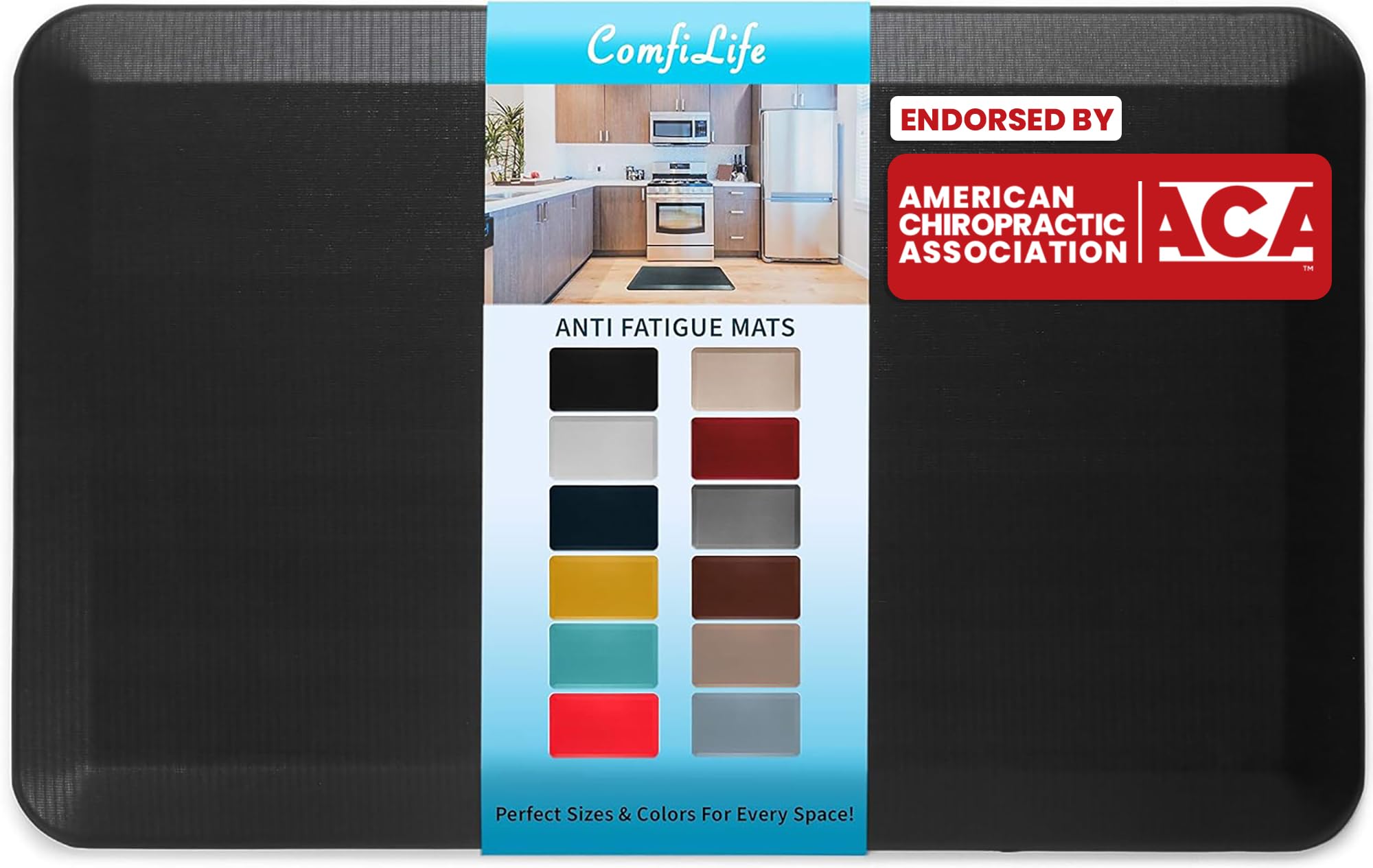

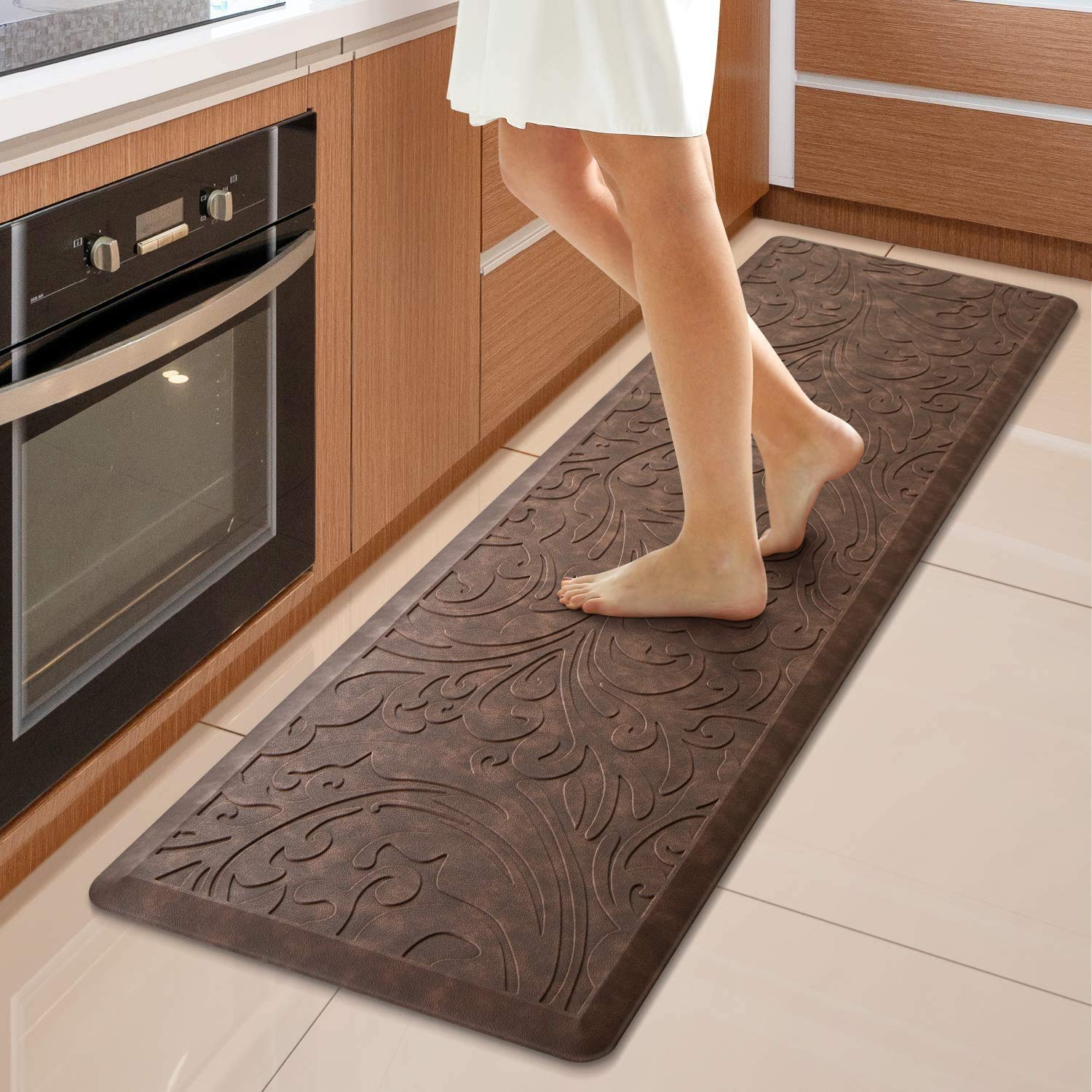


Best for Everyday Kitchen Standing
ComfiLife Anti Fatigue Mat
Key Features
- Care: Wipe with damp cloth
- Size: 20 x 32 in
- Material: Memory foam
- Thickness: 0.75 in
- Price: Premium
Three-quarters of an inch of high-density memory foam is roughly twice the cushion of the thin PVC mats here, and you feel it the moment you step on: the mat gives under your heels and then pushes back instead of bottoming out onto the tile. The footprint is 20 x 32 in, wider than the 17.3 in mats that dominate this list, so you can shift your weight from foot to foot at the sink without stepping off the edge.
That combination is why this is the mat we tell most people to buy. There’s enough foam to change how a long session at the counter feels, the non-slip backing holds it on a dry floor, and the stain-resistant top means a splash of pasta water wipes off instead of soaking in.
The trade-offs are honest ones. At 0.75 in it sits high enough that you want the beveled border facing the walkway, and it can catch the drop-down door of a dishwasher if it lands right in front of one, so ours went beside the sink instead. The black rectangle is also plain; if you want the mat to do some decorating, this isn’t the one.
What keeps it at the top is that it’s the least compromised mat of the group: thicker than everything except the FEATOL, wider than every 17.3 in mat here, and easy to live with day to day. You pay for it, but the money goes into foam and a backing rather than a pattern.
Pros
- 0.75 in memory foam changes long standing
- Wider 20 x 32 in footprint
- Non-slip backing holds on dry tile
- Stain-resistant top wipes clean
Cons
- Solid colors only, no patterned styles
We point most people here: 0.75 inches of memory foam in a 20-inch-wide footprint, with a backing that stays put and a top that wipes clean.
Best for Maximum Cushioning
FEATOL Anti Fatigue Mat
Key Features
- Size: 20 x 32 in
- Weight: 4.2 lb
- Thickness: 0.9 in
- Top surface: PU leather
- Price: Premium
At 0.9 in, this is the thickest mat in the group, and that single figure is the reason to consider it. The high-density foam takes a long standing session without flattening, and the PU leather top doesn’t pick up the imprint of your shoes the way softer memory foam can. If what gives out after an afternoon of cooking is your lower back or your knees, this is the mat here built for that.
The PU top is the detail we appreciated most over the cheaper PVC mats: it resists punctures and tears, so a dropped fork or a dog’s nails are less likely to open it up, and stains wipe away without leaving a shadow. It’s firm rather than squishy, closer to a standing-desk mat than a foam cushion, and that firmer surface is what keeps it from compressing over hours.
The cost of all that height is clearance. The beveled ramp at the edge is low and grippy, but a mat this tall in front of a dishwasher or a low drawer is worth checking before it becomes permanent. It’s also priced up near the top pick, which is fair for this much foam and hard to justify if you only stand at the counter in short bursts.
Pros
- Thickest foam here at 0.9 in
- PU leather top resists punctures
- Wipes clean without staining
- Even support without bottoming out
Cons
- Firm surface with little squish
- Tall 0.9 in edge needs door clearance
Buy it when cushioning is the whole point: nothing here is thicker, and the tough PU top handles dropped utensils and claws.
Best for Long Counter Runs
KMAT Cushioned Runner Mat
Key Features
- Size: 17.3 x 60 in
- Pattern: Floral
- Material: PVC
- Thickness: 0.5 in
- Price: Midrange
Sixty inches of mat is a different idea from a small square by the sink: it cushions a whole run of counter, so you can shuffle from the stove to the cutting board without stepping off onto tile. We think that’s the right shape for a galley kitchen or anyone who works along one wall, and it’s why this KMAT earns a place even at only 0.5 in thick.
Half an inch of PVC foam softens tile and takes the sting out of a long dinner prep, but it doesn’t have the deep give of the memory foam mats here. What struck us is the edge: it tapers to the floor over a wide bevel, so there’s nothing to catch a toe as you move along it, which matters more on a 60 in mat than on a small one.
Two things to know before you order. At 17.3 in wide there’s not much room to stand side-on, so measure the run you actually work at. And the pattern is a bold floral in brown, the least neutral mat in this group, which a kitchen with strong colors of its own may not want. Where the sink and stove sit on opposite walls, a two-piece set covers both instead.
Pros
- 60 in length covers a full counter run
- Low beveled edge won’t catch a toe
- Wipes clean and vacuums easily
- Water-resistant PVC surface
Cons
- Narrow 17.3 in width
- Bold floral print limits kitchen styles
The pick for a one-wall kitchen: 60 continuous inches of cushion from stove to sink, as long as the floral print suits your cabinets.
Best for Coordinated Coverage
HEBE Kitchen Mat Set of 2
Key Features
- Backing: Latex rubber
- Pattern: Farmhouse brick
- Thickness: 0.4 in
- Set includes: 17 x 48 in and 17 x 28 in
- Price: Midrange
A 48-inch runner and a 28-inch mat in a farmhouse brick print: this set is the one to buy if you want the floor to look considered rather than merely cushioned. The long piece runs along a bank of cabinets or a breakfast bar and the short one goes by the sink or the stove, and you can split them between two rooms if your layout asks for it.
The cushion is 0.4 in, soft underfoot and enough for the in-and-out cooking most of us do, and the waterproof top wipes down in one pass, whether it’s oil splatter, flour, or a spilled cup of tea. What surprised us is how low the beveled edge sits; you can step onto these without the little stumble a thicker mat can produce.
Grip is what settles it. HEBE uses a latex rubber backing rather than a plain PVC one, and on a dry tile floor these two stayed where we put them, including along the busy path between the fridge and the counter. Width is the limitation: at 17 in there’s no room for a second cook to stand alongside, and that’s the trade for a set that covers two zones and looks like it belongs.
Pros
- Two sizes cover sink and counter
- Latex rubber backing holds on dry tile
- Wipe-clean waterproof top
- Farmhouse pattern looks deliberate
Cons
- Narrow 17 in width
- Only 0.4 in of cushion
Our pick when the mats have to look as good as they feel: a 48-inch runner and a 28-inch mat that hold their place on dry tile.
Best for Tight Budgets
HappyTrends Kitchen Mat
Key Features
- Care: Wipe with damp cloth
- Size: 17.3 x 28 in
- Material: PVC
- Thickness: 0.5 in
- Price: Budget
The cheapest mat in this group is also one of the smallest: 17.3 x 28 in of PVC foam, 0.5 in thick, in solid black. That’s a mat for the strip of floor in front of a sink or a stove, not for a long run of counter. If your kitchen is generous, a runner or a set will serve you better.
For a small kitchen, a rental, or a second mat by the laundry sink, we found it the sensible buy. The foam is softer than the 0.4 in mats here and it takes the sting out of washing up, though a long session will press it flat. The surface wipes clean, and the beveled edge keeps it from becoming something you trip over at the sink.
The one thing to manage is grip. It uses a plain non-slip PVC backing, and like most mats of this type it wants a dry, smooth floor; on a slightly damp tile it creeps. Dry the floor, set it back down, and it holds again. If you want the same outlay to cover two work zones, the KMAT set does that instead.
Pros
- Cheapest mat in this group
- Soft 0.5 in cushioning underfoot
- Wipe-clean waterproof surface
- Beveled edge limits tripping
Cons
- Foam compresses during long standing
The budget pick for a compact kitchen: real cushioning for the least money here, as long as you’re not standing on it all afternoon.
Best for Colorful Two-Mat Sets
tubeamin Kitchen Mats Set of 2

Key Features
- Color: Teal blue
- Pattern: Dahlia
- Thickness: 0.4 in
- Set includes: 17.3 x 47 in and 17.3 x 28 in
- Price: Midrange
Teal blue with a dahlia print is a commitment, and it’s the reason to look at this set at all: these mats look chosen rather than issued. You get two, 17.3 x 47 in and 17.3 x 28 in, both 0.4 in thick and printed with the same pattern, so the sink and the stove match without you hunting for a pair.
Underfoot they’re soft rather than deep, with foam that gives and then firms up, and the top wipes clean; a wiped-up spill left no mark on the print. The beveled edge is genuinely low, so the mats don’t announce themselves when you step from tile onto them.
What gives us pause is the backing. It’s a plain non-slip PVC, and on smooth tile these can creep under a quick turn at the counter, so a dry floor and a straighten every so often are part of owning them. It’s a set to buy for the look you want in your kitchen rather than for the last word in cushioning.
Pros
- Bold teal dahlia print
- Two mats cover sink and counter
- Wipe-clean waterproof top
- Low beveled edge sits flat
Cons
- 0.4 in foam is on the thin side
- 17.3 in width leaves little room
Buy it when color is the deciding factor: a cheerful teal set of two that wipes clean, with cushioning that’s fine for everyday cooking.
Best for Value Two-Mat Sets
KMAT Kitchen Mats Set of 2

Key Features
- Weight: 4.2 lb
- Material: PVC
- Thickness: 0.4 in
- Set includes: 17.3 x 47 in and 17.3 x 29 in
- Price: Budget
Seventeen and a third inches is the standard width for an inexpensive kitchen mat, and it’s the thing to settle before you order this set. The two pieces, 47 x 17.3 in and 29 x 17.3 in, cover a lot of floor along a wall but don’t leave much room to step sideways. If two people cook at once, or you pivot hard at the counter, look at a 20 in mat instead.
What you get is coverage and a surface that’s easy to live with. Two pieces mean the sink and the stove each get a mat without buying twice, and the PVC top wipes down in seconds, whether it’s flour, oil, or a slopped cup of coffee. The 0.4 in foam is thin; it softens the tile without raising your standing height, which some cooks prefer to a deep cushion.
Grip is the split. The textured non-slip bottom bites on dry tile and ours stayed put, but on a damp floor these skate, so dry the floor first and don’t lay them over a rug. Most mats with a plain PVC back behave the same way.
As a value play it’s hard to argue with: two work zones covered, wipe-clean, and a low bevel that won’t catch a toe. We take it over a single small mat every time, provided the narrow stance suits your kitchen. Measure the floor in front of the sink first, because 17.3 in can leave you shuffling on tile.
Pros
- Two mats cover sink and stove
- Wipe-clean waterproof PVC
- Textured non-slip base bites on tile
- Low cost for the coverage
Cons
- Narrow 17.3 in width limits movement
- Thin 0.4 in foam
Our value pick for a one-wall kitchen: two wipe-clean mats covering both work zones, if 17.3 inches of width is enough for you.
How We Tested a Dozen Kitchen Mats
We started by pulling every mat that published its actual dimensions, thickness, and backing material, then cross-checked reviews for the complaints that keep repeating: curled edges, foam that flattens into a footprint, tops that hold a stain. Anything with vague sizing or no stated nonslip backing got cut before we ever stood on it. That left 12 mats, which we laid down in working kitchens and left there for eight months.
Each mat went where it would really live: in front of the sink for nightly dish duty, along the prep counter during a long Sunday cook, on tile and vinyl that see bare feet, socks, and a dog cutting through. To judge grip, we nudged each one mid-stride and checked whether it had shifted after a spill. For cushioning, we stood through an hour of chopping without sitting and noted where we felt it — heels, arches, lower back — then repeated it in socks to see how the surface felt against bare skin. We also measured every mat against the sink run and the gap between counter and island, since one that spills into a walkway gets kicked out of line all day.
Cleaning got its own round of abuse: coffee, olive oil, tomato sauce, and a dusting of flour, wiped with a damp cloth and, where the label allowed, a mild spray. We looked for staining right after the first wipe and again the next day. Durability was a slow read — eight months of daily traffic, watching edges for curling, the top layer for cracking or peeling, and the foam for compressed dips that never bounce back. Value came down to simple math: how a mat looked and felt at month eight versus the day it came out of the box.
How to Choose an Anti-Fatigue Kitchen Mat
Thickness decides how much relief a mat gives you, and it’s also the number that causes the most trouble, because a mat deep enough to cushion your knees is deep enough to catch a toe or foul a dishwasher door.
What 0.4 inch and 0.9 inch actually feel like
Most mats here fall into two camps. The thin camp is 0.4 to 0.5 in of PVC foam: soft at first step, inexpensive, light enough to kick out of the way, and usually low enough that nobody trips on it. The thick camp is 0.75 to 0.9 in of high-density or memory foam, and that’s the one that changes a long session, because the foam compresses under your heel instead of passing the load straight through to the tile.
The cost of thickness is height. A 0.9 in mat raises you enough to matter in a tight kitchen: check the swing of the dishwasher door and any low drawer, and make sure the beveled edge faces the way you walk. If you stand in short bursts, a 0.5 in mat does most of the job; if you’re at the counter for an hour at a time, buy the thicker one.
Measure the run, not the kitchen
Nearly every mat here is 17.3 in wide, and that’s the number people get wrong, because listing photos flatter the width. Twenty inches, as on the ComfiLife and the FEATOL, is the difference between standing square at the sink and standing half on tile. Lay out the length you need along the counter, from the edge of the stove to the end of the prep area, and remember that a single 28 in mat covers one working position only. Two people cooking at once want a wider single or two mats.
Grip depends on the floor more than the mat
Almost every back in this group is a PVC or rubber non-slip layer, and none of them grips through water. A damp tile, a spill you haven’t noticed, or a mat laid over another rug will let even a good backing slide. Before you place one, dry the floor, shake out the mat, and check that the bevel sits flat all the way round. Textured stone or old tile with deep grout lines gives less contact, so expect to straighten the mat more often.
One mat, a runner, or a two-piece set
Your layout picks this for you. A galley or one-wall kitchen with a continuous counter wants a 60 in runner like the KMAT, because you can move along it in one motion. An L-shaped kitchen, or one where the sink and stove sit on separate walls, wants a set, and the HEBE pieces split up without looking odd. A compact kitchen with a single work station is fine with a 17.3 x 28 in mat, and you’ll pay the least for it.
Cleaning: wipe, don’t soak
Waterproof means the top doesn’t absorb spills; it doesn’t mean the mat wants a bath. Wipe with a damp cloth or a mild spray, vacuum the grit off, and stand it on edge to dry if it gets properly wet. Soaking a foam-cored mat invites water in at the edges, which is where smells and separation start. None of these belong in a washing machine, however many laundry rooms they appear in on the listing.
Frequently Asked Questions
Do anti-fatigue kitchen mats actually help?
On hard tile, yes, and most noticeably if you stand still for long stretches at the sink, the stove, or an ironing board. The foam spreads pressure across the sole, and the slight give keeps your legs working instead of locked. If you already stand on cork or cushioned vinyl, expect a smaller difference. Give a new mat a week of real cooking before you judge it; if your feet still ache, the mat is too thin and you want 0.75 in or more.
Can I use one at a standing desk too?
Yes, and a 20 x 32 in mat such as the ComfiLife or the FEATOL suits a desk stance better than a 17.3 in kitchen mat, because you shift your feet more than you expect over a working day. Go thick for desk use, 0.75 in or more. The thin 0.4 in set pieces here are fine for a quick sink session and not enough for four hours upright.
How do I get the creases out of a new mat?
Unroll it on a clean, dry, flat floor and let it sit in a warm room, weighting the corners with books or a couple of pans. For a stubborn fold, warm the crease with a hairdryer on low, moving it constantly, then press the mat flat again. Don’t iron it or leave it in direct sun, since either can distort the foam.
Will a dog or cat ruin an anti-fatigue mat?
Claws are the usual cause of holes in thin PVC mats, and once the skin is punctured, water reaches the foam. A mat with a PU leather top, like the FEATOL, is the most resistant here. Otherwise trim nails, keep the mat out of the route your dog takes when it launches off the sofa, and check the underside for tears before the mat starts shedding foam.
Final Verdict
Most kitchens want the ComfiLife. It’s the one we recommend first: 0.75 in of memory foam in a 20 in wide footprint, a backing that holds on dry tile, and a top that wipes clean. That combination is what changes a long session at the counter, and nothing else here puts all three together as well.
If your back is the specific problem, the FEATOL’s 0.9 in of high-density foam and puncture-resistant top justify the extra height and the higher price. And if your sink and stove sit on different walls, the HEBE set covers both while looking like part of the kitchen.