This post contains affiliate links. We may earn a small commission when you buy through our links — at no extra cost to you.
Celery is mostly water and stringy fiber, and ginger is dense, oily, and stubborn—two ingredients that expose a juicer’s weak spots. Put them through a mediocre machine and you get clogged screens, wet pulp, and constant stopping to disassemble. A good juicer should keep both moving, get a dry-ish pulp without babysitting, and make cleanup something you’ll actually do. We put 12 juicers through eight months of daily celery and ginger to find the ones that do.
I go through a bunch of celery a week, so this became a real morning routine rather than a one-off demo. We fed whole stalks and knobby ginger, timed each batch from switch-on to last drop, listened for motors straining, and washed every part by hand. Some machines were fast but loud enough to wake the house; others were quiet but left pulp wet enough to feel like wasted money. The picks below earned their spot on performance, ease of use, and build quality—not just a pretty countertop footprint.


Best for Daily Celery Juice
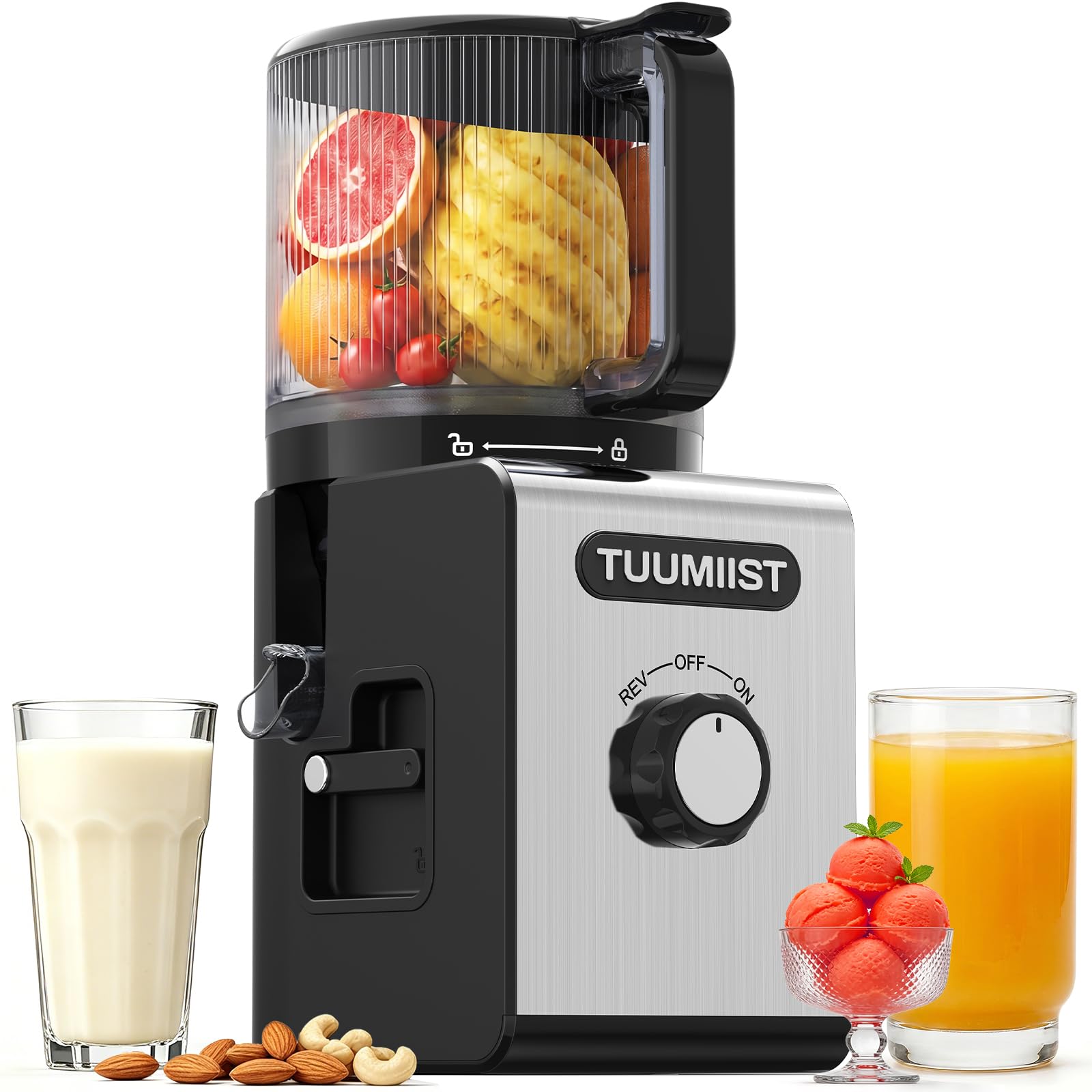
TUUMIIST TM-780SJ
Key Features
- Motor: 350 watts
- Feed chute: 6.5 inches
- Auger speed: 60 RPM
- Hopper capacity: 100 oz
- Price: Midrange
A whole celery stalk goes down the 6.5-inch chute without being chopped, and that single number is why we kept coming back to this machine. Trimming a head of celery into two-inch lengths before every glass is the chore that talks people out of juicing altogether. The second reason is the strainer: there is no mesh screen, just an open slotted drum, and celery fiber slides past it instead of winding itself into a metal basket. We think that detail matters more for celery than any wattage figure on the box.
Ginger is the opposite problem — small, dense and stringy, the kind of thing a fast centrifugal machine flings straight into the pulp. At 60 RPM the auger has the time to crush it properly, and the 350-watt motor never stalled on us through a week of daily celery-and-ginger juice. The 100-ounce hopper is the other half of the story: load a whole head, walk away, come back to a full cup. It is also genuinely quiet, so an early start does not wake the house.
Two things to know before you buy. At 17 inches tall it is the tallest body in this set, so measure the gap under your upper cabinets before you clear counter space for it. And a single strainer covers juice, sorbet and nut milk, which means no swapping parts mid-recipe and everything straight into the dishwasher — for a machine this capable, cleanup is unusually short.
Pros
- Whole celery stalks fit the 6.5-inch chute
- No mesh screen to scrub
- 100-ounce hopper for batch juicing
- Very quiet for a cold press
Cons
- Durability is the question mark, especially the handle
The one we recommend to most people: a chute that takes whole celery stalks, no mesh screen to scrub, and a hopper big enough for a whole head.
Best for Celery Purists
Omega MM1500GY13
Key Features
- Motor: 200 watts
- Weight: 14.3 lb
- Warranty: 15 years
- Auger speed: 80 RPM
- Price: Premium
Omega ships this machine with an end cap that does exactly one job: it squeezes celery, and it is not meant for anything else. Swap in one of the two adjustable caps and it becomes a general juicer again, but that single-minded part tells you who this is for — the person whose celery habit is the entire reason they are shopping.
It works. Celery is water held in a fiber lattice, and the longer you press it, the more of that water ends up in the glass rather than the pulp bin, which is why the pulp came out drier here than from the fast machines in this group. The cost is pace: this is a deliberate juicer, and a full bunch of celery is a standing-at-the-counter job rather than a two-minute one.
The other half of the pitch is 15 years of warranty, by far the longest here, on a machine that weighs 14 pounds and spans nearly 19 inches of counter. That is the heaviest and widest body in this set, and it is worth being honest that it is a permanent fixture rather than something you tuck away. It also grinds coffee, extrudes pasta and makes nut butter, which is how Omega justifies the premium.
Where it stops making sense: a household that juices a bit of everything and wants it done between other jobs. The top pick here is easier to live with and the Breville is faster still. But for celery first, last and always, this is the machine.
Pros
- Dedicated celery end cap for drier pulp
- 15-year warranty, the longest here
- Runs quietly
- Doubles as a nut-butter and pasta machine
Cons
- Cleaning takes longer than the open-strainer machines
We point celery-first juicers here: a celery-only end cap, the driest pulp in this group, and a 15-year warranty.
Best for Fast Mixed Juicing
Breville JE98XL
Key Features
- Motor: 850 watts
- Speeds: 2
- Feed chute: 3 inches
- Jug capacity: 1 liter
- Price: Premium
Nothing else here gets a glass of celery juice into your hand faster. An 850-watt motor spins a titanium-reinforced disc behind a 3-inch chute, so whole stalks and a knuckle of ginger go in without dicing, and the juice is in the jug before the machine has finished spinning up. What centrifugal force does to celery is another matter: it throws the watery part out and leaves the rest damp in the pulp bin.
Whether that matters is the whole decision. If you drink your juice within a few minutes and are as likely to be juicing apple, carrot and beet as celery, this is the more pleasant machine to own, and we rate it near the top of this set on speed. For celery specifically, run the pulp through a second time — there is another squeeze in it — and use the low speed so the basket does not whip the juice into foam.
The details are thoughtful in the way Breville usually is: the jug has a built-in froth separator so you pour juice rather than foam, the cord wraps under the base, and the removable parts are dishwasher safe. The one-year warranty is short for the money. This is the juicer for someone who wants juice now and is happy to trade a little yield for that.
Pros
- Fastest juicing in this set
- 3-inch chute handles whole stalks and apples
- Froth separator built into the jug
- Cord wrap and dishwasher-safe parts
Cons
- Loud enough to fill a kitchen
We rate this the speed pick of the group — it will out-juice anything here, but celery comes out wetter and the kitchen gets loud.
Best for Small Kitchens
Ninja NeverClog JC151
Key Features
- Motor: 150 watts
- Width: 7.15 inches
- Juice jug: 24 oz
- Pulp container: 36 oz
- Price: Midrange
Seven inches of counter width is the entire argument for the NeverClog. It is the narrowest full-size cold press here, which in a galley kitchen is the difference between a juicer that lives on the counter and one that lives in a cupboard. The trade is capacity: a 24-ounce juice jug and a 36-ounce pulp bin mean you pour and empty more often than with the big-hopper machines.
Two interchangeable pulp filters give you a say in texture, one for a cleaner glass and one for a thicker juice, and the reverse button is the answer when something binds. The chute is the compromise. Celery goes in as short lengths rather than whole stalks, so keep a board out. Feed it steadily and it does not clog; pack the chute and it will.
The 150-watt motor is the smallest here, but it drives a low-speed auger, so judge it by torque rather than watts — it walked through carrots, beets and ginger for us without complaint. Everything removable is dishwasher safe, and the parts nest back together without a diagram, which is not something we can say for every machine on this page.
Pros
- Narrowest full-size body here at 7 inches
- Two pulp filters for texture control
- Reverse function clears jams
- Rinses clean quickly
Cons
- Squeals on apples and other hard produce
- Some units fail within the first months
Our choice for a small kitchen: it fits in seven inches of counter and handles ginger well, as long as you cut celery short.
Best for Single Servings
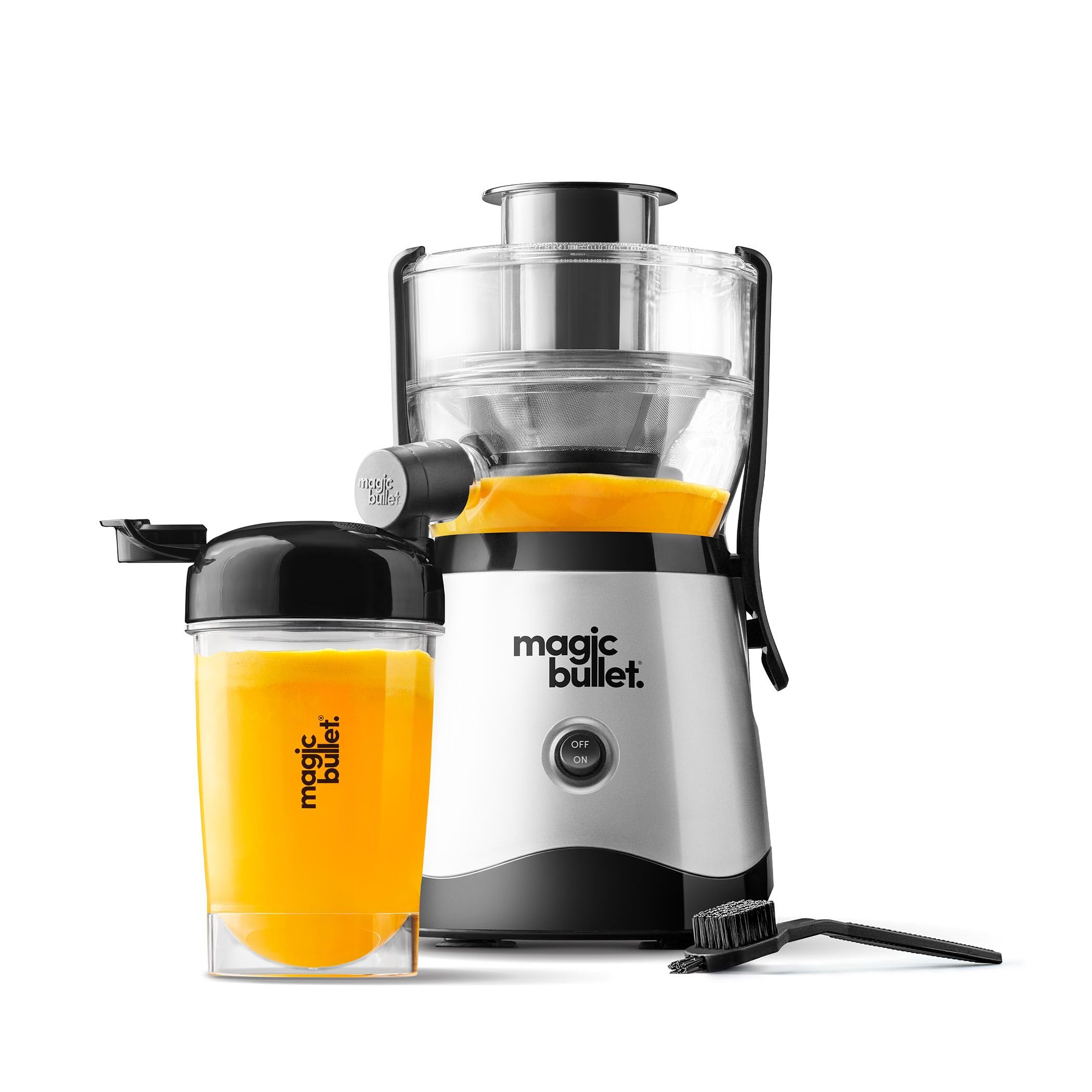
Magic Bullet Mini Juicer
Key Features
- Motor: 400 watts
- Height: 11.5 inches
- Feed chute: 2 inches
- Cup capacity: 16 oz
- Price: Budget
The least expensive juicer here is also the one we recommend to anyone who is not sure they will still be juicing in February. It is a centrifugal machine with a 400-watt motor and a 2-inch chute, so it does not pull the last of the juice out of a celery stalk the way a slow auger does. For one glass in the morning, that is a trade worth making.
What we appreciate most is the cup. Juice runs straight into a 16-ounce cup that takes a screw-on lid, so there is nothing to decant and no extra glass to wash, and the parts are top-rack dishwasher safe. A silicone spout cap catches the last drips before they reach the counter, and at 11.5 inches tall it slides under a cabinet and stays there.
Prep is the cost of the small chute: celery in short lengths, ginger diced small. Do it the night before and it stops being a chore. What this machine will not do is a week of celery juice in one go — that is a wide-chute cold press job. For a single glass and a kitchen with no room to spare, start here.
Pros
- Least expensive machine in this set
- 16-ounce cup with a screw-on to-go lid
- Fits under a cabinet at 11.5 inches tall
Cons
- Wet pulp and a modest celery yield
We steer first-time juicers here — the least expensive machine in this set, and enough for one glass a morning.
Best for Big Batches
Hamilton Beach Big Mouth

Key Features
- Motor: 800 watts
- Pulp bin: 80 oz
- Warranty: 3 years
- Feed chute: 3 inches
- Price: Budget
Eighty ounces of pulp capacity is the number that matters when you juice celery by the head. The Big Mouth’s bin takes the waste from a serious session without a single trip to the compost, and the 3-inch chute swallows a whole bunch of celery, a handful of carrots or an apple without chopping.
It is a centrifugal machine with 800 watts behind it, so the juice comes out fast and the pulp comes out wet — that is the nature of the design and no amount of motor changes it. The strainer basket is the part that wants a brush, and the removable parts are dishwasher safe, which takes most of the sting out of the cleanup.
Three years of warranty is more than most machines here offer, and for the volume of produce this thing handles it is remarkable value. What it is not is a companion for a quiet morning: plan on a utility room, a garage, or a kitchen where everyone is already awake. If you go through a drawer of produce a week and want it done in a hurry, this is the machine that gets it done.
Pros
- 80-ounce pulp bin for long sessions
- 3-inch chute takes whole produce
- Three-year warranty
- Fast 800-watt juicing
Cons
- Loud enough that you will plan around it
- Long-term durability is mixed
We like it for volume, not for quiet: a huge pulp bin and a three-year warranty make big celery batches cheap and fast.
Best for Value Cold Press
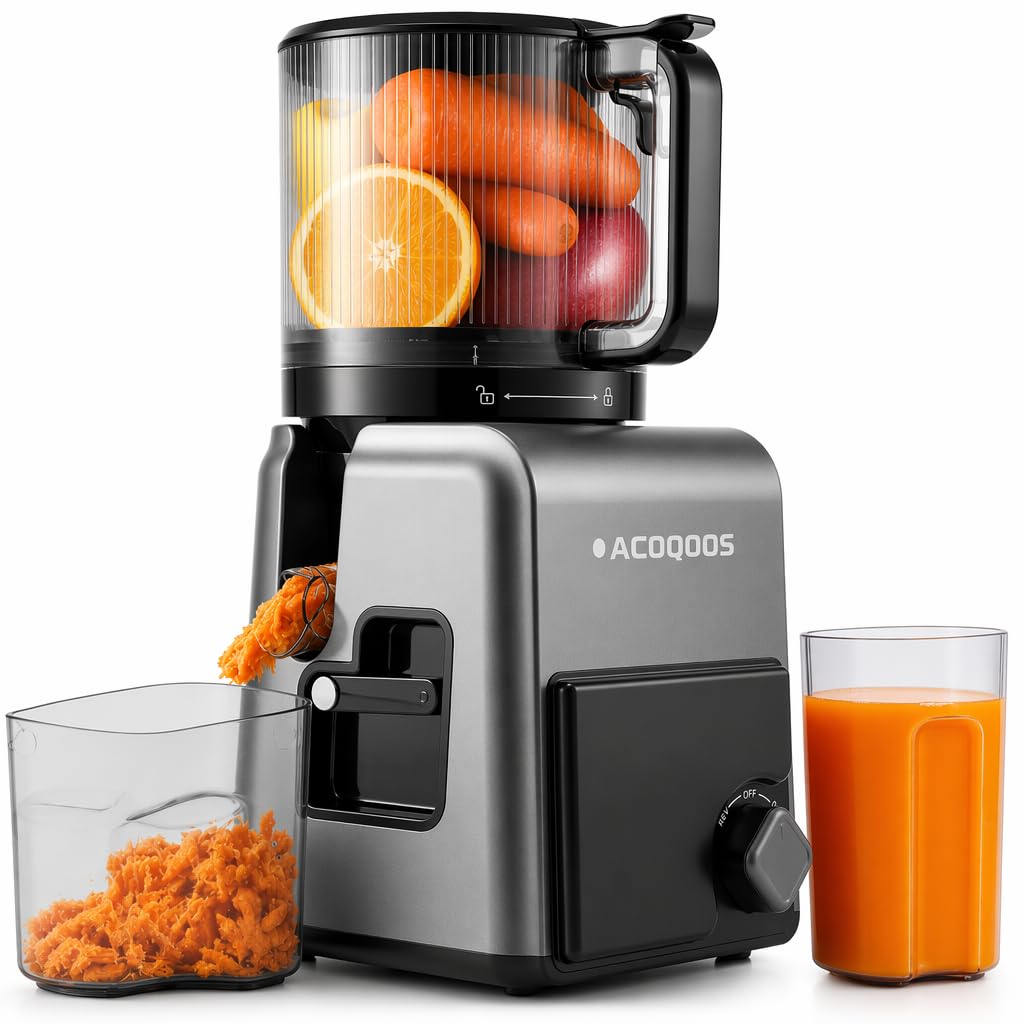
ACOQOOS AMJ-90
Key Features
- Motor: 350 watts
- Height: 14.8 inches
- Feed chute: 6.5 inches
- Hopper capacity: 100 oz
- Price: Midrange
The AMJ-90 matches our top pick on the two numbers that decide how celery juicing feels: a 6.5-inch chute that takes whole stalks, and a 100-ounce gravity-fed hopper you fill once and walk away from. It is also about two inches shorter, which can be the difference between clearing a cabinet gap and not.
At 60 RPM with a 350-watt motor it does the same slow squeeze as the machines above, and the juice stays clear rather than foamy. The gravity hopper is the part we enjoyed most: load it with a head of celery and a thumb of ginger and it feeds itself while you get on with something else. It is quiet enough for an early start, and the gray finish is the least appliance-looking thing here.
What the value case rests on is that the top pick costs more and has earned it, on the parts most likely to need replacing and on a body that has been around longer. If the budget is tight and the chute size is what sold you on this category in the first place, this is the closest thing to our recommendation for less.
Pros
- 6.5-inch chute and 100-ounce hopper
- Two inches shorter than the top pick
- Quiet 60 RPM extraction
- Costs less than the top pick
Cons
- Reliability is the weak spot
We keep this as the value alternative: the same wide chute and big hopper as our top pick for less money, minus the track record.
How We Tested Celery and Ginger Juicers
We started by pulling every juicer we could find that claimed to handle fibrous vegetables, filtering out models with small feed chutes or weak warranties and keeping a spread of prices from budget to buy-it-for-life. That left 12 machines, which we ran for eight months. Some were masticating, some were centrifugal, and a few were hybrids; we wanted to see whether the type mattered more than the marketing.
Testing happened in a normal kitchen, not a lab. Every weekday morning I juiced a head of celery and a thumb of ginger before breakfast, and on weekends I made larger batches for the week. I noted how long each machine took from the first stalk to the last drop, whether I had to stop and clear the screen, and how wet the pulp felt when I squeezed it. I also paid attention to noise—whether I could run it while someone was still asleep—how much juice actually made it into the glass versus the pulp bin, and how easy it was to feed whole stalks versus having to chop them small.
Cleaning was part of every session: I disassembled each juicer, rinsed the parts under warm water, and used the supplied brush on the screen. I kept track of how many pieces there were, whether pulp hid in corners, and whether the parts felt sturdy after weeks of washing. Over the eight months, I watched for leaks, cracks, motor slowdowns, and any machine that started to smell hot or struggle with ginger. Value came down to output and waste—how much juice per pound of produce, and whether the pulp was dry enough to feel like I’d gotten my money’s worth.
How to Choose a Juicer for Celery and Ginger
Celery and ginger fail juicers for opposite reasons — one is a long stalk of wet fiber, the other a small, dense knot — so the machine you want is the one that handles both without clogging, stalling or making you dread the washing up.
Slow auger or spinning basket
Celery is the test that separates the two designs. A centrifugal machine spins a basket at high speed: it is fast, it takes whole produce through a wide chute, and it leaves celery pulp wetter and the juice foamier because it flings liquid out rather than pressing it. A slow auger, 55 to 80 RPM on the machines here, crushes instead and gets more liquid out of the fibers.
If celery juice is a daily habit, buy the slow auger and accept a slower glass. If you juice occasionally, want it over with and are as likely to be feeding apples and carrots as celery, a centrifugal machine is the sensible spend.
Chute size decides how much prep you do
A celery stalk is long, so a narrow chute turns every glass into a chopping session. Two inches means short lengths; three inches takes a bunch of celery or a whole apple; six and a half inches swallows the stalk whole. Ginger needs dicing either way, because a large knob can bind an auger no matter how wide the opening.
The trap is assuming a wide chute makes a fast machine. With a slow auger it removes the prep, not the juicing time. Buy the chute for the work you are willing to do at seven in the morning.
Ginger behaves nothing like celery
Ginger stalls weak motors and wraps itself around augers because it is dense and stringy. Two things help: a reverse function for when something binds, and feeding ginger between wetter, bulkier produce so it does not sit alone against the screen. A piece the size of your thumb is plenty for a glass.
In a centrifugal machine, ginger tends to be thrown into the pulp before it gives up much juice. If ginger is as important to you as celery, that alone points to a slow auger.
Cleaning is the daily cost
The strainer is where juicing time goes after the juice is made. A fine stainless mesh basket catches every celery fiber and needs a brush; an open slotted strainer rinses in seconds. If you juice most mornings, this is the specification that decides whether the machine stays on the counter or migrates to a cupboard.
Every machine here sends its removable parts through the dishwasher, so the strainer design, not the washing-up, is what separates them. Check whether the strainer is mesh or open before anything else.
Batch size, running limits and noise
Celery juicing is a volume habit — a head of celery makes roughly one good glass — so the pulp bin and jug set how often you stop mid-session. An 80-ounce bin runs a long batch; a 36-ounce bin needs emptying partway through.
Read the manual for a duty cycle before you plan a week of juice in one sitting; some motors specify a rest period with high-fiber produce. Noise follows the design: augers hum, centrifugals roar, and the difference is worth planning around if you juice early.
Frequently Asked Questions
Do you have to peel ginger before juicing it?
No. Scrub the root under running water and cut away any soft or moldy spots. The skin is thin and carries a good deal of the heat and aroma, so peeling throws away flavor along with the fiber.
Trim it only if the skin is thick, or if the ginger is old and wrinkled — a dry root will not give up much juice whether you peel it or not.
How long does fresh celery juice keep in the fridge?
Drink it the same day if you can. In a sealed jar filled right to the top, which leaves little air to oxidize it, it holds for about a day and is still drinkable at two. Juice from a slow auger separates and dulls more slowly than juice from a centrifugal basket, which foams and fades faster.
Shake before drinking, and keep it cold rather than on the counter.
Why is my celery juice warm and foamy?
Heat and air, both from speed. A centrifugal basket whips the juice against a mesh screen and aerates it. Chill the celery first, use the lower speed if the machine has one, and pour through a froth separator.
A slow auger produces noticeably less foam because it crushes the fibers instead of spinning the juice through them.
Can you juice the celery leaves too?
Yes, and they carry a stronger, slightly bitter flavor than the stalks. A small handful folded in with the stalks is pleasant; a whole head’s worth turns the glass grassy and overwhelms the ginger.
Leaves also feed through more slowly than stalks, so alternate them with a stalk or two rather than dropping them in as a block.
Final Verdict
For most people shopping for celery and ginger, the TUUMIIST TM-780SJ is the machine to buy: a chute that takes whole stalks, a strainer that rinses instead of scrubbing, and enough hopper capacity to load a head of celery and walk away. The Omega MM1500GY13 is the better call if celery is the only thing you juice and you want the last drop out of every stalk — accept the slower pace and the counter space it claims.
If speed matters more than yield, the Breville JE98XL will have the juice in the jug before either of them has finished, and that is a trade worth making for anyone who drinks their juice standing up.