This post contains affiliate links. We may earn a small commission when you buy through our links — at no extra cost to you.
The first time you take apart a masticating juicer to clean it, you may wonder whether the glass of green juice was worth it. That slow, auger-driven crush is exactly why these machines coax more liquid from kale, celery, and carrots than a fast centrifugal juicer — and exactly why they demand more patience. The best ones make that trade feel fair: they feed easily, don’t choke on fibrous produce, and leave you with dry pulp instead of a soggy mess.
I’ve spent the past eight months running eight masticating juicers through weekday morning green juices and weekend carrot-beet batches, and the differences showed up in places I didn’t expect — how often I had to stop and clear the screen, how loud the motor whined in a quiet kitchen, whether cleanup was a rinse or a ten-minute disassembly project, and whether the price felt justified. A good masticating juicer doesn’t just give you more juice; it makes the whole ritual feel worth repeating. The picks below are the ones that did.



Best for Hands-Free Batches
Nama J2
Key Features
- Weight: 12.1 lb
- Cleaning: Hand wash only
- Feed type: Hands-free hopper
- Auger speed: 50 RPM
- Price: Premium
Load the hopper with a full recipe, set the dial, and walk away: that is the Nama J2’s party trick, and it changes the rhythm of juicing. We filled the self-feeding hopper with a morning’s carrots, apples, and greens and got to do something else while it worked. At 50 RPM it is quiet enough that we could hold a conversation nearby, which is not true of most juicers we have used.
That hands-off pace is why the J2 is our top pick. Leafy greens went through without constant tamping, and the pulp came out dry enough that we did not feel we had left juice behind. The coarse strainer gives you some control over texture, and the low speed keeps the process calm rather than rushed. This is a batch machine, not a shot-glass machine: it rewards loading it up and letting it run.
Quick-release parts and the included brush make cleanup manageable, though the parts are hand-wash only and the juice pitchers are plastic at a price where we expected glass. The 12.1-pound body stays put on the counter; you will not want to haul it out of a cupboard every morning. At 17.7 inches tall, it needs open counter space or a cabinet run with clearance.
Pros
- Hands-free hopper handles a whole recipe
- Quiet 50 RPM operation
- Dry pulp and strong leafy-green yield
- Quick-release parts with cleaning brush
Cons
- Premium price against this set
Our top pick for hands-off batch juicing: the Nama J2 is quiet, high-yield, and the one we choose when juicing needs to fit around everything else.
Best for Value Batch Juicing
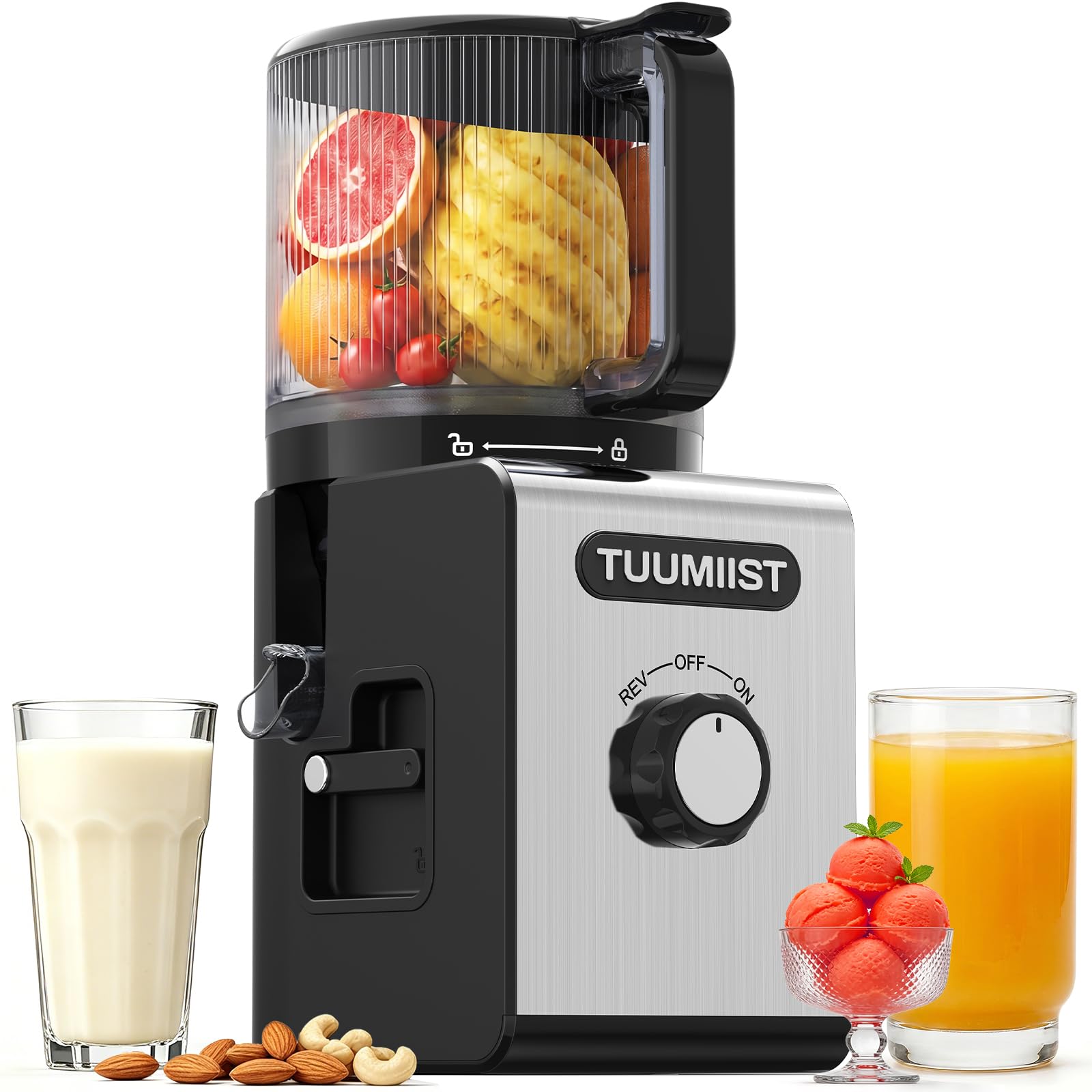
TUUMIIST TM-780SJ
Key Features
- Weight: 7 lb
- Functions: Juice, sorbet, nut milk
- Feed chute: 6.5 in
- Hopper capacity: 100 oz
- Price: Midrange
The value case for the TM-780SJ is easy to see: a 100-ounce hopper, a 6.5-inch chute, and a 350-watt motor for a midrange price. We think it is the best value in this set for batch juicing, because it copies the hands-off shape of our top pick without asking you to spend premium money.
The one smart strainer is a genuinely useful piece of design. It handles juice, nut milk, and sorbet without a drawer full of extra screens, and the no-mesh setup is quicker to rinse than the mesh strainers on several rivals. At 60 RPM, it is not the quietest machine here, but it is calm enough for a kitchen conversation.
The 7-pound body is easier to move than the 12-pound batch machines, and the 6.5-inch chute saves real knife time on apples and celery. For the price, it is the batch juicer we point to first when the hopper matters more than the badge.
Pros
- 100 oz hands-free hopper
- 6.5 in wide feed chute
- 3-in-1 strainer for juice, sorbet, nut milk
- Light 7 lb body
Cons
- Broken parts after months are the durability risk
- 30-day guarantee only
The best value we found for hands-off batch juicing, as long as you accept more durability risk and a shorter guarantee than our top pick.
Best for Quiet Large Batches
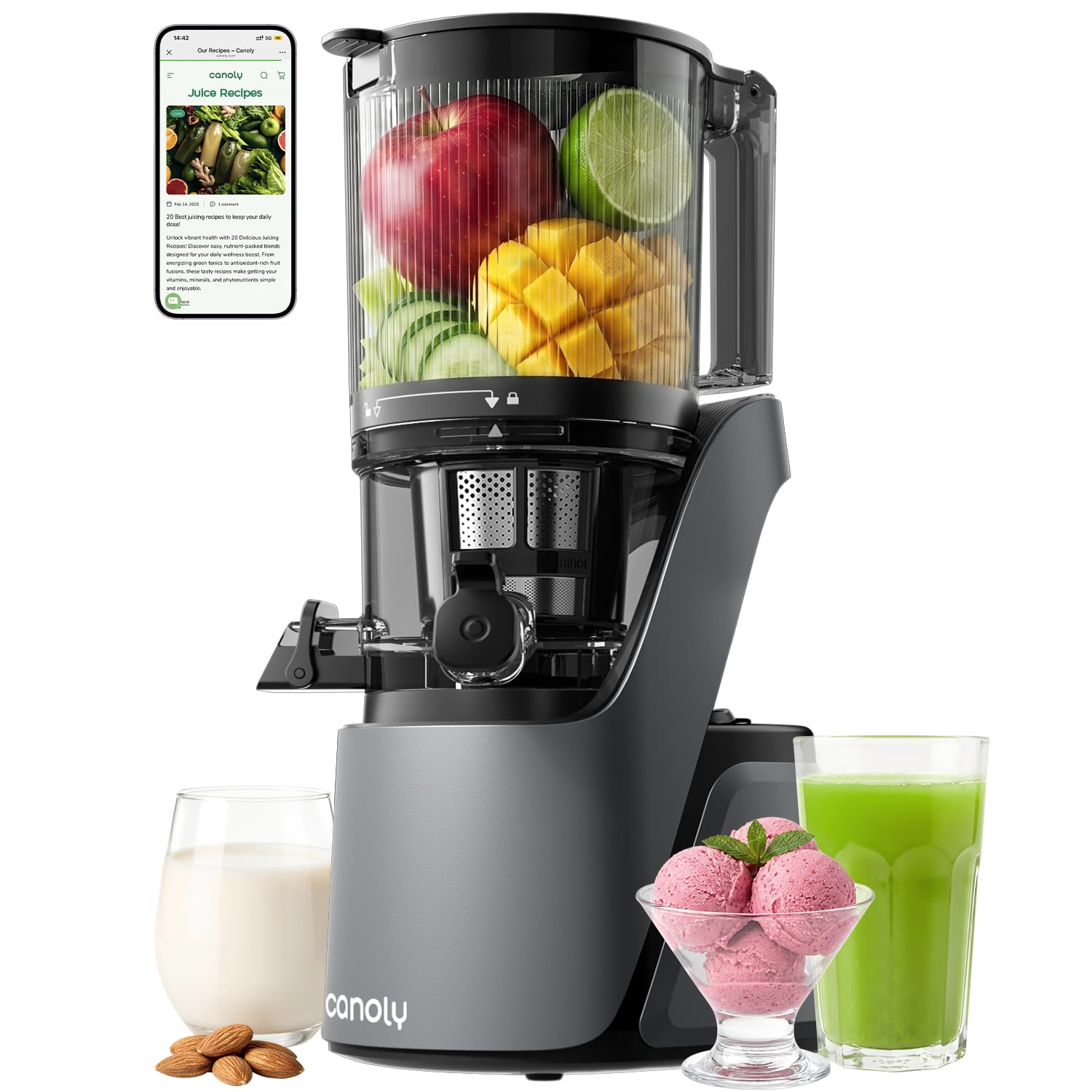
Canoly C16
Key Features
- Weight: 12.6 lb
- Feed chute: 6 in
- Noise level: 35 dB
- Hopper capacity: 90 oz
- Price: Premium
Canoly puts a 35 dB number on the C16, and while we did not measure it with a meter, the claim points at the right strength. This is one of the quietest juicers here, the kind you can run early without feeling as if you have woken the house.
The 90-ounce hopper and 6-inch chute give it much of the Nama’s batch convenience. We loaded it with a family-size mix of apples, carrots, and greens and let the 45 RPM auger work. The three strainers cover juice, sorbet, and nut milk, and the 12.6-pound body stays planted on the counter.
For early-morning batch juicing, we rank the C16 just behind the Nama and ahead of the rest of this set on quiet operation. The touchpad is simple, the parts are dishwasher safe, and cleanup is less of a chore than with mesh-heavy machines. It is a lot of counter machine, and that is the point.
Pros
- Very quiet 35 dB rating
- 90 oz hopper
- 6 in wide feed chute
- Dishwasher-safe parts
Cons
- Cylinder can be stubborn to reseat
- Premium price
For early-morning juicers who want a big hopper without the Nama’s premium, the C16 is the quiet, capable alternative we recommend.
Best for Small Kitchens
Ninja JC151
Key Features
- Motor: 150 W
- Weight: 7.9 lb
- Cleaning: Dishwasher safe
- Pulp control: 2 filters
- Price: Midrange
The JC151 is the juicer we point to when counter space is tight. Dishwasher-safe parts, a 7.9-pound body, and a compact footprint make it easier to live with than the batch machines, and that matters more in a small kitchen than a giant hopper.
The 150-watt motor is the least powerful here, but it handles carrots, beets, and greens without drama. Two pulp filters let you choose less or more texture, and the 24-ounce juice jug is sized for a glass or two rather than a family week. The small feed chute is the trade: we spent more time at the cutting board than with the wide-chute models.
Cleanup is the reason to choose it. The parts go in the dishwasher, the brush helps with the screen, and there are fewer pieces to chase than on the big batch machines. For a small kitchen, that trade is easy to accept.
Pros
- Dishwasher-safe parts
- Compact 7.9 lb body
- Two pulp filters
- Easy cleanup and assembly
Cons
- Can clog on fibrous fruit like mango
We recommend the JC151 for small kitchens that value dishwasher-safe cleanup over whole-fruit capacity.
Best for Simple Daily Juicing
AMZCHEF ZM1902B
Key Features
- Weight: 5.6 lb
- Assembly: 3 parts
- Feed chute: 5.4 in
- Auger speed: 60 RPM
- Price: Budget
Three parts and a 5.6-pound body make the ZM1902B the least fussy juicer here to assemble and store. The stainless-steel exterior gives it a more expensive look than the all-plastic machines, and it takes up little counter width.
That simplicity is why we recommend it for everyday juicing. The 5.4-inch chute has built-in cutting blades that pull produce in, and the 60 RPM auger runs at a calm pace. We found it handled ginger and turmeric without the drama that fibrous roots can cause in cheaper machines.
It is not the highest-yield machine in this set, and the 200-watt motor is not the muscle-bound option. What it gives back is speed of cleanup and a small footprint. For a one-person kitchen or a couple who juices a glass at a time, that is the right trade.
Pros
- Three-part assembly
- Self-feeding cutting blades
- Stainless-steel body
- Compact 5.6 lb body
Cons
- Apples still need trimming
The simple daily juicer we reach for in a small kitchen: three parts, a stainless body, and enough self-feeding help to make mornings easier.
Best for Budget Big Batches
AAOBOSI 3-in-1
Key Features
- Capacity: 100 fl oz
- Cleaning: Hand wash only
- Functions: Juice, nut milk, sorbet
- Feed chute: 6.5 in
- Price: Midrange
The AAOBOSI undercuts the batch-hopper crowd while offering the same 6.5-inch chute and 100-ounce hopper. That combination is unusual at its price, and it is the reason this machine earns a runner-up spot rather than a footnote.
We liked the quiet motor and the way the wide chute swallowed apples and celery. The large hopper is the real story: load a family breakfast and walk away, then come back to juice rather than a pile of prep. Assembly is straightforward, and the parts come apart for cleaning.
For family batch juicing on a budget, we rank it near the top of this set on value and capacity. The caveat is durability: the plastic wear parts are the long-term question mark, so this is a value machine rather than a buy-it-for-decades one. Keep the receipt and treat the warranty as part of the purchase.
Pros
- 6.5 in wide chute
- 100 oz hopper
- Quiet motor
- Strong value for batch size
Cons
- Hand wash only
- Can feel slow on dense produce
The budget batch juicer we recommend for family-size loads, with a wide chute and huge hopper, as long as you accept the durability trade-off.
Best for Budget Whole Fruit
YPONE SJ-057

Key Features
- Motor: 400 W
- Warranty: 1 year
- Feed chute: 5.8 in
- Auger speed: 55 RPM
- Price: Midrange
The YPONE’s 400-watt motor is the biggest number in this set, and it shows in the way the machine takes carrots and celery without the chute dancing. The 5.8-inch feed opening is smaller than the 6.5-inch batch machines, so large apples still need a knife.
At 55 RPM, it runs slower than the centrifugal juicers most people know, but the pace is steady and the noise is manageable. We found the juice output strong and the pulp reasonably dry. The one-year warranty is a useful safety net for a budget machine.
The 4.42 kg body is light enough to move, and the 5.8-inch chute fits most everyday produce. It is a machine you can store in a cupboard if counter space is tight.
We see the SJ-057 as a budget whole-fruit juicer for small households that want real power without paying premium money. It is not the most refined machine here, but it gets the core job done.
Pros
- 400 W motor
- 5.8 in chute
- 55 RPM extraction
- One-year warranty
Cons
- Durability is the weak point
A budget whole-fruit juicer with real power; we recommend it for small households that want easy cleanup and can accept the durability risk.
Best for Small Households
PSIIDAN Juicer-02

Key Features
- Motor: 300 W
- Weight: 7 lb
- Capacity: 1.2 L
- Cleaning: Dishwasher safe
- Price: Midrange
The PSIIDAN’s safety-lock interlock is the first thing we noticed: the machine will not run until the chamber, auger, and lid are seated. That is a small thing that makes a family kitchen feel less accident-prone.
At 300 watts, it is not the most powerful here, but the rotary knob and reverse mode make it easy to manage. We liked the two cups and the way the parts come apart; there is no touchscreen to wipe down, and the reversing function gives you a way out of a jam.
The 7-pound body is easy to move, and the parts are dishwasher safe. It is a compact machine that fits a small counter, and the safety lock is a genuine plus if more than one person uses it.
For a couple or a single person, we recommend it as a compact, dishwasher-safe juicer with a useful safety lock. It is the small-household machine in this group, not the family-batch one.
Pros
- Safety-lock interlock
- Dishwasher-safe parts
- Compact 7 lb body
- Reverse mode clears jams
Cons
- 1.2 L capacity suits small batches only
We like it as a compact, safety-locked juicer for couples and small households, with dishwasher-safe parts and a smaller footprint than the batch machines.
How We Tested the Best Masticating Juicers
We started by pulling together the masticating juicers that kept surfacing in owner reviews and retail roundups, then narrowed the field by auger type, feed-chute size, footprint, and price tier so we weren’t comparing a compact single-user model against a counter-hogging twin-gear machine. Eight models made the cut, and we used each one for eight months — not a single showcase run, but the real pattern of weekday mornings and weekend batch sessions.
On weekday mornings, we fed kale, celery, cucumber, and apple through each juicer, timing how long it took from switch-on to the last drop and noting whether we had to chop produce down to fit the chute. We weighed the produce before and after, measured the juice, and squeezed the pulp by hand to see how much liquid was left behind. Fibrous celery and wheatgrass got their own runs, because that’s where clogging tends to show up: we recorded how often the auger stalled, how quickly the reverse function recovered it, and whether the screen needed clearing mid-batch.
Weekend sessions were heavier — carrots, beets, ginger, and leafy greens — and that’s where noise, cleanup, and durability got tested. We ran each machine in a quiet kitchen and listened from the next room, then broke down every removable part, washed it by hand, and timed the full reassembly. Over eight months we checked augers, screens, and feed tubes for staining, cracks, and loose fittings, and we compared each machine’s output and effort against what it cost. The models that kept earning counter space were the ones that stayed consistent after repeated use, not just impressive on the first glass.
How to Choose a Masticating Juicer
The right masticating juicer is the one whose batch size, prep demands, and cleanup routine match the way you actually make juice.
Start with prep, not wattage
A wide chute or a self-feeding hopper cuts knife time, but it does not eliminate trimming for hard produce. We treat whole-fruit claims as something to check against the opening, not a promise. If you juice apples and celery before work, pay for the 6-inch-plus chute or the hands-free hopper. If you already prep a batch on Sunday, a 5.4-inch model like the AMZCHEF is enough and easier to store.
Match the hopper to your batch
A 100-ounce hopper is a family machine; a 24-ounce jug is a glass-at-a-time machine. The big hoppers let you load a recipe and walk away, which is the whole appeal of the Nama and TUUMIIST designs. The trade is counter space and lifting: most batch models here run 16 to 18 inches tall and some weigh more than 12 pounds. Measure cabinet clearance and decide whether the machine lives on the counter.
Budget for cleaning
Part count matters more than the word easy. A three-part juicer rinses faster than a mesh-heavy one, and no-mesh designs save the most time. Dishwasher-safe parts help only if every food-contact piece qualifies, so check the care instructions before you count on it. If you juice daily, choose the simpler cleanup over an extra sorbet strainer you may never use.
Weigh noise and durability
Low RPM does not automatically mean quiet; motor quality and build tightness decide that. The quietest machines here are the ones with better motors and less vibration, and a cheap motor can squeal even at slow speed. Durability is where budget models separate. A one-year warranty is worth more than a feature you use once, and plastic wear parts are the first place to look when a price seems unusually low.
Frequently Asked Questions
Can a masticating juicer make nut milk and sorbet?
Yes, on 3-in-1 models such as the Nama J2, TUUMIIST TM-780SJ, and Canoly C16. Use the coarse or sorbet strainer, soak nuts first, and freeze fruit hard for sorbet. A plain juice-only model will make a pulpier nut milk, so check the included strainers before you buy.
Do I need to peel everything before juicing?
No. Thin skins on apples, pears, carrots, and cucumbers can go in. Peel citrus and thick-skinned produce, and remove pits, hard seeds, and tough rinds. Cut fibrous celery and greens into shorter lengths so they feed evenly.
Is a masticating juicer worth it over a centrifugal model?
If you juice leafy greens, ginger, or nut milks, yes: slow augers handle them with less heat and usually leave drier pulp. If speed is the priority and you mostly juice carrots and apples, a centrifugal model is faster and simpler. Choose the slow juicer for quality and the centrifugal for rush.
Final Verdict
The Nama J2 is the one we recommend as the default: its hands-free hopper turns a full recipe into a walk-away job, and it backs that convenience with quiet operation and dry pulp. If the premium is too steep, the TUUMIIST TM-780SJ gives you the batch-hopper experience and 3-in-1 flexibility for much less. For a small kitchen, the Ninja JC151’s dishwasher-safe compact build is the smarter fit.