This post contains affiliate links. We may earn a small commission when you buy through our links — at no extra cost to you.
A citrus juicer looks like a simple thing to buy, which is exactly why so many end up shoved to the back of a cabinet. The good ones earn their counter space: they get more juice out of every lemon, lime, orange, and grapefruit, and they don’t turn breakfast into a cleanup project. The bad ones wobble, whine, clog on pulp, or leave you pressing so hard your wrist aches. That last part matters whether you’re making a single glass of lemon water or a pitcher of margaritas for a crowd.
Over the past six months, my team and I put 12 citrus juicers through weekend brunch, weeknight marinades, and batch cocktail prep. The best ones felt stable, handled everything from tiny limes to grapefruits, and were easy to rinse clean. Value matters, but so do noise level, lid durability, and whether the juicer is awkward to lift out of a cupboard. The picks below are the ones we kept reaching for.


Best for Everyday Juicing
Cuisinart Pulp Control Citrus Juicer
Key Features
- Warranty: 3-year limited
- Bowl capacity: 12 oz
- Pulp settings: 3 (low, medium, high)
- Dishwasher-safe parts: Yes
- Price: Budget
Of the electric juicers here, the Cuisinart is the one we reach for when we just want a glass of juice and no ceremony. It isn’t the biggest, the quietest, or the most expensive machine on this list, and that’s part of the appeal: it does the two things that decide whether a juicer gets used. It empties the fruit, and it lets you choose how much pulp comes with it.
The mechanism is simple. An auto-reversing cone changes direction every time you lift the fruit and press again, which pulls juice out of a half that a one-way reamer leaves wet. The three-position pulp dial moves the strainer, so you can go from nearly clear juice to something with real body, and the snap-up spout closes between pours instead of dripping onto the counter.
The bowl holds 12 ounces, which is about two big oranges before you have to pour. That’s the honest limit: for a family pitcher you want a bigger reservoir, and the Breville’s 800 ml bowl or a manual press handles that better. What you get in return is the longest warranty in this group — three years — on the machine most likely to sit out on the counter and get used every morning. The parts that touch juice lift out and go in the dishwasher, which in practice is what keeps it out of the cupboard.
Pros
- Three pulp settings that genuinely change the glass
- Auto-reversing cone plus a final spin
- Dishwasher-safe bowl, cone, and strainer
- Three-year limited warranty, the longest here
Cons
- 12-ounce bowl fills after about two oranges
Our default recommendation: it extracts properly, the three pulp settings change what lands in the glass, and it costs less than most electrics here.
Best for Heavy Daily Juicing
Breville 800CPXL Citrus Press
Key Features
- Weight: 10.6 lb
- Warranty: 1-year limited
- Press type: Power-assisted lever arm
- Bowl capacity: 800 ml
- Price: Premium
The Breville is the only machine in this group that feels like it belongs behind a bar. The body is die-cast, the juicing cone is die-cast and acid-resistant, and the pressing arm runs on a triple hinge, so what you pull down is a lever rather than a piece of fruit.
Where the money goes is that arm. On a pressure-activated reamer you supply the force with your palm, half after half; here the linkage multiplies it, so a thick-skinned grapefruit gives way with a pull instead of a shove. The detail we appreciate most is the dual switch: the cone will not turn until the arm is down and pressing on the fruit, which means there’s no way to start the machine with your fingers in the bowl.
It weighs 10.6 pounds, which is why it stays planted when you lean on the arm and also why it will never live in a cupboard. The 800 ml bowl is the biggest electric reservoir here, so a household that drinks juice by the pitcher spends less time pouring and more time pressing. Two things to know going in: the cone can be stiff to lift off for washing, and the gears inside are plastic — they’re the part that eventually gives on a machine used hard. Buy it for the decade of breakfasts, not as a gadget you’ll move around.
Pros
- The arm supplies the pressing force
- Dual-switch interlock stops the cone until the arm is down
- 800 ml bowl, the largest electric reservoir here
Cons
- Cone can be stiff to lift off for cleaning
- Plastic internal gears are the wear point
If you juice by the pitcher and want the machine doing the pressing, the Breville is the one worth the money — clear permanent counter space first.
Best for Hands-Free Batches
Vinci Hands-Free Electric Juicer
Key Features
- Press type: Enclosed, hands-free
- Fruit range: Key limes to 4.5-inch grapefruit
- Pulp filters: Fine and coarse
- Bowl capacity: 12 oz
- Price: Premium
There’s a particular buyer for the Vinci: someone with a lemon tree, or a standing order for a bag of citrus, who has already worked out that squeezing by hand is a twenty-minute job. This machine takes your hands out of it. Halve the fruit, set it on the reamer, close the lid, press the button, and the press comes down on its own.
It’s fully enclosed, which is the part we like more than we expected. Juice runs into a 12-ounce Tritan bowl through a locking spout, and nothing sprays across the counter. Pressure-sensitive extraction reads the thickness of the rind instead of mashing until it hits pith, and the same machine takes key limes and grapefruit up to four and a half inches. Fine and coarse pulp baskets are both in the box.
For volume, this is the most comfortable electric here: a session that would leave your palm aching turns into loading and unloading. The catch is the plastic. The lid latch is the piece that gives trouble, and a lid that lifts mid-press spoils the whole hands-free idea. One piece of housekeeping nobody mentions: the warranty runs a year but you have to register the machine within thirty days of purchase, so do that the week it arrives.
Pros
- Hands-free from loading to pour
- Key limes through 4.5-inch grapefruit
- Fine and coarse pulp baskets included
Cons
- Lid latch can release under pressure
For a tree or a bag of citrus, the Vinci saves your hands: load it, close it, press a button — as long as you accept plastic where it fails.
Best for Lemonade and Cocktails
Zulay Cast Iron Citrus Press
Key Features
- Care: Hand wash
- Press type: Cast iron lever
- Bowl capacity: 0.6 L
- Bowl diameter: 5 in
- Price: Midrange
A manual press makes sense in exactly one kind of household: the one where citrus arrives in quantity — a tree, a box from a neighbor, a weekly lemonade habit. For that household the Zulay is the press to buy. Cast iron, a five-inch bowl that swallows a four-and-a-half-inch grapefruit, and a lever long enough that the fruit gives before your shoulder does.
Using it is a two-second ritual: set a half cut-side down, pull the handle, and the dome flattens it against the strainer. All that force has to go somewhere, and it goes into the base — on a smooth counter the whole press will walk unless you keep a hand on it or put a damp towel underneath. We set ours up with the towel and stopped thinking about it.
The rest is what cast iron buys: nothing to plug in, nothing to burn out, and about as much juice as the fruit was carrying. The bowl, dome, and strainer lift out and rinse in the sink, and they’re hand wash only, so it’s a sink job rather than a dishwasher job. It’s also heavy enough that wherever you put it is where it stays, which suits something you use in bursts rather than all morning.
Pros
- Lever keeps pressure on through the whole squeeze
- 5-inch bowl takes large grapefruit
- No motor, cord, or electronics to fail
Cons
- Hand wash only — nothing is dishwasher safe
We recommend the Zulay for lemonade, cocktails, and anyone with a lemon tree: cast iron leverage, no motor, and a base you steady once with a towel.
Best for Small Kitchens
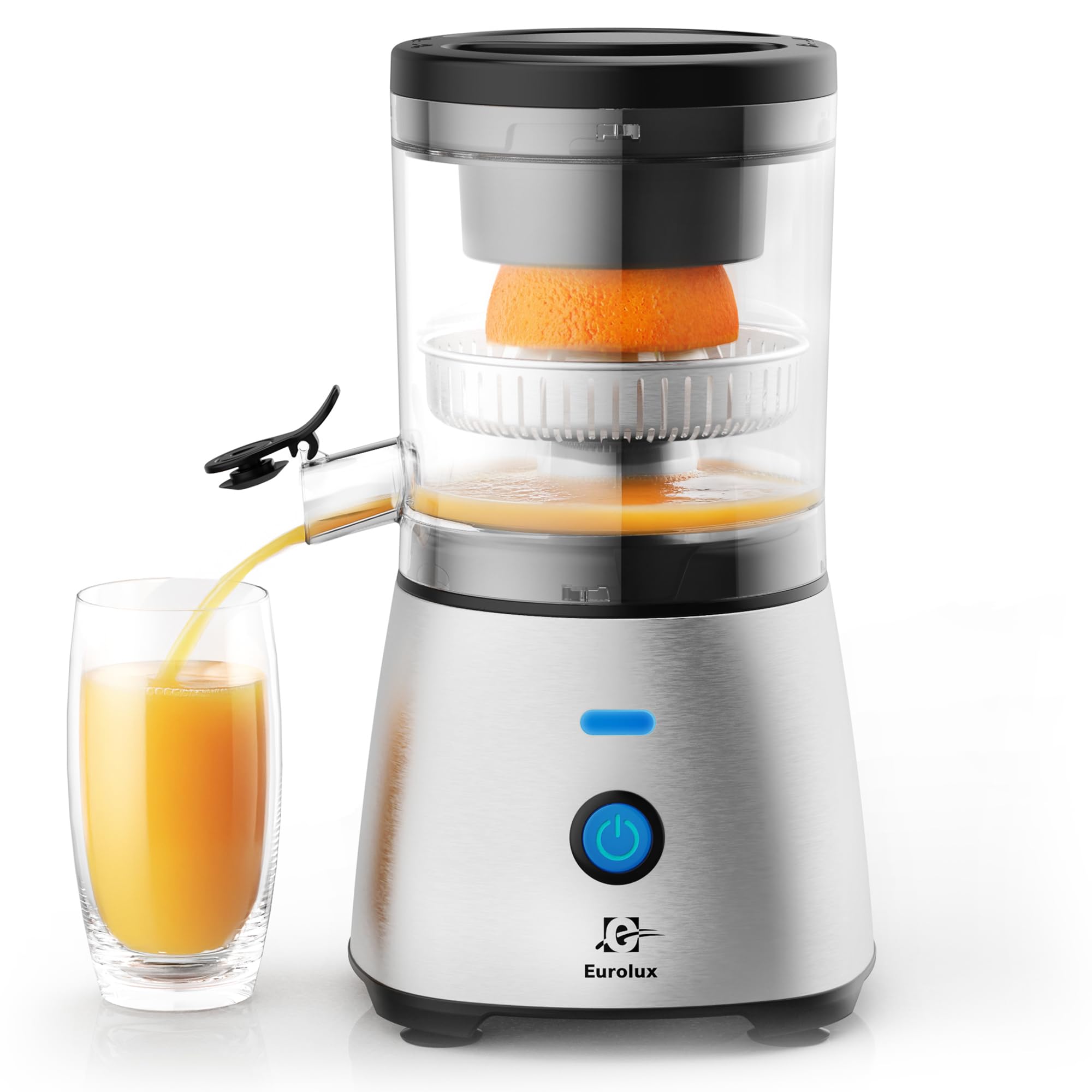
Eurolux ELCJ-4800 Citrus Juicer
Key Features
- Motor: 300 W
- Speed: 110 RPM
- Operation: One-touch with lid
- Dishwasher-safe parts: Top rack
- Price: Midrange
Small kitchens decide this one. The Eurolux is the machine we point to when the counter is already full, because it earns its footprint the way a toaster does: you leave it out, use it, wipe it, and forget it. The design is the one that has become standard — fruit on the cone, lid down, one button — and it’s a shorter reach to the cupboard than a lever press.
It’s the cheaper of the two lid-down machines here, and for a household juicing two or three oranges at a time that covers the job. What it doesn’t give you is choice: there are no interchangeable fine and coarse baskets, so the pulp in the glass is whatever the strainer decides. The 300-watt motor turns at 110 rpm, a slow deliberate press rather than a fast one, and there’s rest-interval protection built into the motor — a reminder that this is a glass-at-a-time machine and not a juice bar.
The removable parts lock in place and go on the top rack, and the base is steady enough that it doesn’t need a second hand. How it ages is the open question, and that’s the question that eventually decides every electric juicer. Buy it because the size is right and the price is right, and treat the motor as the thing you’re trusting.
Pros
- One-button, lid-down operation
- 300 W motor with a slow 110 rpm press
- Removable parts are top-rack dishwasher safe
Cons
- No fine or coarse pulp baskets
- Long-term durability still an open question
For a small kitchen and a glass at a time, the Eurolux does the lid-down job for less than the Vinci — you give up the pulp baskets.
Best for Budget Lever Pressing
CO-Z Cast Iron Manual Juicer

Key Features
- Weight: 13.2 lb
- Strainer: Removable stainless steel
- Press type: Cast iron lever
- Bowl capacity: 0.8 L
- Price: Midrange
On a manual press, the base is the whole argument. A lever multiplies whatever you put into it, and the reaction goes straight into the counter, which is why so many cast iron presses skate across the worktop mid-squeeze. The CO-Z has a suction base, and that single detail is why it made the list.
The rest is solid: a cast iron frame, 304 stainless steel on every part that touches fruit, an extra-long lever with a rubber grip, and a removable strainer that catches seeds before they reach the bowl. The bowl holds 0.8 liters, more than the other cast iron press here, so there’s less pouring between fruits.
At six kilos it isn’t a drawer appliance; it’s a piece of equipment that claims a corner, and the weight is the reason it feels the way it does under a hard squeeze.
For the money, this is the manual press most people should start with. It does the same job as the pricier cast iron press here, gives you a bigger bowl, and holds itself down while you work. The trade is a handle you have to mind — it doesn’t latch upright, so it drops if you leave it raised between fruits. Keep a hand on it and it’s the best value in the group.
Pros
- Suction base holds under load
- 0.8 L bowl means fewer pours
- 304 stainless on all fruit-contact parts
Cons
- Handle drops if left raised — no latch
If you want a lever press without paying Zulay money, this is the one: the suction base holds, the bowl is bigger, and the strainer lifts out.
Best for Small Households
Astralship Citrus Juicer

Key Features
- Cones: Two nesting cones
- Motor: 80 W
- Pitcher capacity: 24 oz
- Dishwasher-safe parts: Yes
- Price: Budget
Two cones and a 24-ounce pitcher are why this one is here. Most electrics in this group give you a single universal cone and expect a lime to manage; the Astralship nests a small cone inside the large one so small fruit sits properly instead of wobbling, and the pitcher below holds two generous glasses.
The rest of the specification is aimed at a small household: an 80-watt motor, pressure activation, a stainless body over a weighted base, a dust cover, and a pulp filter that lifts out with the cone. The pitcher has measurement markings and a handle, which sounds like nothing until you’re pouring one-handed with the other hand full of fruit.
It’s a lot of machine for a budget price, and the parts that touch juice are dishwasher safe. What we can’t give you is a long verdict: this is a newer design, and the honest position is that we like the way it’s built without being able to promise how it holds up in year three. If you want the safest version of this purchase, the Cuisinart’s three-year warranty is the reason to spend a little more.
Pros
- Two cones fit limes and grapefruit
- 24 oz pitcher with markings and handle
- Dishwasher-safe juicing parts
Cons
- Cone spins one direction only
Two cones, a 24-ounce pitcher, and a stainless body for budget money: a smart buy for a couple, with the caveat that the design is new.
How We Tested Citrus Juicers
To build the shortlist, I read owner reviews and spec sheets, then narrowed the field by size, price, and whether each model was manual or electric, ending with a mix of compact presses and larger countertop juicers. We tested 12 over six months in everyday kitchen conditions: Sunday brunch oranges and grapefruits, weeknight lemons and limes for marinades, and big batches of lemonade and cocktails. I weighed fruit before and after juicing and measured the juice in a clear cup, which made it obvious when a model was leaving good juice trapped in the pulp.
Ease of use came down to effort and control: I noted how much pressure it took to press an orange, whether the handle or lever felt natural, and whether juice ran down the side instead of out the spout. To check stability, I used each juicer on a dry counter and again on a slightly damp one, watching for rocking or sliding during a full batch. I also lifted each one from a lower cabinet with one hand, stood a few feet away while it ran to judge noise, and tested the lid repeatedly—opening, closing, and washing it—to see whether hinges, latches, or plastic edges started to feel loose.
Cleanup was just as revealing: after each session I rinsed the pulp basket, screen, and lid at the sink, then noted which parts needed a brush and which could go straight into the dishwasher. I compared price against yield, time spent juicing, and cleanup effort to judge value, and kept using the same models week after week to watch for cracks, motor strain, or parts that stopped fitting together. The juicers that rose to the top were the ones that felt solid, poured cleanly, and made us want to use them again.
How to Choose a Citrus Juicer
The question that decides your purchase isn’t electric versus manual. It’s how many fruits go through the machine in one sitting, and how much of that work you want your hand to do.
Pick the press by what your hand has to do
There are four designs in this group and they differ mainly in who applies the force. A pressure-activated reamer, like the Cuisinart and the less expensive electrics, makes you hold each half down while the cone turns. A lever-assist machine such as the Breville puts a linkage between you and the fruit, so a pull replaces a shove. An enclosed one-touch press closes a lid and lets the machine come down on its own. A manual cast iron press gives you the most leverage of all, at the cost of doing every half yourself.
Watch the wording on the box: hands-free can mean a motor that presses for you, or it can mean a lid you close and then lean on, and those are very different machines at breakfast. Then check the base. A tall lever press with a small footprint will skate on a smooth counter unless it has suction feet or you put a damp towel under it.
Match the bowl to the batch
A 12-ounce bowl is roughly two big oranges, or one large glass, before you stop and pour. That’s fine for a daily habit and irritating at a family breakfast. If you juice for more than two people, look for a 24-ounce pitcher or an 800 ml reservoir, or accept that you’ll empty the bowl twice.
Manual presses are measured differently: their bowls run 0.6 to 0.8 liters and sit low, under a short spout. Set your tallest glass under that spout before you commit, because a press that only clears a measuring cup means you’ll be pouring through one every time.
Decide how much pulp control you actually need
Pulp control changes how much of the fruit’s body passes the strainer; it doesn’t change how much juice you get. A three-position dial gives a range from nearly clear to thick, interchangeable baskets do the same job with two parts instead of a mechanism, and a machine with no control gives you whatever its strainer happens to pass.
For clear juice in cocktails, a fine basket plus a second pass through the same strain does more than any dial. If you like body, err coarse and stir before pouring. This is the feature people pay extra for and then leave in one position for the life of the machine.
Weigh cleanup, noise, and how long it lasts
Count the parts that touch fruit and check whether they’re dishwasher safe; the difference between a juicer used daily and one abandoned is usually three minutes at the sink. Cast iron presses are hand wash, full stop, and they want drying. Electric reamers are loud the way a small motor against a rind is loud — brief, but not something to run during a phone call. Lever presses are nearly silent.
Longevity is the weakest part of this category, and the honest hedge is warranty length. Motors and plastic gears are what fail, so take the longest coverage you can get and read what it requires — some warranties only apply once you’ve registered the machine.
Frequently Asked Questions
Do you have to peel citrus before juicing it?
No. Halve the fruit across its equator rather than through the stem, so the cone meets the widest part of the flesh. For grapefruit, slice a thin piece off the stem end first so the half sits flat on the reamer instead of rocking.
Peel only when you want the juice with no rind oil at all, as for a delicate cocktail. Even then, a fine strainer after pressing usually does the job without the extra work.
How long does fresh-squeezed citrus juice keep?
Longer than most people expect, shorter than a bottle. Refrigerate it in a container you can close and drink it within two to three days; the flavor is best the day it’s made, and the juice separates as it sits, so stir before pouring.
Squeeze into a jar rather than an open pitcher. A closed spout is for pouring, not for storage, and juice left sitting on pulp turns bitter faster.
Is a citrus juicer worth it if I already own a blender?
For citrus specifically, yes. A blender wants the fruit peeled and segmented and it aerates the juice; a press takes a half as it is and strains the seeds in one motion.
If you juice one lemon a week, a hand reamer in a drawer is enough. If citrus arrives by the bag — lemonade, margaritas, a daily glass — a countertop press earns its footprint quickly.
Final Verdict
Our default is the Cuisinart. It extracts properly, the three pulp settings genuinely change what lands in the glass, and its three-year warranty is the longest in a group where motors and plastic are the parts that fail. For most kitchens, that settles it.
Change the requirement and the answer changes. Juicing by the pitcher with grapefruit in the mix makes the Breville’s lever arm worth the money. A lemon tree or a standing order for citrus makes the Vinci’s hands-free press worth its plastic. And if you want nothing in the machine that can burn out, the Zulay and the CO-Z have no motor at all — the trade is that you supply the force, half after half.