This post contains affiliate links. We may earn a small commission when you buy through our links — at no extra cost to you.
A sharp knife makes cooking safer and faster, but many electric sharpeners claim professional results only to leave you with scratched blades or a dead motor within months. The gap between marketing and real-world durability is the biggest frustration in this category.
The difference comes down to abrasive quality and build consistency. A well-designed three-stage system with diamond abrasives will outlast and outperform a cheap two-stage unit, but only if the guides are accurate and the motor can handle repeated use.
This guide focuses on sharpeners that hold up over years of use, not just the first sharpening session. Whether you need occasional touch-ups or weekly maintenance, the right choice depends on how much you invest in long-term reliability.


Best for Razor-Sharp Edges
Chef’sChoice 15XV
Key Features
- Stages: 3
- Abrasive Material: 100% diamond
- Serrated & Ceramic: Serrated only
- Guide Quality: Auto 15° Trizor
- Durability: Diamond (long-lasting)
- Price: Luxury
The 15XV consistently produces razor-sharp edges on both straight and serrated blades in seconds. Its three-stage diamond abrasive system removes metal efficiently and finishes with a polished edge that cuts like new.
This sharpener is built for home cooks who want the sharpest possible edge with minimal fuss, and for owners of high-end knives who want to maintain factory-level sharpness. For those who sharpen only once or twice a year, the premium price is hard to justify — and heavy use over years may cause the diamond wheels to lose some effectiveness.
Pros
- Delivers extremely sharp edges on any blade quickly and repeatably.
- Works equally well on straight and serrated knives without changing settings.
- Requires no special skill — the learning curve is short even for first-time users.
Cons
- The premium price may not feel justified for occasional home cooks who sharpen rarely.
- Diamond wheels can lose effectiveness over extended heavy use over several years.
The fastest route to a razor edge at home, but only if you sharpen regularly and value that sharpness over cost.
Best for Everyday Sharpening
Presto 08800
Key Features
- Stages: 2
- Abrasive Material: Sapphirite ceramic
- Guide Quality: Fixed precision guides
- Durability: Ceramic (moderate)
- Price: Mid-Range
The Presto 08800 is the most popular electric sharpener on the market because it puts dull knives back into action quickly, and at a price that undercuts premium models by a wide margin. Some units may experience motor burnout or blade scuffing, so this works best for everyday home cooks who want a simple, no-regret tool without overpaying.
Pros
- Quickly sharpens dull kitchen knives back to usable condition.
- Build feels sturdy and well-made for a budget-friendly sharpener.
- Delivers noticeable sharpening improvement at a price most home cooks can afford.
Cons
- Motor burnout or blade scuffing may occur in a small number of units — less of a concern with light, occasional use.
The best value sharpener for most kitchens, provided you accept the occasional QC variance.
Best for Long-Term Use
Chef’sChoice 120
Key Features
- Stages: 3
- Abrasive Material: 100% diamond
- Serrated & Ceramic: Serrated only
- Guide Quality: Fixed 20° guides
- Durability: Diamond (long-lasting)
- Price: Luxury
Chef’sChoice 120 has been producing consistent edges for over 20 years, handling serrated knives and straight-edge blades with equal competence. The 100% diamond abrasives and three-stage system create durable edges that stay sharp longer than many electric sharpeners.
This model is best for home cooks who sharpen frequently and want a reliable fixed-angle design at 20°. The premium price and lack of angle adjustment mean it won’t suit users who need 15° edges for Japanese knives or those on a tight budget.
Pros
- Handles all knife types including serrated blades without chipping.
- Well-built with 100% diamond abrasives that last through years of regular use.
- Produces sharp, durable edges that reduce the need for frequent resharpening.
Cons
- Fixed 20° angle cannot accommodate knives requiring 15° edges, such as many Japanese blades.
- Premium price may not appeal to casual users who sharpen only occasionally.
For cooks who sharpen often and prefer a fixed 20° edge, this model’s decades-long track record is hard to beat.
Best for Varied Blades
Presto 08810
Key Features
- Stages: 3
- Abrasive Material: Sapphirite wheels
- Serrated & Ceramic: Serrated only
- Guide Quality: Blade thickness selector
- Durability: Ceramic (moderate)
- Price: Mid-Range
The Presto 08810 upgrades the basic model with a third stage and adjustable blade guides for thin, medium, or thick knives. It produces sharp edges quickly on standard kitchen knives and feels sturdy on the counter at 5.1 pounds. This suits home cooks who sharpen multiple blade types like European, Asian, or serrated and want the angle flexibility without paying for premium models. One tradeoff: the sharpening wheels can remove more metal over time, so periodic checks on blade thickness are advisable.
Pros
- Three-stage system with adjustable guides for thin, medium, and thick blades.
- Solid build with a heavy, stable base that stays put during use.
- Sharpens standard kitchen knives quickly to a very sharp edge.
Cons
- Heavy 5.1-pound design occupies counter space and isn’t suited for drawer storage.
For home cooks who need multi-stage sharpening and blade thickness control at a mid-range price, the Presto 08810 is a capable upgrade.
Best for Angle Flexibility
Chef’sChoice 1520
Key Features
- Stages: 3
- Abrasive Material: 100% diamond
- Serrated & Ceramic: Serrated only
- Guide Quality: Selectable 15°/20°
- Durability: Diamond (long-lasting)
- Price: Luxury
Switch between 15° and 20° edges to match the bevel angle of different knives, from Japanese to German steel. The diamond abrasives produce very sharp edges that hold well across chef, butcher, and serrated blades.
Best for knife collectors who maintain both angle types and value edge sharpness over blade finish. The premium price reflects consistent results, though fine scratches may appear on blade faces during sharpening — a trade-off for those who prioritize edge geometry over cosmetic finish.
Pros
- Selectable 15° and 20° angles cover both Japanese and European knife bevels.
- Sharp edges that hold well, often sharper than manual stones for many users.
- High-quality construction with diamond abrasives for long-term use.
Cons
- May leave fine linear scratches on blade faces during sharpening.
If you own knives with different bevel angles and want a single sharpener that handles both without compromising edge quality, this is the one.
Best for Budget Diamond
Homly 3-Stage
Key Features
- Stages: 3
- Abrasive Material: Diamond
- Serrated & Ceramic: Serrated & ceramic
- Guide Quality: Precision guides
- Durability: Diamond (long-lasting)
- Price: Mid-Range
This Homly sharpener uses diamond abrasives across three stages, giving it an edge on both straight and serrated knives that feels professional-grade. The 2-year warranty adds peace of mind for a newer brand. Home cooks who sharpen a mix of blade types and want quick results under $100 will find it a capable option, though those chasing perfectly consistent razor edges on every knife may need to accept occasional extra passes.
Pros
- Strong performance on serrated and straight knives
- Solid build and sharp edges
- Easy to use with quick sharpening
Cons
- When aiming for a razor-sharp edge on certain knives, the results can vary and may require multiple passes through the fine stage
A strong value for home cooks who sharpen a variety of knives and want diamond abrasives under $100, but if every blade needs a consistent razor edge, the Presto EverSharp’s adjustable guides offer more predictable results.
Best for Countertop Station
Chef’sChoice M130

Key Features
- Stages: 3
- Abrasive Material: 100% diamond
- Serrated & Ceramic: Serrated only
- Guide Quality: Precision angle guides
- Durability: Diamond (long-lasting)
- Price: Premium
The Chef’sChoice M130 delivers remarkably easy, consistent sharpening from a stable countertop station. Its larger footprint suits a permanent spot but not a drawer. The manual can be unclear, but the sharpening process is intuitive. For those wanting a set-and-forget station, this works well, though the 120 model offers similar performance in a more compact, better-value package.
Pros
- Nearly foolproof sharpening with 100% diamond abrasives for all knife types
- Sturdy countertop base stays put during use
Cons
- Large footprint requires dedicated counter space; the manual may be unclear but the process itself is intuitive
Ideal for home cooks who have ample counter space and want a no-fuss sharpener, but the smaller Chef’sChoice 120 is a smarter buy for most.
Best for Stropping Fans
Chef’sChoice 1520 Bk

Key Features
- Stages: 2
- Abrasive Material: 100% diamond
- Serrated & Ceramic: Serrated only
- Guide Quality: AngleSelect + UltraStrop
- Durability: Diamond (long-lasting)
- Price: Luxury
The Chef’sChoice 1520 uses patented UltraStrop stropping disks to produce a refined, polished edge on both 15° Japanese and 20° European knives. Edge quality and speed are strong for routine maintenance. However, without a third coarse stage, it struggles with very dull blades – better suited for keeping sharp knives sharp.
Pros
- Great performance on Japanese and European knives
- Produces razor-sharp edges quickly
Cons
- Some units may show construction wear over time, affecting stability
A capable sharpener for those who routinely maintain moderately sharp knives and want angle flexibility, but not the best choice for restoring badly neglected edges.
Best for Budget 3-Stage
SHARPAL 198H

Key Features
- Stages: 3
- Abrasive Material: Diamond + ceramic
- Serrated & Ceramic: Serrated only
- Guide Quality: Precision guides
- Durability: Diamond+ceramic (good)
- Price: Mid-Range
The SHARPAL 198H uses monocrystalline diamond and ceramic wheels in a three-stage system that sharpens quickly and is simple to operate. It offers good value for budget-conscious buyers. However, because the brand’s track record is shorter than established alternatives and some units can leave light scratches on blade faces, it suits casual kitchen use rather than high-volume sharpening.
Pros
- Three-stage system with diamond and ceramic abrasives.
- Beginner-friendly operation with clear slot guides.
Cons
- Diamond wheels can create superficial scratches on the upper part of the blade.
For home cooks who want an affordable electric sharpener with diamond wheels and are comfortable with a newer brand, the SHARPAL 198H is a solid mid-range choice.
Best for Ultra-Budget Diamond
Narcissus S867
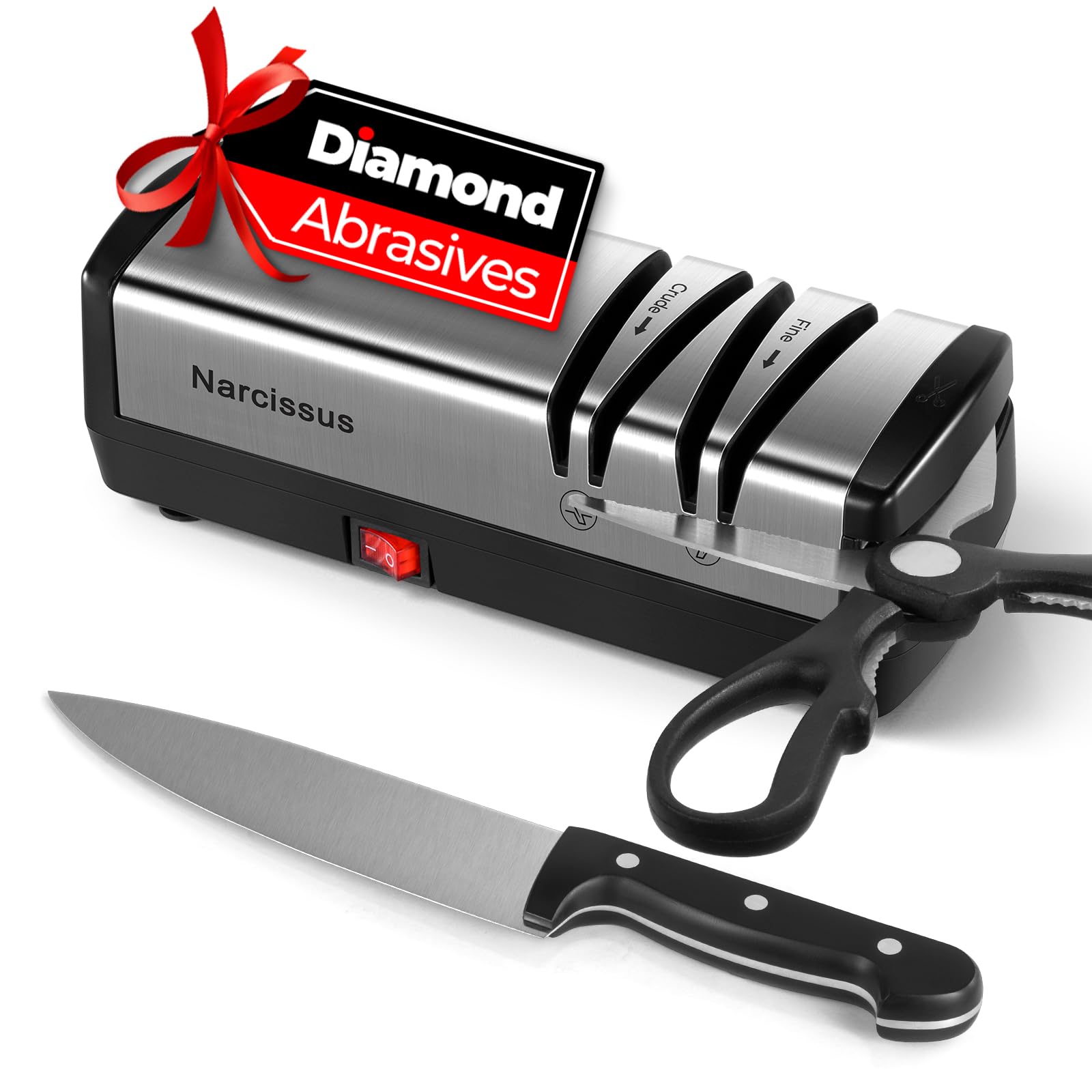
Key Features
- Stages: 2
- Abrasive Material: Diamond
- Guide Quality: Guided slots
- Durability: Diamond (moderate)
- Price: Budget
This sharpener brings diamond wheels and a scissors slot for under $40, making it a cost-effective entry point. However, achieving a truly sharp edge depends more on user technique than with guided systems, and results can vary between knives. For similar money, the Presto 08800 offers more consistent edges with less effort.
Pros
- Sharpens both knives and scissors effectively.
- Compact design with good value for the price.
Cons
- Sharpness can vary between knives — some may not reach a very sharp edge.
If you’re on a tight budget and need a single tool for knives and scissors, this diamond sharpener is a reasonable choice — just expect to invest some practice to get consistent results.
Best for Compact Premium
Chef’sChoice 320

Key Features
- Stages: 2
- Abrasive Material: 100% diamond
- Serrated & Ceramic: Serrated only
- Guide Quality: Fixed 20° guides
- Durability: Diamond (long-lasting)
- Price: Premium
The Chef’sChoice 320 uses diamond abrasives in a compact 1.3 lb body for consistent edges, but its two-stage system and fixed 20° angle limit versatility. It suits home cooks who want a simple sharpener, but for more control or value, consider the Presto 08810.
Pros
- Compact 1.3 lb design fits in a drawer
- Diamond abrasives deliver years of consistent sharpening
Cons
- Two-stage system and fixed 20° angle limit blade type compatibility
Best for light maintenance of straight-edge kitchen knives in a small kitchen; step up to a 3-stage model for heavily dull blades or angle flexibility.
Best for Drawer-Friendly
Work Sharp E2

Key Features
- Stages: 2 (belt + hone)
- Abrasive Material: Premium belt + ceramic
- Guide Quality: Automated cycle
- Durability: Belt (replaceable)
- Price: Mid-Range
The Work Sharp E2 fits neatly in a drawer and sharpens with a single button press, making it appealing for quick touch-ups. However, durability is a tradeoff: the belt system can wear out sooner than expected, so this works best for infrequent use rather than weekly sharpening.
Pros
- Compact footprint slides into a kitchen drawer easily.
- One-button automated cycle simplifies sharpening.
Cons
- Belt longevity can be limited under regular use; some units show wear after modest use.
Best suited for occasional sharpeners who prioritize drawer storage and simplicity over long-term durability.
How to Choose
The number of sharpening stages and abrasive material are the two specs that most directly determine how sharp and long your edges will stay.
Number of Sharpening Stages
A 2-stage system uses a coarse wheel to grind a new edge and a fine wheel to hone it. A 3-stage adds a polishing step that refines the edge further, producing a sharper and longer-lasting result.
For most home cooks, a 3-stage system is worth the extra cost. The polishing stage reduces micro-serrations that cause dullness faster. If you only sharpen twice a year, a good 2-stage still works, but expect edges to fade sooner.
Abrasive Material
Diamond abrasives are the most durable and cut fastest, but they can scratch delicate blade finishes if pressure is too high. Ceramic and sapphirite wheels are gentler on steel but wear out faster with frequent use.
If you own expensive knives, diamond is the better choice for longevity. For budget knives, ceramic is more than adequate and costs half as much.
Serrated and Ceramic Blade Compatibility
Most electric sharpeners handle straight-edge knives well, but serrated blades require a specific slot that follows the scalloped edge. Ceramic blades need diamond abrasives, as ceramic wheels cannot cut them.
If you only have straight-edge knives, compatibility is less important. But if you own serrated slicers or ceramic knives, check the sharpener’s slot design and abrasive type before buying.
Ease of Use and Guide Quality
Precision angle guides lock the knife at the correct angle, removing guesswork. Models with auto-adjusting guides (like a 15° Trizor system) produce consistent edges with minimal effort. Fixed guides are simpler but require you to maintain a steady pull.
For beginners, a guided system is nearly foolproof. Experienced sharpeners may prefer adjustable guides that allow for different edge angles, but they require more attention to avoid uneven sharpening.
Durability of Abrasive Wheels or Belts
Diamond wheels can last for years under regular home use, but they eventually wear and lose effectiveness. Ceramic and carborundum wheels degrade faster, especially if used with heavy pressure. Belt-driven models are the least durable—belts snap or stretch after a few months.
If you sharpen weekly, invest in a diamond-based system. For occasional use, ceramic or belt sharpeners are fine, but plan to replace them within a year or two.
FAQ
How long do the diamond wheels last on an electric knife sharpener?
With normal home use (sharpening once or twice a month), diamond wheels typically last 3 to 5 years before noticeable performance drop. Heavy use or excessive pressure can halve that lifespan. When the wheels stop producing sharp edges consistently, it’s time to replace the unit, as most models don’t have user-replaceable wheels.
Can an electric knife sharpener ruin my expensive chef’s knife?
Yes, if used incorrectly or with a low-quality sharpener. Common issues include scratching the blade face from abrasive debris, overheating the edge from too much pressure, or removing too much steel with aggressive wheels. Using a guided sharpener with diamond abrasives and light pressure minimizes these risks. Scratches are cosmetic; overheating can ruin the blade’s heat treatment.
What’s the difference between a 2-stage and 3-stage electric knife sharpener?
A 2-stage sharpener has a coarse grinding slot and a fine honing slot. A 3-stage adds a third polishing slot that uses a finer abrasive to refine the edge after honing. The polishing stage removes burrs and micro-serrations, resulting in a sharper edge that stays sharp longer. For most home cooks, the extra stage is worth the higher price.
Why does my electric knife sharpener sound slow and not sharpen well?
A slow, struggling motor usually indicates worn abrasive wheels or a clogged slot. Carborundum wheels lose grit over time, and diamond wheels can become glazed with metal residue. Clean the slots with a brush and check for metal dust buildup. If the sound persists after cleaning, the abrasive is likely exhausted and the sharpener needs replacement.