This post contains affiliate links. We may earn a small commission when you buy through our links — at no extra cost to you.
Walk into any coffee forum and you’ll see the same complaint: a burr grinder that claims ‘espresso-ready’ but leaves you choking on uneven, coarse grounds. The gap between marketing and reality is especially wide at the budget end of the electric market.
Manual grinders at the same price often outperform electrics for espresso, but they demand physical effort. The trick is knowing which models actually have the fine adjustment range and burr geometry to deliver a consistent, pressurized shot.
This guide cuts through the claims to match you with a grinder that fits your routine—whether that means a quiet morning electric, a precision manual, or a versatile all-rounder.


Best for Home Espresso
Breville Smart Grinder Pro
The Breville Smart Grinder Pro delivers what its name promises: 60 grind settings from micro-fine espresso to coarse French press, paired with a programmable timer that dispenses the exact dose you dialed. The stainless steel conical burrs produce a consistent particle size across the range, eliminating the guesswork that plagues cheaper electric grinders. After thousands of user reports, the grind quality holds up as a steady performer for daily espresso, pour-over, and drip routines.
The tradeoff comes in two areas. First, the noise level during grinding is noticeable — in a quiet open-plan kitchen or early morning, the motor hum will be present, though it’s typical for this class of electric burr grinder. Second, a minority of units do stop working within the first year, a reliability variance that’s worth checking against your tolerance for potential service. For home baristas who want precise control without moving to a manual grinder, the Smart Grinder Pro covers the widest range of brew methods with minimal fuss.
Pros
- 60 grind settings and micro-adjustments let you dial in espresso, pour-over, or French press with repeatable results.
- Programmable dosing timer in 0.2-second increments for consistent output across every cup.
- Conical stainless steel burrs deliver uniform particle size suitable for espresso and beyond.
Cons
- Motor noise is present during grinding; less of an issue in a busy kitchen than a quiet apartment.
- Reliability can vary — some units may stop working within the first year of use.
If you want one electric grinder that handles espresso through cold brew with programmable convenience, this is the smart choice — just be aware of the noise and the possibility of early failure in a small number of units.
Best for Espresso Lovers
TIMEMORE C5 ESP Pro
The TIMEMORE C5 ESP Pro delivers 50 grind settings at 0.015mm per click, allowing espresso enthusiasts to dial in with the fine control of electric grinders without the noise or power cord. Grinding takes 30–60 seconds per shot — a tradeoff for those who value silence and precision. This is best for home baristas focused on espresso consistency, though a small number of units may develop handle or burr issues within months, so early inspection is wise.
Pros
- 50 micro-settings enable precise espresso dial-in
- Uniform grind consistency reduces channeling and improves extraction
Cons
- Some units may develop handle or burr play within months — inspect early
For espresso purists who prioritize grind precision and quiet operation over speed, this manual grinder is a strong match — just keep an eye on handle durability.
Best for Budget Espresso
Ollygrin Burr Grinder
The Ollygrin’s 40mm conical burrs produce consistent grind across 30 settings, and its gear reduction motor runs quieter than similarly priced electric grinders. This grinder fits first-time burr buyers or small households making 2–4 cups daily, though the stepped adjustments limit fine-tuning for high-end espresso machines.
Pros
- Quieter than other electric grinders in its price range
- Consistent grind output across all 30 settings
- Cost-effective entry point for espresso grinding
Cons
- Static buildup can stick grounds to the collection cup in dry conditions
A capable choice for budget-conscious espresso beginners prioritizing quiet operation over fine-tuning.
Best for Espresso Purists
Baratza Virtuoso+
European steel conical burrs paired with a DC motor produce exceptionally uniform coffee grounds—ideal for espresso where particle consistency directly affects extraction. The 40 grind settings with a digital timer allow repeatable dosing. However, the motor runs louder than many alternatives, and the premium price makes more sense for dedicated espresso enthusiasts who demand absolute uniformity than for casual home baristas.
Pros
- European steel conical burrs produce highly uniform particle size for consistent espresso extraction
- Heavy-duty construction with quality components supports long-term daily use
- Tool-free adjustment ring and digital timer make dosing repeatable and simple
Cons
- Motor noise may be noticeable in quiet spaces—suits kitchens in active homes better
- Extra cost over the top pick may not yield noticeable improvement for those not focused on marginal grind uniformity
For the home barista who prioritizes grind consistency above all else and values a long-lasting build, the Virtuoso+ is a compelling option. Most users will find the Breville Smart Grinder Pro a more balanced choice.
Best for Quiet Espresso
KitchenAid Burr Grinder
While the top pick offers more micro-settings for fine-tuning, the KitchenAid stands out for its near-silent operation – a meaningful advantage for anyone grinding coffee before others wake up. The 70 settings cover espresso well, and the anti-static design keeps grounds from scattering. Best for espresso-focused home baristas who want a stylish red appliance and a quiet workflow, though occasional electronic failures have been noted in early months, and the coarse grind range is limited – not an issue for espresso drinkers.
Pros
- Near-silent grinding that won’t disturb early mornings.
- 70 precise settings deliver consistent espresso-grade grind.
- Anti-static design keeps counter clean after each use.
Cons
- Some units may experience electronic failure within the first several months of use.
For early-morning espresso enthusiasts who prioritize quiet over micro-adjustability, the KitchenAid offers a near-silent grind with enough settings – though the occasional electronic fault is worth factoring in.
Best for Light Use
Capresso Infinity 560
The Capresso Infinity stands out as one of the quietest electric grinders in its class, with solid steel conical burrs producing consistent grinds for drip, pour-over, and even espresso with some dialing-in. Its slow-speed motor keeps morning noise to a minimum, a rare trait at this price. However, the build is best suited for light to moderate use – daily espresso routines may test its lifespan sooner than expected.
Pros
- Quiet operation minimizes disturbance during early-morning grinding.
- Consistent grind quality across a range of brew methods, from coarse to fine.
- Solid steel conical burrs handle small batches evenly.
Cons
- Cleaning requires careful disassembly; static can cause grounds to cling inside the chute.
A quiet, capable entry-level burr grinder for the occasional coffee drinker who doesn’t need daily espresso precision.
Best for Manual Precision
KINGrinder K6

The KINGrinder K6 offers solid aluminum build and consistent grind across 60 clicks, making it a strong contender for manual espresso and pour-over. However, isolated reports of handle bearings rusting may give pause. As a precision-focused manual grinder, it’s a value-driven alternative to pricier models, provided you monitor for that potential issue.
Pros
- Precision aluminum machining provides solid build quality.
- Produces consistent particle sizes for both espresso and drip brewing.
Cons
- Handle bearings may rust in humid environments – not common but worth inspecting.
This grinder fits manual enthusiasts who want high build quality and grind consistency without the premium price, as long as they’re willing to occasionally check the bearings.
Best for Travel Drip
TIMEMORE C3S Pro Manual

The TIMEMORE C3S Pro combines stainless steel conical burrs and a foldable handle for portable use. Grind consistency holds up well across pour-over and drip settings. However, the 36-step adjustment range may not offer the fine-tuning needed for strict espresso — the dedicated C5 ESP Pro is better for that. Some units have reported handle or burr issues over extended use, so durability is worth monitoring.
Pros
- Stainless steel S2C conical burrs deliver consistent grind across settings.
- Foldable handle and compact design make it easy to pack for travel.
Cons
- For espresso, the grind fineness may not be sufficient — best for pour-over and drip.
Best suited for travelers and pour-over brewers who want a portable, consistent grinder without espresso-level precision.
Best for Quiet Budget
Aromaster Burr Grinder
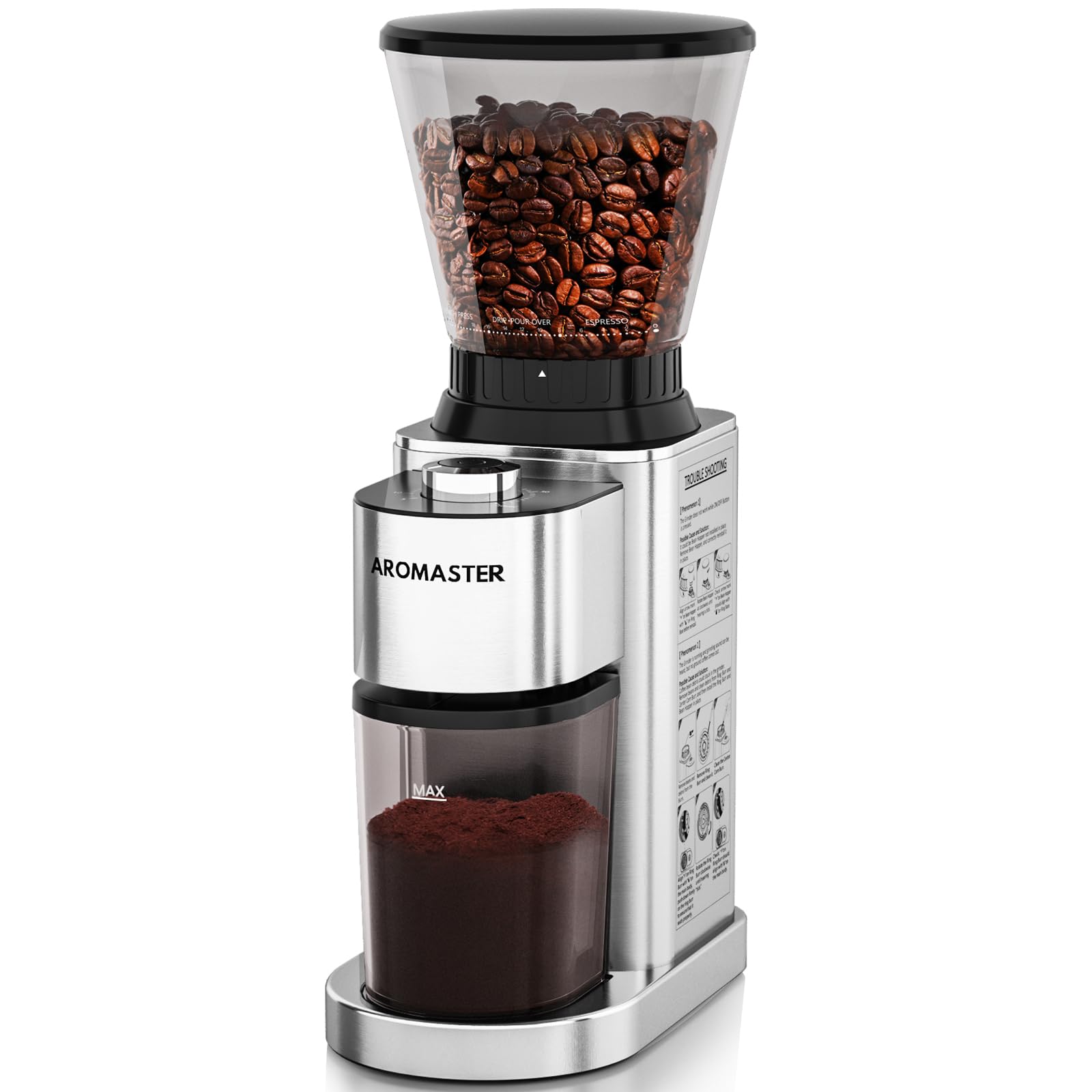
The Aromaster delivers a notably quiet grinding experience for an electric model under $100, and its anti-static design keeps coffee grounds from scattering during dosing. With 48 conical burr settings, it handles fine espresso grinding adequately for occasional home use. Overheating during extended sessions (pulling more than 2–3 shots back-to-back) is a known unit-level limitation, and long-term durability isn’t established—this is a solid entry-level pick for the low-volume user who values silence over heavy throughput.
Pros
- Operates at a low noise level even during fine espresso grinding.
- Anti-static coating minimizes mess when transferring grounds.
Cons
- Under continuous use, some units may overheat and shut down mid-grind.
Best suited for home baristas who pull one or two shots at a time and want a quiet, low-mess electric grinder without spending more than $100.
Best for Quiet Occasional
OXO Brew Burr Grinder

The OXO Brew Grinder runs quieter than many electric models, and its anti-static container cuts down on mess. However, clogging and mechanical issues can arise, making it less dependable for daily espresso grinding compared to the top pick.
Pros
- Quieter operation than many electric burr grinders.
- Anti-static container reduces mess after grinding.
Cons
- Some units may clog or develop issues over time, affecting consistency for daily espresso.
Best suited for occasional espresso use or quieter filter brews, where long-term durability is less critical.
Best for Led Timer
AMZCHEF Burr Grinder
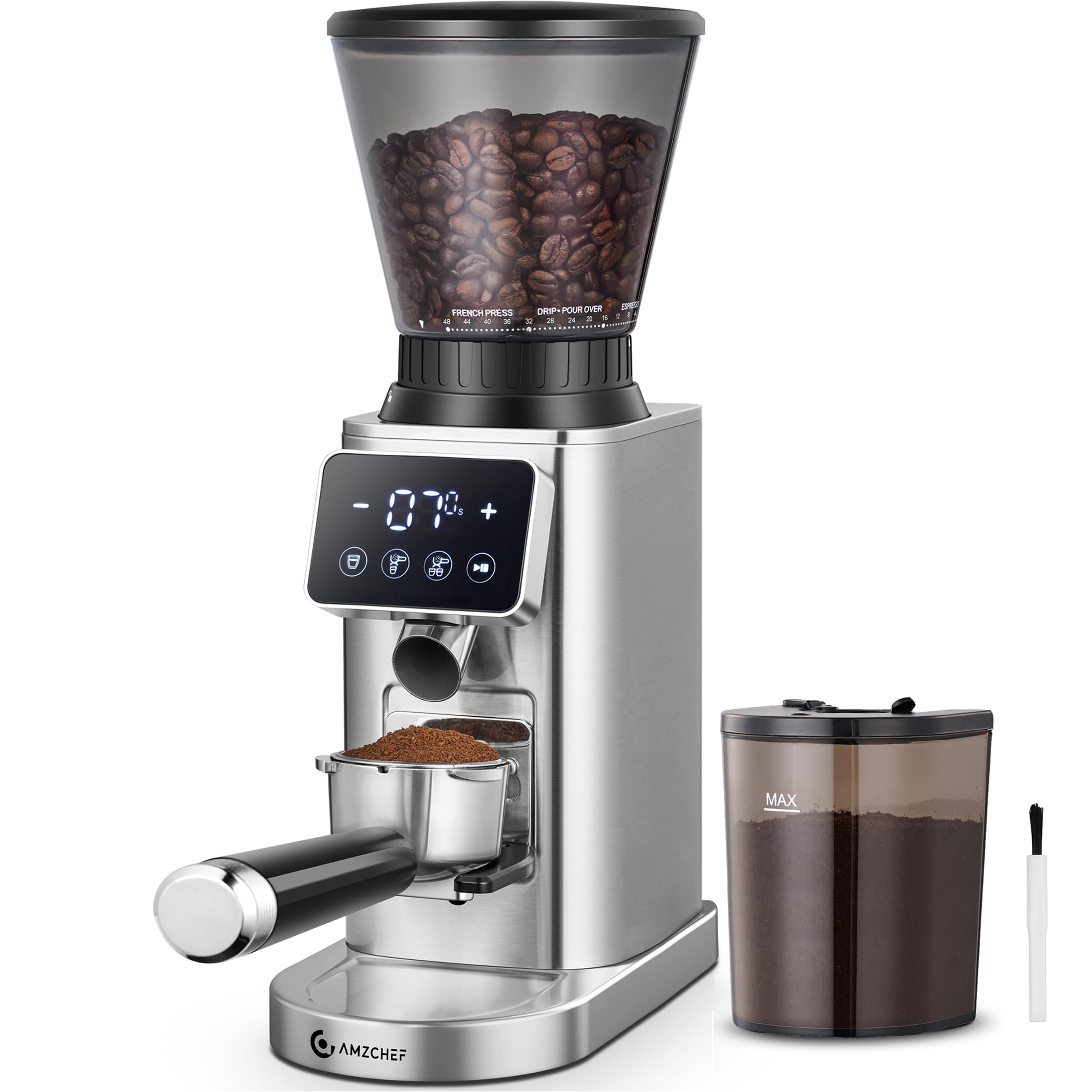
The AMZCHEF delivers 48 grind settings and a convenient LED control panel with timer, complemented by quiet operation and a detachable funnel stand. Motor issues have been noted, and the portafilter holder may not fit non-standard sizes. This unit suits home users who have a compatible 50mm portafilter and want digital control at an entry-level price.
Pros
- Sleek build with quiet operation fits home countertops.
- LED control panel with timer simplifies dose consistency.
Cons
- Motor issues may occur, affecting grinding performance.
Best for budget-conscious home users with a compatible 50mm portafilter who value digital features over long-term reliability.
Best for Ultra-Budget
JavaPresse Manual
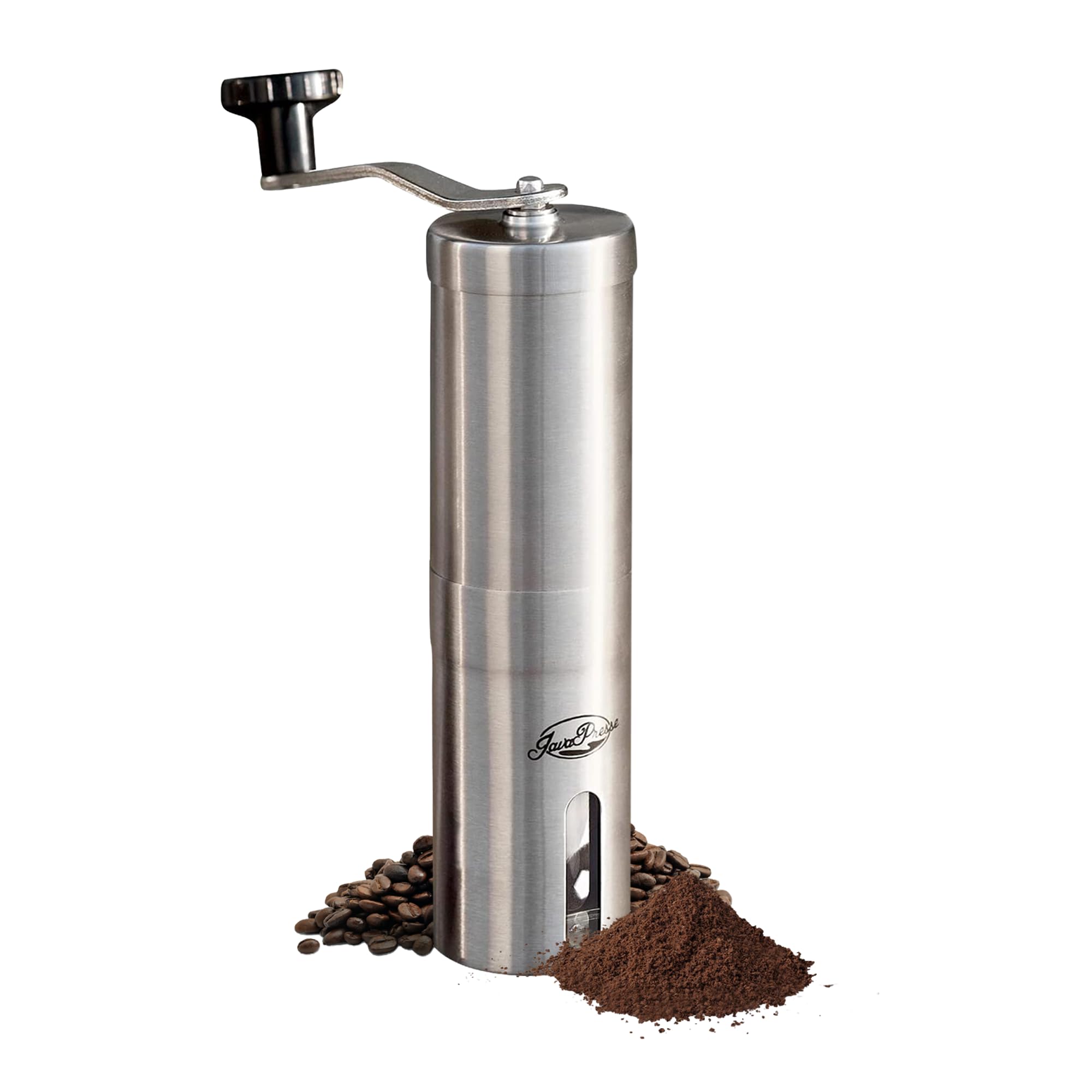
Light and compact, the JavaPresse is easy to pack for camping or as a backup. The ceramic burr offers 18 settings at an entry-level price. But grinding takes several minutes per dose, particle size varies, and the build is not intended for regular use. It suits occasional travel, not daily espresso.
Pros
- Extremely portable and lightweight
- Very affordable entry into manual grinding
Cons
- Slow grinding and inconsistent particle size make it impractical for espresso
A lightweight backup for travel or emergency use when speed and consistency aren’t priorities, but not a primary grinder for espresso.
How to Choose
Many budget electric burr grinders claim espresso capability but fail to grind fine enough – manual grinders at the same price often deliver better results.
Burr Type: Conical vs. Flat
Conical burrs are standard in most home espresso grinders because they produce a more uniform particle size across a wide range of settings. Flat burrs, common in commercial machines, can deliver even finer grinds but require more powerful motors and frequent alignment.
For home use, conical burrs offer a forgiving balance: they stay consistent as burrs wear and self-clean better than flat designs. Avoid any grinder that uses blade-style cutters – they cannot produce the fine, even grind espresso demands.
Grind Settings and Micro-Adjustment
The number of settings matters less than how fine the smallest step is. A grinder with 40 settings but only a 10-micron change per click is more useful for espresso than one with 60 settings that jump 25 microns. Look for models that specify the micron step (e.g., 0.015mm per click) or offer continuous (stepless) adjustment.
At least 30 distinct espresso-viable settings (from very fine to medium-fine) give you enough room to dial in a specific bean and machine combination. Fewer than 20 settings often leave you stuck between too coarse and too fine.
Build Quality and Reliability
Electric grinders under $100 often use plastic gear trains that strip or overheat with daily espresso use. Manual grinders at the same price use all-metal internals and tend to last longer – but their handles can loosen over time. The sweet spot for electric is a metal burr carrier and a DC motor with overload protection.
Look for user reports of motor failure after 6–12 months. A grinder that survives the first year without issues is likely built to last. Baratza and Breville have strong parts support; lesser-known brands may not offer replacement burrs or motors.
Noise Level and Static Control
Electric grinders vary enormously in noise. Gear-reduction motors (like those in Capresso) run quieter than direct-drive designs. If you grind early in the morning, a sub-70 dB model is worth the extra cost. Manual grinders are virtually silent.
Static cling makes a mess of your countertop. Anti-static coatings and metal grind chambers reduce it significantly. Models with a built-in ionizer or conductive plastic container work best, but a simple spritz of water on the beans before grinding is a universal hack.
Ease of Cleaning and Maintenance
Burr grinders need periodic disassembly to remove oil buildup and stale grounds. Models with a removable upper burr and a brush-accessible chamber are much easier to maintain. Some grinders (e.g., Baratza) sell replacement burrs as standard parts; others require you to buy a whole new unit.
Cleaning frequency depends on use – weekly for daily espresso, monthly for occasional use. Avoid grinders with narrow throats or non-removable burrs that trap coffee particles.
FAQ
Can the Cuisinart DBM-8 grind fine enough for espresso?
No. Its flat burrs and 18-step adjuster cannot produce the fine, consistent grind needed for espresso. Many users report that even the finest setting yields coffee too coarse for pressurized portafilters. For espresso, look for a conical burr grinder with at least 30 micro-settings.
How long does a manual coffee grinder take to grind for espresso?
Expect 30–60 seconds of steady cranking for a single shot (14–18g). High-end manual grinders with larger burrs and dual bearings, like the TIMEMORE C5 ESP Pro, grind faster than budget models. If you need multiple shots quickly, an electric grinder is more practical.
Why does my electric burr grinder keep clogging and stop working?
Clogging usually happens when oily beans or very fine grinds build up between the burrs and the exit chute. Models with narrow ground containers or insufficient anti-static protection are prone to this. Regular cleaning (every 2–3 weeks) and using beans that are not overly dark-roasted can help, but some grinders have inherent design flaws that cause repeated jams.
Is the Baratza Encore suitable for espresso?
No. The Baratza Encore is designed for pour-over and drip coffee; even its finest setting is too coarse for espresso. If you want a Baratza for espresso, you need the Virtuoso+ or a dedicated espresso model. The Encore remains an excellent filter-coffee grinder.