This post contains affiliate links. We may earn a small commission when you buy through our links — at no extra cost to you.
Most pizza stones look similar on paper, but after a few uses the differences become clear. Chemical odors during preheating, dough that refuses to release from the surface, and the occasional crack are recurring complaints – especially with cordierite stones under $50. For anyone who bakes pizza more than once a month, these frustrations can turn a fun pizza night into a chore.
The real fork in the road is material. A thick steel plate conducts heat far faster than any stone, producing a bottom crust that rivals a brick oven in under eight minutes. But that performance comes at a cost: a 27‑pound slab that lives in your oven. Stones are lighter and cheaper, but many demand careful handling – parchment paper, cornmeal, and a tolerance for stains. This guide breaks down the trade‑offs so you can pick the surface that fits your cooking style and tolerance for maintenance.


Best for Best Crust, Frequent Use
ThermiChef 16"x16" Steel
Key Features
- Material: Low-carbon steel
- Thickness: 0.375"
- Size: 16×16 in
- Max Temp: 1000°F
- Price: $$$
Thick low-carbon steel transfers heat faster and more evenly than any stone, producing the kind of crust that usually requires a wood-fired oven. The 3/8" plate stores enough energy to char the underside while keeping the interior airy — even with a standard electric or gas oven. After preheating for 45 minutes, the first pizza comes out with a deep, spotty brown bottom and a crisp bite that holds up under toppings.
That thermal mass also means you can bake pizza after pizza without waiting for recovery. Slide a second pie onto the steel while the first is being topped — the surface temperature drops only a few degrees and rebounds within minutes. For anyone who hosts pizza nights or bakes multiple batches, this consistency avoids the slowdown that thinner steels and most stones introduce.
The construction is straightforward: a single slab of low-carbon steel with no coatings, seams, or porous surfaces. It won’t absorb grease, develop odors, or crack from thermal shock — three issues that routinely surface with cordierite stones. The steel develops a natural seasoning layer over time that improves release, though a light dusting of semolina still helps on the first few uses.
This steel is a permanent commitment. At 27.5 lbs, it’s heavy enough that sliding it in and out of the oven each time is a genuine strain, and standard wire racks may bow under the load. The right buyer plans to leave it on the lowest shelf full-time — someone with a dedicated oven, strong rack supports, and enough upper-body strength to handle the one-time installation. It’s not for casual users who make pizza once a month or for anyone with physical limitations or a weak oven rack.
Pros
- Delivers a deeply browned, chewy crust that rivals restaurant-level results in a home oven.
- Built from solid steel with no coatings or seams — no odor, no cracking, no degradation over time.
- Excellent heat retention allows consecutive pizzas without significant temperature drop-off.
Cons
- At 27.5 lbs, moving the steel in and out of the oven is a real physical challenge and may strain standard oven racks.
If you’re a committed home pizzaiolo who can handle the weight and has an oven rack that won’t complain, this steel eliminates every common stone frustration and delivers the best crust a home oven can produce.
Best for Proven Performer, Beginners
Hans Grill 15×12" Cordierite
Key Features
- Material: Cordierite
- Thickness: 0.59"
- Size: 15×12 in
- Max Temp: 1112°F
- Accessories: Includes peel
- Price: $$
The Hans Grill pizza stone delivers even heat distribution that produces a crisp, evenly browned crust – a consistent performance that has made it the most-reviewed cordierite stone on Amazon. The included wooden peel simplifies transferring dough onto the hot surface, making it a convenient all-in-one kit for beginners. But the porous cordierite surface absorbs oils and stains, requiring hand-washing without soap – a routine maintenance step that some users find frustrating.
This stone suits home pizza makers who prioritize crust quality over cleaning convenience, grill users who need a rectangular stone that fits standard barbecue grates, and beginners who appreciate having a peel included. The included peel is slightly narrower than the stone’s full width, so launching larger 14-inch pizzas requires careful technique. If quick cleanup or a non-stick surface is a priority, a steel baking plate (like the top pick) would be a better fit.
Preheat the stone for at least 30 minutes in the oven or on the grill for best results – the thick cordierite retains heat well, mimicking a brick oven. Using a dusting of cornmeal or semolina helps prevent sticking, and the stone can handle temperatures up to 1112°F, suitable for both high-heat pizza and other baking.
Pros
- Even heat distribution produces a crispy, restaurant-quality crust.
- Large 15×12-inch rectangular surface fits standard ovens and grills.
- Included wooden peel simplifies dough transfer – useful for beginners.
- Good value for the price with results comparable to pricier stones.
Cons
- Included peel is smaller than the stone – launching larger pizzas requires extra care.
- Porous surface stains easily and requires hand-washing without soap.
A well-regarded stone that delivers on crust quality at a fair price – just be prepared for the staining and cleaning routine.
Best for Budget, First-Time Buyer
Culinary Couture 15×12"
Key Features
- Material: Cordierite
- Thickness: 0.4"
- Size: 15×12 in
- Max Temp: 1000°F
- Price: $
The Culinary Couture 15×12" cordierite stone matches the crust quality of fancier stones at a fraction of the cost. While the top pick steel plate eliminates stone-related headaches entirely, this budget-friendly option holds its own against the best-selling cordierite stone in this size for a lower price.
This stone suits casual pizza makers who want good results without a large investment. First-time owners will appreciate the learning curve – the 0.4" thickness means you need a longer preheat (45–60 minutes) to get the best crust. For those who bake multiple pizzas in one session, a thicker stone or steel plate recovers heat faster.
The cordierite material heats evenly and produces nicely browned, crispy crusts. Despite the budget price, the stone has a substantial feel and handles repeated use without complaint. Some sticking is possible with wet dough, but cornmeal or parchment paper solves that – a common trait among cordierite stones.
Pros
- Exceptional value – quality that surprises given the low price.
- Produces consistently crispy, well-browned crusts.
- Substantial 0.4" cordierite provides solid heat retention for its price.
Cons
- The 0.4" thickness requires a longer preheat to maximize heat retention – not an issue if you plan ahead.
- Heat recovery is slower than thicker stones, making back-to-back pizzas less ideal without extra preheat.
For occasional pizza bakers who want consistent crust without overspending, this stone is a smart buy – just give it a proper preheat.
Best for Weber Grill Owners
Weber 16.7" BBQ Stone
Key Features
- Material: Cordierite
- Size: 16.7×13.2 in
- Accessories: Includes carry rack
- Price: $$
This cordierite stone snaps directly into the Weber Gourmet BBQ System, replacing the center grate for a stable, even-heating surface. The 16.7-inch rectangular shape matches the grill’s footprint, and the included carry rack makes transferring a hot stone safe and simple.
Weber grill owners who want pizza nights will find this stone a natural fit. The even heat distribution produces a crisp crust, and the carry rack eliminates the awkward stone-moving dance. However, like most cordierite stones, sticking can occur—using cornmeal or parchment paper is a reliable workaround.
Designed for the Weber BBQ system, the stone preheats gradually with the grill, reducing thermal shock risk. The cordierite holds heat well, ensuring consistent baking across the surface. The carry rack also doubles as a serving platter, adding convenience for outdoor cooking sessions.
Pros
- Snaps into the Weber Gourmet BBQ System for a stable, even-heating surface.
- Produces a crisp crust with even heat distribution across the stone.
- Carry rack allows safe handling and doubles as a serving platter.
Cons
- Dough may stick to the stone even with flour or cornmeal.
For Weber grill owners who want outdoor pizza, this stone is a purpose-built solution that delivers great results. Just keep parchment or cornmeal handy.
Best for Lightweight Steel, Occasional
Primica 16"x13.4" Steel
Key Features
- Material: Carbon steel
- Thickness: 0.25"
- Size: 16×13.4 in
- Price: $$
The Primica Pizza Steel uses 1/4-inch carbon steel to transfer heat aggressively into dough, producing a dark, crisp underside that rivals thicker steel plates. At 14.5 pounds, it’s manageable enough to slide onto oven racks without the back strain of 27-pound slabs. Preheat the steel for at least 45 minutes to build sufficient thermal mass, and it works equally well on a gas grill for outdoor pizza nights.
This steel suits home cooks who make one or two pizzas per session. The thinner steel gives up some thermal mass, so it recovers heat more slowly after the first pizza — subsequent pies will need a longer preheat between bakes. For those baking multiple pizzas in quick succession, the thicker ThermiChef plate holds heat better. The crust from this steel is consistently crunchy and well-browned, with a char that stones rarely achieve. But if your pizza night rarely exceeds a pair, the Primica’s lighter weight and similar crust quality make it the more convenient choice.
Carbon steel requires seasoning to resist rust, much like a cast-iron skillet. Users who dry and oil the surface after each use report no issues; neglect can lead to superficial rust spots that scrub away easily. Cleaning is a simple wipe — no scraping stuck dough. The rectangular shape (16×13.4 inches) accommodates standard 12-14 inch pizzas with room to spare.
Pros
- Delivers the crisp, well-browned crust of premium steel plates at a fraction of the weight.
- Weighs about 14.5 pounds — light enough to handle easily, unlike thick 27-pound steel slabs.
- Cleans quickly with a dry wipe after use; no scraping or soaking needed.
Cons
- Without proper seasoning and drying after each use, the steel surface can develop rust spots — easily removed but requires consistent care.
- When baking multiple pizzas in quick succession, the thinner steel recovers heat more slowly than thicker plates, so the second pizza may need additional preheat time.
A smart compromise for home cooks who want steel’s crust performance without the weight — ideal for those baking one or two pizzas per session.
Best for Rv, Small Ovens
waykea 12" Square Stone
Key Features
- Material: Cordierite
- Thickness: 0.6"
- Size: 12×12 in
- Max Temp: 1400°F
- Price: $
This stone’s main advantage is its size: 12 inches square fits perfectly into small ovens that can’t accommodate standard 14- or 16-inch stones. In those cramped spaces, it delivers even heat distribution that eliminates the hot spots common in toaster and RV ovens. The cordierite construction handles up to 1400°F and retains heat well enough for a crisp bottom crust on personal-sized pizzas.
Where a standard home oven user would find this stone limiting, RV owners and toaster-oven bakers get exactly the right tool. The tradeoff comes in two forms: the listed thickness is inconsistent between marketing (0.6 inch) and product details (0.4 inch), and some units have cracked when exposed to rapid temperature changes. Neither issue is a dealbreaker for the intended use, but they’re worth planning around.
Pros
- Fits RV, camper, and toaster ovens with no wasted space
- Eliminates hot spots in small ovens for even baking
- Solid build quality at a budget-friendly price
Cons
- Advertised thickness (0.6") may not match actual stone (0.4")
- Can crack if heated too quickly due to thermal shock
- 12-inch surface limits pizza size to personal or small – not for larger dinners
A niche stone that nails its purpose for small-oven cooking — just confirm the thickness and preheat gently, and you’ll get consistent, crisp results every time.
Best for Large Round Stone
Unicook 16" Round Stone

Key Features
- Material: Cordierite
- Thickness: 0.57"
- Size: 16 in round
- Max Temp: 1450°F
- Accessories: Includes scraper
- Price: $$
The 16" diameter provides generous space for large pizzas, and cordierite retains heat evenly for a crisp crust. Some units may release a chemical odor during initial use, and the stone can crack under temperature shock. These factors make it a viable option for buyers who can tolerate the smell and handle preheating carefully, but it falls short of the consistency and durability of our top picks.
Pros
- Spacious 16” surface accommodates large pizzas and fits standard oven racks.
- Even heat distribution delivers a crispy, well-baked crust.
Cons
- May release a chemical smell when first heated, noticeable in enclosed spaces.
- Temperature shock or uneven heating can cause the stone to crack over time.
If you need a large round stone for occasional outdoor grilling where any odor dissipates, and you’re prepared to preheat carefully, this is a cost-effective option.
Best for Outdoor Grill
KitchenStar 16" Stone Handles
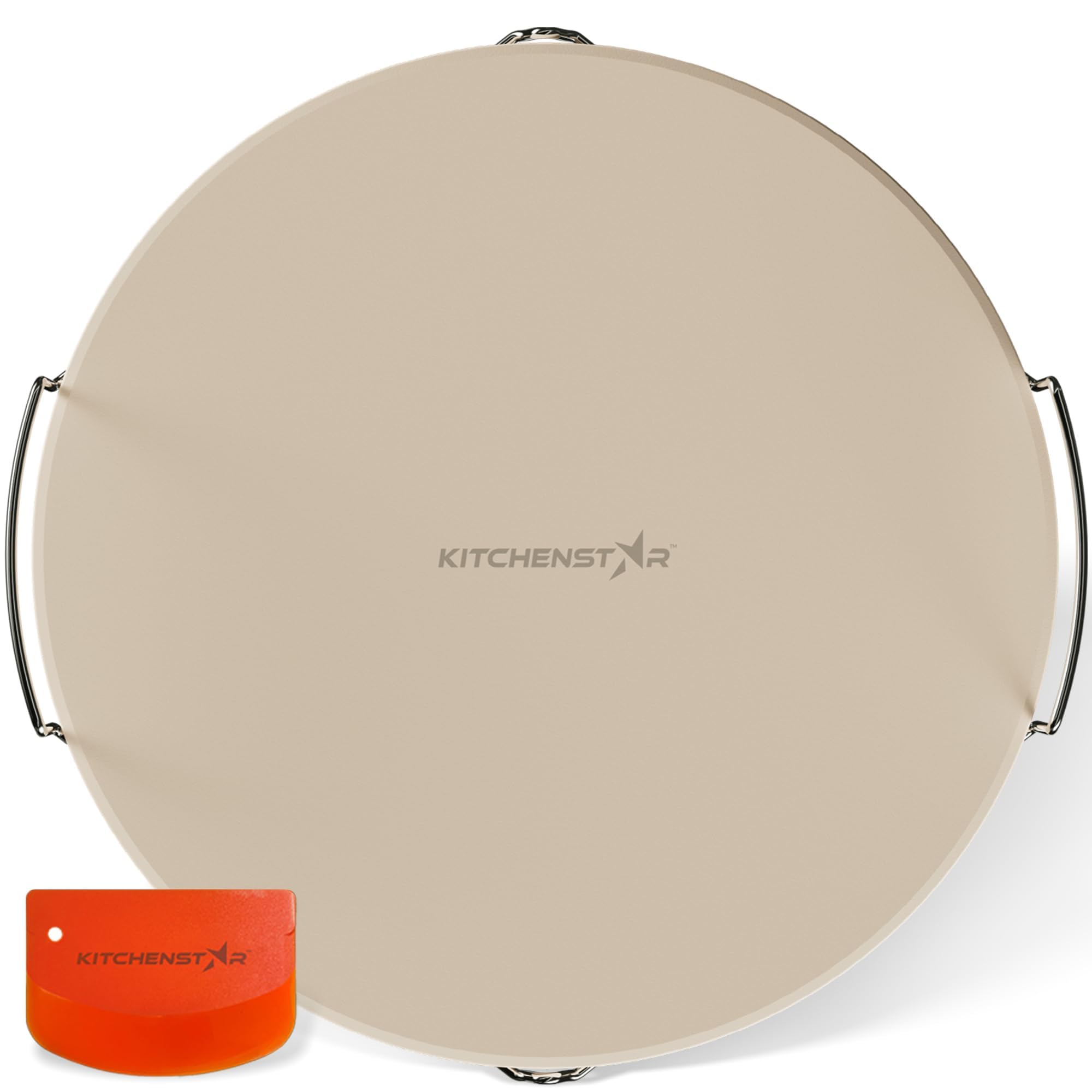
Key Features
- Material: Cordierite
- Thickness: 0.625"
- Size: 16 in round
- Max Temp: 1800°F
- Accessories: Handles
- Price: $$
This 5/8-inch thick cordierite stone delivers even heat distribution for crispy pizza crusts, and the welded handles make it easy to transfer from a hot grill to the table. The stone’s 1800°F temperature tolerance suits high-heat grilling without cracking risk. The strong chemical odor that can accompany early uses is less of a concern outdoors, and sticking can be managed with parchment or cornmeal. For indoor kitchen use, however, the persistent smell and demanding cleaning routine make other options a better fit.
Pros
- Thick 5/8-inch cordierite retains and distributes heat evenly for crispy crusts.
- Welded handles stay cool enough to grip when moving the hot stone from oven or grill.
Cons
- May release a persistent chemical odor that is more noticeable indoors.
- Porous surface can cause sticking, and cleaning requires careful scrubbing.
Best for outdoor grill use where the smell dissipates and sticking is mitigated with parchment — not ideal for indoor ovens.
Best for Small Pizzas, Kit
Gyreuni 13" Round Set

Key Features
- Material: Cordierite
- Thickness: 0.6"
- Size: 13 in round
- Max Temp: 1472°F
- Accessories: Peel, rack, cutter
- Price: $$
The Gyreuni set combines a thick 0.6-inch cordierite stone with an oak peel and a serving rack, offering a complete kit for 13-inch pizzas. Heat retention is solid, producing a crispy crust, and the price undercuts many similar bundles. However, dough can stick to the stone without extra preparation, and the wooden peel may split after limited use—these limitations prevent it from being a top recommendation for frequent users.
Pros
- Thick stone retains heat well for even baking.
- Produces crispy crusts with good heat retention.
- Good value including peel, cutter, and serving rack.
Cons
- Dough can stick to the stone, requiring cornmeal or parchment paper.
- Wooden peel may split after moderate use, especially with heavier loads.
Best suited for occasional home pizza bakers who can manage sticking with parchment and don’t rely on the peel for heavy use.
Best for Premium Kit
Ritual Life 16" Round Set
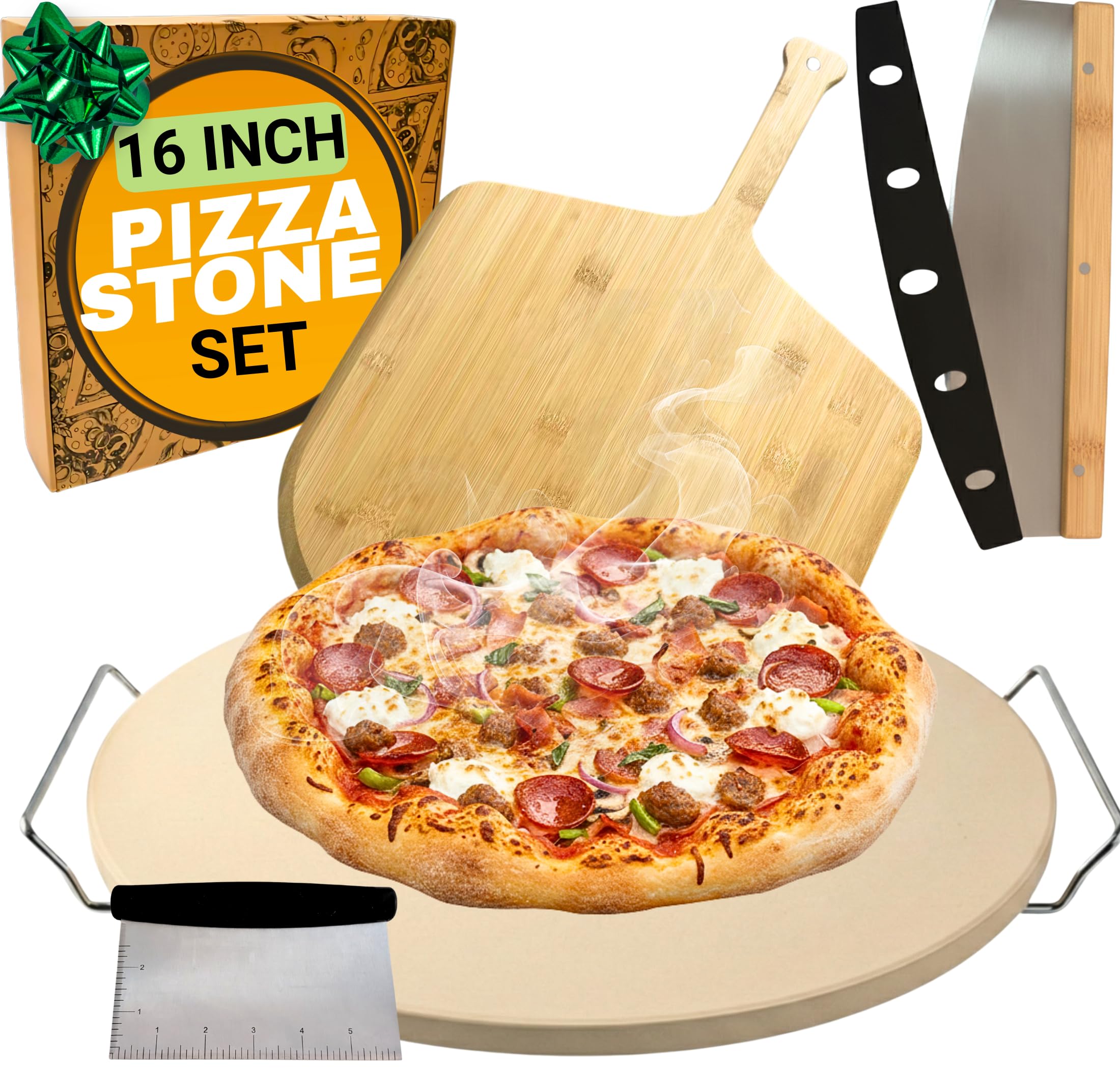
Key Features
- Material: Cordierite
- Thickness: 0.6"
- Size: 16 in round
- Max Temp: 1500°F
- Accessories: Peel, cutter, scraper, recipe
- Price: $$
The Ritual Life 16-inch set impresses with its thick cordierite stone, removable handles for easy handling, and a complete kit that includes a peel, cutter, scraper, and recipe ebook. The stone heats evenly and holds temperature well for crispy crusts. However, because this model only recently entered the market, long-term durability under regular use is not yet confirmed. Sticking can occur without cornmeal or parchment, as is typical of cordierite stones. This set suits early adopters who want a well-packaged premium kit and are comfortable with some uncertainty around lifespan.
Pros
- High build quality with removable handles for safe transport.
- Comprehensive set includes peel, cutter, scraper, and recipe ebook.
- 16-inch diameter accommodates large family pizzas easily.
Cons
This set is a good fit for early adopters who want a premium-feeling kit with all accessories included, but those seeking a proven long-term performer may want to look at more established options.
Best for Budget Set
Cuzi Gourmet 15×12" Set
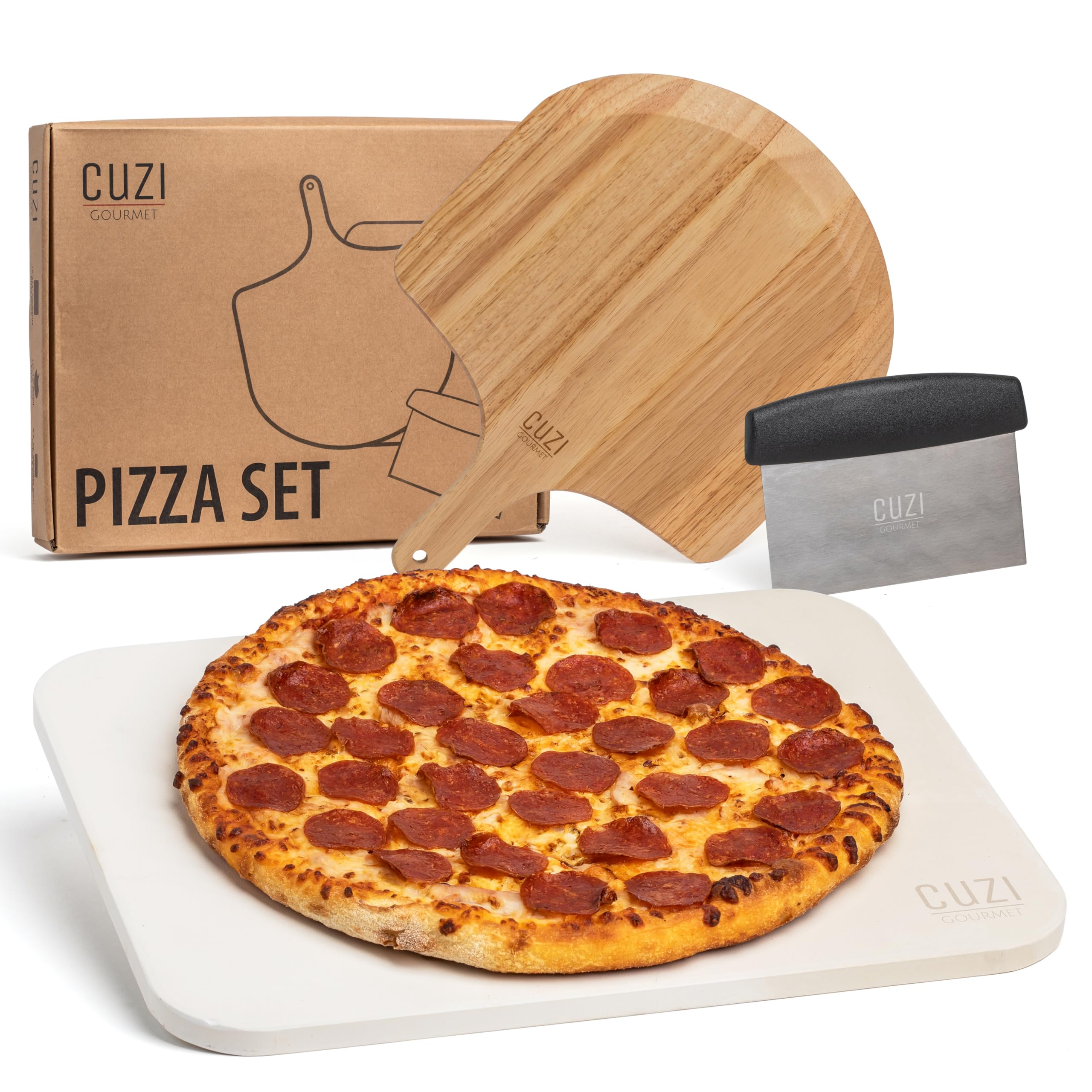
Key Features
- Material: Cordierite
- Thickness: 0.6"
- Size: 15×12 in
- Accessories: Peel, cutter
- Price: $
The stone itself heats evenly and produces a crisp pizza crust – a capable performer for the price. Where this set falls short is its accessories: the wooden peel can split after a few months of use, and some kits arrive missing either the peel or cutter. This works best for buyers who already own a peel and simply want an affordable replacement stone.
Pros
- Produces a crisp, evenly baked crust at a low entry price.
- Includes a peel and cutter for those who need a complete starter kit.
Cons
- Wooden peel may split after several months of regular use.
- Occasional missing pieces (cutter or peel) on delivery.
Worth considering if you already have a peel and just need the stone, but not a dependable all-in-one set.
How to Choose
The biggest decision when buying a pizza stone is whether to prioritize cost and weight (stone) or crust quality and durability (steel).
Stone vs. Steel: Material Choice
Cordierite stone is affordable and light but porous – it absorbs oil and stains, and can emit a chemical odor during first uses. Steel conducts heat up to 20 times faster, giving a crispier bottom in less time, but adds 15–27 pounds to your oven and may require seasoning. For occasional bakers who want a simple, cheap surface, stone works. For anyone making pizza more than once a month, steel’s performance justifies the weight and cost.
Thickness and Heat Retention
Thicker stones (0.6”) and steels (0.375”) store more heat and recover faster between pizzas, allowing you to bake multiple pies without long waits. Thin stones (0.4”) heat up quicker but lose temperature after the first pizza, leading to less consistent results. If you often bake two or more pizzas in a session, a thicker slab is worth the extra preheat time.
Size Matters
A 16-inch round stone fits most home ovens and accommodates a 14-inch pizza. Rectangular models like 15×12 inches offer a similar baking area. For RV or toaster ovens, a compact 12-inch square is the only practical option. Match the stone size to your oven’s interior width and the pizza size you typically make.
Temperature Rating
Most cordierite stones are rated above 1000°F, which is more than any home oven can reach. The real limit is thermal shock resistance – thin stones can crack if placed under a broiler or on a hot grill while cold. A higher max temp rating often indicates better thermal shock tolerance, but proper handling (room temperature preheat) is more important.
What Comes in the Box
Some stones include a wooden peel, pizza cutter, or carry rack. A peel is convenient for launching dough, but many included peels are thinner or smaller than ideal. If you’re a beginner, a kit saves a separate purchase. Experienced bakers may prefer to buy a high-quality peel separately and invest solely in the stone.
FAQ
Why does my new pizza stone smell like chemicals?
This is common with cordierite stones. The odor comes from manufacturing residues or moisture trapped in the porous material. It usually fades after 2-3 uses at high heat. To speed up the process, preheat the stone empty for 30 minutes before your first few bakes. If the smell persists beyond a dozen uses, it may be a defective batch.
Pizza steel vs stone: which is better for home ovens?
Steel is better for crispier crust because it transfers heat 20 times faster than stone. It also eliminates odor and cracking issues. The downside is weight – a steel slab can be 15-27 pounds, making it hard to move. Stone is lighter and cheaper, but requires more care and may produce a less browned bottom. Choose steel if you bake pizza often; choose stone for occasional use or portability.
How do I keep pizza from sticking to a cordierite stone?
Use a generous dusting of cornmeal, semolina, or flour on the peel before launching the pizza. Parchment paper works even better – place the pizza on paper, slide it onto the hot stone, and remove the paper after 2-3 minutes. Avoid washing the stone with soap, as it soaks into the porous surface and can cause sticking later.
Can I use a pizza steel on a gas grill?
Yes, but with caution. Steel can be placed on a gas grill grate to achieve high heat. However, the grill must be in a well-ventilated area and you should avoid direct flame contact that could cause warping. Also, the steel will be extremely heavy to lift – use oven mitts and a sturdy spatula.