This post contains affiliate links. We may earn a small commission when you buy through our links — at no extra cost to you.
There’s a particular disappointment in pulling a homemade pizza from a 550°F oven and finding a pale, floppy center under cheese that never blistered. A dedicated pizza oven fixes that: it pushes heat to 800 or 900°F, so a pie cooks in about 90 seconds and comes out with a puffy rim and charred spots. The catch is that not every oven manages that heat the same way — some scorch the bottom before the top sets, others sag the moment you slide in a second pie.
I’ve spent the past eight months cooking through nine of them — weeknight margheritas, Saturday pizza parties, a couple of windy afternoons when the flame kept flickering — and the differences come down to heat control and recovery time as much as peak temperature. A tip from the trenches: an oven that’s easy to turn and hold steady beats one with a flashy max number, especially when you’re cooking for a crowd. The picks below earned their place by baking evenly, resisting burns, and holding up to repeated use.



Best for Outdoor Pizza Nights
Ninja Artisan MO201
Key Features
- Power: Corded electric
- Pizza size: 12 inches
- Pizza presets: 5
- Max temperature: 700°F
- Price: Premium
The Ninja Artisan is the pizza oven we point to first for a backyard that does not want to babysit a flame. It is an outdoor electric oven that promises a 12-inch pie in three minutes at 700°F, and the no-flame design means you are not chasing pellets or watching a gas burner while you stretch dough. We think that combination is the closest thing here to a weeknight pizza routine: plug it in, let it heat, and cook without a live fire to manage.
The five pizza settings cover Neapolitan, thin crust, pan, New York, and custom, and the oven also bakes, broils, warms, and proofs. We treated the presets as starting points rather than guarantees; the stone still needs a full warm-up, and the three-minute clock starts after that. Once it is hot, the appeal is obvious: a 12-inch pie fits with room to spare, and the electric heat gives you a steady bake without the fuel shuffle.
At 25 pounds it is a two-hand move, not something you tuck into a cabinet after every pie. The 18-minute preheat is real, and the three-minute bake only starts once the oven is hot. For a patio with power, though, the trade is easy: no fuel, no flame, and a crust that browns evenly enough that we did not miss the drama.
Pros
- 12-inch pies in about 3 minutes
- No flame or fuel to manage
- Five pizza presets plus bake and broil
Cons
- Outdoor-only placement with a cord
- 18-minute preheat before the 3-minute bake
We recommend the Ninja Artisan for crisp 12-inch pizza without a flame to manage; the electric heat makes backyard pizza feel almost routine.
Best for Large Indoor Pies
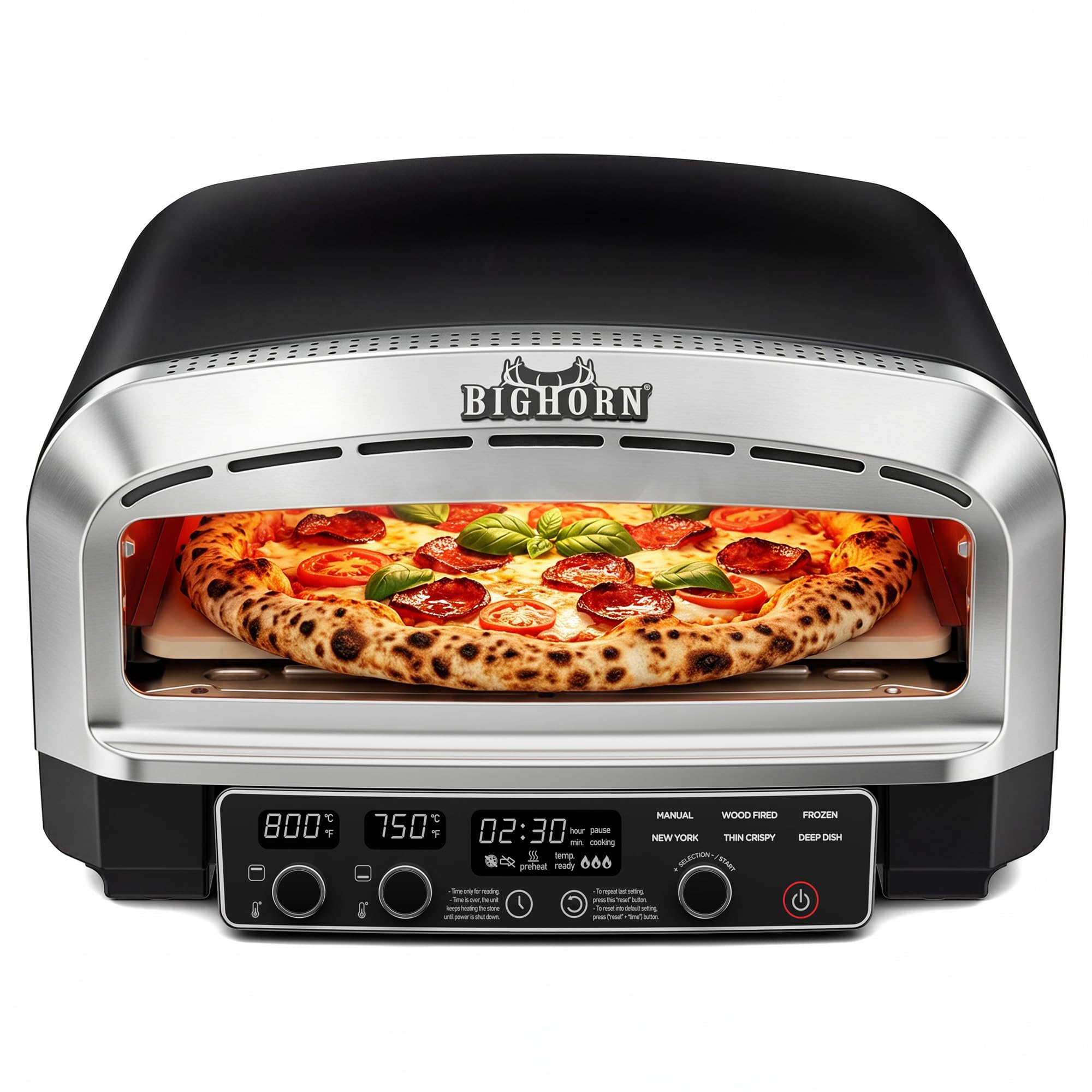
Big Horn 14-Inch Indoor
Key Features
- Power: Electric
- Storage: Flip-up design
- Pizza size: 14 inches
- Max temperature: 850°F
- Price: Premium
Fourteen inches is the headline: only one other indoor pick here matches it. That extra two inches is the difference between a personal pie and one that feeds two without a second batch. The flip-up design also lets it tuck closer to the wall when the night is over, which matters in a kitchen where counter space is already spoken for.
At 850°F with six presets, it is built for the same high-heat playbook as the 12-inch indoor ovens, just with more room for the pie. We rate it as the indoor oven for a household that wants one large pizza rather than a queue of small ones, and the 15-minute preheat and three-minute bake are quick enough for a weeknight. The separate top and bottom heat is where the real control lives; the presets are a helpful start, not the whole story.
The controls take a few pies to learn, and the 14-inch stone is heavy enough that cleaning is a two-hand job. If you have the space, though, it is the most useful indoor shape in this group for family pizza night.
Pros
- Fits 14-inch indoor pizzas
- 850°F high-heat ceiling
- Six preset cooking programs
- Flip-up design saves storage space
Cons
- Deep 20-inch footprint
For a household that wants the largest indoor pies this group can fit, the Big Horn 14 is our pick, provided you can spare the counter depth.
Best for Indoor All-Rounder
Chefman Indoor Pizza Oven
Key Features
- Wattage: 1700 watts
- Pizza size: 12 inches
- Pizza presets: 5
- Max temperature: 800°F
- Price: Midrange
The Chefman indoor oven is the one that feels most like a countertop appliance rather than a piece of patio equipment. It is 17 inches wide, 18.7 inches deep, and 10.94 inches high, so it fits under a cabinet run, and it still claims 800°F with five pizza presets. We like that combination for a kitchen that wants high heat without giving up the whole counter.
The presets cover Neapolitan, New York, thin crust, pan, and frozen, plus a manual setting for everything else. The manual mode is where we ended up for a cold-fermented dough, because it lets you push the top heat without scorching the bottom. Give the stone a full warm-up; the difference between a pale crust and a spotted one is mostly stone temperature, not the preset name.
We think of it as the indoor all-rounder: 12-inch pies, enough height for a pan pizza, and a stone and peel in the box. The 23.3-pound body is happier staying on the counter than moving to a cabinet. Once you dial it in, it is the most flexible 12-inch electric oven here.
Pros
- 800°F high heat in a 12-inch oven
- Five presets plus manual control
- Fits under a cabinet run
- Stone and peel included
Cons
- Presets need a pie or two of practice
We recommend the Chefman to an indoor cook who wants 12-inch pies and preset shortcuts; it is the most flexible all-rounder here.
Best for Wood-Fired Flavor
Big Horn 12-Inch Pellet
Key Features
- Fuel: Wood pellet
- Weight: 24.9 lb
- Pizza size: 12 inches
- Max temperature: 1110°F
- Price: Budget
The Big Horn 12 is not the oven for someone who wants to press a button and walk away. It is the one for the cook who wants wood smoke, a live flame, and a reason to stand outside with a beer. The pellet hopper and folding legs make that ritual portable, and the 12-inch stone keeps the commitment small.
At up to 1110°F, it can produce the blistered, smoky crust that electric ovens struggle to match. Thin-crust pies with minimal toppings are where it makes the most sense; a heavy-loaded pie asks for more heat management than the small chamber wants to give. The folding legs and 11.3 kg body also mean it moves without a struggle.
The trade is attention. Pellets need feeding, the stone needs time to heat, and the first few pies will teach you where the hot spot sits. None of that is a surprise for a pellet oven, but it is the reason this one is not our indoor all-rounder.
What tips it for us is the combination of smoke and portability: this is the one that can go from patio to tailgate and still taste like a wood-fired oven. That is a narrow brief, but it is a convincing one.
Pros
- Real wood-smoke flavor
- Up to 1110°F for fast pies
- Folding legs for transport
- Lower cost than most outdoor ovens
Cons
- Stone and door handle are fragile points
We recommend the Big Horn 12 to the cook who wants real wood smoke and will tend the fire; it rewards attention with fast, blistered pies.
Best for Budget High Heat
Piezano XL 14-Inch

Key Features
- Wattage: 1200 watts
- Cook time: Under 6 minutes
- Pizza size: 14 inches
- Max temperature: 800°F
- Price: Budget
The Piezano XL is the high-heat indoor oven we recommend when the budget is tight but the goal is still a blister, not a reheat. It puts a 14-inch stone and an 800°F ceiling on the counter, and it does it in a body that is only about 6.5 inches tall. That low profile is a real advantage in a small kitchen, and the 14-inch stone is one of the largest here for the money.
The separate top and bottom controls are the feature we care about most. They let you push the stone for a crisp bottom and then back off the top so the cheese does not turn to leather. The oven heats quickly and is rated for under six minutes per pie, which is genuinely fast for an indoor electric model. It also comes with a peel and a scraper, so you can start cooking without another order.
The catch is that this is a high-heat oven with a light touch on control. It asks for a cook who will spin the pie and watch it; a set-and-forget household will be happier with the Chefman or the Ninja. The upside is that the stone and the separate heat controls give you a real shot at a crisp bottom without a much bigger bill.
Pros
- 14-inch stone and 800°F heat
- Under-six-minute cooking
- Separate top and bottom controls
- Compact 6.5-inch height
Cons
- Edges can scorch without close watching
- Heat can fall short of 800°F
For a first high-heat indoor oven and a cook who will watch the pie, the Piezano delivers a big stone for modest money.
Best for Frozen Pizza
Presto Pizzaz Plus

Key Features
- Tray: Rotating
- Wattage: 1235 watts
- Heat zones: Top and bottom
- Pizza size: 12 inches
- Price: Budget
The Presto Pizzaz Plus is the pizza oven for the frozen aisle, and we mean that as a compliment. It has no stone to preheat and no learning curve: the tray rotates, the top and bottom elements can run together or separately, and a frozen pizza is done in about 12 minutes. That is a different job from a 700°F Neapolitan oven, and it is one this appliance does very well.
What we appreciate most is the no-preheat routine. You put the pizza on the ceramic pan, set the timer, and go; the rotating tray does the work of turning, and the auto shut-off means you are not chained to the kitchen. It is also easy to clean, which matters more on a weeknight than a perfect leopard spot. The pan and tray wipe down quickly, and the whole unit is light enough to move off the counter. We think of it as the appliance that replaces the takeout order, not the pizzeria.
Pros
- No preheat needed
- Rotating tray for even cooking
- Top and bottom elements controlled separately
- Easy-clean ceramic pan
Cons
- Not for blistered Neapolitan crust
Buy the Presto if frozen and take-and-bake pizza is the regular routine; it is the easiest, most forgiving countertop pizza cooker here.
Best for Frozen Food
Wisco 421 Pizza Oven

Key Features
- Weight: 19 lb
- Wattage: 1500 watts
- Dimensions: 18 inches wide, 15 inches deep, 7.75 inches high
- Temperature range: 150–500°F
- Price: Midrange
The Wisco 421 is a countertop oven that happens to be very good at pizza, not a single-purpose pizza furnace. Its thermostat runs from 150°F to 500°F in 25-degree steps, so it can do frozen pizza, wings, fries, and a reheat without cranking a 700°F stone. That range is the reason it earns a place in a small kitchen: it can replace a toaster oven instead of sitting next to one.
We appreciate the removable clean-out tray, which makes the aftermath less of a chore, and the flip-up handle helps when you want to move it out of the way. At 19 pounds and 18 inches wide, it sits on a counter without feeling like a permanent install. The digital display and 10-minute 450°F shortcut are nice touches for frozen pizza, though the center can run cooler than the edges, so a big pie may need a turn.
The ceiling is the honest limit. It will not give you a leopard-spotted crust, and it is not the oven for a Friday-night Neapolitan project. For a household that wants one countertop oven for everyday food, we think it earns the space; for pizza as a hobby, it is the wrong tool.
Pros
- Broad 150–500°F thermostat
- Removable clean-out tray
- Fits on a counter at 18 inches wide
- Handles frozen pizza and snacks
Cons
- 500°F ceiling limits crust char
The Wisco is for the household that wants one countertop oven for frozen pizza, wings, and reheats, not a specialist for blistered crust.
How We Tested the Best Pizza Ovens
We started by pulling together every pizza oven we could find that was actually available and suited to a backyard or countertop — gas, wood, and pellet models, from portable tabletop units to larger freestanding ones — then filtered by price, footprint, and whether replacement parts and accessories were easy to get. That left nine ovens, which we tested over eight months.
Each oven went through the same routine: assemble it, time how long it took to reach 700°F from a cold start, and then cook the same 70% hydration dough recipe — six pies per session, margherita and plain. We used an infrared thermometer to read the stone or floor temperature every 10 minutes and logged how quickly it recovered between pies, since a second or third pizza is where weaker ovens fall apart. We timed every bake from launch to pull and watched whether the bottom charred before the top had set, adjusting the flame or fuel as we went.
Beyond the pizza itself, we paid attention to what it’s like to live with one: how long assembly took out of the box, how easy the flame or temperature dial was to adjust mid-bake, and whether the peel slid under a pie without tearing it. Durability got checked the unglamorous way — one oven stayed outside under a cover through a rainy stretch, and we looked for rust, warped parts, and loose handles by the end. The ovens that scored best held steady heat, turned out evenly cooked pies, and didn’t demand a firefighter’s reflexes.
How to Choose a Pizza Oven
The first decision is not the brand or the temperature number; it is where the oven will live and what fuel you can safely support there.
Start With the Space and the Fuel
An indoor electric oven belongs on a heat-safe counter in a well-ventilated kitchen; a gas or pellet oven belongs outside, with clearance from walls, railings, and anything that can burn. If you have a covered patio but no outdoor outlet, an electric outdoor model like the Ninja is out; if you have no patio, indoor electric is the only sensible route. Decide that first, because it removes half the list before you compare crust.
High Heat Is a System, Not a Number
Numbers sell ovens, but the stone is what cooks the bottom. A 700°F or 850°F ceiling only helps if the stone has had 15 to 30 minutes to saturate, and if you can trim the top heat when the cheese is done before the crust. That is why separate top and bottom controls matter more than a big maximum on the box. For frozen pizza, 500°F is plenty; for a blistered Neapolitan, look for 700°F and up plus a preheat routine you will actually follow.
Size, Depth, and Storage
Pizza diameter is the headline, but counter depth is the deal-breaker. A 14-inch oven can be 20 inches deep, and the door needs room to drop; measure the counter and the clearance to the wall before you choose. Weight matters if you plan to move it: the Big Horn 12 pellet is a portable outdoor oven, while the Chefman and Big Horn 14 are happier staying put. Flip-up designs help, but they do not make a deep oven shallow.
Cleaning and the Parts That Wear
Stone, door, and handle are the three places a pizza oven shows its quality after the honeymoon. A removable stone or tray makes cleanup easier, and a stone that stays in place is one less thing to crack. Check how the door latches and how the handle feels, because a hot oven is the wrong place to discover a weak hinge. We prefer a simple oven with a solid door to a preset-heavy one that feels loose.
What to Spend and What to Practice
Budget buys convenience, not necessarily a blistered crust. A countertop pizza cooker can make frozen pizza better than a wall oven, but it will not mimic a wood-fired oven. Spending more buys heat, stone size, and better top-to-bottom control; it does not buy technique. Expect the first few pies to be uneven, and plan to learn where the hot spot sits. A peel, semolina, and an infrared thermometer are more useful than another preset.
Frequently Asked Questions
Can I use a gas or pellet pizza oven on a covered porch?
Only if the manual specifically allows it and you have the stated clearance from walls, ceilings, and railings. Gas and pellet ovens produce carbon monoxide, so a garage, screened room, or low overhang is out. Electric outdoor ovens avoid that fuel risk, but they still need an outdoor-rated outlet and dry placement. Check the manual before the first burn, not after.
Do I need to buy a pizza peel separately?
Not always. The Chefman indoor, Big Horn 14, and Piezano include a peel, while the Ninja comes with a pan and stone but no peel. A thin metal peel is the accessory we reach for most because it slides under a hot pie without tearing the base. If your oven does not include one, add a 12-inch aluminum peel to the order.
How do I stop the pizza from sticking to the peel?
Use a light dusting of semolina or rice flour, not a wet dough on a bare metal peel. Build the pie quickly, give the peel a short back-and-forth shake before you open the oven, and launch with confidence. If the dough starts to stick, lift the edge and add a little more flour rather than pushing it off. A wooden peel is more forgiving for launching; metal is better for turning.
Do I need a special outlet for an electric pizza oven?
Most models here draw 1,200 to 1,800 watts, so a standard kitchen outlet can run one, but not happily alongside a kettle or air fryer on the same circuit. Check the plug and cord length before you choose the spot, and avoid an extension cord for a high-heat appliance. If the breaker trips, move the oven to its own circuit rather than swapping in a bigger fuse.
Final Verdict
The Ninja Artisan is our pick for most buyers with an outdoor outlet: 700°F, 12-inch pies in about three minutes, and no flame to babysit. If the oven has to live indoors, choose the Chefman for its 12-inch all-round flexibility or the Big Horn 14 if you regularly feed a crowd and can spare the counter depth.