This post contains affiliate links. We may earn a small commission when you buy through our links — at no extra cost to you.
Nothing stings like pulling a roast out of the freezer to find it wrapped in ice crystals — the bag gave out around week three, and dinner went with it. Vacuum sealer bags are the cheapest part of the setup and the only part that decides whether the setup was worth buying. A weak seam or a pinhole from a chicken bone undoes a machine that cost more than a month of groceries.
Thickness gets all the ink on the packaging, but it’s the seam and the bag’s surface that hold a vacuum, not the mils alone. A bag an inch too big also wastes money on every seal. Over the past six months, my team and I have run 18 rolls and packs of precut bags through our own machines to see which held and which quietly failed.
We compared cost per bag as carefully as we compared seals, because these get bought again and again. Some picks suit portioning leftovers, others a whole brisket or a season’s worth of fish. Every one below survived the same freezer and water-bath treatment.


Best for Everyday All-Purpose Sealing
FoodSaver Custom Length Rolls Multipack
Key Features
- Material: BPA-free multi-ply
- Safe for: Freezer, fridge, microwave, dishwasher
- Roll count: 5
- Roll widths: 8 in and 11 in
- Price: Premium
Five rolls arrive in one box, in two widths: three at 11 inches, two at 8. Cut-to-length film means nothing is sized for you, so you are not forcing a chicken thigh into a quart bag or spending a gallon bag on a single burger, and having both widths in the same order covers a Sunday spent breaking down a pork loin and a Tuesday night of portioning leftovers.
The reason this is our top pick is the pairing. This is FoodSaver’s own multi-ply film going into a FoodSaver machine, and that is the combination least likely to fight you at the sealing strip. It is made in the USA, BPA-free, and rated for the freezer, fridge, microwave, and dishwasher. We ran the wide roll on a shoulder roast and the narrow one on a stack of chops; both pulled tight and held their seam.
What you pay for it is the highest film cost per foot here. If your freezer sessions are mostly ground beef, chicken breasts, and blocks of cheese going into 8-inch bags, a third-party roll does the same work for noticeably less money, and the Wevac two-pack further down is where we point those shoppers.
One pattern worth knowing: the 8-inch rolls disappear well before the 11-inch pair, because most of what goes into a bag is a portion, not a roast. If that sounds like your kitchen, keep a narrow two-pack alongside this box so you are not rationing the wide film for a pork chop.
Pros
- Two roll widths cover portions and roasts
- Film matched to FoodSaver machines
- Freezer, microwave, and dishwasher safe
- Made in the United States
Cons
- Highest film cost per foot here
- Every bag needs a bottom seal first
Our default for FoodSaver owners: two widths in one box and the brand’s own multi-ply film, the pairing least likely to fight your sealer.
Best for Bulk Packing Sessions
Wevac 8-Inch Vacuum Sealer Rolls, 2-Pack
Key Features
- Material: BPA-free polyethylene
- Roll size: 8 in x 50 ft
- Compatibility: All suction heat sealers
- Rolls per pack: 2
- Price: Budget
Two 50-foot rolls of 8-inch film, and by the foot this is the cheapest way to keep a freezer stocked in this group. We recommend it for anyone packing in volume, whether that is a quarter of beef, a deer, or a club-store run of chicken, where the price of film stops being incidental and the bag is simply the wrapper around the meat.
The film is commercial-grade polyethylene with embossed channels down one side, and it is listed as compatible with every suction heat sealer going, FoodSaver and Seal-a-Meal and Nesco and Weston included. Compatibility is the claim we tested hardest, and it held: the embossing gives the pump a path, air comes out fast, and the channel collapses into a hard, flat seam. It is BPA-free and rated for the freezer and for sous vide.
Two things to plan around. The pair weighs 2.2 pounds and the rolls are fat, so on a machine with an onboard roll compartment they may not fit and this ends up in a drawer instead. And it is 8-inch film only, the narrow width; if your sealer takes 11-inch bags and you pack big cuts, you are folding meat to fit rather than sealing it flat.
What you give up against the top pick is convenience, not results. The FoodSaver box buys you a second width and a name you already trust, and it charges more per foot for both. This one buys you a lot of film and a low price, which is the trade most bulk packers are happy to make.
Pros
- Lowest cost per foot in this group
- Runs in every suction sealer
- Holds up in the freezer without rips
Cons
- Fat rolls may not fit onboard storage
- 8-inch width only
The value pick: two long rolls at the lowest film cost per foot here, and the one we trust for a long packing session.
Best for Small Portions
Wevac 6×10 Pre-Cut Pint Bags, 100 Count
Key Features
- Count: 100
- Bag size: 6 x 10 in
- Material: BPA-free polyethylene
- Compatibility: All suction heat sealers
- Price: Budget
Six inches by ten is the size of a chicken breast, a pound of ground beef pressed flat, or one serving of chili, which is to say most of what actually goes into a home freezer. The bags are pre-cut and sealed on three sides, so the routine is fill, wipe, seal once, and you are done.
That is why this is the box we keep for portion work: no measuring, no cutting, and no pre-sealing a stack of bag bottoms before a session starts. The film is the same embossed polyethylene Wevac uses on its rolls, BPA-free and rated for the freezer and sous vide, and it runs in any suction sealer. A flat-packed pound of meat also thaws faster than a chub, a small thing you notice every time you cook.
The trade-off is a fixed size. There is nothing here for a whole fish or a rib roast, and six inches runs narrower than the sealing strip on most machines, so you are using part of the bar. Pair it with a roll and both ends are covered. A hundred bags also means you stop rationing them, and a bag you do not think twice about is a bag you actually use.
Pros
- No cutting or pre-sealing needed
- Pint size suits single portions
- Runs in any suction sealer
Cons
- Pint size only, nothing for roasts
For single servings and meal prep, the grab-and-go bag: no cutting, no bottom seal, and a pint that fits most of what you freeze.
Best for Mixed-Size Jobs
Syntus 150-Piece Pre-Cut Combo
Key Features
- Count: 150, 50 per size
- Material: BPA-free PA+PE
- Bag sizes: 6×10, 8×12, 11×16 in
- Thickness: 4 mil
- Price: Midrange
Fifty bags in each of three sizes, 6 by 10, 8 by 12, and 11 by 16, which makes this the only box here that covers a snack, a portion, and a whole chicken without a second order. The gallon bag takes a rack of ribs or a bird; the pint takes a single chop.
The film is 4-mil PA+PE with a textured dot pattern on one side, BPA-free, and rated for the microwave, freezer, boiling, and sous vide. Each bag has a notch at the bottom for tearing it open later, a detail we noticed every time we opened a frozen bag with wet hands.
This is the pack we point a new sealer owner toward, because it lets you find out which size you actually reach for before you buy a case of one. The catch is arithmetic: the 8-by-12s run out first and leave you holding a pile of pints and a few gallons. Once you know your size, buy a dedicated box of it and keep this one for odd jobs and the occasional whole bird.
Pros
- Three sizes cover snacks to whole birds
- Tear notches on every bag
- Freezer, microwave, boil, sous vide rated
Cons
- 4-mil film, thinner than heavy-duty picks
The best first purchase for a new sealer: three useful sizes in one box, so you learn what you pack before committing to 200 of anything.
Best for Clean Straight Cuts
Syntus 8-Inch Roll with Cutter Dispenser
Key Features
- Included: Dispenser box with cutter
- Material: BPA-free PA+PE
- Roll size: 8 in x 150 ft
- Thickness: 4 mil
- Price: Midrange
The dispenser is the whole idea. A 150-foot roll sits inside a box with a slide cutter, you pull the length you want, and one pass leaves a square edge. We like it for that more than for the film itself, because a stretched, wavy cut is where wrinkles start, and a wrinkle running through the seal gives air a path back in a week later.
The film is 4-mil PA+PE, BPA-free, single-side embossed, and rated for the freezer, microwave, and sous vide; it runs in any suction sealer. The box is the practical half. The cutter stays square instead of wandering, the roll does not unspool itself in a drawer, and 150 feet is enough that you stop rationing film for small jobs and start cutting the length the food actually needs.
Two limits worth weighing. It is 8-inch film only, so no wide bags for big cuts, and it is a single roll, so there is no variety in the box. Sharp edges are the other consideration: 4 mil is respectable but not armor, so give a rack of ribs or a bone-in chop some slack around the bone and a second seal for insurance. For ground beef, leftovers, cheese, and marinade, this is the roll that stays on the counter.
Pros
- Built-in cutter makes square edges
- 150 feet lasts through a busy season
- 4-mil film rated for sous vide
Cons
- Single 8-inch roll, no size variety
The roll we recommend for anyone who makes a lot of bags: a dispenser that produces square edges, and 150 feet of film that behaves.
Best for Bone-In and Fish
FoodSaver Heavy Duty Quart Bags, 44 Count
Key Features
- Count: 44
- Bag size: Quart, pre-cut
- Safe for: Freezer, microwave, sous vide
- Thickness: 30% thicker than standard
- Price: Midrange
Thirty percent thicker than FoodSaver’s standard pre-cut bag is the entire pitch, and it is aimed at one problem: a bone, a shell, or the corner of a frozen brick pushing through the film and turning a good seal into a leak.
They are quart size, pre-cut, sealed on three sides with an easy-tear seam at the top, so there is no scissors and no bottom seal, which makes them the fastest bag here to fill and close. Microwave, freezer, and sous vide rated, BPA-free, and they run in older FoodSaver models as readily as current ones.
This is the box we keep for the jobs that ruin thin film: lamb shanks, fish with fins, ribs cut into single portions, anything where a hard edge sits against plastic for months. If your freezer is mostly ground beef, shredded cheese, and leftover chili, the standard-weight bags do the same work for less and seal faster on a small machine, since extra thickness asks more of the heating element. But when there is a bone involved, we do not reach for anything else here.
Pros
- 30% thicker film resists punctures
- Pre-cut with an easy-tear seam
- Fits current and older FoodSaver models
Cons
- Highest cost per bag in this group
- Small 44-bag count
The heavy-duty answer: 30% thicker FoodSaver film for bone-in cuts, fish, and sharp corners, in a fast pre-cut format.
Best for Bulk Meal Prep
O2frepak 8×12 Quart Bags, 200 Count
Key Features
- Count: 200
- Bag size: 8 x 12 in (quart)
- Material: Food-grade PA+PE
- Thickness: 3.5 mil front, 4 mil back
- Price: Premium
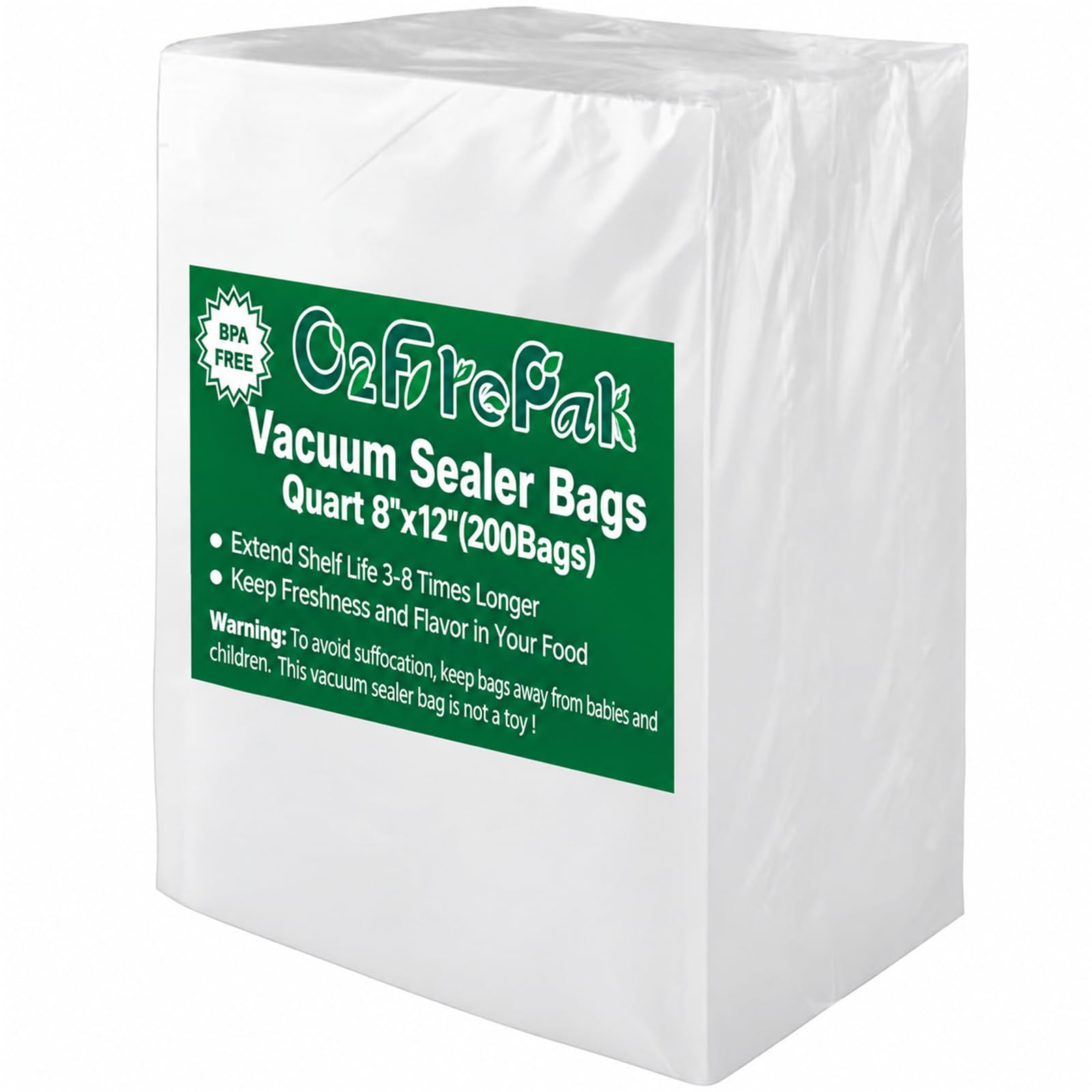
Two hundred quart bags in a single box is a different kind of purchase from a five-roll multipack, closer to buying a season of film than a week of it, at a per-bag price near the bottom of this group. Eight by twelve is the workhorse size: a pound of ground beef pressed flat, two chicken breasts, a quart of stew.
The construction is food-grade PA+PE with a 3.5-mil front panel and a 4-mil textured back, plus bone guards at the edges, and O2frepak lists them as boilable, freezable, microwavable, and dishwasher-safe. They are built for clamp-style machines, which covers FoodSaver and its imitators, and the textured back gives air somewhere to travel on the way out.
The film is where these bags do not quite match their billing. Against the 4-mil spec the panels feel closer to a standard bag than to the heavy-duty FoodSaver box, and that is part of how the per-bag price stays low. For ground beef, chili, and pre-portioned chicken it does not matter; for bones, shells, and anything with a corner, buy the thicker film.
What 200 identical bags buy you is a freezer that stacks: same size, same shape, same seal every time, so a month of meal prep fits in one drawer instead of three. Buy this one when your answer to the size question is always quart, and buy it after you have stopped experimenting.
Pros
- Lowest per-bag price for pre-cut bags
- Textured back panel and bone guards
- Boil, freeze, microwave, dishwasher safe
Cons
- Seals can fail on wet, fatty fills
- Quart size only in this box
Two hundred identical quart bags at a low per-bag price: the bulk buyer’s box, best for portioning rather than bones.
How We Chose and Tested These Bags
We started with every bag and roll we could find that fits the machines most people already own, then sorted them by format — pint, quart, gallon, and continuous rolls — so we weren’t comparing a 6-inch pint bag against 11-inch roll material. From there we filtered on BPA-free construction, claimed thickness, seal width, and cost per bag, and cut anything that listed a count without a size.
Eighteen rolls and packs went into the rotation over six months. They lived where bags actually live: on a shelf beside the sealer, in the chest freezer, in a sous vide pot on a Tuesday night, and in a cooler on a weekend hunting trip. We portioned chicken thighs, ground beef, and blocks of cheese, and froze soup and stock in quart and gallon sizes.
Every bag got the same going-over. We sealed it, pressed along the seam looking for channels or bubbles, then dropped filled bags into a water bath for an hour to see whether the seal crept. Bone-in cuts were the real test — we checked for pinholes after a week in the freezer, then looked for ice crystals and dried edges at the three-month mark. We ran the same roll through two different machines to see whether it fed and sealed cleanly in both, and timed a custom-length cut with and without a cutter or dispenser.
Cost was tracked per bag rather than per box, including the inches wasted at the end of a roll. Bags that tore while loading or needed a second pass to close dropped out early.
How to Choose Vacuum Sealer Bags
The bag is the half of the seal you actually control, and matching the film to your machine matters more than the logo on the box.
Match the Bag Width to Your Machine
Bag width decides more purchases than any other number. Most clamp-style sealers are built around 8-inch film; an 11-inch vacuum seal bag needs a machine with a sealing strip long enough to close across it, and a bag wider than the strip will not seal along its full length however carefully you position it. On a compact model, measure the sealing bar before you order a multipack.
The roll has a footprint too. A 50-foot roll is a bargain until it is too fat for the machine’s onboard compartment, at which point it lives in a drawer and gets used less. Neither issue is a defect in the bag; both are the details that decide whether a good roll earns its place on the counter.
Rolls Versus Pre-Cut Bags
Rolls cost less per foot and cut to whatever length a brisket or a baguette demands. Pre-cut bags arrive sealed on three sides, ready to fill. The hidden cost of a roll is machine time: every bag needs a bottom seal before it can hold food, which doubles the passes through the sealer on a long session. We keep rolls for odd shapes and long cuts, and pre-cut bags for portioning the same thing forty times.
Count matters as much as format. A 200-count box of quart bags at a per-bag price near the bottom of this group beats a 44-count box of the same size by a wide margin, but only if quart is the size you actually reach for. Buying two hundred of the wrong size is an expensive way to learn what you needed.
Thickness Cuts Both Ways
Mil figures and 30% thicker claims are about puncture resistance, which is what you want under a rack of ribs, a lamb shank, or a bag of jerky with sharp corners. The textured, embossed side does the work: the channels give air a path to the pump, then collapse flat into the seam.
Heavy film also asks more of the machine. A stiff bag can be harder for a small, low-wattage sealer to pull flat and close than a thin one, so an extra-thick bag that will not seal on your counter is a mismatch rather than a bad batch. If a heavy bag fights you, run a second seal above the first instead of pressing harder on the lid.
Check What the Bag Can Survive
Freezer, microwave, sous vide, boiling, dishwasher: the ratings differ bag to bag, and one does not imply another. Film rated for the freezer is not automatically rated for a hot water bath, and microwave safe usually means defrosting and short reheats rather than cooking from frozen. If you are bagging for sous vide, buy film the maker explicitly lists as sous-vide safe, and keep a cheaper freezer bag out of the water bath.
Frequently Asked Questions
Can you reuse vacuum sealer bags?
Film bags are built to be used once, and a bag that held raw meat should not be washed and refilled however thorough the rinse. A bag that held bread, cheese, or dry goods can be cut open below the old seal, rinsed, dried, and used again if enough length remains. If reuse is the goal, buy zipper-style bags with a valve; they are made for washing and resealing.
Can you vacuum seal hot food or liquids?
Let food cool first. Steam trapped in a warm bag condenses, and that moisture both weakens the seal and leaves frost inside the film. For soup, chili, or marinade, portion it into the bag, stand the bag in a container, and freeze until solid before vacuuming, or hang the bag over the counter edge so the liquid sits below the strip. Keep the strip dry and seal twice.
Why did my bag lose its seal after a few days?
Usually the seam rather than the film. Moisture or fat in the seal area keeps the layers from fusing, a crease across the seam leaves a channel, and overfilling pushes contents into the seal as the air leaves. Run a thumb along the seam after sealing; a soft spot or a visible channel means resealing an inch higher. Also check that nothing sharp is resting against the bag in the freezer.
Final Verdict
We recommend the FoodSaver Custom Length Rolls Multipack as the default, because two widths and brand-matched film remove the two things that go wrong first: a bag sized for the wrong job and a seal that fights the machine. If you pack in volume and want the cheapest film per foot, the Wevac rolls are the better buy and hold up in the freezer just as well.
If you want to skip bag-making entirely, the Wevac 6-by-10 pints turn portion work into one step. And if bones, shells, or sharp corners are in the rotation, spend the extra on the heavy-duty FoodSaver box and keep the cheaper film for everything else.