This post contains affiliate links. We may earn a small commission when you buy through our links — at no extra cost to you.
Many home cooks discover that their spiralizer slides across the counter mid-use or that the plastic gears give out after a few zucchinis. The gap between marketing and reality is wide in this category.
This guide zeroes in on the models that hold their ground—literally—and produce consistent noodles batch after batch. Whether you need a compact foldable, a vertical gravity-fed unit, or an electric model to save your wrists, the right spiralizer hinges on stable suction, sharp blades, and a body that won’t wear quickly.
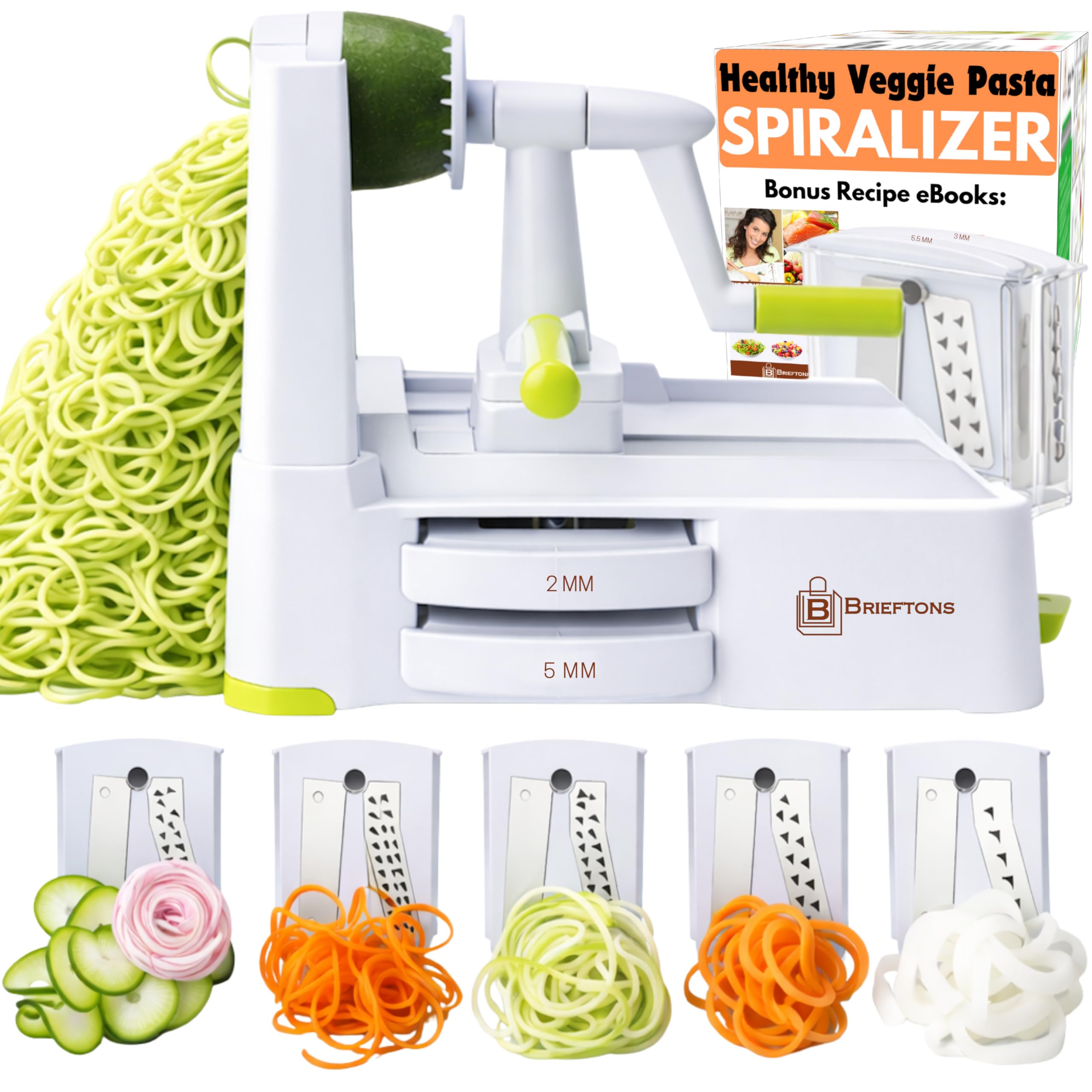


Best for Weekly Zoodle Making
Brieftons 5-Blade Spiralizer
Key Features
- Blades & Cuts: 5 blades (incl ribbon)
- Build Material: Plastic/Stainless
- Suction Stability: Oversized pad
- Storage Footprint: Standard
- Price: Mid-Range
The Brieftons 5-Blade Spiralizer handles zucchini, carrots, and beets with minimal hand effort. Its oversized suction pad locks onto granite, quartz, and laminate surfaces without sliding during use. The five Japanese steel blade options produce noodles from thin angel hair to wide ribbons, covering every common spiral cut without extra attachments.
For home cooks who spiralize weekly, the all-plastic body holds up to regular cranking without gear wear. The blade assembly requires rinsing each piece individually after use, but a included cleaning brush speeds the task. The suction pad may lose grip on rough stone or textured countertops — worth testing before committing to a dedicated counter spot.
Pros
- Cuts through dense vegetables with little effort, even after multiple uses.
- Sharp blades maintain edge for months; no rust or dulling reported.
- Interchangeable blades produce five noodle sizes from thin to wide ribbons.
Cons
- Suction pad may not hold on rough or textured stone countertops.
- Cleaning the blade assembly requires disassembly and individual rinsing.
The safest choice for anyone who wants a manual spiralizer that works day one and stays sharp — no electric complexity, no flimsy plastic gears.
Best for Small Spaces, Rvs
Brieftons QuickFold
Key Features
- Blades & Cuts: 5 blades (2-7mm + ribbon)
- Build Material: Plastic/Stainless
- Suction Stability: Oversized pad
- Storage Footprint: Foldable
- Price: Mid-Range
The QuickFold folds flat to about an inch thick, sliding into a drawer or cabinet with ease, while still packing the same 5 Japanese steel blades (2/3/5/7mm and ribbon) that make the brand a go-to for zucchini noodles. The trade-off: its oversize suction pad may not hold as firmly on textured or imperfectly smooth countertops, so the standard Brieftons model is a better bet if your workspace is uniform and you spiralize daily.
This spiralizer suits cooks who stash their gear between uses — think RV kitchens, apartment counters, or anyone tired of a bulky gadget dominating a cabinet. For occasional batches of softer vegetables like zucchini or cucumber, the plastic body and foldable frame deliver consistent cuts without taking permanent real estate. It’s less ideal for heavy-duty sessions on dense sweet potatoes or for those who prefer all-metal build.
Pros
- Folds flat for simple drawer or cabinet storage
- Five sharp blades cover common noodle thicknesses
- Included cleaning brush makes rinsing quick
Cons
- Suction grip varies on textured or uneven countertops
If storage space is your main constraint, the QuickFold delivers the same blade selection as the top pick in a packable form — just expect to prep your counter for suction.
Best for Budget Vertical
NUNEWARES 4-in-1 Vertical
Key Features
- Blades & Cuts: 4 rotating blades
- Build Material: Plastic/Stainless
- Suction Stability: Oversized
- Storage Footprint: Compact
- Price: Budget
The vertical gravity feed requires less downward force than horizontal spiralizers, so even firmer vegetables like sweet potatoes move through smoothly. Four rotating blades cover standard noodle cuts, and the included brush makes cleanup quick. The catch container holds about half a zucchini’s worth of spirals, so larger batches need a separate bowl underneath. Suction grip varies on very smooth countertops — a damp base improves hold. This suits budget-conscious buyers with limited counter space who make single servings or small batches.
Pros
- Vertical design reduces the force needed for cranking, especially with dense vegetables.
- Included brush speeds up cleaning of blades and container.
- Compact footprint fits small kitchens and stores easily.
Cons
- Suction cup hold can be inconsistent on very smooth counters, requiring extra prep.
- Catch container is small — larger batches need a separate bowl.
A solid budget vertical spiralizer for occasional single servings, provided you don’t mind adjusting for suction or swapping out the container for bigger jobs.
Best for Electric, Hand Fatigue
Hamilton Beach Electric
Key Features
- Blades & Cuts: 3 cutting cones
- Build Material: Plastic/Stainless
- Storage Footprint: Large
- Price: Premium
Electric operation cuts through a whole zucchini in seconds, requiring none of the hand twisting that can aggravate arthritis or repetitive strain. This model suits users who spiralize in volume or have hand discomfort, but the motor on some units may not activate on first use, and the six pieces that need cleaning after each batch are more involved than a manual model’s quick rinse.
Pros
- Fast and effortless operation
- Easy to assemble and clean
- Great for those with hand pain or arthritis
Cons
- Motor on some units does not activate on first use — worth testing immediately
Best for those who want electric convenience to avoid hand strain, but verify unit function early.
Best for Metal Durability
Homarden Stainless 5-Blade
Key Features
- Blades & Cuts: 5 blades
- Build Material: Stainless steel
- Suction Stability: Industrial-strength
- Storage Footprint: Compact
- Price: Premium
The Homarden spiralizer’s 304 stainless steel body and blades provide durability that plastic models lack, and the compact design saves counter space. The strong suction cups hold it steady during cranking. However, the short arm requires cutting large vegetables like zucchinis in half before spiralizing, which adds a prep step. This suits home cooks who primarily use smaller produce and want a metal spiralizer that won’t degrade over time.
Pros
- Stainless steel body resists wear and cleans easily.
- Strong suction cups keep the spiralizer stable during use.
- Compact footprint fits small kitchens and drawers.
Cons
- Some units may experience breakage under heavy use.
A space-saving metal spiralizer that holds up well for smaller produce, but requires an extra cutting step for large vegetables.
Best for Oxo Brand Loyalists
OXO 3-Blade Tabletop
Key Features
- Blades & Cuts: 3: spag, fett, ribbon
- Build Material: Plastic/Stainless
- Suction Stability: StrongHold
- Storage Footprint: Tabletop
- Price: Mid-Range
The StrongHold suction cup and onboard blade storage keep the OXO 3-Blade Tabletop stable and organized during use — a hallmark of the brand’s kitchen-focused design. Its three blades (spaghetti, fettuccine, ribbon) cover the common zoodle cuts, but the selection stops there. On smooth surfaces the suction holds well; on textured or porous countertops, it may lose grip during cranking.
This spiralizer suits small households that spiralize a few times a week and value easy assembly and compact storage. Buyers who need more blade variety or a suction that grips on any surface should consider the higher-rated option in this category.
Pros
- Easy to set up and operate
- Onboard blade storage keeps blades organized and accessible
- Build quality consistent with OXO’s kitchen reputation
Cons
- Blade selection limited to three cuts — no thicker or decorative options
- On rough or uneven countertops, the suction cup may not hold firmly during operation
If you need only basic spiral cuts and prefer a compact OXO design, this is a capable choice — but the top pick’s extra blades and more reliable suction make it a stronger all-around option.
Best for Large Batches
Spiralizer 7-Blade

Key Features
- Blades & Cuts: 7 blades
- Build Material: Plastic/Stainless
- Suction Stability: Suction pad
- Storage Footprint: Large
- Price: Mid-Range
The 7-blade set includes cuts from fine to thick, and the 420 stainless steel blades grip vegetables securely. A lifetime warranty backs the sturdy ABS housing. For those making large batches regularly, this is a cost-effective workhorse. Its fixed design and average footprint mean it needs counter space and won’t fold flat — a trade-off for the price.
Pros
- Seven blades produce a wide range of noodle sizes, from angel hair to thick ribbons.
- Sturdy stainless steel blades and reinforced ABS frame resist daily wear.
Cons
- Fixed, non-foldable body requires dedicated counter space — not suitable for tight storage.
Best for households that spiralize frequently and have counter space to spare, offering a strong build and blade variety without the foldable feature.
Best for Simple Zucchini Noodles
Paderno 3-Blade

Key Features
- Blades & Cuts: 3 blades
- Build Material: Plastic/Stainless
- Storage Footprint: Counter-mounted
- Price: Mid-Range
The original counter-mounted spiralizer prioritizes simplicity with over 15 years of use. Three blades handle basic spaghetti and ribbon cuts—fine for zoodles but not for varied styles. The suction base works on smooth counters but hasn’t changed. Best for traditionalists who want a durable, no-fuss tool for occasional use.
Pros
- Quick to assemble and start using immediately
- Blades and body rinse clean easily; dishwasher safe
Cons
- Only three blades — covers spaghetti and ribbon, but no fine noodle or julienne option
A no-frills choice for occasional zoodle makers who value longevity over blade variety.
Best for Angel Hair Noodles
WellToBe 6-Blade Stainless

Key Features
- Blades & Cuts: 6 blades (incl angel hair)
- Build Material: Stainless steel
- Suction Stability: Suction pad
- Storage Footprint: Compact
- Price: Premium
This spiralizer’s 304 stainless steel body and blades provide long-term durability that plastic models can’t match. However, it costs more than many plastic alternatives and takes up more counter space. The blades may occasionally cut vegetables too thinly or break under pressure.
Pros
- All-stainless body resists wear and staining over time
- Smooth surfaces make cleanup quicker than plastic models
Cons
- Some blades may break or produce very thin slices
Best for cooks who prioritize all-metal longevity over compact storage or lower cost.
Best for Tech-Savvy Cooks
Mealthy SpiraSlicer 5-Blade

Key Features
- Blades & Cuts: 5 blades
- Build Material: Plastic/Stainless
- Suction Stability: Oversized
- Storage Footprint: Standard
- Price: Mid-Range
The Mealthy SpiraSlicer offers a well-rounded package with five Japanese steel blades, an oversized suction cup for stability, and a recipe app for inspiration. However, suction may still fail on some surfaces, and the app is a minor addition compared to the broader review volume and feature set of the top pick.
Pros
- Easy to use with good build quality that holds up to regular use.
- Includes a storage container, blade caddy, and cleaning brush for a complete kit.
Cons
- Suction cup may lose grip on certain counter surfaces.
For cooks who want a complete kit with a recipe app and don’t need the highest review volume or extra features, this is a capable choice.
Best for Budget Vertical
Ourokhome 5-Blade

Key Features
- Blades & Cuts: 5 blades (2-6mm)
- Build Material: Plastic/Stainless
- Suction Stability: 4 suction cups
- Storage Footprint: Compact
- Price: Mid-Range
The Ourokhome’s vertical gravity feed reduces hand strain, and the five blades cover common spiral cuts. However, the four suction cups may not hold on textured countertops, making stability unpredictable—better suited for smooth surfaces.
Pros
- Easy to use, especially vertical design
- Good value for money
Cons
- Suction cups may not hold well on some surfaces
A budget-friendly vertical model for small kitchens where countertops are smooth and spiralizing needs are occasional—not for heavy use or uneven surfaces.
Best for Single Servings
OXO Handheld Spiralizer

Key Features
- Blades & Cuts: 1 fixed blade
- Build Material: Plastic
- Storage Footprint: Handheld
- Price: Budget
The OXO Handheld Spiralizer fits a specific niche: single servings or occasional use where portability matters. Its compact size slips into a drawer or camping kit, and the fixed blade handles soft vegetables like zucchini with little effort. For those times when you want one bowl of noodles without dragging out a countertop model, this works. But the trade-offs are clear – hand fatigue sets in after a single zucchini, and harder vegetables like carrots can be difficult to spiralize. This is a tool for light, on-the-go tasks, not batch prep or robust veggie noodles.
Pros
- Slips into a backpack or kitchen drawer for travel or small-space storage.
- Quick to set up and use for one or two servings of zucchini noodles.
Cons
- Hand fatigue can become noticeable after spiralizing more than one medium zucchini.
Pick this only if your priority is an ultra-portable spiralizer for occasional single portions and you’re comfortable limiting use to soft vegetables.
Best for Occasional Light Use
Veggetti Handheld Spiralizer

Key Features
- Blades & Cuts: 2 blades (thick/thin)
- Build Material: Plastic/Stainless
- Storage Footprint: Handheld
- Price: Budget
The Veggetti’s low price and palm-sized design make it an easy grab for infrequent zoodle making in cramped kitchens. But the plastic body and limited leverage mean it suits only soft vegetables like zucchini, and some units show wear after a few uses. Cleaning also requires attention to small crevices. For someone who wants to try spiralizing without commitment or needs a travel option, it gets the job done for light duty.
Pros
- Compact design stores easily in a drawer or travel bag.
- Budget-friendly price for getting started with veggie noodles.
Cons
- Plastic components may crack or separate after limited use, especially with harder vegetables.
Suitable for occasional single servings of zucchini noodles in small spaces; consider a sturdier tabletop model for regular use.
Best for Occasional Travel
Veggetti Original Handheld

Key Features
- Blades & Cuts: 2 blades
- Build Material: Plastic/Stainless
- Storage Footprint: Handheld
- Price: Budget
This yellow handheld works fine for occasional zucchini noodles, but being identical to the Ontel white model offers no unique advantage. Hand fatigue may set in during longer sessions, and hard vegetables like carrots are a struggle.
Pros
- Easy to use and clean after spiralizing soft vegetables.
- Compact and lightweight for tossing in a bag or suitcase.
Cons
- Hand fatigue can build up when spiralizing more than one zucchini.
Best for occasional single servings of zoodles when portability is the priority, not for regular use or firm vegetables.
Best for Beginners Budget
Fullstar 4-in-1 Handheld

Key Features
- Blades & Cuts: 4 adjustable blades
- Build Material: Plastic/Stainless
- Storage Footprint: Handheld
- Price: Budget
The Fullstar 4-in-1 is the cheapest way to make zucchini noodles, with adjustable blades and dishwasher-safe parts. But its small capacity requires cutting vegetables into short lengths, and the twisting motion can tire your hands after a single serving.
Pros
- Compact and very affordable
- Easy to use and assemble
Cons
- Small size forces you to pre-cut vegetables, and hand fatigue can set in after a few minutes of use
Best for budget-conscious cooks who spiralize one zucchini at a time and want a compact tool for occasional use.
How to Choose
Suction cup performance varies wildly by countertop material; test your surface before buying a manual spiralizer.
Number of Blades and Cut Types
More blades don’t automatically mean better spiralizing. Most home cooks consistently use only two or three cuts: spaghetti, fettuccine, and ribbon. Extra blades like angel hair or curly fry add versatility but take up storage space.
Build Material
Plastic bodies are light and inexpensive but can crack over time, especially under the torque of hard vegetables. Stainless steel bodies resist wear and feel more solid, but they add weight and often cost more.
The trade-off is longevity versus cost. If you spiralize a few times a month, a quality plastic model with stainless blades holds up. For weekly users, a stainless steel frame avoids the hinge and gear fatigue that plagues all-plastic units.
Suction Cup Stability
Suction cups rely on a smooth, non-porous surface. Granite, textured tile, or wood counters can break the seal regardless of the pad size. Many models include oversized pads or multiple cups to compensate, but no suction system works on every countertop.
Check your counter’s finish before buying. If your counter is rough, consider a vertical gravity-fed model that doesn’t rely on suction, or use a damp cloth under the pad to improve grip.
Ease of Cleaning
Blade assemblies with many crevices trap bits of vegetable and are hard to rinse without a brush. Dishwasher-safe models simplify cleanup but dull blades faster. Hand washing with the included brush keeps blades sharp longer.
Models that disassemble into fewer parts are quicker to clean. Handheld spiralizers with a single blade are the easiest, but they trade off capacity and stability.
Size and Storage Footprint
Tabletop spiralizers take up counter space and require a dedicated drawer or cabinet. Foldable models collapse to a flat profile for easy storage. Vertical units have a small footprint but may need more vertical clearance.
If you have limited kitchen storage, a foldable or vertical model prevents counter clutter. Handheld units fit in a drawer but require more effort for each batch.
FAQ
Why does my spiralizer keep sliding on the counter?
Suction cups require a smooth, non-porous surface. Granite, textured tile, or wood can break the seal. Wipe the counter and suction pad clean, then press firmly. For rough surfaces, use a damp cloth under the pad or switch to a vertical gravity-fed model that doesn’t rely on suction.
Can a spiralizer handle sweet potatoes and beets?
Yes, but hard vegetables require more torque. Manual spiralizers with stainless steel blades and a sturdy frame handle sweet potatoes and beets, but you may need to cut them into shorter pieces. Budget handheld models often struggle with hard vegetables and can crack under the pressure.
Which spiralizer blade makes the best zoodles for pasta?
A spaghetti cut (around 3mm to 5mm) is the closest to traditional pasta. Most spiralizers include a spaghetti blade. For thicker texture, use a fettuccine blade. Ribbon cuts are best for lasagna-style dishes or stir-fries.
How do I clean a spiralizer without getting cut?
Use the included cleaning brush to remove food from the blade assembly. Hold the blades by the plastic frame, never touch the cutting edges. Dishwasher-safe models let you place the parts on the top rack, but hand washing with a brush is safer and keeps blades sharper longer.