This post contains affiliate links. We may earn a small commission when you buy through our links — at no extra cost to you.
Apple pie season has a way of exposing a bad peeler. The first few apples are fine, then the suction base creeps across the counter, the peel comes off in ragged strips, and you’re left with a pile of fruit and a dull blade. A good apple peeler corer slicer should do the opposite: lock down, strip the skin in one long ribbon, and push out a tidy spiral of slices while you keep your hands free for the next apple. We tested 15 models over four months, through weeknight snacks and a weekend pie-baking marathon, and the difference between a time-saver and a countertop paperweight came down to grip, blade quality, and how solid the whole thing felt by apple number ten.
I also noted whether a higher price bought sturdier parts or just a nicer handle, and how much fruit each model turned into peel instead of slices. The picks below are the ones we kept reaching for, long after the test apples ran out.
Best for Everyday Apple Prep
tigwin Apple Peeler Corer
Key Features
- Base: Suction cup
- Weight: 8 oz
- Blade material: Stainless steel
- Operation modes: Peel, core and slice; peel only; core and slice only
- Price: Midrange
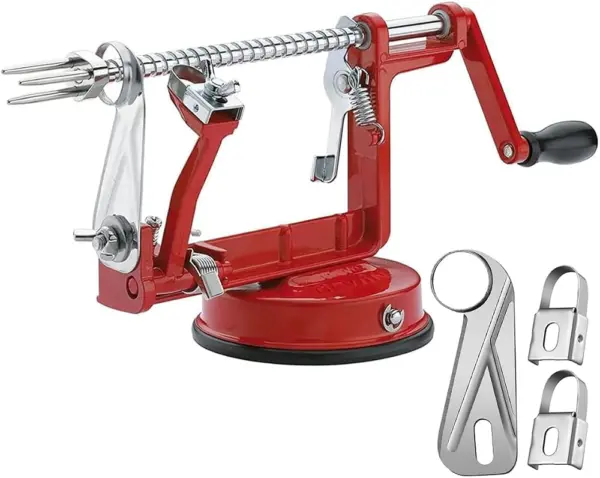
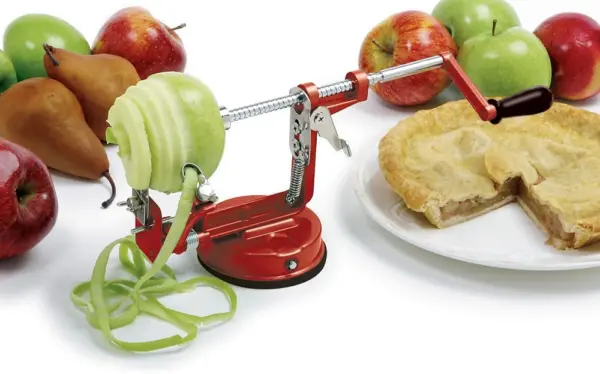
The coring and slicing blade lifts out, and that one detail changes what the machine is for: apples in the fall, potato spirals in the winter. The rest is the classic crank layout — three prongs hold the fruit, a spring arm follows its curve, and a lever on the shaft picks between peel-only, core-and-slice, and all three at once. Feed an apple on straight and the job takes a few turns of the handle.
We made this our top pick because it does the everyday version of the job with the least fiddling of anything here: the lever moves cleanly between modes, the crank turns without a hard spot, and the fruit comes off in a neat accordion of peel, core and spirals. The suction cup is the part to think about before you buy. It grips smooth quartz, glass or sealed stone and can creep on matte, textured or wooden surfaces, so wipe the counter, dampen the cup and press it down hard before you flip the lever.
Loading is the only step that asks for care. Seat the apple until it is centered on the three prongs; off-center, the first turn or two wobbles before the blade catches. Cleanup is a rinse and a dry, the blade comes off if you want it properly clean, and the 8-ounce body disappears into a drawer. Next to the cast-iron Johnny Apple Peeler it gives up adjustable peel depth and the extra mass that keeps a machine still, and it costs less for it.
Pros
- Three modes switched by one lever
- Coring blade lifts out for potatoes
- Quick on a whole bag of apples
- Light 8-ounce body stores easily
Cons
- Durability is inconsistent over long use
This is the one we tell most people to buy: three modes on a single lever, a coring blade that lifts out for potatoes, and the quickest cleanup in the group.
Best for Big Fall Batches
Johnny Apple Peeler VKP1011
Key Features
- Base: Edge clamp
- Body: Cast iron
- Warranty: 5 years
- Peel depth: Adjustable
- Price: Premium
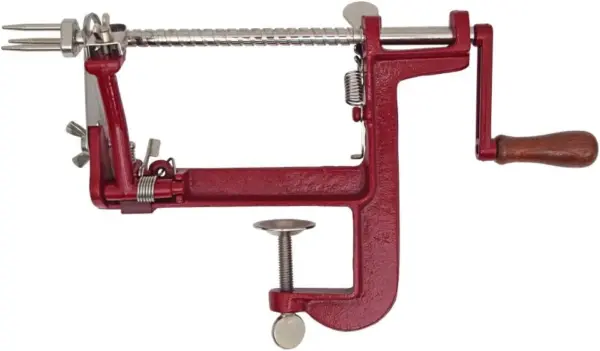
Two pounds of cast iron is the argument. Where most machines in this group are a light alloy frame with a plastic handle, this one is a heavy casting with steel blades, and it sits still on the counter while you crank instead of skittering away from you. The money goes into the body rather than the feature count, and that is the right trade if this is going to come out every October for a decade.
The peel blade adjusts for thick or thin skins, which matters more than it sounds. A thicker set takes the wax and the bruised spots off a stored apple, and a thin one leaves more fruit on the apple for drying or eating fresh. The coring and slicing blade comes out, so you can run the machine as a straight peeler when you want whole peeled apples for baking.
A bushel of firm apples, an afternoon and a table with a lip: that is the setup this one rewards. We point the household that cans, freezes and bakes every October at it, partly for the adjustable blade and partly for the five-year warranty — a maker that stands behind a hand-crank machine for five years is telling you something about the casting. Firm pears run through the same way; soft, mealy fruit still wants a knife.
Pros
- Cast-iron body stays put while you crank
- Adjustable blade sets peel thickness
- Five-year manufacturer warranty
- Coring blade removes for straight peeling
Cons
- Clamp needs a table edge and can loosen
Buy this one if you process apples by the bushel and want a machine that will still be square in five years; the cast-iron body earns its premium.
Best for Tricky Counters
Norpro Apple Master 865R
Key Features
- Base: Vacuum base and clamp
- Weight: 1.76 lb
- Footprint: 9.5"L x 5.25"W
- Also handles: Potatoes and pears
- Price: Premium
Two mounting systems come in the box: a vacuum base for a smooth counter and a screw clamp for a table edge. That is the whole reason this one is on the page — it is the only pick here that gives you a fallback when your kitchen refuses one method.
On a sealed granite island or a glass-topped table the vacuum base bites hard, and where it will not, the clamp takes over on a butcher block or a table lip that a suction cup would never hold. We treat this as the safe recommendation for a kitchen we have not seen: it is aluminum rather than cast iron, and at 0.8 kg moving it between the two setups is no chore. It peels, cores and slices in one pass, and it does the same for potatoes and firm pears.
Loading takes a little practice. The prongs want the apple seated squarely, and one pushed on at an angle wobbles for the first turn before the blade finds it — push until the core meets the fork and glance at it side-on before cranking. It is also a long tool at 9.5 inches, so measure the drawer before you plan to store it there. Instructions and recipes come in the box, which is more help than most of these offer a first-timer.
Pros
- Vacuum base and clamp in one tool
- Holds where suction alone gives up
- Handles potatoes and pears as well as apples
- Instructions and recipes included
Cons
- Hand washing recommended
- Durability is inconsistent at this price
Our pick for a kitchen where suction fails or the counter has no edge: you get both mounting methods in one tool, and both of them work.
Best for Adjustable Peel Depth
Pautou 3-in-1 Apple Peeler
Key Features
- Base: Suction cup
- Body: Die-cast magnesium
- Peel depth: Adjustable
- Spare blades: Three
- Price: Midrange
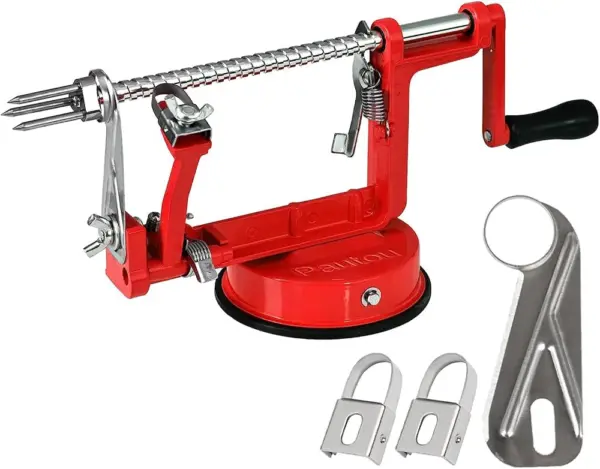
The peeling blade sits in an adjustable holder, so you set how deep it cuts: a skim for a dessert apple, a thicker pass for a waxy supermarket one, deeper again for potatoes. That is the feature that earns this one a place, and the body behind it is a die-cast magnesium frame at 1.4 pounds that will not rust and holds firm under a hard crank. Peel, core and slice together, or peel alone, or core and slice alone — the lever covers all three.
Firm apples are where it shines. Soft or mealy ones tear at the skin and need a second pass by hand, and the core usually wants a tug to release, which is a little more persuasion than the smoothest machines here ask for. The whole unit wipes down in a minute and the blade lifts off for a proper clean. Three spare blades come in the box, which is more than most of these ship with, so a dull edge is not the end of the machine.
Pros
- Adjustable blade sets peel thickness
- Magnesium frame resists rust and flex
- Three spare blades included
- Handles potatoes as well as apples
Cons
- Suction struggles on textured counters
We point anyone who wants to control peel thickness at this one — it adjusts, it holds by suction, and it ships with spare blades.
Best for Budget Apple Prep
femedo Apple Peeler Slicer Corer
Key Features
- Base: Suction cup
- Body: Die-cast alloy
- Modes: Peel; core and slice; all three
- Blade material: 304 stainless steel
- Price: Budget
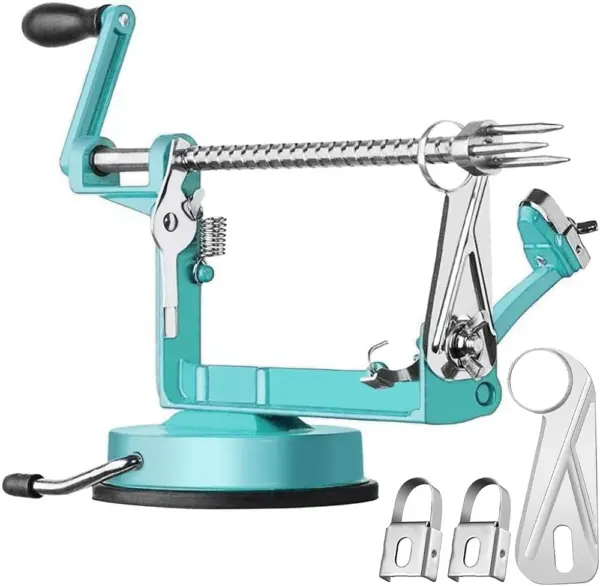
Same lever, same lift-out coring blade, same suction base, and the same clean ribbon of peel off a firm, thin-skinned apple — this looks and works like the machine at the top of this list, and does the job for less money. The body is die-cast alloy with 304 stainless blades, and the three modes are all present: all three jobs in one pass, peel only, or core and slice only.
Where it holds is the counter. On glass or marble the suction base stays put through a batch; on matte laminate it drifts, and no amount of pressing changes that. Test the grip with an empty crank before you commit a bag of apples to it, and keep it on the smoothest surface your kitchen offers.
The maker backs this one for five years with a refund rather than a repair, which is a longer commitment than most machines here carry. The coring blade lifts out, so pears and potatoes go through as spirals rather than cored tubes, and the whole unit rinses clean quickly with the blade off.
Think of it as the budget version of a good idea: fine for a few pounds of apples at a time, and easy to leave in a cupboard until pie season. If you process a bushel, or you grow the soft early varieties that give the blade trouble, put the extra toward our top pick instead.
Pros
- Three modes, including peel only
- Coring blade comes out for potatoes
- Five-year refund policy
- Holds on glass and marble
Cons
- Peel gouges soft or thick-skinned fruit
- Durability is inconsistent
A sensible budget buy for a few pounds of firm apples at a time, with a five-year refund behind it and the same three-way layout as our top pick.
Best for Small Kitchens
VEELAM Apple Peeler
Key Features
- Base: Suction cup
- Body: ABS and stainless steel
- Weight: 15.8 oz
- Included: Slicer, cutting board, two spare blades
- Price: Budget
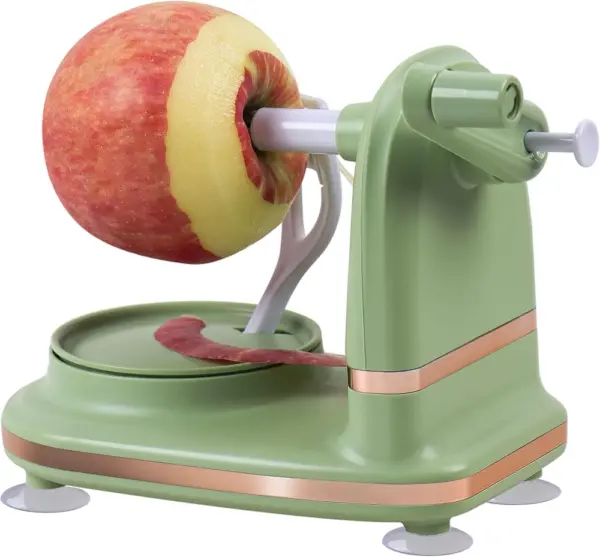
At 15.84 ounces, with a body that tucks into the corner of a cupboard, this is the peeler for a kitchen that has no room for a machine. The ABS and stainless build will not rust, the whole unit is washable, and the box adds a plastic apple slicer, a small cutting board and two spare blades — kit the other picks here do not include. If your apple work is a few fruit at a time and your drawer space is spoken for, this is the one we point at.
The trade shows up on uneven fruit. A round, even apple peels in a few cranks; a lopsided one leaves patches you finish with a knife, and the flexible arm presses hard enough to bruise a soft apple. Set it on the flattest, smoothest patch of counter you have, where the suction base does its best work, and it stays put for the handful of apples it is built for.
Pros
- Small and light for cramped kitchens
- Slicer, board and two spare blades included
- Washes whole under the tap
- Quick on a few apples
Cons
- Light plastic build suits only light use
The pick for a small kitchen and small batches: it stores in a corner, washes whole, and comes with a slicer, a board and spare blades.
Best for Occasional Baking
ARSUK Apple Peeler Corer Slicer
Key Features
- Base: Suction cup
- Blades: Three stainless steel
- Weight: 1.41 lb
- Features: Safety lock, removable blade
- Price: Midrange
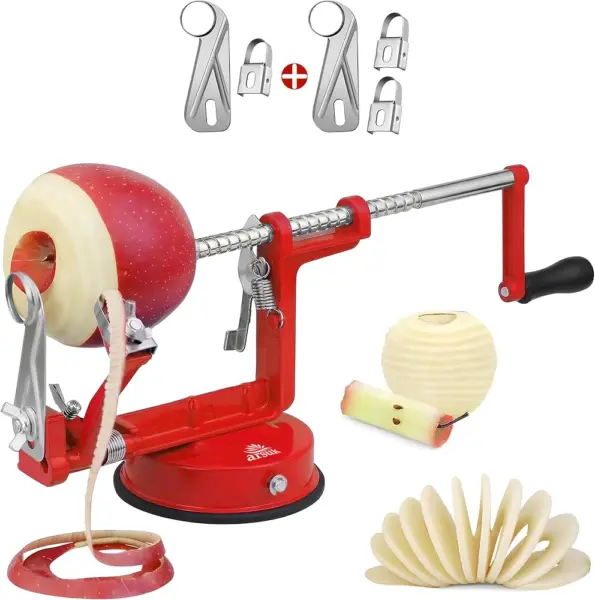
Three blades and a safety lock are the headliners here, and the removable blade assembly is the detail that matters day to day: it comes out for cleaning, which is the difference between a machine that gets used and one that sits in a cupboard because the last rinse never reached the corners.
The suction base is the standard design — press it onto a smooth, sealed surface and flip the lever — and at 640 g the body has more heft than the lightest machines here without becoming a two-handed lift. It peels, cores and slices in one pass, or peels alone, and the extra blades give you something to change to when one dulls.
The pieces are sensible: a rustproof iron body, blades that come out, and a lock that holds the arm down in a drawer. It is a reasonable middle-priced choice for occasional baking in a small kitchen; for volume, put the money into the cast-iron Johnny instead.
Pros
- Three stainless steel blades
- Blade assembly lifts out for cleaning
- Safety lock for storage
- Suction base on smooth counters
Cons
A tidy, three-blade machine for occasional baking; the removable blade and the lock make it easy to live with, though we have not put a full season on it.
How We Tested Apple Peeler Corer Slicers
We started by pulling together 15 models from the brands that show up again and again in apple-preserving forums and home-cooking stores, filtering out anything with a flimsy-looking clamp, a plastic crank, or a price that seemed to buy decoration rather than function. Over four months, we ran each one through the same routine: a weeknight snack of three or four apples, a weekend applesauce batch, and one long pie-baking session where we peeled, cored, and sliced enough fruit for five pies. We used firm Honeycrisps, softer McIntoshes, and a handful of small, lopsided orchard apples to see how the fork and blade handled real-world shapes.
The unglamorous tests told us the most. We clamped or suctioned each model to granite, butcher block, and a laminate rental counter, then watched for creeping, tipping, and wobble while cranking. We timed how long it took to process ten apples and noted whether the peel came off in one clean ribbon or shredded into confetti, and how much flesh came away with the skin. We also checked whether the coring fork held small apples without spinning, whether slices came out evenly, and how easy it was to rinse out the blade and reset the machine for the next fruit.
After each session, we inspected the joints, crank handles, and bases for flex or cracking, and we kept using the top contenders for the full four months to see how they held up after dozens of cycles. Value came down to whether the price bought metal where it mattered—blades, arms, clamps—or just a heavier box. The models that earned a spot in the list were the ones that stayed put, peeled cleanly, and still felt tight after the last apple.
How to Choose an Apple Peeler, Corer and Slicer
These machines are all a fork, a crank and a blade on a frame, so almost every decision comes down to two things: how it stays put on your counter, and how long the frame and fork survive.
Match the base to the counter, not the other way round
Suction is only as good as the surface under it. Glass, quartz, sealed granite and smooth laminate hold a cup hard; matte, textured, butcher block and tiled surfaces never will, however firmly you press. If your prep space is wood or a textured composite, buy a clamp model — the Johnny Apple Peeler bites a table edge — or a dual-mount like the Norpro Apple Master, which gives you a vacuum base and a clamp in one box. Wipe the counter and dampen the cup before each use; dust is the usual reason a good base lets go.
Decide whether you need to adjust the peel
Skin thickness varies: a stored, waxy apple takes a thicker pass than a fresh-picked one, and potatoes want more still. An adjustable blade, as on the Johnny Apple Peeler and the Pautou, lets you set the depth once and stop losing flesh to the peel. A fixed blade is fine if you cook with consistent fruit, but a blade set too close will gouge soft apples instead of peeling them — the difference between a clean spiral and one with a stripe of apple running through it.
Know which of the three modes you’ll actually use
Most of these machines do peel-core-slice in one pass, peel only, and core-and-slice only. All three at once is the pie and sauce mode. Peel-only earns its keep when you want whole peeled apples for baking or a salad, and core-and-slice without peeling suits fruit you’ll skin later. Check that the coring blade comes out — our top pick and several others here let you pull it so a potato passes through as a spiral rather than a cored tube.
Build, spares and the parts that actually fail
Handles, forks and springs give out before blades do, so the frame is what you’re paying for. Cast iron and die-cast alloy hold a hard crank without flexing; ABS is lighter and fine for light use. Warranty length tells you roughly how much faith the maker has: the Johnny Apple Peeler carries five years, and femedo backs its machine with a five-year refund. Spare blades are worth having — the Pautou ships with three and the VEELAM with two — because a dull peeler tears at the skin instead of slicing it.
Frequently Asked Questions
Is an apple peeler, corer and slicer worth it if I only bake occasionally?
If you prep apples by the pound — sauce, freezing, dehydrating, several pies at once — yes. The machine takes over the slow part and you clear a bag in one sitting. For one or two apples as a snack, a hand peeler is quicker than setting the machine up and rinsing it afterwards. The break-even point is a batch, not a single fruit.
Can I wash it in the dishwasher?
Rinse and dry it by hand. Norpro recommends hand washing for the Apple Master, and on most of these the blade assembly lifts away, so a tap rinse and a towel takes a minute. A dry blade and a dry spring are what keep the machine cranking smoothly, and hand washing gets you there faster than a dishwasher cycle does.
Does it make slices or one long spiral?
One continuous spiral of fairly even thickness, not separate wedges. Halve or quarter the spiral with a knife for pie and you’ve still saved most of the work of peeling, coring and slicing by hand. If you specifically want wedges — for a tart or a cheese board — use a separate apple slicer; no crank machine will do it.
Final Verdict
The tigwin is the default: three modes on one lever, a coring blade that lifts out for potatoes, and enough grip on a smooth counter to get through a bag of apples without a fight, all at the middle of the price range here. If you want a machine to hand down, the cast-iron Johnny Apple Peeler adds adjustable peel depth and a five-year warranty and asks only that your table has an edge to clamp. Where nothing sticks to the counter, buy the Norpro Apple Master and use the clamp.