This post contains affiliate links. We may earn a small commission when you buy through our links — at no extra cost to you.
Hot water and coffee sit in a machine for minutes, then linger in a carafe for an hour, so the materials that touch them matter as much as the brew itself. I started paying attention after a hand-me-down drip maker left a faint plastic taste in every pot. A good non toxic coffee maker should still make excellent coffee, clean up easily, hold heat, look decent on the counter, offer controls that make sense, and survive daily use — otherwise, what’s the point? Over eight months, we brewed with 12 machines to find out which ones did all of that.
The differences show up in small things: whether the lid seals without dribbling, whether the filter basket rinses clean, whether the carafe still pours neatly after months of mornings. I also learned that “non toxic” isn’t a regulated claim on coffee makers, so it helps to look for clear material disclosures for every part that contacts hot water or coffee — not just the carafe. The picks below are the ones that held up and kept brewing well.
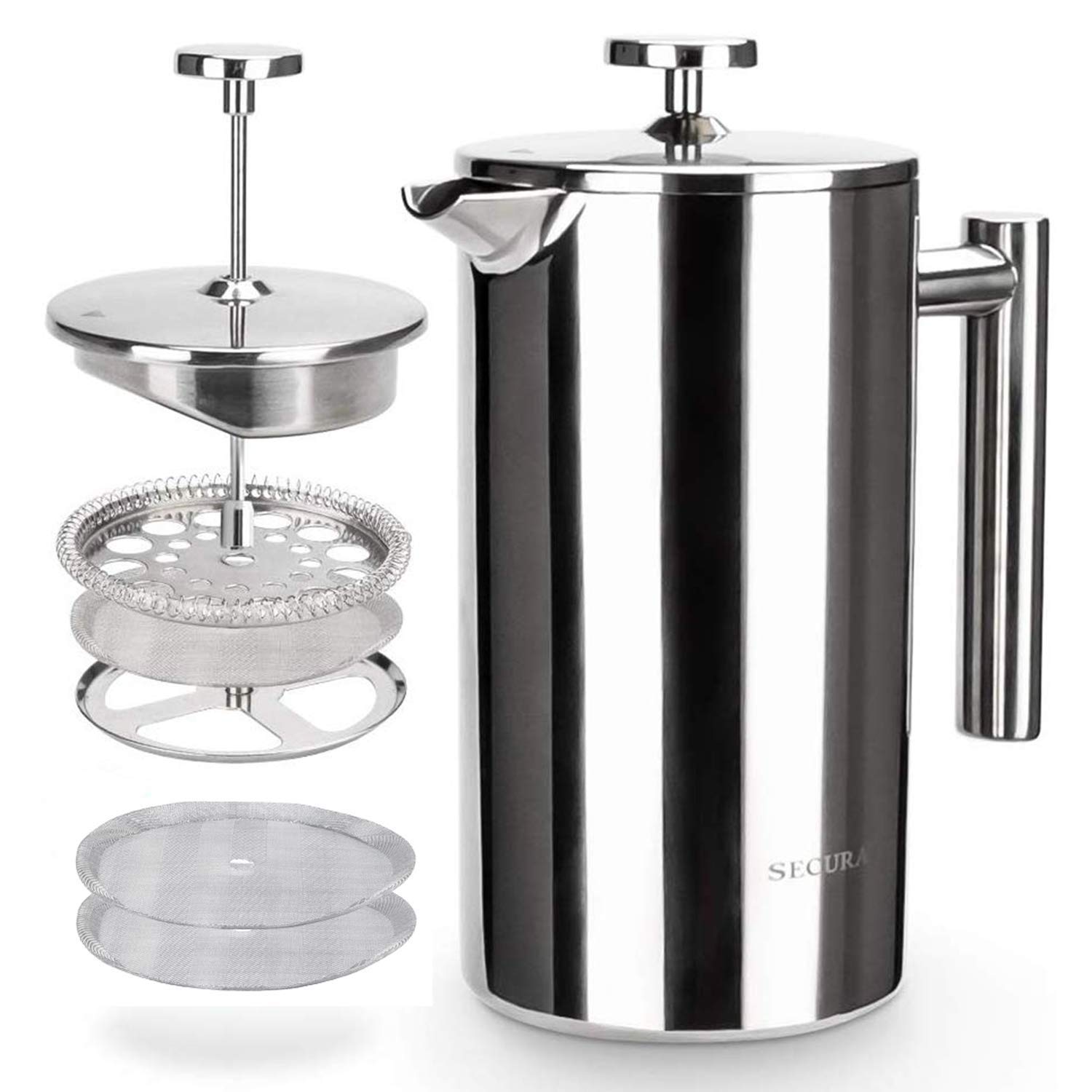

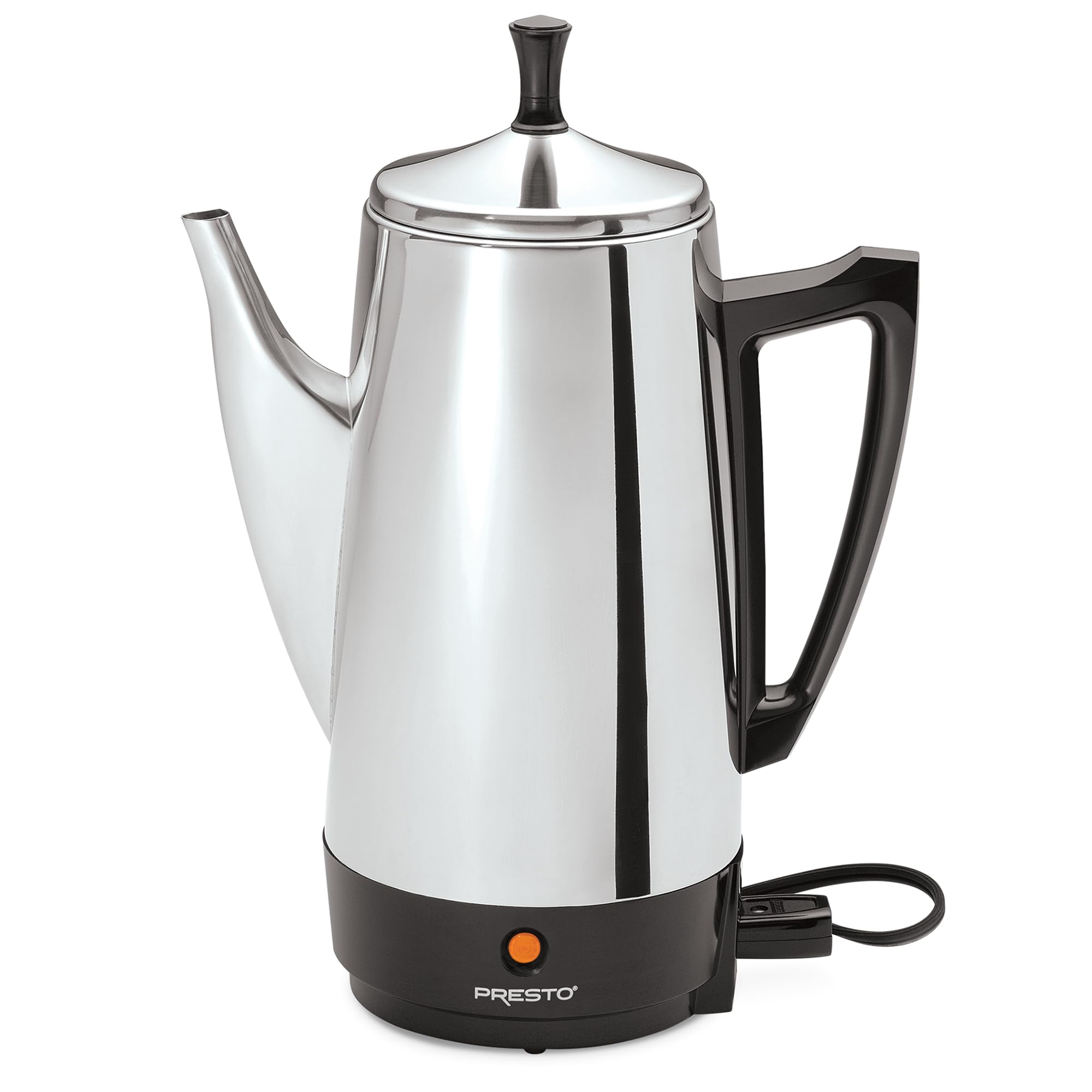
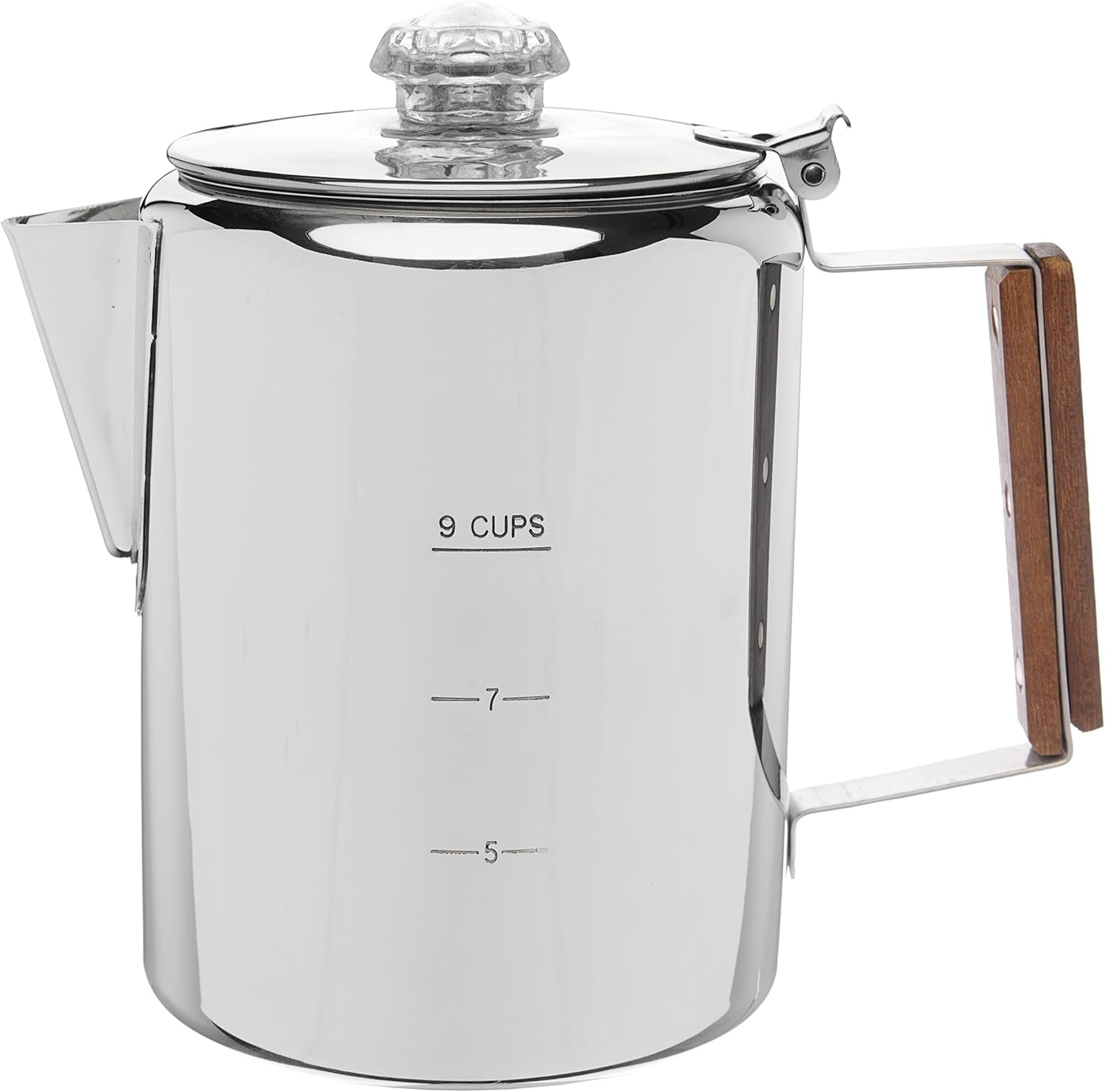


Best for Everyday All-Steel Brewing
Secura Stainless French Press
Key Features
- Filter: Three-layer steel, 2 spares included
- Capacity: 34 oz (1 Litre)
- Cleaning: All parts dishwasher safe
- Brew-path material: 304 stainless steel, interior and exterior
- Price: Budget
Stainless steel, inside and out, is the whole reason the Secura sits at the top of this list. There’s no glass carafe to chip and no paper filter to rebuy, and the parts that meet the hot water — the body and the three-layer filter stack — are all 304 grade steel. For a purchase driven by what touches your coffee, that’s the shortest materials list here.
What we appreciate most after living with it is how little there is to break. A glass press gets handled like stemware; this one gets knocked against the sink, stacked in the drying rack and handed to whoever drew dish duty, and the finish shrugs it off. Every part is dishwasher safe, and the filter stack unscrews into flat pieces, so old grounds rinse away instead of packing into a mesh shoulder. The two spare screens are a nice touch as well: stack an extra one when you want a cleaner cup.
Thirty-four ounces is the useful middle size — two big mugs with enough left for a third, or four smaller cups for company. Steel holds heat longer than glass does, so the second cup is still hot without a trip to the microwave, and the handle and the knob stay cool enough to grab mid-pour.
What it won’t give you is a view. The body is opaque, so there’s no watching the bloom or judging strength by eye; you settle on a ratio and let the timer do the work. That’s the entire cost of the trade, and it’s a small one for a press that will still be on your counter when a glass one would be in the recycling.
Pros
- No glass or plastic in the brew path
- Three-layer filter plus two spare screens
- Every part is dishwasher safe
- Holds heat far longer than a glass press
Cons
- 2.4 pounds is a lot to pack
Our default pick for anyone who wants nothing but steel between them and their coffee: dishwasher-safe, nothing to break, and big enough for two.
Best for Flavor Clarity
Chemex 8-Cup Pour-Over
Key Features
- Filters: CHEMEX Bonded, not included
- Capacity: 40 fl oz (8 five-oz cups)
- Cleaning: Dishwasher safe
- Brew-path material: Borosilicate glass with paper filter
- Price: Midrange
Paper sounds like a compromise until you taste what it does. The Chemex brews through a thick bonded filter into a borosilicate flask, so hot water meets glass and paper and nothing else, and what lands in the carafe is the brightest cup of the bunch — fruit and acidity up front, no muddiness underneath.
Forty ounces is eight of Chemex’s five-ounce cups, which in real life is three mugs and a top-up, and the narrow flask holds heat better than its shape suggests. Cleanup is the easiest here: lift the filter and grounds out together, rinse the glass, and it can go in the dishwasher when a rinse isn’t enough. Filters are not included, so order a box with the maker — it’s the only thing you’ll buy twice.
We keep it in the lineup because nothing else here separates flavor this cleanly, and because the process is genuinely pleasant: four minutes of pouring in slow circles beats pressing a button for a start to the morning. What it isn’t is fast. The kettle has to come off the boil and sit for a moment before it hits the grounds, so if you leave the house at a run, this is the maker that gets abandoned.
Pros
- Glass and paper are the entire brew path
- Brightest, cleanest cup in this set
- Rinses clean and is dishwasher safe
Cons
- Thin glass carafe chips or cracks when knocked
We recommend it to anyone who puts flavor clarity above speed: glass and paper are the whole brew path, and the cup is the cleanest in the roundup.
Best for Full Pots, Electric
Presto 12-Cup Electric Percolator
Key Features
- Power: 800 watts, 120 volts
- Capacity: 2 to 12 cups
- Cleaning: Hand wash only
- Brew-path material: Stainless steel basket and pot
- Price: Premium
Twelve cups, a cord, and no ceremony: this is the machine we point to when coffee has to be ready before people start arriving. It’s the only electric brewer here that keeps a full pot hot without a plastic tank in the water’s path — the basket and the pot itself are stainless steel.
It percolates at roughly a cup a minute, so a full pot is done in about the time it takes to shower and get dressed, and the automatic temperature control holds it there while people work through it. Coffee comes out hot and strong, and it keeps coming for the second and third mug.
The routine it asks for is worth knowing before you buy. The base isn’t a dishwasher item, so the basket and perk tube get rinsed under the tap, which takes a minute and keeps the stainless looking new. That’s the price of a pot this size that never has hot coffee sitting against plastic.
Pros
- Stainless basket and pot, no plastic tank
- About a cup a minute for twelve cups
- Keep-warm control holds the pot at temperature
Cons
- No auto shut-off, so you unplug it
- Thermostat failures can shorten its life
For a full pot before everyone wakes up, we point to this: twelve stainless cups, kept hot, at about a cup a minute.
Best for Camp and Outages
Coletti Bozeman Percolator
Key Features
- Power: Stovetop or campfire, no electricity
- Capacity: 45 fl oz (9 five-oz cups)
- Cleaning: Dishwasher safe
- Brew-path material: Stainless steel with glass view top
- Price: Midrange
Coletti says it in the title — no aluminum, no plastic — and it holds up. The pot, basket and stem are stainless steel, and the only non-metal part anywhere near the coffee is the glass view knob on the lid. If your reason for shopping is a short list of materials, this is one you can check off without further research.
We like it for the mornings when there’s a flame and no outlet: fill it, set it on a burner, watch through the glass until the coffee starts rising, then turn the heat down and let it finish. No cord, no pump, nothing to plug in, so it works on a camp stove, a grate over a fire, or a gas ring during an outage. Forty-five ounces is four mugs, and it’s dishwasher safe once you’re home.
The glass knob is the weak point, and it’s the same knob that makes the pot pleasant to use, so treat the lid like a wine glass even though the rest of it is built like a bucket. Percolator coffee is its own thing, too: the water keeps recirculating, so every extra minute on the heat pushes the flavor from strong toward stewed. Pull it early and it’s a good cup.
Pros
- Explicitly no aluminum and no plastic
- Works on a campfire, camp stove, or gas ring
- Dishwasher safe once you’re home
Cons
- Glass view knob is the part that cracks
For camping and outages this is where we start: stainless inside, glass only in the view knob, and no aluminum anywhere.
Best for Keeping Coffee Hot
Utopia Kitchen Steel French Press
Key Features
- Filter: Four-layer stainless steel
- Capacity: 34 oz
- Heat retention: Double-wall insulation
- Brew-path material: 304 stainless steel, double-walled
- Price: Budget
Two all-steel presses sit near the top of this list, and the Utopia is the one that keeps coffee hot longest. The double wall does the work: the outside stays comfortable in your hand while the coffee inside is still steaming, which isn’t something you can say about any glass press here.
That insulation is why we kept it in the roundup rather than treating it as a second Secura. Same 34-ounce capacity, same four-layer steel filtration, roughly the same two-pound body — but built for the second cup rather than the first, and for a table where people come back for a top-up.
Small details are where it gives ground. Insulation cuts both ways: with a cool exterior there’s no squeezing the pot to judge how much heat is left, and the pour slot on the lid isn’t marked, so finding it is a quarter-turn of hunting until you learn it. The parts come apart for washing, so grounds don’t collect in a corner.
Pros
- Double wall holds heat far longer than glass
- All 304 stainless, with nothing to smash
- Four-layer filter traps fine grounds
Cons
- Pour slot on the lid is unmarked
Our pick when the pot has to stay warm — a double-walled steel press that keeps the second cup hot without a reheat.
Best for Paper-Free Pour-Over
Cosori Pour-Over Coffee Maker
Key Features
- Filter: Double-layer stainless steel mesh
- Capacity: 34 oz (eight 4-oz cups)
- Cleaning: Decanter and filter dishwasher safe
- Brew-path material: Borosilicate glass with 304 steel filter
- Price: Budget
Every reusable pour-over has a moment where it earns its keep: the Sunday morning when the filter box is empty and the coffee still gets made. The Cosori is built around that. Two layers of 304 stainless mesh do the job of a paper cone, and nothing in the water’s path is plastic.
The 34-ounce decanter fills three mugs, and it’s designed to be handled. A wooden sleeve keeps your hand off the hot glass, the decanter and filter both go in the dishwasher, and the glass is thermal-resistant enough to take a low flame if you want to keep the pot warm on the stove.
Mesh lets more through than paper does. Expect a fuller body and a little silt in the bottom of the last cup, which mostly disappears if you grind a notch coarser than you would for a filter cone. The wooden sleeve has to be wiped rather than washed, the only part that needs special treatment.
Where it fits for us is the middle ground between a French press and a paper pour-over: more clarity than a press, more body than a Chemex, and no recurring cost at all. That’s a genuinely useful place to sit, and the glass means you can watch the whole brew, which the steel presses here can’t offer.
Pros
- Reusable double-layer steel filter, no paper
- Decanter and filter are dishwasher safe
- Glass can take a low stove flame
- Wooden sleeve keeps hands off hot glass
Cons
- Mesh basket can separate from its rim with use
For paper-free pour-over we recommend this: glass and steel, dishwasher-safe, and a carafe that fills three mugs.
Best for Big Stovetop Batches
Farberware Yosemite 12-Cup Percolator

Key Features
- Filter: Permanent stainless basket
- Capacity: 12 cups
- Cleaning: Fully immersible, dishwasher safe
- Brew-path material: Polished stainless steel, glass knob
- Price: Midrange
The one part of this pot you have to think about is the glass knob on the lid. Everything under it is polished stainless steel — body, basket, the lot — and the knob exists so you can watch the coffee start to perk without lifting the lid and losing heat. It’s also the piece that cracks when a lid gets set down hard, so lift by the rim.
Twelve cups is a serious batch, and the pot earns its cupboard space by being fully immersible and dishwasher safe, with a permanent basket that means no filters to buy. On a big burner it comes up to temperature quickly, and with the lid on it holds heat long enough for second cups.
We noticed the capacity markings inside are faint, which matters more than it sounds: the difference between eight cups and twelve is the difference between good coffee and a weak pot, so measure the water going in rather than trusting the lines. Do that and it’s a straightforward, good-looking pot that lives in the cupboard instead of on the counter.
Pros
- Twelve cups on any gas or electric burner
- Polished stainless body and permanent basket
- Fully immersible and dishwasher safe
Cons
- Faint capacity markings inside the pot
We like this for a household that empties twelve cups before nine: a big, simple stovetop pot with one glass part to baby.
Best for One or Two Mugs
Bean Envy Pour-Over

Key Features
- Filter: Reusable stainless steel mesh
- Capacity: 20 oz
- Cleaning: All three components dishwasher safe
- Brew-path material: Borosilicate glass, steel mesh, silicone base
- Price: Midrange
Twenty ounces is two mugs, and that’s the entire case for the Bean Envy: you brew exactly what you’re about to drink, into a carafe small enough to live on a crowded counter without being moved every time someone needs the toaster.
All three components are dishwasher safe, which is more than most pour-overs here can claim, and the silicone base does two jobs — it keeps glass off a hard countertop and stops the whole thing sliding while you pour. The stainless mesh is fine enough that the cup lands closer to a Chemex than to a French press.
Two things to know. The mesh basket is the part that wears, and it can separate from its rim after months of daily use, so rinse it gently rather than scrubbing. And if you’re strict about polymers, the base is silicone rather than steel: it sits under the glass rather than in the water’s path, but it is a synthetic part on an otherwise glass-and-metal brewer.
For a single coffee drinker in a small kitchen, the size is the feature rather than the limitation — a 34-ounce carafe would be half full and cooling while this one gets emptied. We found it the easiest of the pour-overs here to live with day to day, and the lifetime warranty is a fair hedge on the mesh.
Pros
- All three components dishwasher safe
- Non-slip silicone base protects the counter
- Fine steel mesh gives a clean cup
Cons
- Mesh basket can separate from its rim
For one or two mugs on a crowded counter, this is the pour-over we reach for: glass, steel mesh, and a base that stays put.
How We Tested Non Toxic Coffee Makers
We started by narrowing the field to machines marketed as non toxic or made with glass, stainless steel, and clearly disclosed plastics, then filtered by brew style, counter footprint, price, and whether replacement filters and carafes were easy to find. We ended up with 12 units and used them for eight months in ordinary kitchens — on rushed weekday mornings, lazy weekend pots, and second rounds for guests. Each machine brewed the same medium roast with the same grind and filtered water so we could compare flavor, sediment, and whether the coffee tasted clean rather than papery or plastic-tinged.
Early on, we checked the parts that contact hot water and coffee — carafe, basket, reservoir, and any visible tubing — and ruled out models with vague material disclosures. We timed full brew cycles, checked whether a second batch tasted as good as the first, and programmed delay timers and pause-and-pour in a dim morning kitchen to see which controls made sense without the manual. We also poured from a full carafe to check for drips, then left coffee sitting and took temperature readings at 20 and 60 minutes to see which pots actually held heat.
Cleaning happened after breakfast, not in a lab: we disassembled lids, baskets, and carafes, hand-washed the parts that could not go in the dishwasher, and checked for coffee oil in crevices after a week. Appearance got judged the way a shopper would, with each machine left on the counter to see how much space it ate and how the finish held up. Durability came from repetition — daily cycles, descaling, opening and closing lids, and pressing every button for eight months — and we noted which hinges loosened, which carafes stained, and which machines still looked and performed like new.
How to Choose a Non-Toxic Coffee Maker
The material question is narrower than it looks: the body of a coffee maker matters far less than the few parts that hot water and finished coffee actually sit against.
Follow the Hot Water, Not the Body
Every brewer here has a short list of contact surfaces: the vessel, the filter or basket, the lid, and whatever seals the plunger. A listing can advertise a stainless steel filter while the housing around it is plastic, and a glass carafe can come with a plastic lid that steam passes on the way out.
Read the parts list rather than the headline. When a maker names its materials, 304 stainless steel or borosilicate glass, you know what you’re getting. When it only says BPA-free, that tells you which additive is missing rather than what the part is actually made of.
Choose by the Morning You Actually Have
Immersion, pour-over and percolation make three different cups and ask three different things of you. A French press is four minutes of steeping and one plunge. A pour-over is four or five minutes of standing there pouring in circles. A percolator recirculates until you stop it, which is why it suits a big pot and rewards turning the heat down early.
Pick the method you’ll still be using in February. If a thermos and four people leave the house at seven, an electric percolator earns its counter space; if it’s one mug before the school run, a small pour-over is quicker to rinse than a press.
Count Capacity in Mugs
Listings count a cup as four to five ounces, which is not the mug you’re holding. A 34-ounce French press is roughly three ten-ounce mugs; a 20-ounce pour-over is two; a 12-cup percolator is about 60 ounces, six mugs. Add up what the household drinks in a morning and buy slightly above it, because a reheated pot never tastes like the first pour.
Two people who each want a refill need 40 ounces or more. One person who drinks a single mug is better served by a small pour-over than by a press that leaves half its capacity cooling.
Glass, Steel, and Where the Breakage Happens
Glass is the most inert thing you can brew into and the part most likely to end the relationship. In this group it’s the carafes and the small glass view knob on percolator lids that crack, usually from a knock in the sink or a fast temperature change rather than from brewing itself.
Steel is heavier and hides the coffee, but it survives being dropped and washed in a hurry. If the pot lives beside a sink or goes camping, buy steel. If you want to watch the coffee and don’t mind handling the vessel like stemware, glass gives you a better cup.
The Costs That Arrive Later
Paper is the only consumable in this category. A Chemex needs its bonded filters, which don’t come in the box, while a steel press, a mesh pour-over or a percolator basket costs nothing after purchase.
Electricity is the other one: an electric percolator draws power for as long as it holds a pot warm, and the models without an auto shut-off rely on you to pull the cord. Neither cost shows up in the first week; both show up in year two.
Frequently Asked Questions
Can I use a French press or pour-over for cold brew?
Yes, and both do it well. Use a coarse grind about the texture of raw sugar, add cold water, and steep in the fridge overnight; twelve hours is a sensible starting point. Then plunge a press slowly, or let a pour-over drain completely.
Glass and steel vessels are ideal because they go straight into the fridge. A percolator is not the tool for this, since it needs heat to circulate the water.
Do percolators need paper filters?
No. Percolators use a stainless basket and circulate the water through it on their own, so there is nothing to buy. You’ll get a little fine sediment in the last cup, which is normal for the method.
If the sediment bothers you, cut a round paper filter to fit inside the basket; it catches most of the fines without changing how the pot perks.
Why does my French press leave sludge in the cup?
Usually the grind. A press needs coarse grounds, and coffee pre-ground for drip machines is fine enough that the mesh can’t hold it back. Grind coarser, steep for four minutes, and press slowly, stopping the plunger just above the grounds instead of driving it to the bottom.
If you still get silt, pour the finished coffee through a paper filter on the way into the mug. It costs a few seconds and leaves the press doing what it’s good at.
Final Verdict
Start with the Secura if what you want is the shortest materials list and a pot that survives the sink. That’s the answer for most people reading this, and it’s ours: steel inside and out, dishwasher-safe, and no filter to remember.
If the cup itself is the point, the Chemex makes a cleaner one and asks for five minutes of your morning. If a household needs a full pot at once, the Presto is the electric answer. Everything else here exists for a narrower need: a camp stove, a small counter, a second cup that has to stay hot.