This post contains affiliate links. We may earn a small commission when you buy through our links — at no extra cost to you.
Scalloped potatoes should be a study in even, creamy layers, not a test of your knife skills. A mandoline slicer turns a pile of potatoes into uniform rounds or matchsticks in minutes, but the wrong one can make dinner prep a knuckle-bruising, counter-cluttering chore. The best models slice cleanly, adjust thickness without guesswork, and clean up without a hidden blade ambush. Over the past six months, our team has tested 12 mandoline slicers, focusing on how they handle everything from russets for gratins to Yukon Golds for weeknight hash browns.
What separates a good mandoline from a frustrating one often comes down to sharpness and stability—a dull blade tears potatoes, while a wobbly frame makes every slice a gamble. We also paid attention to the small stuff: how easily the blade swaps out, whether the hand guard actually protects, and if the whole thing fits in a drawer. You don’t need to spend a fortune to get clean, even slices, but you do need to know which features matter. Here’s what we found after six months of slicing, scrubbing, and yes, a few near misses.



Best for Potato Prep
ONCE FOR ALL Safe Mandoline
Key Features
- Cleaning: Dishwasher safe
- Cutting modes: Slice, julienne, matchstick, dice
- Safety system: Hidden blade with chute and pusher
- Thickness range: 0.1–8 mm
- Price: Premium
The hidden blade is the reason this is our top pick. You load potato into the chute, push the handle, and the blade stays tucked behind plastic; there is no glove to remember and no exposed edge to brush past. The 0.1–8 mm dial covers see-through chips through thick fry cuts, and the four modes take you from slices to julienne without swapping blades.
On potatoes, the chute sets the real limit. A large russet needs to be cut down to fit, so you trade some whole-potato convenience for the safety. Once it fits, the pusher gives you a straight run through dense flesh, and the slices come out even enough for gratins or air-fryer chips. We like that the blade never leaves the body; cleanup is less nerve-racking than with a bare mandoline.
The folding body and brush make storage and washing easier, and the catch container keeps a batch contained. We reach for this one when we want chips, fries, or diced potatoes from the same tool, and we accept the trimming step because the cut is consistent. The 2-pound frame stays put on the counter, which matters when you are pushing a firm potato through.
Pros
- Hidden blade keeps fingers out of the cut
- 0.1–8 mm range covers chips through fries
- Four cut modes without blade changes
- Folding body and catch container
Cons
- Starch can cling around the blade housing
We recommend the ONCE FOR ALL first for potato slices, chips, and fries: the hidden blade, 0.1–8 mm range, and chute make dense potatoes manageable.
Best for Budget Multi-Blade
Fullstar Pro 6-in-1
Key Features
- Cleaning: Top-rack dishwasher safe
- Blade count: 6 interchangeable blades
- Safety extras: Glove and finger guard
- Catch capacity: 5 cups
- Price: Budget
The Fullstar Pro bundles six interchangeable blades, a 5-cup catch tray, a glove, and a finger guard into one compact set. That is a lot of parts, but they stay together, and the container doubles as storage.
For potatoes, the straight slice blade is the one that matters, and it turns out even rounds for gratins and chips. The catch tray keeps slices contained, which we appreciate when the counter is already crowded. The glove is not a gimmick; it makes the last inch of a potato less tense. This is the value kit we reach for when we want several cuts in a small kitchen.
The feed is narrow enough that big potatoes need halving, but the parts stack into the container for storage. Dry them before packing them away. The blades are sharp out of the box, and the slice quality holds up for everyday cooking; this is a slicer for chips and gratins, not a fry maker.
Pros
- Six blades and a catch tray in one kit
- Glove and finger guard included
- Slices potatoes evenly
- Compact storage with catch container
Cons
- Blades can dull with heavy use
We hand the Fullstar Pro to anyone who wants potato slices, a catch tray, and a glove without moving up to a premium chute slicer.
Best for Hands-Off Safety
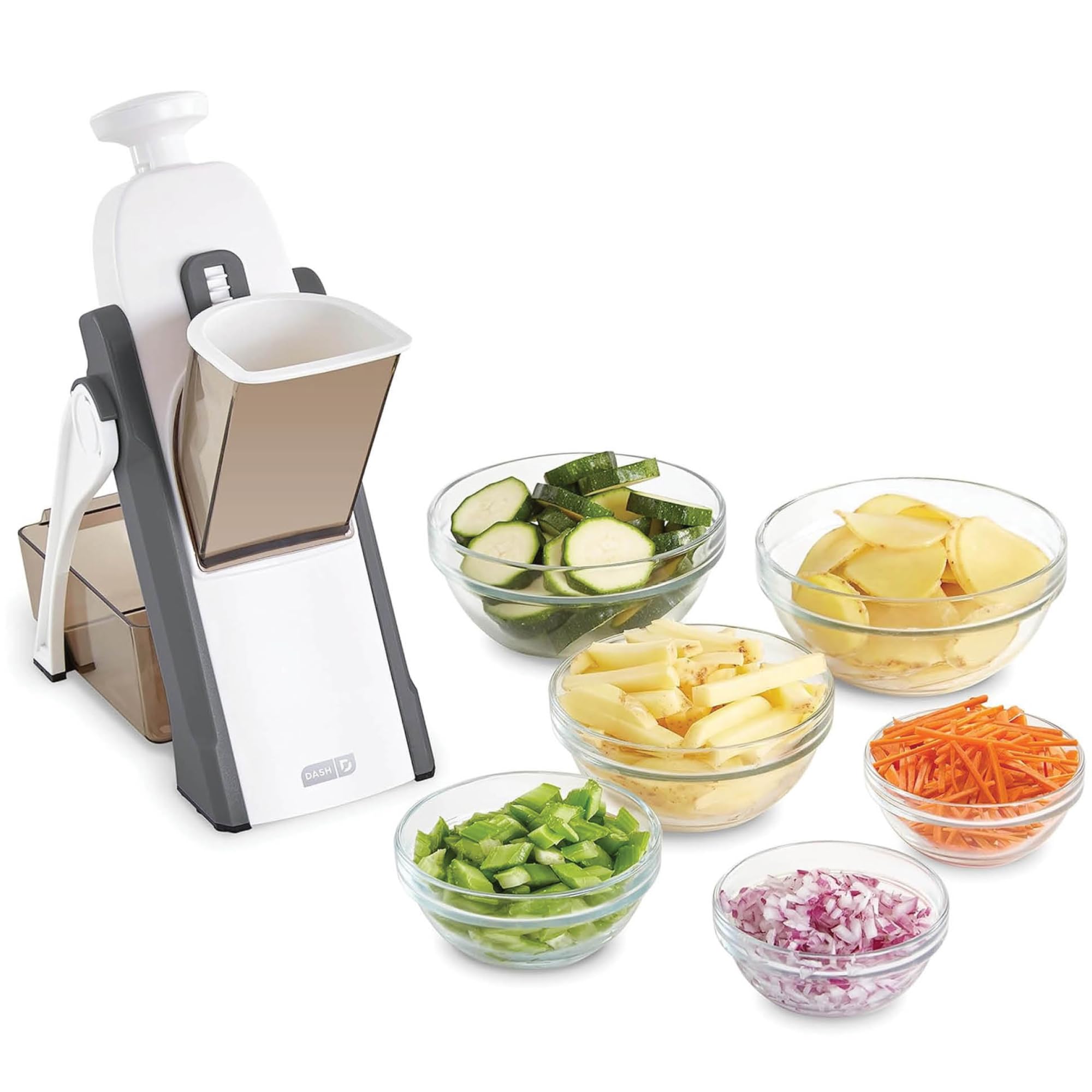
Dash Safe Slice
Key Features
- Storage: Folds down
- Safety system: Hands-away chute
- Slicing options: 30-plus presets
- Thickness range: 1–8 mm
- Price: Premium
The Dash puts a plastic chute and a pusher between your hand and the blade, and that is the whole appeal. You drop potato into the chute, press the handle, and the blade stays out of sight.
The 30-plus presets and 1–8 mm thickness range cover potato chips, julienne fries, and dice. The fold-down body stores compactly, and the catch container keeps slices off the counter. For a safety-first kitchen, that is a useful combination.
We think it earns its place for anyone who flinches at open blades, but firm potatoes need to be cut to fit the chute and can take real force. Some batches come out less cleanly than with a dedicated slicer. The trade-off is worth it for the hands-away design.
The fold-down body is the detail we appreciate most after use; it turns a bulky-looking tool into something that fits a cupboard. The catch container is a close second, because it keeps a pile of potato slices from spreading across the counter.
Pros
- Hands stay away from the blade
- 30-plus presets and 1–8 mm range
- Folds down for storage
- Catch container keeps slices contained
Cons
- Cleaning takes a brush in the crevices
We choose the Dash Safe Slice for cooks who want hands well away from the blade and more cut shapes than a plain mandoline, even if cleaning takes a brush.
Best for Small Kitchens
OXO Good Grips Handheld
Key Features
- Design: Handheld with non-slip handle
- Cleaning: Dishwasher safe
- Blade length: 8.5 inches
- Thickness settings: 1, 2.5, and 4 mm
- Price: Budget
The OXO earns its place by staying small. It is a handheld slicer with a non-slip handle and foot, a window for judging volume, and three thickness settings—1 mm, 2.5 mm, and 4 mm. We reach for it when we want potato chips or a quick gratin and do not want to haul out a countertop rig.
The three settings cover thin and medium slices, and the 8.5-inch blade and window make it easy to slice over a bowl or plate. The non-slip foot keeps it steady on a cutting board, and the hand guard is there for the end of the cut.
Large potatoes are awkward because the slicer is narrow; small and medium potatoes fit better. We still like it for the last few potatoes in the bag, where a big slicer feels like overkill. It is dishwasher safe, stores in a drawer, and the handle gives you a firm grip when the potato is wet.
Pros
- Three thickness settings for chips and gratins
- Non-slip handle and foot
- Window shows slicing volume
- Fits in a drawer
Cons
- No julienne or thick fry cut
We keep the OXO handheld for small batches of thin potato slices, where drawer space matters more than fry cuts.
Best for Simple Thin Slicing
PrepSolutions Adjust-A-Slice

Key Features
- Safety: Hand guard and blade lock
- Cleaning: Dishwasher safe
- Dimensions: 12.75 x 5 x 1.5 in
- Blade material: Ceramic
- Price: Budget
The Adjust-A-Slice keeps things simple: one slicing surface, a ceramic blade, and a low-profile body that slips into a drawer. There is no blade swap and no bulky catch tray.
For potatoes, that simplicity is the point. The adjustable dial gives you thin rounds for chips or scalloped potatoes, and the non-slip base holds it steady over a bowl. We like that there are fewer parts to wash and fewer places for starch to hide. The safety lock is the feature to check before every use.
The thickness range is limited compared with the multi-blade picks, so it is not the one for fries or julienne. What it does well is thin, even potato slices with very little fuss. The ceramic blade is the detail that keeps it useful for soft vegetables and fruit, and the compact body is why it stays within reach.
Pros
- Adjustable thickness for thin rounds
- Ceramic blade and compact body
- Few parts to clean
- Non-slip base
Cons
- Hand guard feels basic
We suggest the PrepSolutions Adjust-A-Slice for simple, compact thin slicing, especially when you do not need a drawer full of blades.
Best for Precision Chips
Benriner Mandoline

Key Features
- Care: Hand wash only
- Blades: 4 blades
- Slicing surface: 2.5 inches wide
- Thickness range: 0.5–8 mm
- Price: Premium
The Benriner is the most precise slicer here. Its Japanese stainless blade and four-blade set make clean, thin cuts, and the 0.5–8 mm dial covers chips, hash browns, and fine julienne. The 2.5-inch slicing surface is narrow, though, so it is happiest with small to medium potatoes.
The straight blade is the star for potatoes; it makes crisp rounds and shoestring strips with the julienne inserts. Dense potatoes can jam the julienne blades if you force them, so trim the pieces to fit and let the blade do the work. The safety guard holds smaller pieces, and the non-skid base keeps the slicer from skating across the counter.
It is a hand-wash tool in our book. The body disassembles for cleaning, but the blades need respect, and the narrow frame means you cannot rush a big potato through it.
We reach for the Benriner when the goal is a delicate potato chip or a pile of fine julienne, not when we are feeding a crowd. It is slower and narrower than the chute slicers, but the control is worth it for precise work. The blade can be removed for sharpening, which is a point in its favor for a tool this simple.
Pros
- Japanese stainless blade takes a fine edge
- 0.5–8 mm thickness dial
- Four blades for slices and julienne
- Non-skid base
Cons
- Hand wash only
We reach for the Benriner when we want thin, precise potato chips and julienne, and we accept a narrow slicer that rewards a deliberate hand.
Best for Chopping and Slicing
Mueller 10-in-1 Chopper

Key Features
- Blades: 8 blades
- Cleaning: Dishwasher safe
- Container: Catch container
- Dimensions: 11.18 x 5.47 x 5.2 in
- Price: Midrange
The Mueller is a chopper that also slices, not a mandoline that happens to chop. The 8-blade set and catch container are built around dicing and chopping, and the slicer insert is one part of that system. That matters if you want one gadget for onions, carrots, and potatoes.
For potato chips, the slicer insert works: it turns potatoes into thin rounds that cook evenly, and the container catches them. The chopper side is fast for potatoes destined for hash or soup. The french-fry insert is where the design shows its limit: the strips come out very thin, closer to shoestring than steak fries.
We like the Mueller for a crowded kitchen because it replaces several tools, but it is not the slicer we choose for a perfect gratin. The blades are sharp and the parts are dishwasher safe, though there are many pieces to keep track of.
The container is the part we use most; it turns the chopper into a prep bowl, not just a blade holder. The blade box keeps the inserts together, which matters when a drawer is already full.
Pros
- 8 blades cover chopping, slicing, and grating
- Catch container keeps prep contained
- Dishwasher-safe parts
- Slicer insert makes even potato chips
Cons
- Many parts to store and track
We think of the Mueller as the chopper-first pick: it makes quick work of potatoes for chips, but its fry cut is thin and it is not a dedicated mandoline.
Best for Glass Catch Bowl
Fullstar Safer Mandoline

Key Features
- Cleaning: Top-rack dishwasher safe
- Cutting modes: Slice, julienne, dice
- Safety system: Chute, pusher, hand guard
- Thickness range: 1–8 mm
- Price: Midrange
The glass catch container is the first thing we notice. Unlike the plastic trays on most mandolines, it gives you a clean view of the slices and does not pick up potato or carrot stains. The rest is familiar: a food chute, pusher, hand guard, and 1–8 mm dial for slices, julienne, and dice.
On potatoes, the chute does the work and keeps fingers out of the blade path. The slices are even enough for gratins, and the 8 mm top end is a real fry cut. The glass container is heavy enough to stay put, which we appreciate when the counter is crowded.
The folding stand is the part to treat gently. The body locks down for storage, but the hinge and handle are where a hard shove can cause trouble; a few rough uses can crack the plastic. The blades are sharp, and the catch container is the reason to pick this over a plastic-tray model.
We choose the Fullstar Safer when a glass container matters, especially for potato gratins and leftovers. It is not as established as the top pick, and the durability question is real, but the glass tray and the 1–8 mm range make it a useful alternative. The container is the part we keep using; it moves from counter to fridge without a separate bowl.
Pros
- Glass catch container resists staining
- 1–8 mm range covers slices and fries
- Food chute and hand guard protect fingers
- Top-rack dishwasher-safe parts
Cons
- Folding stand can crack under force
Our pick when a glass catch container matters is the Fullstar Safer, though its folding stand needs gentler handling than the top pick.
How We Tested the Best Mandoline Slicers for Potatoes
We started by researching the most popular and well-reviewed mandoline slicers on the market, then narrowed the field to 12 models that represented a range of blade styles, thickness settings, and price points. We ruled out anything with flimsy plastic frames or blades that couldn’t be removed for sharpening or replacement.
For six months, these slicers lived in my kitchen and my team’s kitchens, tackling potatoes in every form: thin rounds for scalloped potatoes, thicker slices for gratins, matchsticks for hash browns, and paper-thin chips. We sliced russets, Yukon Golds, and sweet potatoes, noting whether the blade glided or required force, if slices came out uniform, and how much time we saved compared to a chef’s knife. We stored each one in a standard kitchen drawer to see how much space it really took up.
Cleanup was a big part of the test—we noted how easily each model disassembled, whether food got trapped in the blade slots, and if the hand guard was intuitive to use or a puzzle. After repeated use, we checked for wobbling frames, dulling blades, and cracks in the plastic. We also factored in value: a budget slicer that slices evenly and cleans up quickly can be a better buy than a pricier model with fussy adjustments. The best ones earned their counter space.
How to Choose a Mandoline Slicer for Potatoes
For potatoes, the right mandoline is less about the number of blades and more about a stable cut, a thickness range that matches chips or fries, and a safety system you will actually use.
Start with the cut you want, not the blade count
A 1–2 mm setting gives you potato chips and delicate gratins; 3–4 mm is the workhorse for scalloped potatoes and quick sautés; 6–8 mm is where fries begin. If fries are the goal, look for a julienne mode or a dedicated fry blade, not just a straight slicer. The ONCE FOR ALL covers 0.1–8 mm and four cut modes, which is why it is our default. A three-setting handheld like the OXO is enough for chips and gratins, but it stops short of fries.
Safety systems change how you cut
Open-blade mandolines rely on a hand guard and a careful hand; chute slicers keep the blade behind plastic and use a pusher. We prefer a chute for dense potatoes because it gives you leverage and keeps your fingers out of the path. The trade-off is size: a chute can be too small for a large russet, so you trim the potato to fit. The Dash and ONCE FOR ALL show the pattern—safety first, with a little prep before the cut.
Stability and leverage matter with dense potatoes
Potatoes are dense, so a slicer that skates or flexes is worse than a sharp knife. A non-slip foot, a wide base, or a catch container that sits flat all help. Handheld models like the OXO work for small batches because the handle and foot hold the slicer against a board or bowl; countertop models like the Fullstar Pro use a catch tray and a broader stance. If you regularly slice more than a couple of potatoes, choose the more stable design even if it takes up more space.
Cleaning and storage decide how often you use it
Potato starch dries into crevices, so removable blades, a brush, and a dishwasher-safe body are not luxuries. A folding chute slicer saves cabinet space, but the hinge and blade housing need attention. A simple handheld like the PrepSolutions is quicker to rinse and store, while a multi-blade kit has more parts to keep together. We prefer a slightly slower slicer that cleans easily to a fast one that stays in the cupboard.
Frequently Asked Questions
Why use a mandoline for potatoes instead of a knife?
A knife can make potato slices, but keeping them truly even at 1–3 mm across a whole batch is slow work. A mandoline is the easier way to get chips that crisp at the same rate or gratin layers that stack flat. If you slice potatoes only once or twice a month, a sharp chef’s knife is still a reasonable choice.
Can a mandoline handle sweet potatoes?
Yes, but sweet potatoes are denser than russets and punish a light, flexing slicer. Choose a sharp blade and a stable base, trim the potato to fit the chute, and use a pusher rather than your hand. A 4–8 mm setting is more forgiving than a paper-thin cut; a flimsy handheld can flex before the blade gets through.
How do I keep potato slices from sticking to the blade?
Cut the potato to fit the chute, do not overload the slicer, and clear the blade housing with the brush before starch builds up. Rinse the slices in cold water and pat them dry before cooking. A wet, starchy potato pushed too quickly is what causes clumping and uneven slices.
Final Verdict
Buy the ONCE FOR ALL if you want one mandoline that handles potato chips, gratins, and fries with a blade you never touch. Its 0.1–8 mm range and chute design make it the best default for potato prep, and the four cut modes cover more than a straight slicer.
If your kitchen is short on drawer space and you mainly make thin chips, the OXO handheld is the better fit; if you want a budget multi-blade kit with a catch tray, the Fullstar Pro is the one.