This post contains affiliate links. We may earn a small commission when you buy through our links — at no extra cost to you.
Weighing your food instead of scooping it is the habit change that makes meal prep actually work: four ounces of chicken is four ounces, the macros on your spreadsheet mean something, and Sunday’s containers stretch to Friday. The catch is that a bad scale turns the routine into a chore — numbers that drift between weighings, a platform so small a container hides the display, a battery that quits mid-recipe. We’ve had 14 scales on the counter for four months now, and the good ones separate themselves fast.
What surprised me is how often the small things decide it, and how rarely price does. A scale that reads in 1-gram steps is fine for a chicken breast and maddening for yeast; one that reads in 0.1-gram steps is lovely until you set a stockpot on it. Capacity, display angle, and how quickly the numbers settle matter more, day to day, than a tenth of a gram. The picks below cover both kinds of cooks, and every one of them earned its place.



Best for Portioning Meals
Etekcity EK3551 Food Scale with Bowl
Key Features
- Bowl: Detachable, doubles as cover
- Units: oz, lb:oz, g, mL, fl’oz
- Capacity: 11 lb / 5 kg
- Increments: 1 g / 0.1 oz / 1 mL
- Price: Midrange
The detachable bowl is the most useful single idea in this group. It clips on for weighing, lifts off so you can carry a prepped portion to the stove or straight into the fridge, and turned over it sits on the platform as a cover. That is one vessel instead of two, and one less thing to wash after you have portioned four lunches.
Underneath, it is a straightforward 11 lb scale with 1 g steps, a tare button that resets instantly, and the usual unit list of grams, ounces, pounds-and-ounces, milliliters, and fluid ounces, plus water and milk volume modes for recipes written in cups. The add-and-weigh habit works well here: tare the bowl, weigh the rice, tare again, weigh the protein, and the display keeps up without the lag that makes you stop and wait.
The limit sits at the bottom of the range. There is a 5 g minimum for dependable readings, so a gram of yeast or a pinch of salt can sit at zero however carefully you sprinkle it. Build the heavier ingredients first and add the small stuff on top of them, and it registers fine.
Cleaning is the quiet win: stainless platform and bowl wipe down in seconds, with no raised buttons for flour to pack into. Two AAA batteries come fitted, the backlight stays readable with the bowl loaded, and the two-year warranty is longer than most here. It is the one we leave out on the counter, which is the highest compliment a kitchen scale gets.
Pros
- Detachable bowl doubles as a platform cover
- 1 g steps with fast tare and add-and-weigh
- Stainless surface wipes clean in seconds
- Two-year warranty, batteries included
Cons
For anyone portioning meals in grams, this is the scale we recommend: the bowl makes weighing, carrying, and storing one motion instead of three.
Best for Small Budgets
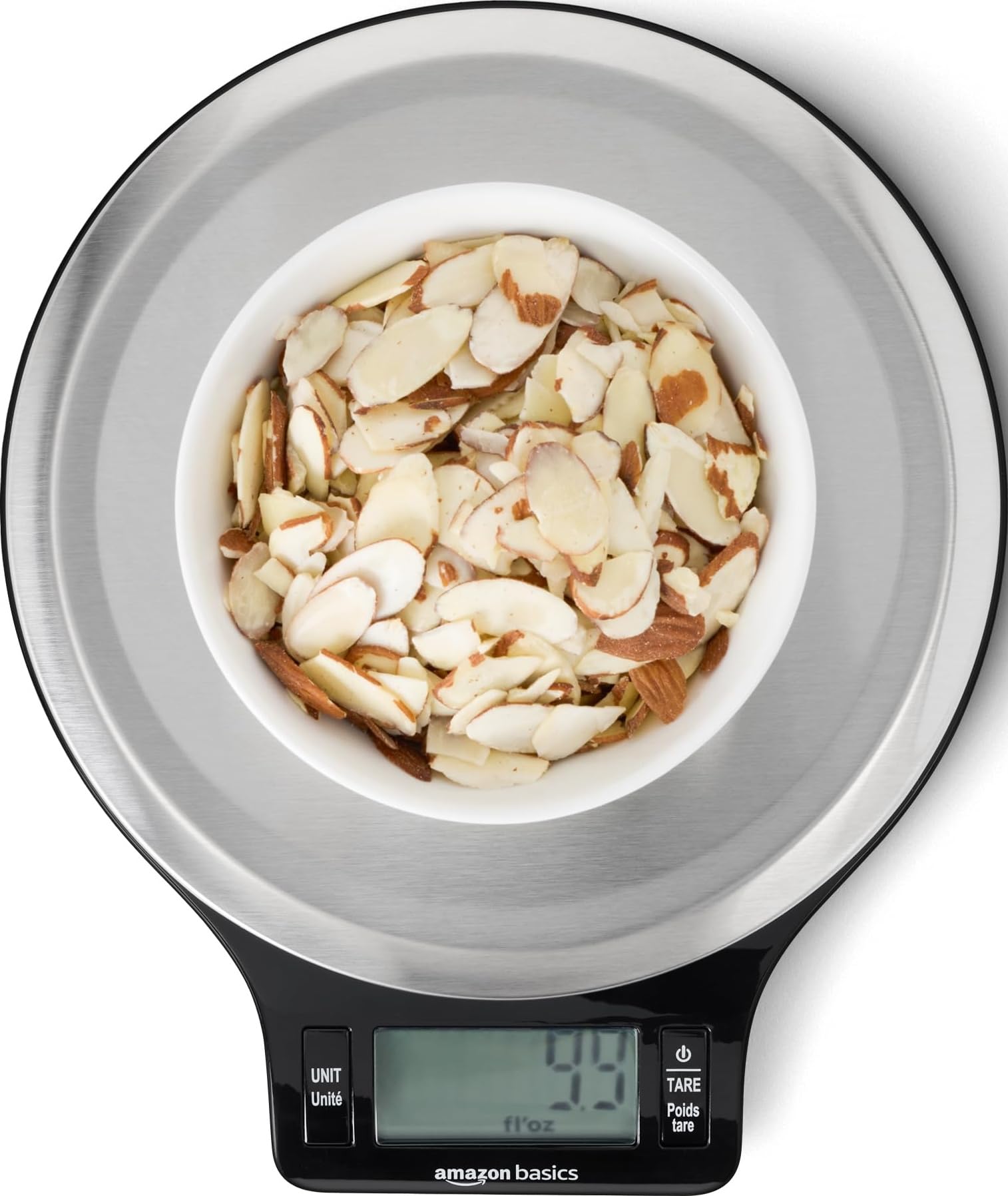
Amazon Basics Digital Kitchen Scale
Key Features
- Readout: 0.04 oz
- Capacity: 11 lb
- Platform: Stainless steel
- Minimum weight: 0.07 oz
- Price: Budget
Eleven pounds of capacity, 1 g increments, a tare button, five units, and a stainless platform wide enough for a dinner plate: this is the scale that proves you do not have to spend much to portion food properly. Two AAA batteries come in the box, and the body under the steel is BPA-free plastic.
Our reservation is longevity rather than day-one performance. When one fails, it tends to fail early, with a display that dims and then dies or buttons that stop responding inside the first year, so the return window does most of the work. As a first scale, a second one for the pantry, or the one that goes to a dorm, it earns its place easily; as the only scale in a house that preps every day, it is a gamble.
One practical detail: the platform is broad but the housing beneath it is small, so a wide plate can rock when you set it off center. Flat-bottomed bowls sit true, and centering the plate fixes it.
Pros
- Wide stainless platform holds a dinner plate
- 1 g increments and a working tare at the lowest price here
- Batteries included, nothing else to buy
Cons
- Additions under 2 g may not register
The budget pick we are comfortable recommending: a full-size platform and 1 g steps, with the caveat that it may not last a decade.
Best for Big-Batch Baking
Cooking Master 22 lb Food Scale
Key Features
- Readout: 1 g / 0.1 oz
- Surface: Tempered glass and stainless steel
- Capacity: 22.04 lb (10000 grams)
- Weighing range: 0.1 oz to 22 lb (2 g/3 g to 10 kg)
- Price: Midrange
Twenty-two pounds of capacity is the pitch, and it answers a specific problem: an 11 lb scale runs out the moment you set a heavy mixing bowl on it and start adding a double batch of dough. At 22 lb (10 kg) with 1 g steps, this one keeps counting.
The top combines tempered glass with a stainless surface, which wipes clean in one pass, and the backlit display sits where a wide bowl does not hide it. Tare works through a heavy bowl, and the unit button cycles grams, kilograms, pounds-and-ounces, fluid ounces, and milliliters.
Of the high-capacity scales here, this is the one whose readings we trusted most in the gram range: the numbers held steady as we trickled ingredients in rather than jumping. The trade is counter space, since it has a bigger footprint than the slim 11 lb models and wants a permanent spot. For big-batch baking, that is the right trade to make.
Pros
- 22 lb capacity that holds 1 g increments
- Backlit display stays visible under a wide bowl
- Glass and stainless top wipes clean
- Steady readings when adding small amounts
Cons
- Minimum 2 g to 3 g for small additions
We reach for this one for big-batch baking: 22 lb of capacity that still resolves in 1 g steps.
Best for Everyday Simplicity
Escali Primo P115C
Key Features
- Readout: 1 g / 0.05 oz
- Capacity: 11 lb (5,000 g)
- Controls: Two-button sealed panel
- Dimensions: 8.5 x 6 x 1.5 in
- Price: Midrange
Two buttons, a sealed membrane over the controls, and a rounded plastic body: this is the least complicated scale here, and for a lot of kitchens that is the entire argument. No app, no mode to learn, no backlight to forget to switch off. You put a bowl down, press tare, and weigh.
It reads to 1 g (0.05 oz) up to 11 lb, which covers portioning, baking, and coffee, and auto shut-off keeps it from draining itself between uses. The finish is chrome-colored plastic rather than metal, worth knowing before it lands next to your appliances.
The sealed panel is the real reason to buy it. Flour, oil, and wiped-up spills stay on the surface instead of working their way into the buttons, and the rounded body has no crevice to dig at with a cloth. Backed by a five-year limited warranty, it is the scale you buy once and stop thinking about.
Pros
- Sealed two-button panel wipes clean
- 1 g increments up to 11 lb
- Five-year limited warranty
Cons
- Wide bowls can hide the front display
We keep it here for the two-button panel, the wipe-clean seal, and the five-year warranty, a reminder that less to learn is a feature.
Best for Wide Bowls
OXO Good Grips 11-Pound Scale
Key Features
- Meter: Shows remaining capacity
- Display: Pull-out, optional backlight
- Readout: +/- 1 g or +/- 0.1 oz
- Capacity: 11 lb
- Price: Premium
Set a wide mixing bowl on any scale and it sits between your eyes and the numbers. OXO’s answer is a display head that pulls out on a short arm, so it clears the rim of the bowl or a dinner plate and you can read it without leaning over the counter.
We expected a gimmick and came away calling it a habit. Taring a bowl you cannot see the screen past means pressing zero twice to be sure, and the arm removes that doubt in one movement. The rest is solid: 1 g or 0.125 oz increments to 11 lb, large digits with an optional backlight for a dim kitchen, and a meter that shows how much capacity is left, which is genuinely handy when you are loading a stockpot.
There is no bowl in the box, and it costs more than anything else here by a wide margin. That is the honest trade for the display arm, and if you portion onto plates and into wide bowls more often than into a mixing bowl, it is an easy one to justify.
Pros
- Pull-out display clears wide bowls and plates
- Capacity meter shows remaining headroom
- Optional backlight and 1 g increments
Cons
- Heaviest pick here, so it lives on the counter
Worth the premium if you weigh into wide bowls: the pull-out display keeps the numbers visible, and we think that fixes a daily annoyance.
Best for Bulk and Rechargeable
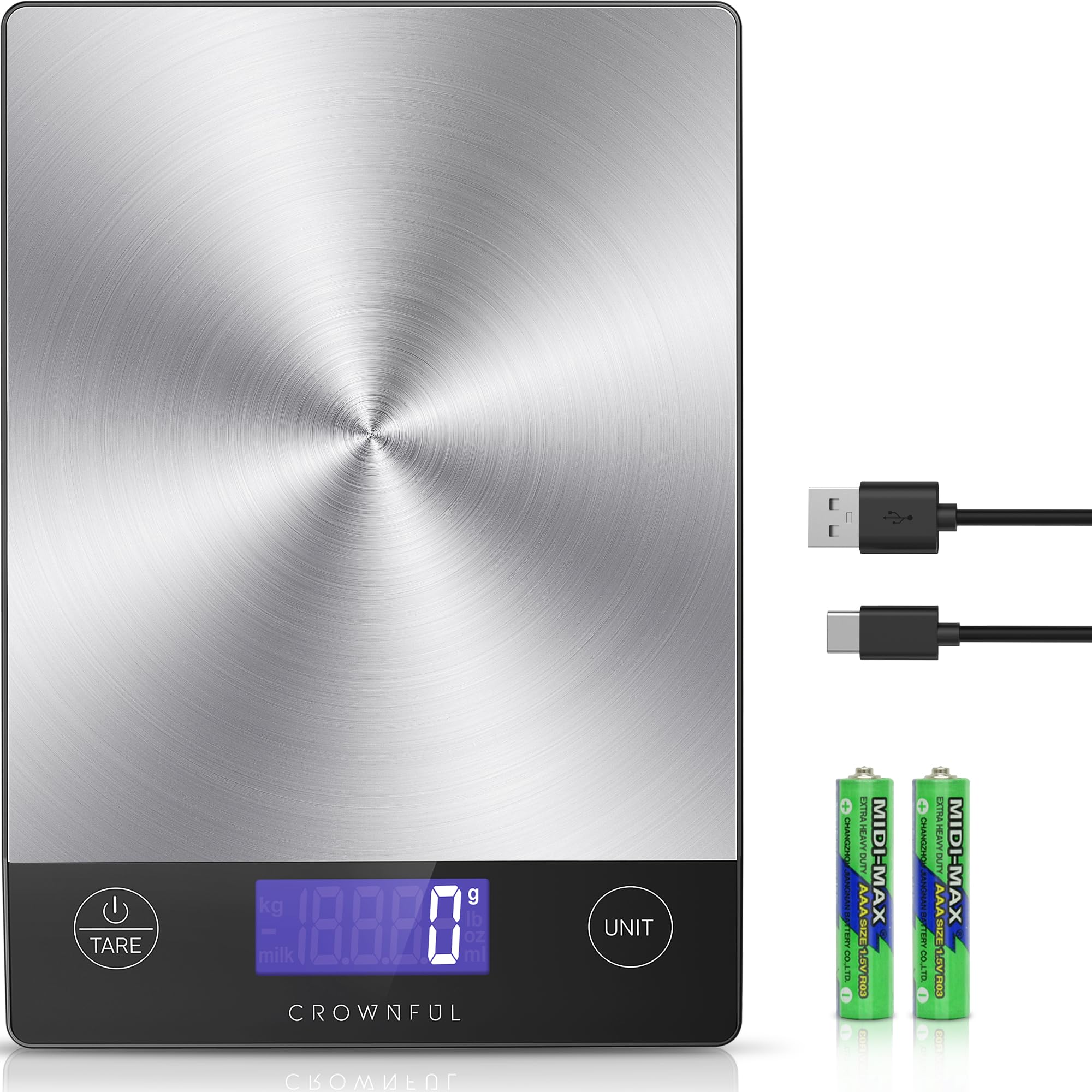
CROWNFUL K210H 33 lb Scale
Key Features
- Power: USB-C or 2 AAA batteries
- Readout: 0.04 oz
- Capacity: 33 lb / 15 kg
- Minimum weight: 0.11 oz
- Price: Midrange
Two ways to keep this one running: a USB-C port and a pair of AAA batteries, both in the box. That is more practical than it sounds, because a scale that dies halfway through portioning is a genuine nuisance, and the battery bay turns the cable into a convenience rather than a dependency.
Capacity is the other headline. Thirty-three pounds (15 kg) with 1 g steps, on a wide stainless panel that takes a full stockpot or a bulk sack of flour without complaint. The screen is angled back so a tall pot does not hide the numbers, and the unit button cycles grams, kilograms, pounds, ounces, milliliters, and a milk mode.
Where it needs care is the small end. The readings can drift while nothing is being added, so we tare once and add small amounts in a single pour rather than trickling them in. Heavy, high-volume work is what this scale is built for; for gram-level portioning, one of the 11 lb picks suits better.
Pros
- Charges over USB-C or runs on AAA batteries
- 33 lb capacity with 1 g steps
- Wide stainless panel and angled display
Cons
- Charge runs down quickly with daily use
Bulk weighing is where this one earns its keep: 33 lb of capacity, and a USB-C port we actually use.
Best for Small Kitchens
Greater Goods 480 Food Scale

Key Features
- Battery: CR2032, preinstalled
- Readout: 0.04 oz
- Capacity: 11 lb (5 kg)
- Warranty: 5 years
- Price: Midrange
Seven ounces and a body thin enough to stand on edge: this is the scale that disappears into a drawer, which matters when your counter already holds a board, a kettle, and whatever is for dinner. The CR2032 cell comes fitted, and the non-backlit LCD is a deliberate trade to spare the battery.
On the platform it is a plain 11 lb (5 kg) scale with 1 g steps, one-touch tare, and conversion between grams, ounces, pounds, and milliliters. Auto shut-off is on by default, so a forgotten scale does not sit there draining itself.
The display is not backlit, and in a dim kitchen you will squint at it, which is a fair swap for battery life and less fair at six in the morning with the overheads off.
Set against the rest, it is the storage-first pick: slim, light, and carrying the longest warranty here at five years. For a small kitchen where the scale lives in a drawer between uses, that combination is hard to argue with.
Pros
- Slim, light body stores upright in a drawer
- Five-year warranty, the longest in this group
- One-touch tare and four units
Cons
- Readings wander on very small additions
We point cramped kitchens here: the 480 is slim enough to live in a drawer and light enough to forget about.
Best for Bulk Ingredients
KOIOS K68 33 lb Scale

Key Features
- Power: USB-C or 2 AAA batteries
- Readout: 0.1 oz
- Capacity: 33 lb
- Platform: 9.0 x 6.3 in tempered glass
- Price: Midrange
The top is a single piece of tempered glass with no seam around the edge, so flour, oil, and wiped-up egg have nowhere to collect. Of everything here, this is the easiest surface to clean, and it is the reason the scale has a place in this guide at all.
It goes to 33 lb, runs on USB-C or two AAAs, and shows five units on a backlit LCD whose white characters stay legible in a dim kitchen. Tare is a single press, and the 9 by 6.3 inch platform takes a wide bowl without overhang.
The catch is resolution. This one works in 0.1 oz steps, roughly 2.8 g, not the 1 g the meal-prep picks here manage. Portioning rice or chicken, you will watch the number jump rather than climb, and small additions can sit unregistered.
So it earns its spot for bulk and wet work: a sack of potatoes, a bowl of batter, anything where the cleaning matters more than the last gram. For portioning lunch by the gram, choose one of the 1 g scales above.
Pros
- One-piece tempered glass top wipes clean
- 33 lb capacity, USB-C or AAA power
- Backlit display readable in low light
Cons
- 0.1 oz resolution is coarse for portioning
We like it for bulk and wet ingredients, with one honest caveat: it resolves in 0.1 oz, not grams.
How We Tested the Best Kitchen Scales for Meal Prep
We started by pulling together roughly 60 scales from major retailers and cutting the list by the things that actually matter for meal prep: a capacity of at least 5 pounds, readable increments, a platform wide enough for a full container, and a flat top that wipes clean. Reviews that mentioned drifting readings or units that arrived dead got a model cut. That left 14 scales, a mix of budget and mid-range, and they’ve been in daily rotation for four months.
Accuracy came first. Every scale was checked against a 100-gram calibration weight at the start of testing and again at the end, and we weighed the same bowl of rice three times in a row to see whether the reading repeated. We also dropped 5 grams of salt and 7 grams of yeast onto each platform to find out which ones rounded to the nearest 5 and which held the odd gram. Any scale that disagreed with itself between sessions was retested, then set aside.
The rest was lived-in testing. We portioned Sunday chicken and rice, weighed coffee at six in the morning, and set a stockpot on each platform to see how the display held up under a wide bowl at counter height. We counted button presses to tare and to switch between grams and ounces, watched whether the numbers settled or hunted, and judged glare and viewing angle from a standing position. Each scale was wiped with a damp cloth after every use and one survived a slide off the counter; we logged the date whenever a battery died and what it took to replace it. Value got the last word: a cheap scale that skipped grams wasn’t cheap.
How to Choose a Kitchen Scale for Meal Prep
The scale that helps most with meal prep is not the one with the biggest number on the box; it is the one whose tare you can reach with a full bowl in the way, and that registers the small stuff.
Precision Before Capacity
Most meal prep happens between 30 g and 500 g, where 1 g resolution is exactly what you want. Capacity only becomes the deciding figure when you weigh into big vessels: an 11 lb scale handles a bowl of oats, a chicken portion, and a batch of pancakes, but a heavy mixing bowl plus a double batch of dough will push past that ceiling.
Watch what you trade at the top end. The KOIOS resolves in 0.1 oz, which is fine for a sack of potatoes and coarse for 40 g of rice, while our 22 lb pick keeps its 1 g steps. Higher capacity is worth paying for only when the precision survives it.
Check the Minimum, Not Just the Increment
Every scale has a floor below which small additions may not register at all, and it is rarely the number on the front of the box: 2 g on the Amazon Basics, 3 g on the CROWNFUL, 5 g on our top pick. If you portion yeast, salt, spices, or supplements, that floor decides whether the scale is useful to you.
The workaround is technique, not equipment: load the heavy ingredients first, then add the light ones on top of what is already there. The scale reads the total, so the small additions land. If your prep is mostly small weights, buy the scale with the lowest floor you can find.
Tare and the Add-and-Weigh Rhythm
Tare is the button you will press most, and the useful question is how fast it answers. A scale that pauses before settling makes you wait before every addition; one that zeroes instantly lets you build a lunch in a single bowl without thinking about it.
Auto shut-off matters for the same reason. A short timer that fires while you are chopping forces you to re-tare and start the count again. Generous shut-off and a quick zero are worth more day to day than an extra unit mode you will never use.
Flat, Sealed, and Easy to Wipe
Meal prep means raw chicken, oil, flour, and egg on the platform, and the platform is the easy part. What collects food is everything around it: raised buttons, a seam at the bezel, a ridge where the top meets the body.
A sealed membrane like the Escali’s or a one-piece glass top like the KOIOS’s saves a few seconds every single day, and seconds are what meal prep actually runs on. Wipe, do not soak, and the electronics stay out of trouble.
Power: AAAs, a Coin Cell, or a Cable
Battery life is a recurring weak point on budget scales, and the power source is where you decide how much it will annoy you. Standard AAAs are cheap and swappable anywhere; a CR2032 lasts but is fiddly to source; USB-C is convenient right up until the charge runs down mid-prep.
Our preference is a scale that takes standard AAAs, with a charging port as a bonus rather than a replacement. The CROWNFUL is the model here that offers both, and that arrangement is the one we trust when the cable has gone missing again.
Frequently Asked Questions
Can I weigh liquids in milliliters on a kitchen scale?
Only as an approximation. Milliliter and fluid-ounce modes assume the density of water, so they are close for stock, milk, and juice, and the milk mode on some scales adjusts for that. For anything that matters, such as oil for a dressing or syrup for a bake, weigh in grams instead.
The conversion is easy to remember: a milliliter of water weighs a gram. Anything denser than water will read low in volume mode.
How do I check that my scale is accurate at home?
Use something with a known weight. A US nickel weighs 5 g, so ten of them should read 50 g, and a sealed bag of flour gives you a rougher check at the other end of the range.
Then weigh the same object twice, lifting it off between readings. A scale that gives two different numbers, or that does not return to zero, needs fresh batteries before it needs replacing.
Why does the reading change when I set the bowl down again?
Placement and surface, usually. Scales read through feet or a strain gauge, and a soft mat, a stovetop, or an unlevel counter throws the load off. Set the scale on a bare, hard, level counter and put the bowl in the middle rather than on a corner.
If the number drifts while nothing is being added, check the battery first. That is the most common cause, and it is the cheapest to fix.
Final Verdict
The Etekcity EK3551 is the scale we point most people to. Its bowl turns weighing into one motion, portion, lift, carry, and the 1 g readings and quick tare do the rest of the work.
If your prep is big-batch baking, the Cooking Master’s 22 lb capacity is the better tool. If you weigh into wide bowls and cannot see the numbers, the OXO’s pull-out display solves exactly that. Buy for the way you actually portion, not for the biggest capacity on the shelf.