This post contains affiliate links. We may earn a small commission when you buy through our links — at no extra cost to you.
A lunch bag on a construction site has to survive rough handling, hot weather, and the weight of a full day’s meals. Many bags marketed as ‘heavy-duty’ fail within weeks—zippers jam, strap attachments snap, and insulation gives out by lunchtime. The ones that actually hold up balance rugged materials with enough capacity for a 12-hour shift.
The main trade-off is between modular versatility and compact reliability. Bags with MOLLE webbing or extra compartments offer flexibility for pouches and organization, but can be bulkier. Simpler designs with fewer moving parts often fit in tight lockers and have fewer failure points.
Understanding what you’ll pack—multiple meal prep containers, tall thermoses, or just a few items—determines whether a roomy 16L bag or a compact 8L option suits your day. The right choice keeps your lunch cold and your frustration low.


Best for Blue Collar Work
ThinkFit Tactical 16L
Key Features
- Capacity: 16 L
- Material: 900D Oxford
- Carrying: MOLLE webbing
- Price: $$
The ThinkFit Tactical Lunch Box wraps a 16-liter interior in 900D Oxford fabric with military-grade zippers and a waterproof lining, then adds MOLLE webbing across the front and sides. This construction handles the scrapes and drops that come with construction work, and the webbing lets you clip on tool pouches or a radio without losing space inside. Included meal containers and a shaker bottle add immediate value for meal preppers.
The bag is best suited for workers who pack three to four full-size meal prep containers plus snacks — the listed six-container claim is optimistic. Occasional reports of seam separation after a month of daily use suggest the long-term durability isn’t bulletproof across all units, but the heavy-duty materials and reinforced stitching give it a clear advantage over softer bags that collapse or rip within weeks.
Pros
- MOLLE webbing allows attaching tool pouches or radios directly to the bag.
- 16-liter capacity handles a full day’s meals and snacks with room to spare.
- Comes with a set of meal containers and a shaker bottle, saving the cost of extras.
Cons
- Six full-size meal prep containers can feel tight; the bag fits three to four comfortably.
- Seam integrity can vary — some units show separation after a month of heavy use.
If you work a blue-collar job and need a lunch bag that stands up to tools, dirt, and daily hauling, the ThinkFit delivers where soft-sided coolers give out — just plan for four containers, not six.
Best for Moderate Lunch Needs
Carhartt Worksite Lunchbox
Key Features
- Capacity: 8 L
- Material: Plastic, Polyester
- Carrying: Shoulder strap
- Price: $$
The Carhartt Worksite Lunchbox separates itself from tactical competitors with a dual-compartment layout that keeps food and drinks organized – no MOLLE webbing, but reinforced stitching and a thick exterior handle job site abuse. It’s best suited for construction workers with moderate lunch needs (8L fits ice packs, multiple containers, and a water bottle), though those packing four or more large containers will find the capacity limiting.
Pros
- Reinforced stitching and tough exterior handle job site abuse.
- 8L capacity fits ice packs, multiple containers, and a water bottle for a full shift.
- Insulation keeps lunches cool through 10-hour shifts with ice packs.
Cons
- Can be too small for workers needing to pack four or more meal containers.
- Insulation may lose effectiveness in extreme heat without substantial ice packs.
A durable choice for construction workers with standard lunch needs – grab it if you want a bag that lasts years without tactical extras.
Best for Budget Max Space
GLENKEY Expandable 16L
GLENKEY’s Expandable 16L delivers the highest capacity in its budget tier, with a water-resistant Oxford exterior that shrugs off rain and job-site splashes. The insulation, when paired with ice packs, keeps food cold through an eight-hour shift. For construction workers who need to pack a full day’s meals and aren’t expecting the bag to outlast premium tactical options, this is a practical buy. However, the zipper can stick in gritty conditions, and some owners have noted seam separation after several months of daily use.
Pros
- Expandable 16L capacity fits a full shift’s worth of meals and drinks.
- Water-resistant Oxford fabric holds up well against rain and job-site splashes.
Cons
- In dusty or gritty worksites, the zipper may stick or catch on the fabric lining.
- For workers who load the bag heavily every day, seam separation has been noted after several months.
Best for buyers who want maximum meal capacity per dollar and can accept that the bag won’t endure years of daily abuse.
Best for Separate Wet/dry
MIER Dual Tote 14L
Key Features
- Capacity: 14 L
- Material: Polyester
- Carrying: Padded shoulder strap
- Price: $$
The MIER Dual tote provides a clean separation between a dry upper compartment and an insulated cold lower compartment, with bottle holders and a padded shoulder strap. Compared to tactical bags with MOLLE webbing, this tote prioritizes a polished look and organized packing. It suits workers who need ample capacity for a full shift’s food and drink and prefer distinct zones over modular attachments. Note that the zipper can catch on the interior fabric, and occasional seam leaks have been noted in the bottom compartment — worth checking before loading liquids.
Pros
- Separate dry and cold compartments keep items organized.
- Stitching and zippers hold up under daily use.
- Insulation keeps food cold throughout long shifts.
Cons
- Zipper may catch on the fabric lining when closing.
- Bottom compartment seam can leak in some units.
A strong dual-compartment option for workers who value organization and capacity over tactical extras — just be mindful of the zipper and seam quirks.
Best for Hot/cold Separation
MIER Dual Compartment 10L
Key Features
- Capacity: 10 L
- Material: Polyester
- Carrying: Adjustable shoulder strap
- Price: $$
The MIER lunch bag’s extra-tall bottom layer sets it apart for workers carrying upright thermoses or tall soup containers — a practical twist on the dual-compartment format. The 10L capacity holds a full day’s meals for 12-hour shifts, with separate zones keeping hot and cold items organized.
This size works best for those with ample locker space or truck cabs; the 9" x 7" x 11" footprint can crowd smaller lockers or break room fridges. The polyester build holds up to daily job site use, though the plastic handle warrants care under heavy loads.
Pros
- Extra-tall bottom compartment accommodates upright thermoses without tipping.
- Dual compartments keep hot and cold foods separated for organized packing.
- Durable polyester construction stands up to daily job site handling.
Cons
- Plastic handle can crack when the bag is loaded with heavy meals.
A solid choice for workers who need tall container storage and dual-zone organization — just confirm your locker can fit the footprint.
Best for Budget Max Capacity
MIYCOO Double Deck 15L
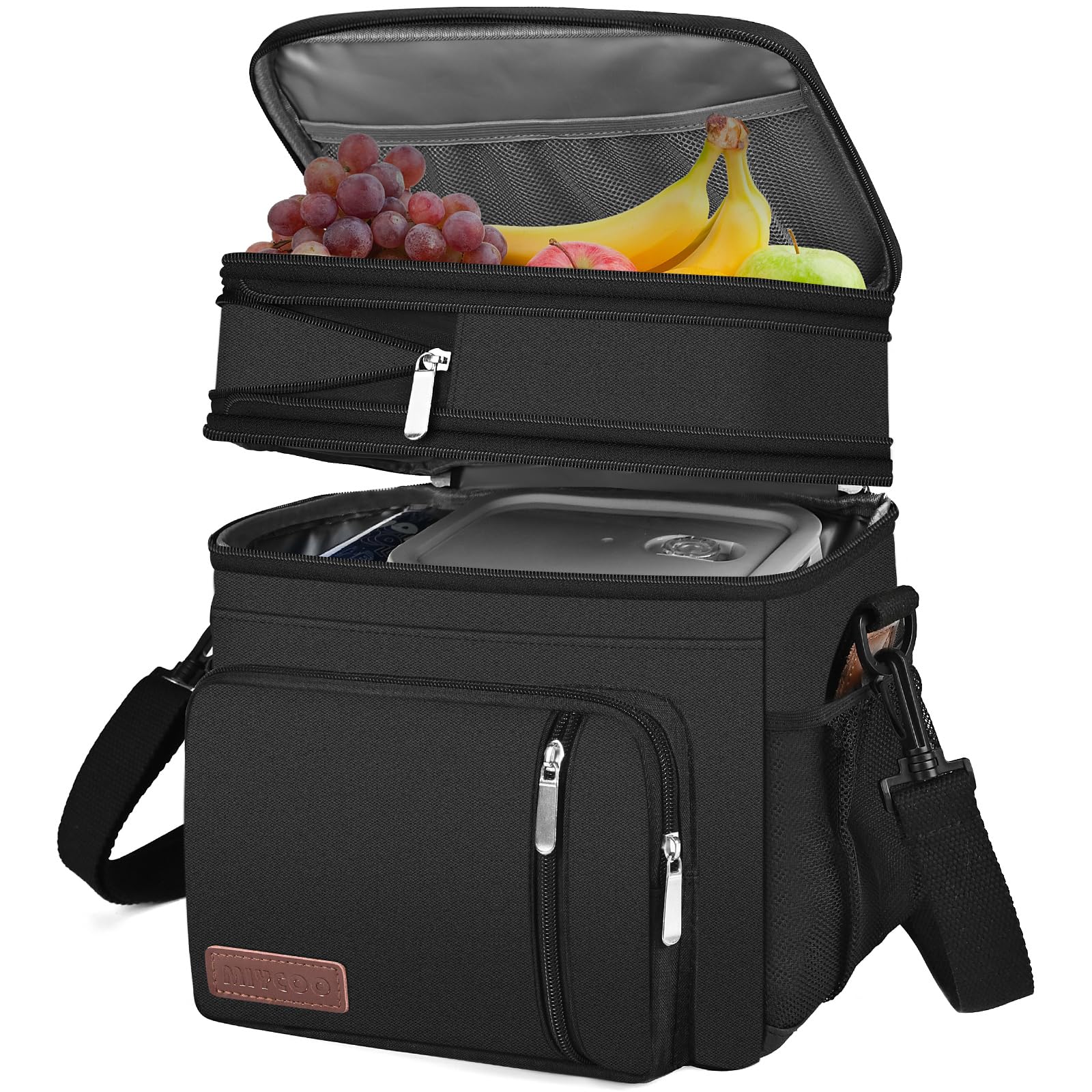
Key Features
- Capacity: 15 L
- Material: Polyester
- Carrying: Removable shoulder strap
- Price: $
This bag crams a 15-liter expandable main compartment with side pockets and a separate dry section into a budget-friendly package — enough room for multiple meals, drinks, and snacks. Insulation holds up for a full shift when paired with ice packs. However, the soft polyester shell can collapse and sag when not packed full, and the strap attachment hardware has been noted to give way under heavy loads. Those tradeoffs keep it from job-site duty but make it a practical choice for picnics, beach trips, or office lunches where volume matters more than ruggedness.
Pros
- Large 15L capacity with expandable top fits multiple meals and drinks.
- Multiple pockets and compartments for organized storage.
Cons
- Bag can collapse and lose shape when not fully packed; strap attachments may break under heavy loads.
A solid value for picnics, beach days, or casual office lunches where budget and storage space take priority over job-site toughness.
Best for Budget Backup Bag
OPUX Double Decker 12L

The OPUX Double Decker provides 12 liters of capacity split into two compartments, making it easy to keep a hot meal separate from cold items. Temperature retention holds up well with ice packs. However, the zipper can jam or malfunction under regular use, and the seams may pull apart when the bag is packed full — these limitations make it a better fit for backup or occasional use than for daily job site demands.
Pros
- Two separate compartments keep hot and cold foods organized
- Holds temperature well when used with ice packs
Cons
- Zipper can jam or malfunction under regular daily packing
A capable double-decker lunch bag for occasional use or as a backup, but not built to withstand daily construction work.
Best for Light Office Use
Lifewit Medium 9L

Key Features
- Capacity: 9 L
- Material: Polyester
- Carrying: Adjustable shoulder strap
- Price: $
For $8, the Lifewit provides decent insulation for a few hours with an ice pack and holds standard containers. However, the polyester construction and strap attachments are not built for daily heavy use — under the constant loading a construction worker would subject it to, the handles and zippers can give way within months. This is a temporary solution for light packing, not a job-site workhorse.
Pros
- Budget-friendly price with decent insulation for the cost
- Good capacity for a standard lunch with containers and drinks
Cons
- Under daily heavy use on a job site, strap attachments and zippers can fail within months
Works as an inexpensive backup or for light office lunches, but lacks the durability for construction work.
How to Choose
The bag’s material and stitching determine whether it lasts months or years on a construction site, but capacity and insulation decide if your lunch stays cold and fits your appetite.
Capacity and Volume
A too-small bag means packing fewer meals; an oversized one may not fit in a crowded locker. Capacity is measured in liters or can count, but shape matters – a 16L bag that is tall and narrow might not hold wide meal prep containers. Look for a bag that fits your typical containers with room for an ice pack.
Build and Stitching Quality
The fabric denier (weight) and stitch reinforcement directly impact longevity. 600D polyester is common but can fray under heavy use; 900D Oxford or ballistic nylon is tougher. Reinforced stitching at stress points – handles, strap attachments, zipper seams – prevents early failure on job sites.
Insulation and Temperature Retention
Most bags use foam or PEVA lining to keep food cold. Thicker insulation maintains temperature longer but adds bulk. For hot construction sites, a bag with a high-density foam layer and a reflective interior can keep food cold for 8-10 hours with a quality ice pack. Without sufficient ice packs, even the best insulation struggles above 90°F.
Leakproof Lining
A leakproof lining is essential for soups and sauces. PEVA (polyethylene vinyl acetate) is common and effective, but cheap heat-sealed linings can separate after a few months. Look for stitched and taped seams for lasting protection.
Carrying and Attachment Options
A padded shoulder strap is standard, but its attachment anchor point is a common failure spot – check that it’s reinforced with bar-tack stitching. MOLLE webbing allows modular pouches for tools or extra food, but adds weight and complexity. For tight spaces, a compact bag with a sturdy handle might be simpler.
FAQ
How many meals can a 16L lunch bag hold for a construction worker?
A 16L bag typically holds 3-4 full-size meal prep containers plus snacks and an ice pack. Taller items like thermoses may reduce the count. For most workers, that’s enough for a full day on site.
Why do lunch bag zippers keep breaking on construction sites?
Dust and grit from job sites get into zipper teeth, causing jams and wear. Plastic zippers are especially vulnerable; metal zippers with large teeth last longer. Periodic cleaning with a brush helps, but the best prevention is a bag with a heavy-duty zipper from the start.
Is MOLLE webbing worth it on a lunch box for blue collar workers?
MOLLE is useful if you plan to attach extra pouches for utensils, napkins, or small tools. If you don’t need modular accessories, built-in pockets are simpler and lighter. For most workers, a well-designed bag with internal organization is more practical.
What is the best insulated lunch bag for 12-hour shifts in hot weather?
Look for a bag with thick foam insulation and a reflective interior. The ThinkFit tactical bag and Carhartt worksite lunchbox both perform well with a quality ice pack. Keep the bag out of direct sun when possible and use a large enough ice pack—at least one that covers half the interior volume.