This post contains affiliate links. We may earn a small commission when you buy through our links — at no extra cost to you.
A backpack cooler should earn its place on your shoulders. Too heavy and you’ll leave it in the car; weak insulation and you’re drinking warm water by lunch. I’ve learned that the hard way on more than one hike, which is why I care less about fancy straps and more about whether a bag keeps food and drinks genuinely cold through a long afternoon in the sun. The right one fixes both problems at once.
Over eight months, our team carried 12 backpack coolers on hikes, beach days, and tailgates. We noted how each one felt loaded with a day’s food and drinks, whether the straps dug in after a mile, and if the bottom stayed dry when we set it down in a puddle. The best weren’t the biggest or the priciest—they were the ones we wanted to carry again the next day. The picks below are the ones that earned it.
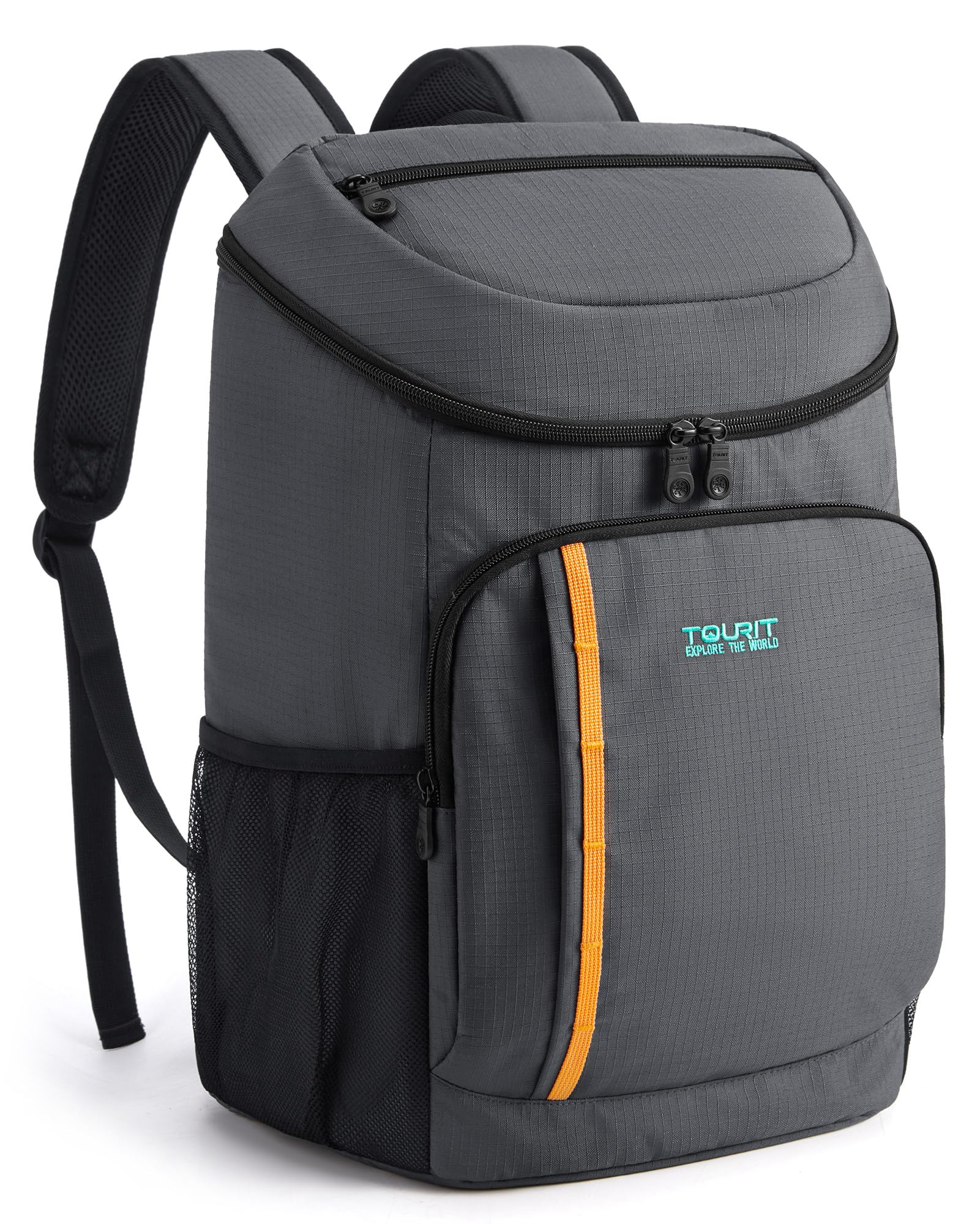


Best for Everyday Outings
TOURIT 30-Can Backpack Cooler
Key Features
- Pockets: Six plus bottle opener
- Capacity: 30 cans / 28 L
- Dimensions: 13 x 7.5 x 17 in
- Empty weight: 1.1 lb
- Price: Midrange
A 28-liter cooler bag that weighs 1.1 pounds empty is one you stop noticing on the walk down to the water. The TOURIT holds 30 cans in a 13-by-7.5-by-17-inch body, and the weight is a big part of why it’s our default: load it with drinks and ice, put it on, and you still have both hands for a chair and a kid.
The layout is the other half of the argument. A main compartment, two side mesh pockets, two zippered front pockets, a lid pocket, a mesh pocket, and a bottle opener on the strap give you enough separation that plates, napkins and a phone don’t end up in the meltwater. We used the front pockets constantly — they’re where the dry things live while the drinks stay in the main bay.
Where it wins is consistency. It isn’t the biggest bag here, the least expensive, or the one with the longest cold rating, but it does every part of the job well enough that we kept picking it up: 28 liters is a two-person day, the shell is waterproof, and nothing about it needs a manual.
The one thing to plan around is water. The liner is welded and leak-proof, but the zip isn’t, so a bag of melting ice left lying on its side will weep through the teeth. Keep it upright, pour off the melt, and use sealed ice packs on anything longer than an afternoon. The 24-month warranty is the other reassurance — two years of cover for quality problems, which is longer than the one-year terms on several bags here.
Pros
- 28 liters and 30 cans at 1.1 lb
- Six pockets plus a strap-mounted opener
- Waterproof shell
- 24-month warranty on quality issues
Cons
- Inside lining is the first thing to wear
- Hand wash only
We think this is the backpack cooler most people should buy: 28 liters and 30 cans at 1.1 pounds, with the pockets to keep a whole day organized.
Best for Serious Cold
YETI Hopper M12 Backpack
Key Features
- Closure: Magnetic MagShield lid
- Capacity: 15 lb
- Dimensions: 17 x 8 x 16 in
- Insulation: ColdCell foam
- Price: Premium
The Hopper M12 costs several times what anything else on this list does, and we rate it as the one bag here that earns a price like that. Not on capacity — it’s the smallest cooler in this group — but on cold retention and build, where nothing else comes close. If the cooler is the point of the trip, this is the one; if the drinks for six people are the point, it isn’t.
What the money buys is a different approach. Closed-cell ColdCell foam, a DryHide shell built to shrug off punctures and UV, a leakproof liner, and a magnetic MagShield closure that holds the lid open while you load and snaps shut with a push instead of a zip. That closure is the detail we kept coming back to. Fighting a wet zipper one-handed on a beach is a small misery; a lid that stays where you put it is a small pleasure.
It isn’t frictionless. The magnetic opening is stiff to hold wide when the bag is packed, and a 15-pound capacity makes this a drinks cooler rather than a food one — the kangaroo pocket outside holds a phone, keys and a little hot sauce, and that’s about the extent of the storage. Boats, tailgates and beach days where the cooler is the center of the operation: that’s its territory.
Pros
- Magnetic lid stays open while you load
- ColdCell foam holds ice for a long day
- DryHide shell resists punctures and UV
- Carries comfortably as a backpack
Cons
- Costs several times what the rest of the set does
- Lid is stiff to hold open when packed
We rate it the best cold-keeping backpack here, and the only bag whose price is about build rather than capacity.
Best for Group Hauls
Maelstrom 35-Can Cooler Backpack
Key Features
- Harness: Padded ventilated back
- Capacity: 35 cans / 32 L
- Dimensions: 12.9 x 9 x 18.7 in
- Empty weight: 15.2 oz
- Price: Midrange
At 32 liters and 18.7 inches tall, the Maelstrom is the biggest bag here, and that fact shapes everything else about it. You don’t pack it for a sandwich. You pack it when the drinks for a whole party are your responsibility and carrying them on your back beats two hands and a cooler handle.
The harness is what makes the size workable. A thicker padded back panel with ventilation channels and wide, adjustable shoulder straps do real work once the bag is heavy, and at 15.2 ounces empty there’s very little of those 32 liters spent on the bag itself.
The extras are better judged than most picnic gear. A stainless bottle opener sits on the shoulder strap, an adjustable buckle above the right mesh pocket holds a wine bottle upright, and two condiment bottles fit in the top of the tableware pocket. Small things — but they’re the difference between a cooler and a bag you can serve lunch out of.
The limit is water. Tip it and the melt finds the zipper, so this is a bag for a trunk, a wall or a picnic table rather than something rolling around in the bottom of a boat. Packed upright with ice packs, it’s a lot of cold storage for what it costs, and it’s the one we hand the person who’s organizing everyone else.
Pros
- 32 liters, the largest capacity in this group
- Ventilated padded back and wide straps
- Bottle opener and wine buckle built in
- 15.2 oz empty for a 32-liter body
Cons
- Meltwater reaches the zipper if the bag tips
We like it best for the person hauling for a group: 32 liters, a harness that handles the weight, and picnic extras that actually get used.
Best for Picnic Lunches
SPARTER 33-Can Cooler Backpack
Key Features
- Capacity: 33 cans / 21 L
- Insulation: 8 mm foam
- Compartments: Two insulated
- Cold retention: Up to 20 hours
- Price: Midrange
Two insulated compartments is the idea that sells the SPARTER: drinks and ice in one, sandwiches and fruit in the other, and no meltwater on the sandwiches. For a picnic that separation is worth more than another five liters of space, and it’s the reason this bag is here rather than a bigger single-bay cooler.
The figures are modest and coherent — 21 liters, 33 cans, 1.1 pounds empty, 10.5 by 7.5 by 17 inches. Insulation is 8 mm foam behind a silver PEVA seal, rated by SPARTER for up to 20 hours. We read that as a closed-lid number: realistic for a day out, optimistic for an afternoon where the bag gets opened every twenty minutes.
The catch is the zip. SPARTER says plainly that the zipper isn’t leak-proof, so this stays upright on a seat or in a trunk rather than sloshing around in a boat. Accept that and you’re getting two temperature zones, a 1.1-pound carry and a lifetime warranty — the longest on this list — for less than most of the bags here.
Pros
- Two insulated compartments split cold and dry
- 8 mm foam with a 20-hour cold rating
- Lifetime warranty, the longest here
- 1.1 lb empty
Cons
- Zipper isn’t leak-proof, so it must stay upright
- 21 liters is less than the 28-liter bags here
We recommend it for anyone who wants cold drinks and dry food in one bag — just keep it upright, because the zipper isn’t sealed.
Best for Work Lunches
TOURIT 38-Can Double Deck
Key Features
- Capacity: 38 cans / 28 L
- Insulation: Five foam layers, EVA liner
- Compartments: 4 L top, 24 L bottom
- Empty weight: 2.27 lb
- Price: Budget
The leak-proof claim on this TOURIT stops at the zipper, as it does on nearly every soft cooler here, and we still think it’s the best value in the group. Five layers of foam behind an EVA liner is more insulation than the price suggests, and the 4-liter top deck over a 24-liter cold compartment is the layout most people end up wanting.
The shape is a commuter’s: 11.8 by 8.3 by 17.5 inches, 28 liters in total, 1.03 kilograms empty, with a padded ventilated back, wide straps, a front hanging strap for a hat or keys, and a bottle opener. The upper section stays dry, which is where a phone, a paperback and a lunch that doesn’t need chilling go.
Filled with ice packs and kept upright, it holds cold through a workday and the drive home, and at just over a kilogram empty it’s light enough that the walk from the car isn’t a chore. It’s the bag we point at when someone wants a lunch bag for work that also handles a six-pack on Friday.
Pros
- 38 cans across a dry top and cold bottom
- Five foam layers and an EVA liner
- Bottle opener and front hanging strap
- 1.03 kg empty
Cons
- Top compartment holds only 4 liters
We think this is the value pick of the group: 38 cans, a dry top deck, and five foam layers behind a welded EVA liner.
Best for Short Trips
RTIC 15-Can Backpack Cooler
Key Features
- Capacity: 15 cans / 5.63 qt
- Dimensions: 11 x 8 x 15.25 in
- Empty weight: 1.6 lb
- Cold retention: Up to 24 hours
- Price: Premium
Fifteen cans, 5.63 quarts, and 1.6 pounds empty: the RTIC is the smallest cooler here, and it’s built for the outing where you carry it further than you empty it. A shift at work, a half-day hike, a picnic for two.
What we like is that it behaves like a backpack first. The mesh side pockets hold water bottles where you can reach them, the lid has an interior mesh pocket for keys and a wallet, and the body sits against your back instead of swinging from a shoulder. RTIC rates it for up to 24 hours of cooling — the longest figure here — and with frozen bottles in it rather than loose ice, it holds cold through a long day.
It only makes sense if light and small are the point rather than a compromise: carried for an hour before it’s opened, it’s the easiest bag here to live with. Opened on a beach for four people, it’s the wrong choice, and you’ll know within the first hour.
Pros
- 24-hour cold rating, the longest here
- Mesh side and lid pockets within reach
- 1.6 lb and daypack-shaped
Cons
- 90-day warranty is the shortest here
- Costs more than larger bags on this list
We keep it for people who carry a cooler rather than stock one: 15 cans, 1.6 pounds, and a 24-hour cold rating.
Best for Parties and Picnics
MIYCOO 40-Can Cooler Backpack

Key Features
- Capacity: 40 cans / 28 L
- Exterior: Side bottle straps
- Dimensions: 11 x 8.6 x 15.7 in
- Compartments: Two
- Price: Budget
Two adjustable straps on the sides of the MIYCOO hold wine bottles upright, and a bottle opener rides on the shoulder strap. That tells you what the bag is for: a picnic, a concert, a birthday in the park where someone remembered the wine and nobody remembered an opener.
Underneath is a capable 28-liter bag — 40 cans across two compartments, 11 by 8.6 by 15.7 inches, an extendable zip pocket for valuables and a separate dry section on top. We like the shape most: at 15.7 inches tall it sits lower on your back than the 17- and 18-inch bags here, which is an advantage when you’re bent over a blanket or a low table.
It’s a party bag rather than an expedition one. The two compartments and the bottle straps suit an afternoon in a park better than a week of camping, and 28 liters won’t swallow a family’s lunch. For a long day out with friends, though, the layout does exactly what it should.
Pros
- Side straps hold wine bottles upright
- Opener on the shoulder strap
- 40 cans across two compartments
Cons
- Meltwater can escape through the top
We take it to picnics: bottle straps that hold wine upright, an opener on the shoulder, and 40 cans across two compartments.
Best for Air Travel
SINVICKO 30L Cooler Backpack

Key Features
- Carry: Luggage strap for trolley
- Capacity: 30 L
- Dimensions: 12.3 x 6.3 x 16.2 in
- Compartments: Dual deck
- Price: Midrange
A luggage strap on the back panel slides over the handle of a rolling suitcase, and that changes the kind of trip this bag is for. It’s the cooler you pack for a flight or a long drive, then wear from the car park to the sand.
The rest is a competent 30-liter double-decker: 12.3 by 6.3 by 16.2 inches, an insulated lower compartment with a separate dry upper one, multiple zip pockets, waterproof nylon, hand wash only. The 6.3-inch depth is the number that matters — it’s slim enough to sit flat against your back or on top of a case without turning into a box.
Sealed ice packs and an upright bag keep it cold through a travel day, and 30 liters leaves room for drinks plus the odds and ends a trip collects: chargers, a paperback, a jacket.
Judged as a travel bag, we think the strap is worth more than the extra liters a taller cooler gives you. Packed for a holiday, strapped to a suitcase and worn from the terminal to the beach, it does the job without asking you to carry two things at once.
Pros
- Luggage strap mounts on a rolling case
- 30 liters split into cold and dry
- Slim 6.3-inch depth
Cons
- Seams and shape are the weak point over time
We pack it for travel: a luggage strap that mounts on a rolling case, and a 30-liter double deck for drinks and gear.
How We Tested Backpack Coolers
We started by scanning reviews and specs for packs with at least a 20-can capacity, welded or water-resistant bottoms, and straps that looked comfortable under load. From that pool, we bought 12 models at our own expense and used them for eight months—through weekend hikes, beach afternoons, tailgates, and the occasional grocery run.
To check cooling, we packed each cooler the same way: two frozen gel packs, a bag of ice, six cans, and a sandwich, then left it in a parked car on an 85-degree day and checked every two hours. We also turned each one upside down after a half-hour in the sun to see if meltwater crept through seams or zippers, and we noted whether the interior stayed dry enough for a paper bag of chips.
Portability was judged on the move: we loaded each pack with 15 pounds of gear, walked a two-mile loop, and rated how the shoulder straps, back panel, and hipbelt felt at the end. We also opened and closed every zipper 50 times, dragged the bags across pavement, and rinsed out spills to see how easily the liners cleaned. At the end, we compared what each cooler could hold against what it cost—because a pack that only fits a six-pack isn’t a bargain at any price.
How to Choose a Backpack Cooler
The can count printed on the box is the least reliable number on it; what actually decides whether a backpack cooler works is how it seals, how it carries when it’s heavy, and whether its compartments match the way you pack.
Compare liters, not can counts
The can figures and the volume figures in this group don’t track each other: a 21-liter SPARTER claims 33 cans while a 28-liter TOURIT claims 30. Cans are counted packed tight and without ice, so treat any can number as a ceiling rather than a packing plan. Liters are the honest comparison.
For a couple’s day out, 20 to 28 liters is plenty; for a family or a group, look at 28 to 32. Under 20 liters you’re buying a lunch bag with a cold section, which is exactly right for a commute and wrong for a beach.
Decide whether you need a split deck
One insulated bay is simplest and holds the most for its size. A split deck — a small dry upper section over the cold lower one — costs a few liters but keeps sandwiches, a phone and a paperback away from the melt. The 4-liter top on the TOURIT 38 is a good example: big enough for lunch and a book, not for a second meal.
The alternative is two insulated compartments, as on the SPARTER, which is better for a picnic where you want one zone properly cold and the other merely cool and dry.
The zipper is where a soft cooler leaks
Every bag here has a welded or heat-pressed liner, and the liner is rarely the problem — the zip is. Meltwater sits in the bottom, finds the teeth and wicks through, which is why a cooler that was fine on the way out leaves a wet patch on the car seat home.
Two habits prevent most of it: keep the bag upright, and use sealed ice packs rather than loose ice for anything longer than an afternoon. If you want the closure itself to be the seal, you’re shopping for a magnetic lid like the YETI’s, and paying for it.
Rated hours assume a shut lid
Cold ratings — 20 hours on the SPARTER, 24 on the RTIC — describe a packed, closed bag, not one being opened every twenty minutes on a hot beach. Thicker and more numerous foam layers buy you time, which is why the five-layer TOURIT 38 holds on longer than its price suggests.
Pre-chilling the bag and the drinks before they go in does more for retention than any single feature on this list, and costs nothing.
Weight matters when it’s full, not empty
Empty weights here run from 15 ounces to 1.6 pounds, which sounds decisive until you fill one: a 28-liter bag with drinks and ice is a serious load, and that is when the harness starts to matter. Wide padded straps and a ventilated back panel — the Maelstrom’s are the most substantial in this group — are what keep a heavy bag comfortable past the first mile.
A light bag with a thin strap is worse on a long walk than a heavier one that carries well.
Frequently Asked Questions
Is a backpack cooler better than a hard cooler?
Only if you’re carrying it. A hard cooler holds ice longer and gives you more capacity for the money, but it takes two hands and wants a car nearby. A soft backpack cooler frees both hands, folds flat when empty, and keeps a day’s drinks cold well enough.
If you park next to your spot, buy the hard cooler. If you walk more than a few hundred yards to get there, the backpack wins.
How do I clean a backpack cooler?
By hand: warm water, a little mild soap, a soft cloth on the liner, then a rinse. Never machine wash or tumble dry one — the insulation and the welded seams won’t survive it.
Then stand it open, upside down if you can, somewhere with airflow until the liner, the seams and the zip tape are completely dry. Stored zipped and damp, it will smell of old cooler by the next trip.
Can I take a backpack cooler on a plane?
Yes, provided it fits your carrier’s carry-on or personal-item dimensions — an empty soft cooler packs flat and weighs almost nothing. A full 28-to-32-liter bag is a substantial cabin bag, so check the size limit before you fly.
Also check the airline’s rules on frozen ice packs before you rely on them, and drain any meltwater before you reach security.
Final Verdict
Buy the TOURIT 30-can bag. It’s the one that gets out of the way: 28 liters for 1.1 pounds, pockets that separate the dry things from the cold, and a price in the middle of this group. Keep it upright, use ice packs rather than loose ice, and it handles a beach day, a tailgate or a shift at work.
If cold retention matters more than capacity, the YETI Hopper M12 is the only bag here built to outlast the decade. If you’re hauling for a group, the Maelstrom’s 32 liters and padded harness carry it better, and for a light solo day the RTIC 15-can pack is the easiest thing here to wear.