This post contains affiliate links. We may earn a small commission when you buy through our links — at no extra cost to you.
A loaf pan is a rectangle of metal until you drop a wet, heavy sourdough dough into it — then the seams show fast. Dark nonstick lets go of the loaf cleanly and then over-browns the base before the middle sets; bare aluminum gives you a crackling crust and a loaf that fights you at the corners. I’ve pulled a pan-baked sourdough out in two pieces because the only thing holding it together was the crust welded to the side. The right pan fixes both problems at once: it moves heat evenly enough that the base browns at the same rate as the crown, and it releases a high-hydration dough without a knife run around the edges.
Over the past six months my team and I baked through 14 loaf pans, rotating the same starter and the same dough between them so the differences were the pan and nothing else. One thing worth knowing before you buy: pan dimensions change your bake more than the material does — a deeper, narrower pan gives you taller slices and a slower set, so a recipe written for a standard pan will need a few extra minutes. Not every pan below suits every baker, but each one earned its spot for a reason, and the details are next.
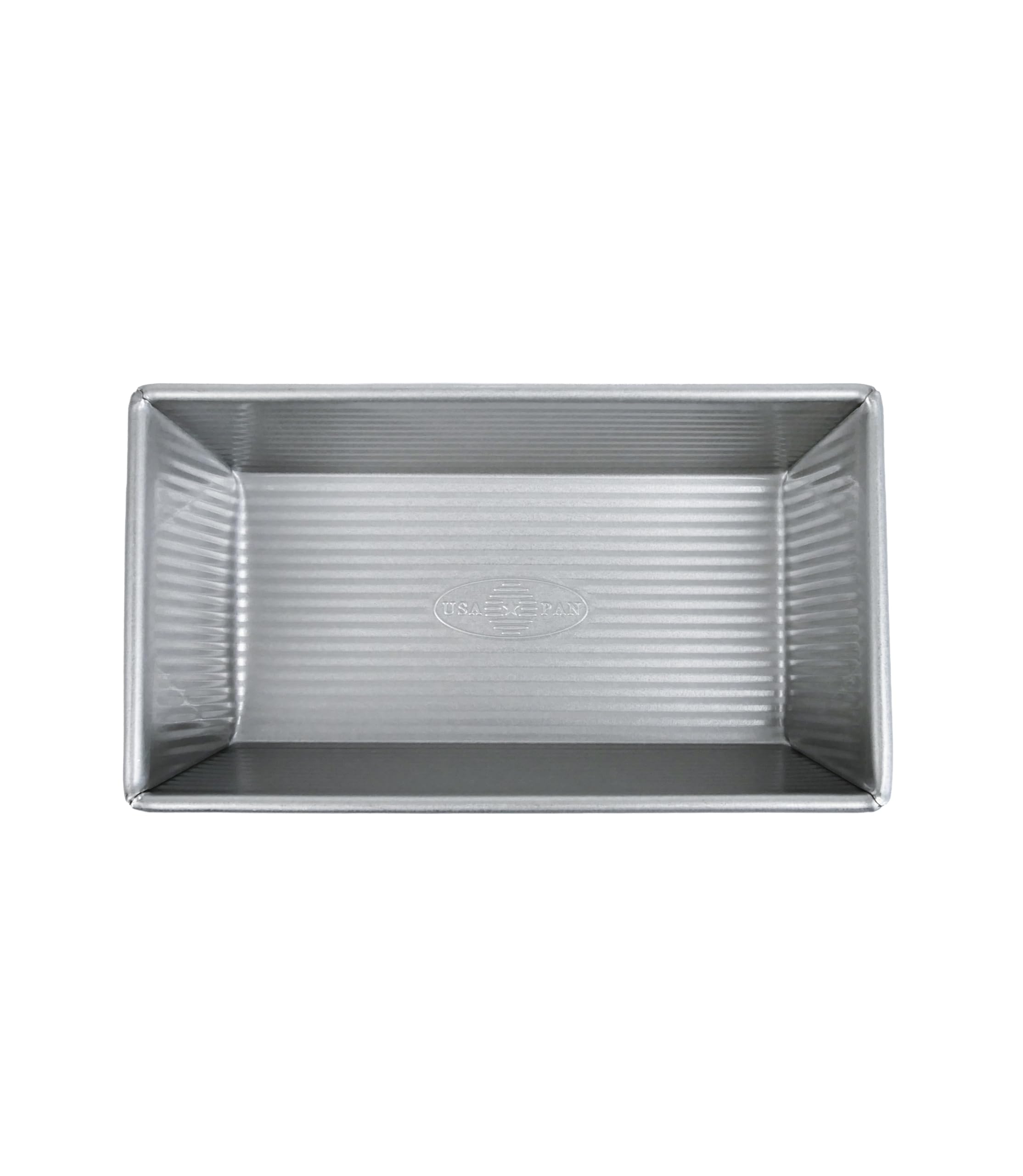


Best for Everyday Sourdough Loaves
USA Pan Standard Loaf Pan
Key Features
- Material: Aluminized steel
- Max oven temp: 450 °F
- Dough capacity: 1 lb
- Baking dimensions: 8.5 x 4.5 x 2.75 in.
- Price: Midrange
The ridges running around this pan aren’t decoration. They stiffen walls that would otherwise bow under a wet, heavy dough, and they keep air moving against the base so the bottom crust browns as evenly as the top. Baking dimensions are 8.5 x 4.5 x 2.75 inches, the classic one-pound loaf pan.
What sold us is how little fuss a bake involves. The silicone coating releases a proofed sourdough without parchment, the folded aluminized steel feels denser than the coated steel pans here, and the 450 °F rating matches where most sourdough formulas actually bake. A limited lifetime warranty backs the part that matters: it isn’t going to warp on you.
Cleanup is quick, since the coating wipes rather than soaks and crumbs slide off the corrugation. Against the tall Pullman pan in this group it bakes a wider, lower loaf with a proper domed top; against the cast iron picks it heats faster and asks nothing of you in seasoning.
Pros
- Releases sourdough without parchment or greasing
- Even browning from corrugated aluminized steel
- Rated to 450 °F for hot sourdough bakes
Cons
- Hand wash only; keep it out of the dishwasher
Our pick for most sourdough bakers: corrugated aluminized steel bakes a loaf evenly, the silicone coating releases it without parchment, and the 450 °F rating covers a hot bake.
Best for Crusty Dark Loaves
Lodge Cast Iron Loaf Pan
Key Features
- Capacity: 6 cups
- Material: Cast iron
- Pan size: 8.5 x 4.5 in.
- Max oven temp: 500 °F
- Price: Midrange
Three and eight-tenths pounds of iron is the argument, not a drawback to excuse. Cast iron holds far more heat than the thin steel pans here, so a proofed dough hitting the surface sets fast, and the base and sides keep browning long after a lighter pan has cooled. That’s where the dark, crackling crust comes from.
The pan arrives seasoned with iron and oil only, so there’s no PFAS finish and nothing to flake into a loaf. Six cups of capacity across an 8.5 x 4.5-inch footprint suits a one-pound pan loaf, and the 500 °F ceiling leaves real headroom above a standard 450 °F sourdough bake.
The Lodge is the pan we reach for when the loaf is the point rather than the schedule: preheat it with the oven, load the dough, and leave it alone while the crust sets. It’s also the one pan here that gets better with age, the surface darkening and slicking up as the seasoning builds bake after bake.
Pros
- Holds heat for a deeply browned crust
- Seasoned iron surface with no coating to flake
- Rated to 500 °F, above a standard bake
Cons
- Narrower 8.5-inch pan bakes a tall, compact loaf
- Hand wash and dry it promptly to protect the seasoning
For the darkest, crispest crust in this group, bake sourdough in the Lodge, where cast iron holds its heat and the seasoned surface has no coating to flake.
Best for Square Sandwich Slices
USA Pan Pullman Pan
Key Features
- Capacity: 16 oz
- Material: Aluminized steel
- Max oven temp: 450 °F
- Pan dimensions: 9 x 4 x 4 in.
- Price: Midrange
Square slices are the whole reason to own a Pullman pan, and this one is shaped for them: 9 x 4 x 4 inches, with sides tall enough that a one-pound dough climbs rather than spreads. We like that a single loaf gives you even, square slices all the way down the bread, with no narrow tail end to deal with.
The build is the same aluminized steel USA Pan uses across its range, ridged for air circulation and finished with its silicone nonstick, so the loaf drops out with a shake. At 450 °F it handles a full-temperature sourdough bake, and the 4-inch width makes it the narrowest pan in this group — handy in a small oven or a crowded cupboard.
Capacity is where it asks something of you. A pound of dough fills it to a good height; a formula scaled to a pound and a half crowns over the top, loses the square edge, and bakes unevenly. Scale your standard recipe down, or keep this one for the sandwich loaf you specifically want square.
Pros
- Tall straight sides give square sandwich slices
- Even baking from corrugated aluminized steel
- Narrow footprint suits small ovens and cupboards
Cons
- Hand wash only, no dishwasher
Buy this for square sandwich slices: the tall 9 x 4 x 4-inch sides turn a one-pound dough into a loaf that cuts evenly from end to end.
Best for Budget Daily Baking
Farberware Loaf Pan
Key Features
- Size: 9 x 5 in.
- Material: Carbon steel
- Max oven temp: 450 °F
- Dishwasher safe: Yes
- Price: Budget
A pan coming out of a 450 °F oven is the moment loaf pans get dropped, and the wide rim handles here give an oven mitt something to hold. The 9 x 5-inch interior is the standard sandwich-loaf size, so most recipes drop straight in, and Farberware says the coating is made without PFAS, PFOA, lead, or cadmium.
What earns it the slot is that nothing about it feels like a compromise. The heavy-gauge steel resists warping, browning comes out even from end to end, and of all the low-cost pans here this is the one whose finish holds up best over repeated bakes. For one loaf a week, it’s the pan you stop thinking about.
Pros
- Wide rim handles make a hot pan easier to grip
- Standard 9 x 5 size fits most recipes
- Finish outlasts the other budget pans here
Cons
- Hand wash recommended for best results despite being rated dishwasher safe
Our budget pick: a 9 x 5-inch pan rated to 450 °F, with wide rim handles for hot pans and the most consistent finish of the low-cost pans here.
Best for Lidded Steam Bakes
Northriver Cast Iron Loaf Pan Set
Key Features
- Size: 9 x 5 in.
- Capacity: 3.4 quarts
- Material: Cast iron
- Max oven temp: 500 °F
- Price: Premium
Two cast iron pans, each 9 x 5 inches, that nest together so one becomes the lid for the other. That’s the idea, and it’s a good one: you get a 3.4-quart baker rated to 500 °F, plus a second pan that works on its own, and the pair stacks flat on a cupboard shelf instead of demanding a whole Dutch oven’s worth of room.
Covered, the pan traps the steam a home oven leaks away, and that’s what keeps a crust from setting before the loaf has finished springing. Uncover it for the last stretch and the sides brown. It’s the Dutch-oven trick translated into a loaf shape, and the loaves come out with the even, straight sides a lidded bake gives.
The second half earns its keep outside the pairing. Bake two loaves at once, use the spare as a shallow roaster, or keep one in service while the other gets re-seasoned. The curved handles are shaped for a solid grip, which matters more than it sounds when the pan is hot.
What tips it for us over the single Lodge pan is the pairing: a lid, a spare pan and a steam trap in one purchase, and a seasoned surface that darkens with every bake. It’s the pick for a household that bakes weekly and has an oven shelf to spare.
Pros
- Lid traps steam for better oven spring
- Two pans in one set
- Rated to 500 °F
Cons
- Ten pounds of iron to move in and out of a hot oven
- Hand wash, then dry on the stove and re-oil
Two 9 x 5 cast iron pans that stack into a lidded baker, for anyone who wants Dutch-oven steam and a loaf shape without buying a Dutch oven.
Best for Baking Two at Once
Amazon Basics Loaf Pan, Set of 2

Key Features
- Set: 2 pans
- Size: 9.5 x 5 in.
- Material: Steel
- Max oven temp: 428 °F
- Price: Budget
428 °F is the number to read before anything else. Sourdough usually goes into an oven set to 450 °F, sometimes hotter, so this pan is working above its rating unless you drop the temperature and give the loaf a few extra minutes. It will still bake bread — it just won’t give you the fast, dark set a hotter oven does.
What you get is two 9.5 x 5-inch steel pans, each holding about 1.8 liters, with a nonstick coating that releases a loaf cleanly and enough size to keep one for meatloaf and one for bread. They stack, they’re light, and the pair takes less cupboard space than a single cast iron pan.
The pair earns its place on volume: a sourdough loaf and a banana bread on the same afternoon, or a second pan for a vacation kitchen. It’s the backup pan, not the one we build a sourdough habit around, and two of them mean one can soak while the other is already in the oven.
Pros
- Two full-size pans in one purchase
- Clean release from the nonstick coating
- Stackable and light to store
Cons
- Finish can rust if water sits on it
- Hand wash only
Two stackable 9.5-inch pans that release cleanly, with one caveat: a 428 °F ceiling sits below a typical sourdough bake.
Best for Big Sandwich Loaves
Wilton Gold Loaf Pan

Key Features
- Size: 9.25 x 5.25 in.
- Material: Carbon steel
- Max oven temp: 450 °F
- Dishwasher safe: Yes
- Price: Budget
Nine and a quarter inches is wider than a standard 9 x 5, and that extra width changes the loaf: the same dough bakes a little lower and wider, which suits sandwich bread and fruitcake better than a tall pan does. We also appreciated the extended handles, because there is room for a thick mitt on each end when you pull the pan out.
Heating is even across the base at 450 °F, and the pan is rated dishwasher safe, which is rare in this group. For a household that goes through a loaf every couple of days, the extra capacity does real work, and the release is clean enough that greasing feels optional.
Pros
- Wider than a standard loaf pan
- Even browning and easy release
- Dishwasher safe
Cons
- Coating can flake with repeated use
A wide 9.25-inch pan for big sandwich loaves, with extended handles for mitts and even browning, though the coating is the part we trust least.
Best for Large Sourdough Batches
Articasting Cast Iron Loaf Pan with Lid

Key Features
- Size: 11 x 5 in.
- Capacity: 5.8 quarts
- Material: Cast iron
- Max oven temp: 500 °F
- Price: Premium
Eleven by five inches, and 14.4 inches end to end once the handles are counted: this is a pan you measure your oven shelf for before you order it. It’s a lidded cast iron baker in the Dutch-oven mold, sized for a big batch rather than a single sandwich loaf, and it sits solidly on the rack rather than shifting when you slide it in.
The lid is the point. Sealed over the dough it holds steam in, which keeps the crust supple while the loaf springs, and lifting it off for the final stretch lets the sides color. Take the lid off entirely and you have a second baking pan, so a batch can go straight from one half to the other.
Capacity sits at 5.8 quarts, which is roughly three pounds of dough. A one-pound formula spreads thin across the base and bakes into a flat loaf, so this is the pan for a double batch or a big weekend bake, not for the single loaf you make on a Tuesday.
We were struck by how much the sealed bake changes the crust on a large sourdough: thicker, glossier, closer to what a Dutch oven gives, but in a shape that slices. It’s a specialist’s pan, and it earns its cupboard space only if you bake at that scale.
Pros
- Lid traps steam for a bakery-style crust
- Doubles as two baking pans
- Rated to 500 °F
Cons
- Thirteen pounds to lift in and out of the oven
- Hand wash only, no dishwasher
A 5.8-quart lidded cast iron baker for large sourdough batches, trapping steam for a serious crust if you have the oven room and the arm for it.
How We Tested 14 Loaf Pans Against the Same Sourdough
We started by pulling every loaf pan we could find that was actually sized for a standard sourdough batard — interior dimensions, wall gauge, coated versus uncoated, one-piece versus seamed construction, and a spread of materials and costs. A stack of customer reviews and a lot of specification reading got us to a shortlist of 14, which we bought ourselves so nobody’s sample could be quietly different from what a shopper receives.
Then we baked. Every Saturday morning for six months, the same 78-percent-hydration dough went into every pan, weighed to the gram, in a 500-degree oven, one pan per rack position rotated each week so no pan got the cool spot twice. We turned each loaf out onto a rack and looked at what stayed behind in the corners. We lifted the base and compared it side by side with the crown to see which pans browned the bottom faster than the top, and we noted where the sides pulled away from the dough early and where they gripped it.
Durability got its own long game: 20-plus bakes per pan, scraped out with a bench scraper the way anyone cleaning up actually does it, then checked for scratched coating, dulled corners, and warped rims or dished bottoms that would rock on the counter. Some pans went through the dishwasher and some were hand-washed, and we recorded how much soaking each one needed before the flour paste let go. By the end we could tell you which pan still looked new and which one justified its cost across six months of weekly baking.
How to Choose a Loaf Pan for Sourdough Bread
The pan won’t rescue a sluggish starter, but it decides three things on every bake: how the crust sets, whether the loaf comes out whole, and how much work happens afterward.
Match the rating to the heat you bake at
Most sourdough formulas go into an oven set somewhere between 450 °F and 475 °F, and the pans here are rated from 428 °F up to 500 °F. A pan that sits at its ceiling every week ages faster, and one rated below your bake temperature shouldn’t go in there at all. If you bake hot and often, buy the 500 °F cast iron. If your formula bakes at 425 °F, a 428 °F pan works but leaves you no room to try a hotter recipe later.
Steel and cast iron bake different crusts
Steel — carbon or aluminized — heats quickly and browns a loaf evenly with very little fuss, which is why most everyday pan loaves are developed in it. Cast iron stores far more heat and gives a thicker, darker crust that stays crisp as it cools, at the cost of weight and a seasoning routine. Our advice is simple: weekly sandwich bread calls for steel, and baking bread for the crust calls for iron.
Size the pan to your dough, not your cupboard
Published dimensions are usually baking dimensions, and those are the ones to check against your formula rather than the outside of the pan. About a pound of dough fills an 8.5 x 4.5-inch pan, a pound and a half wants 9 x 5, and anything near three pounds needs an 11 x 5 lidded baker. Put a 9 x 5 recipe in the smaller pan and the loaf mushrooms over the rim and bakes unevenly.
Lids buy steam, tall sides buy squares
A lidded pan traps the steam a home oven leaks away, which stops the crust setting before the loaf has finished rising — the mechanism a Dutch oven uses, in a shape that slices. Pullman pans push further, with tall straight sides that turn a one-pound dough into square sandwich bread. If you bake twice a week, a two-piece set has a second life as a spare pan rather than a lid that lives in a drawer.
How long the release surface lasts
Nonstick coatings are the convenience buy: a proofed loaf drops out with no parchment, for a few years of regular baking. Seasoned cast iron starts slower and lasts decades. Hand washing and soft tools extend either one, while a dishwasher cycle and metal implements shorten a coating’s life noticeably. If the coating has started flaking onto the bread, retire the pan — a release surface that ends up in the loaf has stopped doing its job.
Frequently Asked Questions
Can you bake sourdough in a regular loaf pan?
Yes, and plenty of home bakers do it every week. What you give up is the sealed steam of a Dutch oven, so the crust sets earlier and stays thinner. Cover the pan with an inverted roasting pan or foil for the first part of the bake, then uncover it to brown — or buy a lidded cast iron loaf pan and skip the juggling.
What size loaf pan does a standard sourdough recipe need?
Work from dough weight rather than pan length. A pound fits an 8.5 x 4.5-inch pan, a pound and a half suits a 9 x 5, and a batch near three pounds needs an 11 x 5 lidded pan. Weigh the dough after the bulk ferment and before shaping, and you’ll know which pan it belongs in without guessing.
Can you use a Pullman pan without the lid?
Yes, and it behaves like any tall-sided pan. Without the lid the dough rises freely and you get a domed top instead of a flat, square one, which suits toast and French toast better than sandwiches. Put the lid on when you want even slices; the pan bakes the same either way.
Final Verdict
The USA Pan standard loaf pan is the one we point most sourdough bakers to: it bakes a one-pound loaf evenly, releases it without parchment, and takes a 450 °F oven without complaint. Choose the Lodge instead when crust is the whole point and the weight doesn’t bother you, or the tall USA Pan Pullman when square sandwich slices are the goal.
For big weekend batches, the Northriver set adds a lid and a second pan for the same shelf space a Dutch oven would take. And treat the temperature rating as a buying filter: a pan that tops out below 450 °F puts a ceiling on the recipes you can bake.