This post contains affiliate links. We may earn a small commission when you buy through our links — at no extra cost to you.
A Japanese knife will take a keener edge than almost anything else in your kitchen — and it will also punish you if you treat it like a cleaver. The first time I watched a thin, hard-steel blade glide through a tomato and then chip on a stray chicken bone, I understood the tradeoff: sharpness and precision on one side, fragility and fuss on the other. What a good Japanese knife fixes is the daily friction of cooking — crushed basil, torn fish, onions that bruise instead of slice — because a blade that is thin behind the edge and balanced in your hand does less work and lets you do less correcting.
Over the past nine months, my team and I have cooked with 14 Japanese knives, from everyday santokus to longer gyutos, and the differences come down to more than steel hardness. Weight and handle shape matter as much as out-of-box sharpness: a knife that feels nimble for one cook can feel twitchy for another after an hour of prep. We also kept an eye on value and edge durability, because a razor edge that disappears after three weeks is not a bargain. The picks below are the ones that stayed in the block.



Best for Everyday Chef’s Work
SHAN ZU 8-Inch Chef Knife
Key Features
- Steel: 10Cr15Mov, 62 HRC
- Handle: G10
- Weight: 9.17 oz
- Blade length: 8 inches
- Price: Midrange
The first thing we look at in a Japanese-style chef’s knife is the steel, and the SHAN ZU’s 10Cr15Mov core is rated to 62 HRC. That hardness is why the 15-degree edge feels so aggressive on onions and carrots, and why it keeps that bite through a run of dinners. It is also a knife with real presence: 8 inches of blade, 260 g of weight, and a G10 handle that stays planted in a wet hand. That combination makes it the best default here for a home cook who wants one knife to do most of the work.
The 260 g weight gives it a solid, planted feel, and the balance keeps the tip from diving. We liked that heft when working through dense vegetables, and the G10 handle stayed secure even when our hands were slick. The handle is not as warm as pakkawood, but it is grippy, stable, and easy to live with.
The 67-layer Damascus cladding gives the blade a deep pattern that looks good without shouting, and the 2.5-inch height gives your knuckles room. We also appreciate that the profile is useful rather than novelty: the gentle curve supports a rocking chop, and the tip is thin enough for shallots and garlic. It is a knife that feels purpose-built for a home cook who spends real time at the board.
What seals it for us is the overall balance of sharpness, comfort, and price position. The SHAN ZU sits in the middle of this group, yet it feels more substantial than the budget picks and more approachable than the premium Shun. It is not the lightest or the most traditional Japanese knife here, but it is the one we recommend first to most home cooks.
Pros
- Aggressive 15-degree edge
- 62 HRC steel holds an edge
- Balanced 260 g build
- Grippy G10 handle
Cons
- Heavier than the lightest picks here
For most home cooks, this is the Japanese-style chef’s knife we recommend first: sharp, balanced, and substantial without feeling clumsy.
Best for Vegetable Prep
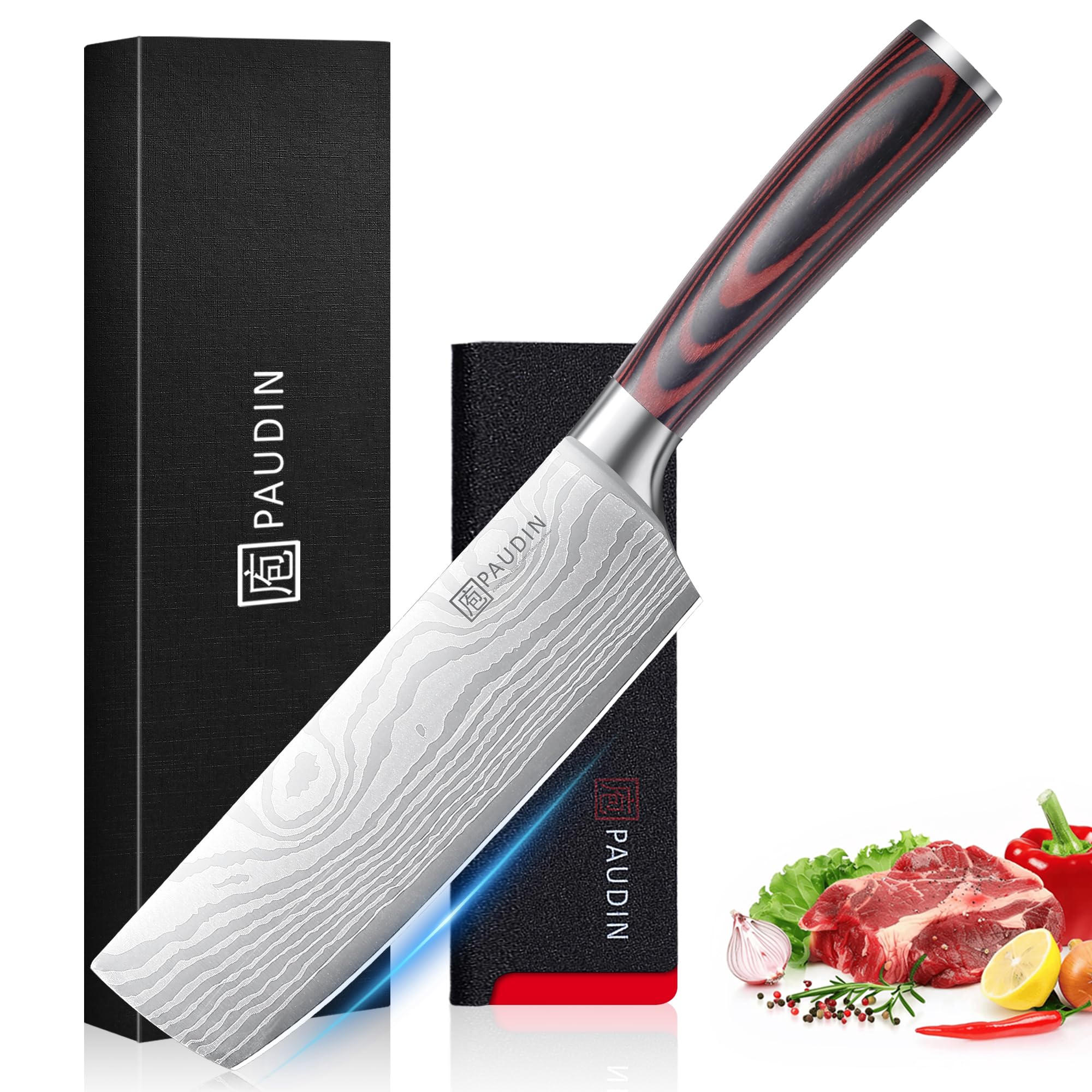
PAUDIN 7-Inch Nakiri
Key Features
- Steel: 5Cr15Mov, 56+ HRC
- Handle: Pakkawood
- Weight: 7.94 oz
- Blade length: 7 inches
- Price: Midrange
A nakiri is the knife that makes a vegetable drawer feel manageable. The PAUDIN’s 7-inch blade is tall and flat, so you can drop it through a cabbage or a pile of onions without the steering you get from a curved chef’s knife. The 225 g weight is light enough to keep going through a big prep session, and the pakkawood handle has a soft, rounded feel that we found easy to grip.
This is the vegetable knife we recommend from this group. The 5Cr15Mov steel is rated at 56+ HRC, which takes a keen edge and is less fussy about the occasional accidental contact with a stem or a seed. The wave pattern on the blade is decorative rather than true Damascus, so buy it for the cut, not the forging story.
The shape rewards a push-cut: keep the tip down and guide the blade through the food rather than rocking it hard. We liked the tall blade for scooping chopped vegetables off the board, a small thing that makes dinner feel less messy. It is not the knife for breaking down a chicken, but that is true of any nakiri.
Pros
- Tall blade handles big vegetables
- Light 225 g build
- Comfortable pakkawood handle
- Sharp out of the box
Cons
- Softer steel than premium picks
If your cutting board is mostly vegetables, this nakiri is the one we reach for: tall, light, and quick through cabbages, onions, and herbs.
Best for Budget Chef’s Knife
HOSHANHO 8-Inch Chef Knife
Key Features
- Steel: 10Cr15CoMoV
- Weight: 12.3 oz
- Edge angle: 13° per side
- Blade length: 8 inches
- Price: Budget
The HOSHANHO’s 13-degree edge is the reason it caught our attention. That is a steeper, keener angle than the 15- or 16-degree edges on most of the other chef’s knives here, and it makes the first cuts through tomatoes and peppers feel almost frictionless. The 10Cr15CoMoV steel is a proper Japanese high-carbon recipe, and the pakkawood handle has a comfortable curve. For us, it is the best budget chef’s knife in this group.
The 350 g weight gives it a solid, planted feel, and the handle gives you a secure grip. It is not a featherlight Japanese slicer; it is closer to a workhorse, and we did not mind that for chopping. If you have wrist fatigue or prefer a lighter knife, the imarku is the better fit.
The comfortable handle and the keen edge make it an easy recommendation for a cook who wants a sharp knife without spending much. It is a knife that rewards a clean, deliberate cut rather than a heavy hand, and it feels more substantial than most budget blades.
Pros
- Keen 13-degree edge
- Japanese high-carbon steel
- Comfortable pakkawood handle
- Solid 350 g feel
Cons
- Blade durability is the weak point
For cooks shopping on a budget, this 8-inch chef’s knife delivers a genuinely keen edge and a comfortable pakkawood handle.
Best for Premium Japanese Cooking
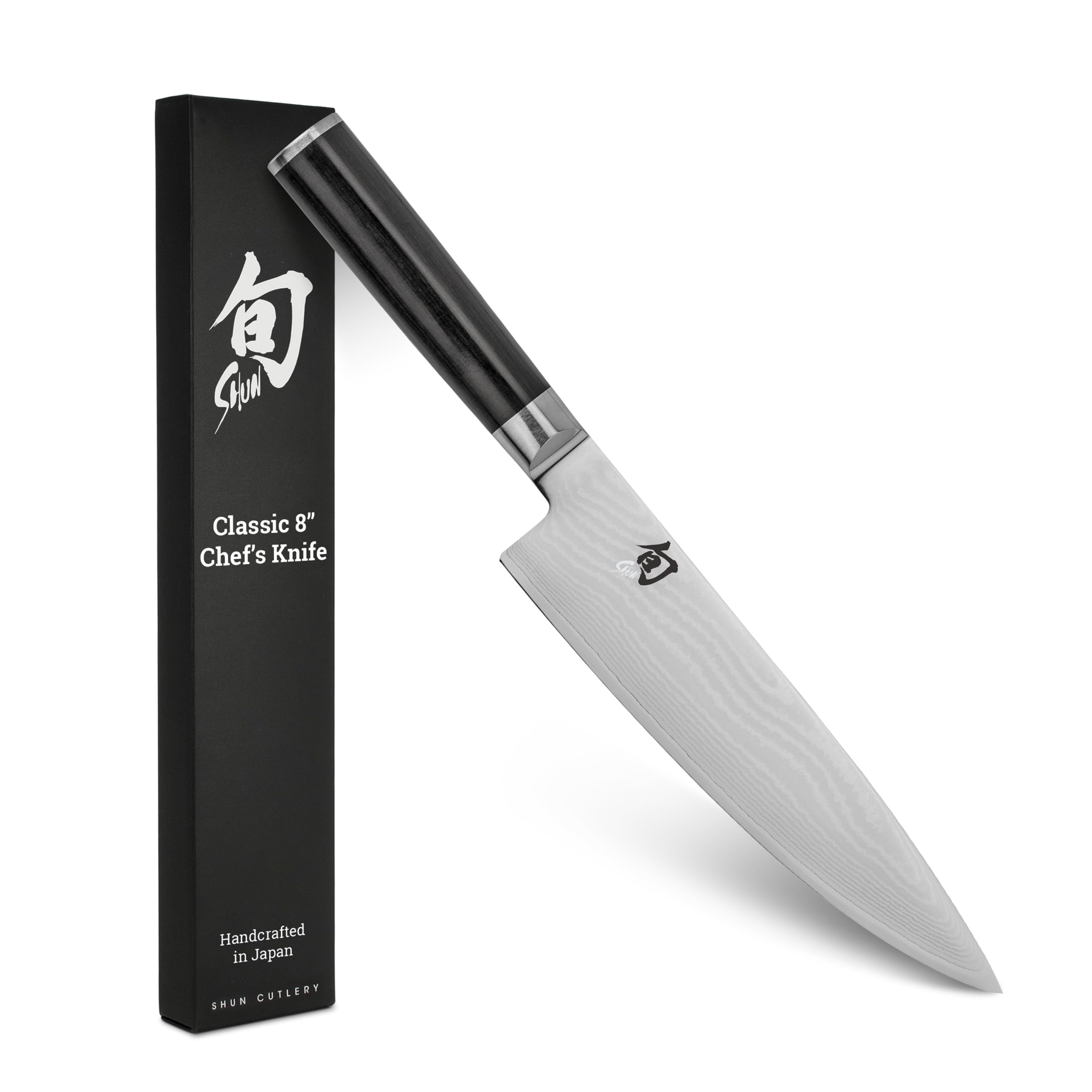
Shun Classic 8-Inch Chef
Key Features
- Steel: VG-MAX
- Weight: 7.27 oz
- Cladding: 68 layers
- Edge angle: 16°
- Price: Premium
The Shun Classic is the knife in this group with the deepest traditional pedigree: VG-MAX steel, 68 layers of Damascus cladding, a 16-degree edge, and a D-shaped pakkawood handle. It is also the lightest of the premium-leaning chef’s knives here at 206 g. That combination gives it a precise, almost delicate feel that we noticed immediately when moving from the heavier SHAN ZU.
It is the premium pick we trust for a cook who wants a Japanese-made knife with a long warranty and a light touch. The 16-degree edge is not as aggressive as the 13-degree HOSHANHO, but it is beautifully consistent, and the D-shaped handle locks into a pinch grip. The blade is thin behind the edge, so it glides through onions and delicate herbs without splitting them.
The D-shaped handle is a point of difference. It is comfortable for both left- and right-handed cooks, and the pakkawood has a warm, polished feel that the G10 handles here cannot match. At 206 g, the knife is light enough to use for a long prep and balanced enough that the tip stays under control.
The Shun is a knife for someone who wants a Japanese-made blade with real craft, a light feel, and a lifetime warranty. It is the one we point to when the cooking matters enough to justify the upgrade.
Pros
- VG-MAX steel with 68-layer Damascus
- Light 206 g feel
- D-shaped pakkawood handle
- Lifetime warranty
Cons
- Premium price versus the other chef’s knives here
- Thin edge is vulnerable to chipping
For cooks who want a Japanese-made knife with a light, precise feel and a lifetime warranty, this Shun is the premium pick we trust.
Best for Starter Knife Set
Brewin 5-Piece Knife Set
Key Features
- Steel: 56+ HRC
- Handle: Red pakkawood
- Pieces: 5
- Weight: 2.6 lb
- Price: Midrange
The Brewin Chefilosophi set is the one that makes a first kitchen look pulled together. Five knives, red pakkawood handles, and a gift box: the presentation is a big part of the appeal, and we appreciate that the set does not look like a generic block set. The 56+ HRC stainless blades are hand-sharpened, and the set is built around a full-tang, forged construction.
The five knives cover the everyday jobs: a chef’s knife for most prep, plus the smaller shapes for trimming, slicing, and detail work. The handles are the standout. They have a warm, slightly glossy finish and a shape that feels secure in a pinch grip, which is more than we expect from a set in this price range.
The set earns its place for someone who wants a coordinated look and a useful spread of knives without buying each one separately. The blades are thin enough for precise work, and the handles wipe clean. The gift packaging is a nice touch if you are buying for someone else.
Pros
- Five knives cover everyday prep
- Striking red pakkawood handles
- Sharp 56+ HRC blades
- Gift-ready packaging
Cons
- Steel is softer than the premium single knives here
For a first kitchen or a gift, this five-piece set covers the everyday jobs with sharp blades and handles that look far more expensive than they are.
Best for Light Daily Prep
imarku 8-Inch Chef Knife

Key Features
- Steel: High carbon stainless
- Handle: Pakkawood
- Weight: 6.56 oz
- Blade length: 8 inches
- Price: Budget
The first thing we notice about the imarku is the weight, or rather the lack of it. At 6.56 ounces, it is the lightest 8-inch chef’s knife in this group, and that changes how it feels in the hand: quick, nimble, and easy to steer through a pile of onions. The pakkawood handle is comfortable and the blade has a familiar, gentle curve.
For a cook who does a lot of vegetable prep, that lightness is a real advantage. The knife does not tire your wrist the way a 350 g workhorse can, and the balance sits close to the bolster so the tip does not feel tippy. We also like the deep brown pakkawood handle, which gives it a warmer look than the synthetic handles here.
The high-carbon stainless blade takes a sharp edge, and the forged construction gives it a solid feel despite the low weight. It is not a knife we choose for heavy butchery or frozen food, but that is true of most Japanese-style chef’s knives. For slicing, dicing, and everyday meal prep, it has the easy handling that makes a knife feel like an extension of your hand.
It is the light-duty chef’s knife we reach for when a recipe calls for a lot of chopping and we want less weight in the hand. It is a sensible pick for a small kitchen or a cook with wrist fatigue, and it costs less than the midrange picks.
Pros
- Light 6.56 oz build
- Comfortable pakkawood handle
- Sharp high-carbon blade
- Easy to control for everyday prep
Cons
- Handle and blade durability are inconsistent
For cooks who want an eight-inch chef’s knife that feels light in hand and easy to control, this imarku is a sensible budget choice.
Best for Fish and Poultry
HOSHANHO 7-Inch Fillet Knife

Key Features
- Steel: 10Cr15CoMoV
- Handle: Pakkawood
- Weight: 10.6 oz
- Blade length: 7 inches
- Price: Midrange
A fillet knife is not a chef’s knife with a different name. The HOSHANHO’s 7-inch blade is narrow and flexible, so it can follow the line of a fish’s backbone and slide under skin without tearing the flesh. That flexibility is the whole point, and it is why this knife feels so different from the broad 8-inch blades that dominate the rest of this group.
The 10Cr15CoMoV steel takes a keen edge, and the pakkawood handle is shaped for a secure grip even when your hands are wet from cleaning fish. We also like the blade’s finish: it is bright and clean, with a slight curve that helps with trimming and butterflying. At 300 g, it has enough heft to feel controlled without being clumsy.
This is the specialist we recommend for fish and poultry. It does a job the broader blades cannot do as cleanly, and it is easy to control along a backbone or around a joint. For anyone who cooks whole fish or breaks down poultry, it earns its space.
Pros
- Flexible 7-inch blade for fish
- Sharp 10Cr15CoMoV steel
- Secure pakkawood handle
- Controlled 300 g build
Cons
- Specialist fillet blade; not a chef’s-knife substitute
If you break down whole fish or bone poultry, this flexible fillet knife is the specialist we recommend for the job.
Best for Complete Kitchen Setup
imarku 14-Piece Knife Set

Key Features
- Block: Acacia with sharpener
- Steel: 56 ± 2 HRC
- Pieces: 14
- Edge angle: 15° per side
- Price: Premium
The imarku 14-piece set is the most complete package in this group. You get the chef’s knife, santoku, bread knife, slicing knife, paring knife, utility knife, six steak knives, kitchen shears, and a wooden block with a built-in sharpener. For someone starting from nothing, that is a lot of kitchen covered in one purchase.
The built-in sharpener is the detail we appreciate most. It is a simple pull-through design built into the block, which makes it easier for a beginner to keep the edges in decent shape without buying a stone or learning a sharpening angle. The acacia wood block also gives the set a warmer look than the usual black or stainless blocks.
The blades are sharpened to 15 degrees per side and rated at 56 ± 2 HRC, which is a sensible middle ground for a set. It is not as hard as the 62 HRC SHAN ZU or the VG-MAX Shun, so it will not hold a polished edge as long, but it is easier to maintain and less likely to feel fragile in everyday use. The full-tang construction and stainless handles give the set a solid, uniform feel.
It is the most complete set here for someone who wants the whole drawer sorted at once. It is not the set for a knife enthusiast who wants the best single chef’s knife, but for a new home, a rental kitchen, or a gift, the combination of tools, storage, and built-in sharpening is hard to beat.
Pros
- 14 pieces cover most kitchen tasks
- Built-in block sharpener
- Acacia block and storage
- 15-degree edges
Cons
- Block takes up counter space
For someone outfitting a kitchen from scratch, this 14-piece set covers the tools and the storage, with a built-in sharpener that makes upkeep simpler.
How We Chose and Tested the Best Japanese Knives
We started by pulling together a shortlist of Japanese knives sold in the U.S. — santokus, gyutos, nakiris, and petty knives — and filtered it by blade steel, length, grind, handle style, and price bracket. We ruled out anything with vague steel descriptions, loose-fitting handles, or sloppy fit and finish, and we noted out-of-box sharpness before the first cut. That left 14 knives, which we put into daily rotation for nine months.
Testing happened in our own kitchens, not on a lab bench. We used each knife for weeknight dinners and weekend prep sessions: slicing ripe tomatoes and checking whether the skin split cleanly or the fruit crushed, mincing herbs and looking for bruised leaves, breaking down boneless chicken and fish, and working through piles of onions, carrots, and cabbage. We weighed every knife and noted where it balanced at the pinch grip, then cooked through a full 45-minute prep session to see whether the handle created hot spots or the blade felt twitchy.
After each week we checked the edge under light and made 20 cuts through tomato skin to see whether it still bit or needed honing. We hand-washed and dried every knife after use — no dishwasher — and watched for handle shrinkage, loose rivets, and micro-chipping along the edge after normal board work. Value was judged against the whole package: how it cut, how it felt after an hour, and how well the edge held up, not just the sticker price.
How to Choose a Japanese Kitchen Knife
The right Japanese knife is the one whose blade shape matches the food you cut most, so start there before you compare steel or handles.
Match the Blade to the Board
A gyuto or chef’s knife is the default for a reason: the gentle curve supports rocking and the tip handles detail work. A nakiri is better if vegetables dominate—its tall, flat blade drops straight through cabbages and onions. A fillet knife is a specialist for fish and poultry, not a replacement for a chef’s knife. We keep an 8-inch chef’s knife as the one-knife answer and add a nakiri when the cutting board is mostly produce.
Read Steel Hardness Before the Pattern
Hardness tells you how long an edge lasts and how careful you need to be. A 56 HRC blade is forgiving and easy to sharpen; a 60 HRC and up blade holds a keener edge but chips more readily if you twist it through bone or frozen food. A Damascus pattern is not a performance guarantee. We prioritize a hardness that matches your habits rather than the highest number on the page.
Pick a Weight You Can Control
The 8-inch chef’s knives here run from about 186 g to 350 g, and the difference is obvious after ten minutes of chopping. A light knife such as the imarku reduces wrist fatigue and suits smaller hands; a heavier blade such as the HOSHANHO feels planted through dense vegetables. Balance matters as much as the number: you want the knife to sit steady at the pinch point, not tip forward. If you can, handle the knife before buying; if not, choose lighter for fatigue and heavier for force.
Choose a Handle You Will Maintain
Pakkawood is warm and comfortable but wants hand washing and drying; G10 is grippier and more weather-resistant but feels more utilitarian. A D-shaped handle can lock into a pinch grip, while a rounded handle is more forgiving if you switch grips. Neither is automatically better. We match the handle to the cook: wood for someone who enjoys the ritual of care, synthetic for a busy sink. Whichever you choose, do not leave a Japanese knife soaking.
Buy One Good Knife Before a Set
A set solves storage and covers odd jobs, but the money often goes into pieces you rarely use. If you are building a kitchen, buy one good 8-inch chef’s knife first and add a nakiri or fillet knife when a specific job demands it. A set makes sense for a new home, a rental, or a gift, especially one with a built-in sharpener. We prefer a set when the steel is honest and the block earns its counter space.
Frequently Asked Questions
Can I cut through bones or frozen food with these knives?
No. The thin, hard edges on most Japanese-style knives are not built for bone or frozen blocks; they can chip under a twist. Use a cleaver or a heavier Western knife for bones, and let frozen food thaw until a knife tip goes in without force. Keep your Japanese knife for vegetables, boneless proteins, and fish.
Are these knives suitable for left-handed cooks?
Yes. The chef’s knives, nakiri, and fillet knife here are double-bevel, so the edge can be used from either side, and the Shun’s D-shaped handle is designed for both left- and right-handed users. The exception is a traditional single-bevel knife, which is ground for one hand; if you buy one, order the left-handed version.
How should I sharpen a Japanese knife at home?
A 1000-grit whetstone is enough for most home maintenance; finish with a finer stone if you want a polished edge. Match the factory angle—15 or 16 degrees per side on the knives here—and use light pressure. A pull-through sharpener is acceptable for a set like the imarku if you keep the strokes gentle, but a whetstone gives you more control.
Final Verdict
The SHAN ZU 8-inch chef’s knife is the one we recommend first for a home kitchen. Its 62 HRC steel, 15-degree edge, and balanced 260 g build give you the sharpness and control that matter most, and it does not ask for the care of a premium Japanese blade.
If vegetables dominate your cutting board, the PAUDIN nakiri is the better tool. If you want a Japanese-made knife with a lighter feel and a lifetime warranty, the Shun Classic is the upgrade worth considering. For a first kitchen, the Brewin set covers more ground; for fish, the HOSHANHO fillet is the specialist.