This post contains affiliate links. We may earn a small commission when you buy through our links — at no extra cost to you.
I used to think a honing steel was just a fancy rod that came with a knife block—until I watched a chef revive a tired knife with a dozen quick strokes. That’s the thing about honing steels: they don’t sharpen a dull edge, they realign it, which means the right steel can make a decent knife feel sharp again without ever touching a whetstone. Over the past eight months, my team and I have tested 12 honing steels, from 8-inch models to 12-inch rods, and we paid close attention to how each handled the daily wear of home cooking.
Length turned out to matter more than we expected—not just for reach, but for control and storage. A steel that’s too short forces your knuckles toward the blade; one that’s too long feels unwieldy on a small counter. We also kept an eye on quality, sharpening performance, and value, because a budget steel that works as well as a pricier one is worth knowing about. The picks below earned a spot in our knife rolls.
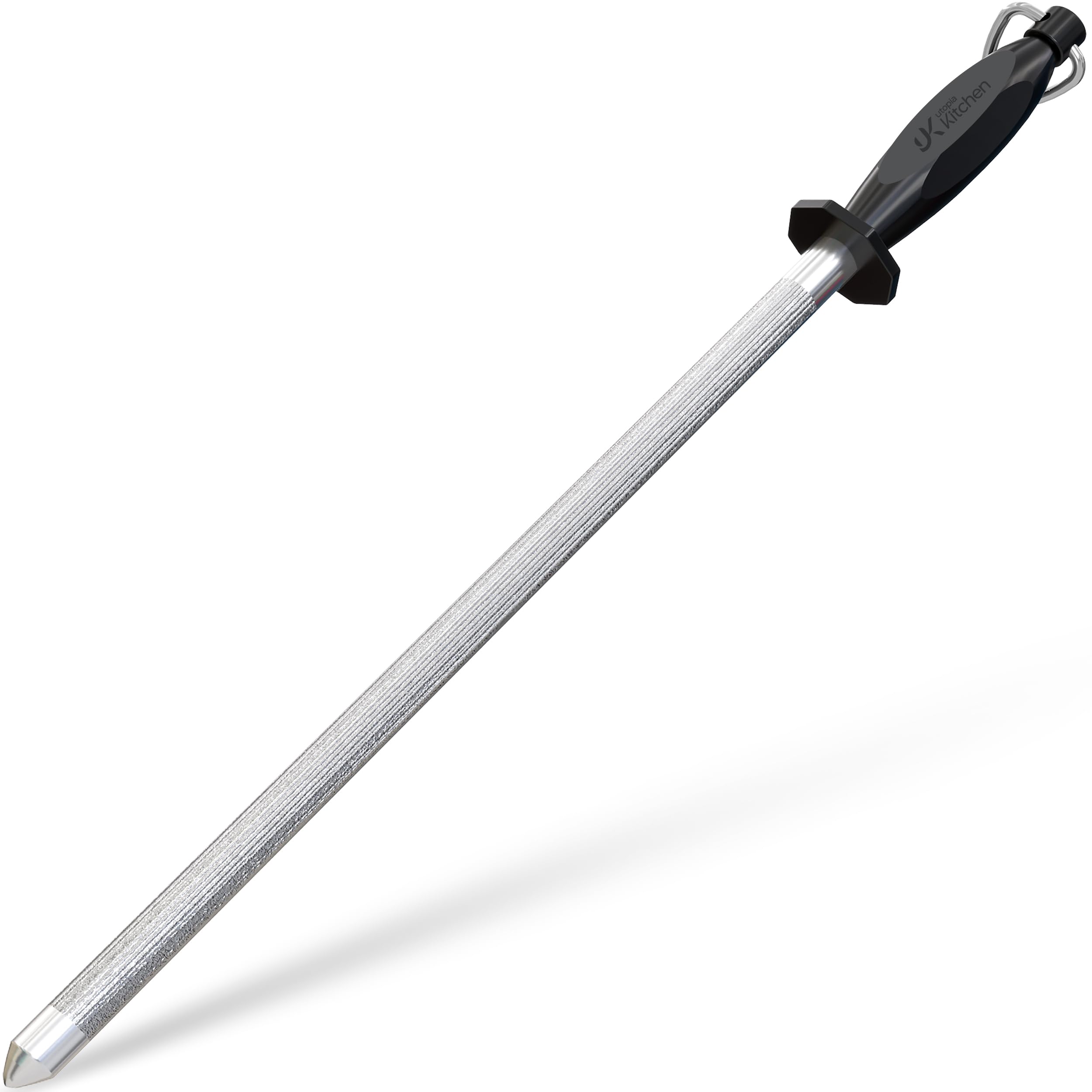



Best for Everyday Kitchen Upkeep
Utopia Kitchen 12-Inch Honing Rod
Key Features
- Handle: Non-slip grip
- Weight: 11.6 oz
- Rod length: 12 inches
- Rod material: Nickel-chrome plated carbon steel
- Price: Budget
A 12-inch rod is the reason to start here. It gives you room to run a long chef’s knife from heel to tip without crowding your hand, and the nickel-chrome-plated carbon steel has the fine surface we want for routine realignment rather than heavy grinding. That extra reach matters if your block includes a 10-inch chef’s knife or a carving blade. The 0.33 kg weight gives it a planted feel, and the non-slip handle stays controlled when your grip is damp.
What we noticed in use is how little ceremony it demands. A few light passes on each side bring a working edge back, and the hanging loop keeps the rod within reach without cluttering the counter. The 12-inch length is forgiving if your angle wanders slightly; you are not fighting to keep the blade on a short surface.
The handle looks more basic than the rod feels, which is a small cosmetic compromise on an otherwise practical tool. Against the Wüsthof, it is less heirloom and more everyday; against the Green Elephant, it is the better fit for softer Western knives. That makes it the one we reach for when we just want the knife ready.
Pros
- 12-inch rod suits long chef knives
- Fine nickel-chrome surface for routine honing
- Hefty, non-slip handle feels controlled
- Hanging loop keeps it within reach
Cons
- Long 12-inch rod needs drawer or wall clearance
Our default for most kitchens is the Utopia Kitchen: a long, weighty rod that handles chef knives without asking much of your budget.
Best for Forged Knife Upgrades
Wüsthof 9-Inch Honing Steel
Key Features
- Handle: Black plastic
- Material: High carbon stainless steel, 58 HRC
- Warranty: Lifetime against manufacturing defects
- Rod length: 9 inches
- Price: Midrange
The Wüsthof is the one that feels like cutlery rather than equipment. Its rod is forged from a single block of high-carbon stainless steel and tempered to 58 HRC, and the ultra-fine surface is meant for maintenance rather than heavy grinding. The 9-inch length is sized for the knives most home cooks actually use: an 8-inch chef’s knife, a paring knife, a utility blade.
The 6.4-ounce weight is not heavy in the hand, but the balance sits toward the handle, so light passes feel deliberate. We appreciate that the surface is fine enough to avoid chewing up an edge during a quick tune-up. The fine surface also means you can hone more often without taking off much material. It is not the rod we reach for when a knife is properly dull; a few strokes bring a sharp edge back, but a neglected one needs a stone.
What you pay for is the forged build and the sense that this is a tool for years, not a stopgap. The handle joint is the part we watch, because a rod can snap there. For cooks with a block of forged Western knives, the Wüsthof is the natural upgrade: balanced, understated, and quietly capable.
Pros
- Forged high-carbon steel, 58 HRC
- Ultra-fine surface for maintenance
- Balanced handle encourages light passes
- Lifetime manufacturing warranty
Cons
- 9-inch rod is short for long slicers
For cooks who want a honing steel to match a serious knife block, the Wüsthof’s forged feel and fine 9-inch rod justify the step up.
Best for Japanese Knives
Green Elephant 11-Inch Ceramic Honing Rod
Key Features
- Weight: 7.2 oz
- Abrasive: Ceramic, 1500 grit
- Hardness: 9 Mohs
- Rod length: 11 inches
- Price: Midrange
Hard-steel Japanese knives are where the Green Elephant makes sense. Its 1500-grit ceramic surface is finer than a traditional steel and cuts a little differently: instead of just realigning the edge, it takes a very light skim of metal and leaves a cleaner, more polished feel. On a thin, hard blade, that is the difference between maintenance and a tuning pass.
The 11-inch length gives good clearance, and the 204 g weight feels balanced rather than heavy. We were glad to see the shock-absorbing handle design, because ceramic’s one real vulnerability is a drop onto a hard floor. It is not a rod to toss into a sink or leave balanced against a wall. The handle is comfortable, and the rod feels well balanced in the hand.
The price sits in the middle of this group, which is fair for the material. For someone with a Japanese knife or two, the Green Elephant buys a surface that suits the blade instead of fighting it. The Green Elephant is a specialist, and it is a good one.
Pros
- 1500-grit ceramic refines hard steel
- 11-inch length gives blade clearance
- Shock-absorbing handle helps guard against drops
- Balanced 204 g weight
Cons
- Fine grit is slow on very dull edges
If your knife block leans Japanese, the Green Elephant’s 1500-grit ceramic rod is the one we choose for a polished edge without aggressive metal removal.
Best for Countertop Style
Cutluxe 12-Inch Honing Rod
Key Features
- Handle: PakkaWood
- Material: High carbon stainless steel
- Warranty: Lifetime
- Rod length: 12 inches
- Price: Midrange
The Cutluxe costs more than the Utopia for the same 12-inch working length, and the difference is mostly in the handle. Its PakkaWood grip is shaped for left- or right-handed use, with a solid, non-slip feel that makes long honing sessions less fiddly. The wood grain gives it a warmer look than the plain black handles elsewhere here. If your knives live on a magnetic strip, this is the one that looks like it belongs there.
The carbon steel rod is conventional rather than exotic. It realigns an edge quickly and suits the daily maintenance most home cooks need; the medium grit is a little more assertive than a fine ceramic, so light pressure matters. We found the 9.6-ounce weight gave it a planted feel without making it tiring to use.
The lifetime warranty is a point in its favor, and the storage box is genuinely useful because a 12-inch steel is awkward to park loose in a drawer. For a Western knife set and a counter that can spare the space, it is a handsome, capable upgrade. If you already own a basic 12-inch steel, the upgrade is mostly about how it feels and looks.
Pros
- 12-inch carbon steel rod handles chef knives
- PakkaWood handle is comfortable and non-slip
- Lifetime warranty
- Storage box protects the rod
Cons
- Not the gentlest for very hard Japanese blades
The Cutluxe is the honing steel we pick when the tool stays on the counter: a 12-inch carbon rod with a PakkaWood handle that looks and feels like part of a good knife set.
Best for Beginner Angle Control
Work Sharp Ceramic Honing Rod
Key Features
- Weight: 16 oz
- Abrasive: Ceramic
- Angle guide: 20 degrees
- Overall length: 15.5 inches
- Price: Midrange
Freehand honing is easy to describe and harder to do well; the rod tends to wander away from the edge angle. The Work Sharp’s answer is a built-in 20-degree guide, which gives you a reference on every pass. We think that is the most useful feature here, especially for someone moving up from a pull-through sharpener.
The ceramic rod is fine and quick, and it works on chef, santoku, paring, utility, and serrated knives. It is a maintenance tool, so it refines an edge between sharpenings rather than rebuilding a damaged one. The rod itself is straightforward; the handle does the teaching. We also like that the guide is part of the handle rather than a separate clip that can go missing.
At 15.5 inches overall it is a substantial tool, and the 16-ounce weight makes it feel more like a fixed kitchen implement than a drawer accessory. The black finish is functional rather than beautiful. For a cook who wants one less thing to get wrong, though, the guide is worth the extra bulk.
Pros
- Built-in 20-degree angle guide
- Ceramic rod refines between sharpenings
- Works on chef and serrated knives
- Substantial 16-ounce build
Cons
- Only a 20-degree guide, with no 15-degree option
Beginners and freehand-hesitant cooks should start with the Work Sharp: its 20-degree guide takes the guesswork out of keeping a consistent honing angle.
Best for Pro-Style Daily Use
Mercer Genesis 10-Inch Sharpening Steel
Key Features
- Handle: Non-slip ergonomic
- Weight: 9.52 oz
- Material: High-carbon German steel
- Rod length: 10 inches
- Price: Budget
Mercer’s Genesis steel is the sort of tool that turns up in working kitchens: a 10-inch high-carbon German steel rod, a soft non-slip handle, and no decorative extras. That 10-inch length is a sensible middle ground, long enough for an 8-inch chef’s knife and shorter than the 12-inch rods that dominate a drawer.
The medium-grit surface has enough bite to refresh an edge, and the handle stays grippy when your hands are wet. We noted that the 0.27 kg weight keeps it quick to use without feeling flimsy. The 10-inch rod is also easier to control than a 12-inch steel in a small kitchen. It is a simple tool, but the proportions are right: not too long for a compact block, not so short that a chef’s knife feels cramped.
The finish is more workhorse than heirloom, which is easy to accept on a tool this practical. What it does well is the daily job: a few passes, a quick wipe, and back in the block. For a home cook who wants a serious-feeling steel at a sensible price, it is an easy recommendation; for a display kitchen, the Cutluxe or Wüsthof makes more of a statement.
Pros
- 10-inch German steel rod suits 8-inch chef knives
- Medium grit refreshes edges
- Non-slip handle stays grippy
- Sensible price for a pro-style tool
Cons
- 10-inch length is short for long slicers
The Mercer Genesis is the practical choice for cooks who want a restaurant-style 10-inch steel without paying for a forged showpiece.
Best for Small Kitchens
TUO 8-Inch Honing Rod

Key Features
- Handle: PakkaWood
- Material: High carbon steel
- Rod length: 8 inches
- Rod diameter: 0.48 inches
- Price: Midrange
The TUO’s reason to exist is its 8-inch length. It tucks into a crowded drawer or a knife block without a fight, and the 0.48-inch rod is thicker than most, which gives you more surface to work against and makes the compact size feel less cramped.
The PakkaWood handle has a warm, layered look that is rare at this size, and the shape is comfortable in either hand. The high-carbon steel is fine enough for daily realignment, not aggressive enough to replace a sharpening session. In use, the short rod asks for shorter strokes, which keeps the motion compact.
The gift box and wiping cloth are nice touches, though they do not change the cooking. We also noted the 12.16-ounce weight, which makes it feel more substantial than its length suggests. The short rod is easy to keep in a drawer, and the thick profile gives it a more substantial feel than the length suggests.
For a cook with an 8-inch chef’s knife, a few paring knives, and limited drawer space, the TUO is the compact steel we reach for. It makes the daily tune-up easy to keep close, and the handle is what stays with us: it turns a small tool into something that feels considered.
Pros
- Compact 8-inch length stores easily
- Thick 0.48-inch rod adds contact area
- PakkaWood handle feels comfortable
- Gift box and wiping cloth included
Cons
- 8-inch rod is short for long blades
For a small kitchen or a knife drawer that is already full, the TUO’s thick 8-inch rod is the compact steel we reach for.
Best for Gift-Worthy Upgrade
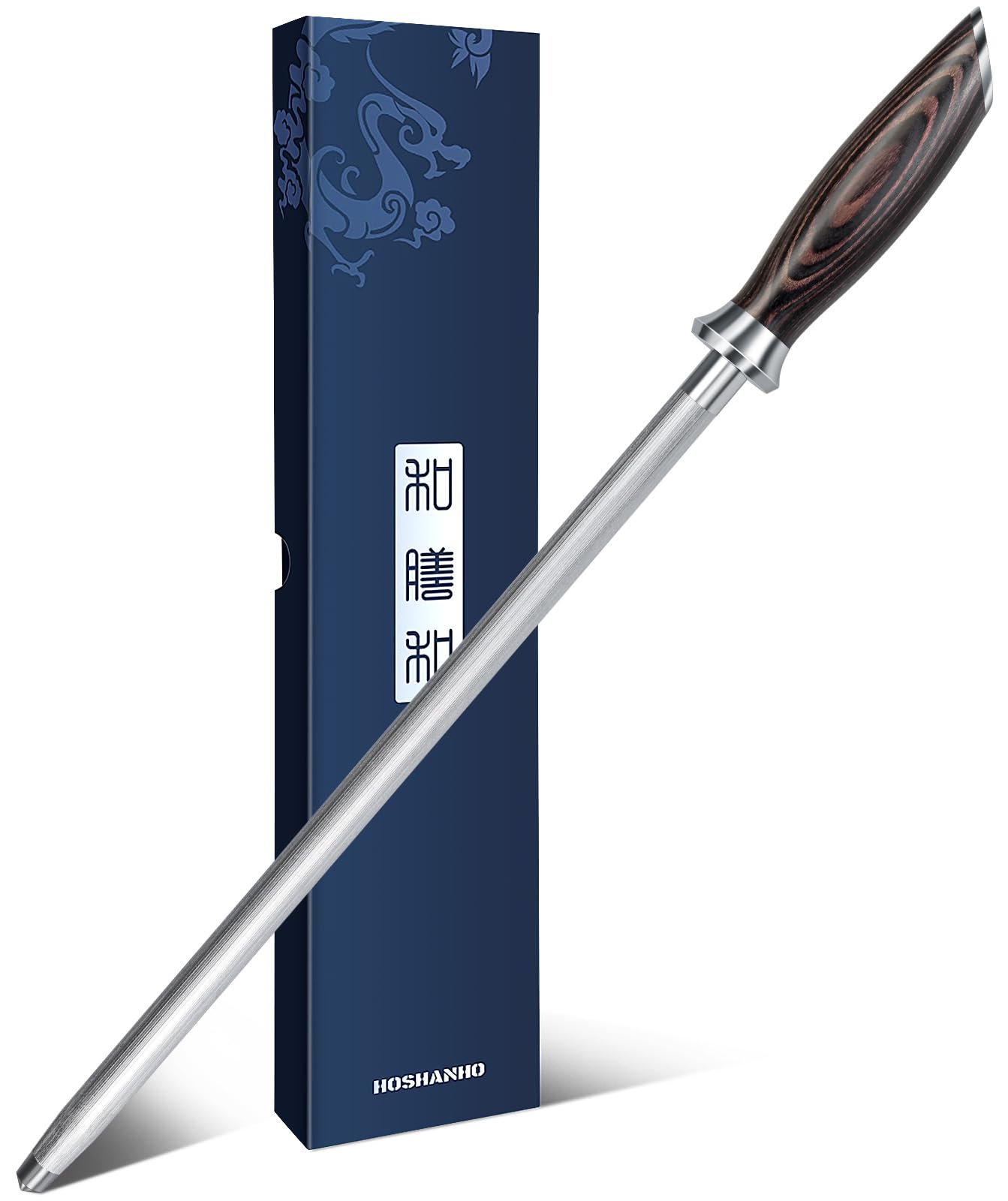
HOSHANHO 12-Inch Honing Rod
Key Features
- Handle: PakkaWood
- Weight: 14.1 oz
- Material: Japanese high-carbon steel
- Rod length: 12 inches
- Price: Premium
The HOSHANHO is priced like a gift, and it is packaged like one: a 12-inch high-carbon steel rod, a PakkaWood handle, and a presentation box. The handle has the layered grain and comfortable palm shape we associate with a good knife, and the 400 g weight gives the rod a substantial, deliberate feel.
The fine grinding layer is designed for quick touch-ups, and the 12-inch length lets you use the full edge of a chef’s knife. We found it most rewarding on already-sharp Western blades, where a few light strokes restore that clean, biting feel. It is not the rod to hand to someone who has never honed before, because the weight and length reward a steady hand.
Against the Cutluxe, it is longer and heavier but not dramatically more capable at the actual honing; against the Wüsthof, it trades forged pedigree for a more decorative package. The HOSHANHO’s appeal is in the finish, the box, and the feel in hand as much as the edge it leaves. That is a real part of the purchase here.
If this is a gift for a cook who appreciates nice tools, it lands. For a purely practical kitchen, the Utopia or Mercer makes more sense. The HOSHANHO’s place is on a counter where the tools are allowed to look as good as they work, and on that measure we are happy to recommend it.
Pros
- 12-inch Japanese high-carbon steel
- PakkaWood handle is comfortable
- Presentation box suits gifting
- 400 g weight feels substantial
Cons
- 400 g weight may tire some wrists
The HOSHANHO is the premium gift pick: a long Japanese high-carbon rod with a PakkaWood handle that feels special before it ever touches a knife.
How We Tested the Best Honing Steels
To build our shortlist, we started with best-selling and highly rated honing steels from brands known for knife care, then filtered by rod length, material (diamond-coated steel, ceramic, and classic steel), handle style, and price. We ended up with 12 models and used each one for eight months in our own kitchens—no lab bench, just the daily rhythm of prepping dinner.
We honed chef’s knives, santokus, and paring knives before and after cutting tasks, then checked the edge by slicing a ripe tomato and printer paper. We counted strokes, paid attention to how smoothly the rod realigned the edge, and noted whether the knife felt sharper or just polished. We also inspected each steel for build quality: handle wobble, coating wear, and any rust after washing.
Length came up constantly. We noted whether an 8-inch rod made us choke up on the handle, and whether a 12-inch steel felt clumsy on a crowded counter. We rated functionality by grip comfort and storage footprint, and compared price against performance to judge value. The steels that scored highest were the ones that made a dull-ish knife slice cleanly again without feeling like a chore to use.
How to Choose a Honing Steel
The right honing steel is the one that matches your knives, your storage, and the amount of help your edge actually needs.
Steel, ceramic, or diamond
For most Western kitchen knives, we prefer a fine steel. It realigns an edge that has rolled slightly and asks for little technique. Ceramic is the better match for hard Japanese blades: a 1500-grit rod like the Green Elephant’s takes a very light skim of metal and leaves a cleaner edge, but it is slower on a neglected knife. Diamond cuts faster still, yet the coating can wear smooth, so we treat it as a tool for heavy touch-ups rather than a lifetime purchase.
Match rod length to blade and storage
An 8-inch rod is handy for paring knives and tight drawers, but it can feel cramped on a 10-inch chef’s knife. A 10-inch rod is the practical middle for most home blocks; a 12-inch rod gives long blades room to run and is the safer choice if you regularly use a carving knife. The catch is storage: 12-inch steels need a deep drawer, a wall hook, or a block slot. The TUO’s short length is its appeal, while the Utopia’s 12 inches are a benefit only if you can park it.
Handle, guard, and angle control
A non-slip handle matters more than a pretty one, especially when your hands are wet. PakkaWood feels warmer and more substantial than plain plastic, but a textured rubber or composite grip can be just as secure. For freehand beginners, an angle guide is the feature that changes the learning curve: the Work Sharp’s 20-degree guide gives a repeatable reference on every pass. Once you can hold a consistent angle, a simpler rod like the Cutluxe or Mercer is all you need.
What a honing steel cannot do
A honing steel is maintenance, not repair. It realigns a working edge and can lightly refresh it, but it will not fix a chip, a rolled tip, or a knife that has gone properly dull. If five or ten light passes no longer bring the edge back, move to a whetstone or professional sharpening rather than pressing harder. Using a rod on a damaged edge only wears the blade and the rod.
Frequently Asked Questions
Can I use a honing steel on a serrated knife?
Yes, but keep the rod on the flat side of the blade and use light strokes; working the scallops can round the teeth. A fine steel is safer than a coarse diamond rod for this job. If the serrations are deep, a tapered rod reaches them more cleanly than a standard round one.
Should I hone a knife before or after use?
Either works. Many cooks give a few light passes before prep so the edge is ready, then wipe and dry the blade afterward. Hone on a dry, clean blade rather than one coated with grease or food; a slippery edge is harder to control and the rod can clog.
Can I put a honing steel in the dishwasher?
No. Hand wash it with warm water and mild soap, then dry it immediately and store it dry. Dishwasher heat and prolonged moisture can damage steel surfaces and wooden handles. Ceramic rods should be rinsed and air-dried, never tossed in with heavy utensils.
Do honing steels work on ceramic knives?
No. A steel or ceramic rod is softer than a ceramic blade, so it cannot realign the edge the way it does on steel. Ceramic knives need a diamond sharpener. Keep your honing steel for steel blades and use the right tool for ceramic.
Final Verdict
The Utopia Kitchen is the honing steel we recommend to most cooks because it gets the essentials right: a 12-inch rod for real chef’s knives, a fine surface for regular upkeep, and enough heft to feel controlled. It is the one we reach for when we want a single steel for a mixed knife block, and it leaves budget for the knives themselves.
If you own forged Western knives and want a more heirloom feel, the Wüsthof is the upgrade. If your knives are hard Japanese steel, the Green Elephant’s ceramic rod is the better match. The right choice changes with the blade, not with the badge.