This post contains affiliate links. We may earn a small commission when you buy through our links — at no extra cost to you.
Nonstick pans have a dirty little secret: most of them are wonderful for about a year. Then the coating starts to craze, eggs begin to stick in a stubborn ring around the middle, and you’re shopping all over again. A frying pan worth your money should outlast that cycle — heat evenly across the whole surface, sit balanced in your hand when it’s loaded with food, shrug off a metal spatula, and wipe clean in seconds so you actually reach for it on a Tuesday night.
I’ve burned through my share of cheap ones, and my team and I have now spent six months cooking with 12 frying pans to find the ones that don’t pull that trick. The biggest thing I learned is that the price tag tells you less than you’d think, and that most people buy a pan that’s too big — a 12-inch looks impressive until you’re washing it. The picks below are the ones we kept reaching for long after the testing schedule said we could stop.



Best for Everyday Nonstick Cooking
T-fal Ultimate Hard Anodized 2-Pack
Key Features
- Coating: Titanium nonstick
- Oven safe: 400 °F
- Stovetops: Gas, electric, ceramic (not induction)
- Set contents: 10-inch and 12-inch fry pans
- Price: Midrange
Ten inches and twelve inches are the two pans that do most of the work in a home kitchen, and this set gives you both in one box. The smaller one handles two eggs, a grilled sandwich, or a single pork chop; the larger one takes four chicken thighs without crowding, which is where most single 10-inch pans run out of room. That pairing, more than any one feature, is why this is our top pick.
The body is hard-anodized aluminum, so it heats quickly and evenly and stays light. About 3.4 pounds for the pair means tilting and tossing with one hand doesn’t take a braced wrist. The Thermo-Spot in the center turns solid red once the pan is properly preheated, which sounds like a gimmick until you’ve watched someone drop a cold chop into a cold nonstick pan. A preheat cue heads off the two mistakes that kill nonstick fastest.
Release is what matters most here, and it held up on eggs, pancakes, and a sticky soy glaze. The coating is a wear item, so treat it accordingly: medium heat, a soft sponge, no steel wool. Both pans are oven safe to 400 °F and dishwasher safe when you can’t be bothered.
The pair also makes a sensible base for a kitchen that’s still growing. If you want a pan that will outlast the century, the Lodge is a different tool entirely, and worth owning alongside this set rather than instead of it.
Pros
- Two useful sizes in one purchase
- Thermo-Spot indicator shows when preheated
- Light enough to toss one-handed
- Oven safe to 400 °F and dishwasher safe
Cons
- Not compatible with induction cooktops
Our default recommendation: the 10- and 12-inch pair covers weeknight cooking from eggs to a family stir-fry, and the nonstick releases cleanly with very little oil.
Best for Searing and Baking
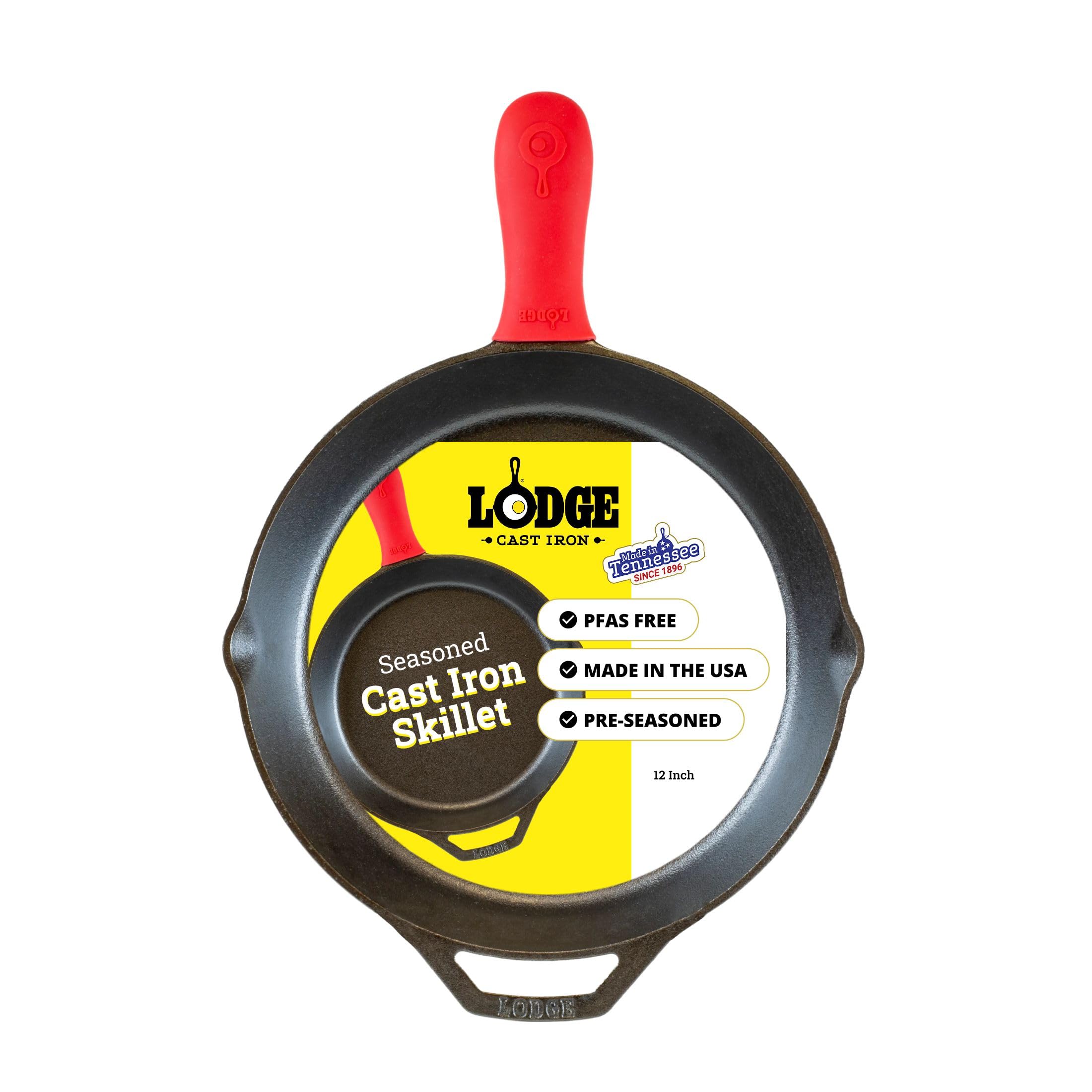
Lodge 12-Inch Cast Iron Skillet
Key Features
- Size: 12 inches
- Weight: 7.5 lb
- Included: Silicone handle holder
- Material: Pre-seasoned cast iron
- Price: Midrange
Seven and a half pounds is a lot of pan. Lift the 12-inch Lodge by its handle with one hand and the weight is the first thing you notice and the last thing you stop thinking about. It’s also the reason a steak comes out with a crust a thin aluminum skillet can’t manage: cast iron soaks up heat and gives it back slowly, so the pan doesn’t crash when cold food lands in it.
That’s the trade we keep making it for: searing, cornbread, roast chicken, anything that starts on the burner and finishes in the oven. It arrives pre-seasoned, so dinner can happen the day it does. The seasoning is the nonstick, though, and that’s the honest catch. The surface starts out textured, and eggs on a new pan need a real film of fat and some patience; a few weeks of bacon and cornbread settles it into something slicker.
The included silicone handle holder matters more than it sounds like it should, because bare cast iron stays hot long after the burner goes off. Wash it by hand, dry it on a warm burner, wipe on a thin layer of oil. It’s made in the USA and PFAS-free, which is a nice bonus on a pan whose entire finish comes from polymerized cooking oil rather than a factory coating.
Pros
- Sears hard and holds heat through cold food
- No coating to chip, flake, or replace
- Oven, grill, and campfire safe
- Silicone handle holder included
Cons
- Heavy 7.5 pounds to lift and pour
- Eggs need a built-up seasoning layer
Buy it if you want grill-grade sear marks and a pan that will outlive everything else in the kitchen, and you’re willing to learn its seasoning.
Best for Induction Cooktops
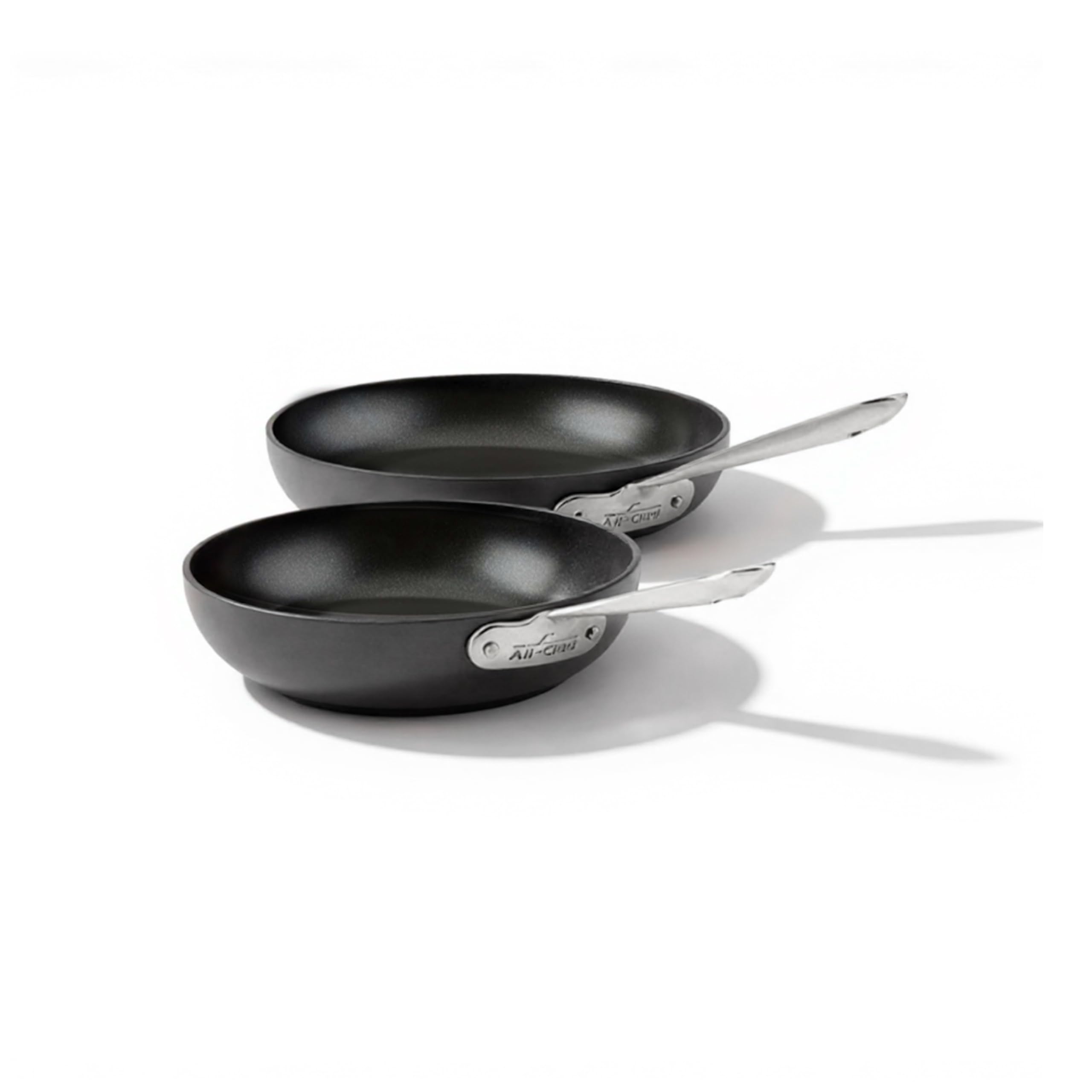
All-Clad HA1 2-Piece Fry Pan Set
Key Features
- Oven safe: 500 °F
- Stovetops: All, including induction
- Set weight: 5 lb
- Set contents: 8-inch and 10-inch fry pans
- Price: Premium
If your cooktop is induction, our top pick is out of the running, and this is where we send you. The HA1 set is an 8-inch and a 10-inch fry pan in hard-anodized aluminum with a bonded stainless base: genuinely induction ready, oven safe to 500 °F, and dishwasher safe. The sizes suit a couple or a small household. Cook for four and the 10-inch pan is the one that will feel tight.
The extra money goes into the body. The stainless base resists the warping that ruins cheaper pans on a hot burner, and heat spreads across the base rather than in a ring under the flame. At five pounds for the two they’re heavier than the T-fal pair, planted on the burner rather than tossable, with long riveted stainless handles that feel secure and a little utilitarian in the hand.
Our reservation is the one that applies to any nonstick: the coating, not the metal, decides how long these pans stay in service. Because they hold heat so well, it’s tempting to run them hot, and that shortens the release. Used at medium heat and washed by hand, the bodies will outlast several coatings. For induction kitchens willing to treat them well, this is the set we recommend without hesitation.
Pros
- Induction ready alongside gas and electric
- Oven safe to 500 °F
- Bonded stainless base resists warping
- Dishwasher safe
Cons
- Five pounds is heavy for a nonstick pair
- Premium price for only two pans
The set we point to for induction cooktops: two sensible sizes, even heat, and a 500 °F oven rating in a body built to stay flat.
Best for Pan Sauces
All-Clad D3 12-Inch Fry Pan
Key Features
- Size: 12 inches
- Included: Tempered glass lid
- Oven safe: 600 °F
- Construction: Tri-ply bonded stainless
- Price: Premium
The browned crust stuck to the bottom of a stainless pan isn’t a problem, it’s dinner: deglaze it with stock or wine and you have a pan sauce no nonstick surface will ever give you. This is the pan for that job, a 12-inch tri-ply fry pan with an aluminum core bonded between two layers of stainless, a lid, and an oven rating to 600 °F.
We reach for it for steak, chops, and anything that needs a hard sear followed by a stretch in the oven. Twelve inches is the useful part: four chicken thighs or a full pan of onions go in without piling up and steaming. It’s just under five pounds, so plan on two hands when the pan is full and hot. And it will teach you to cook on stainless, because preheating it and adding fat is not optional.
Rush it and eggs will weld themselves to the bottom; that’s the pan, not a defect. Cleaning takes a soak and a light scour, and the surface will discolor with heat no matter what you do. The lid makes it more than a searing pan, though, because it steams, simmers, and goes from stovetop to oven to table.
What you get for the premium is a pan with no coating to expire, induction compatibility, and an oven rating higher than anything else here. Most kitchens don’t need it. If you’ve been cooking on nonstick and want to learn the technique, this is the last pan you’ll buy for a long while.
Pros
- Tri-ply body heats evenly and holds heat
- Oven safe to 600 °F
- Lid included for steaming and simmering
- Works on induction
Cons
- Food sticks without preheating and fat
- Hand wash only
The stainless pan we choose for searing and pan sauces, and the one to learn the technique on if you want a skillet that never wears out.
Best for First Kitchens
Utopia Kitchen 3-Piece Fry Pan Set
Key Features
- Coating: Nonstick, PFOA free
- Handles: Riveted Bakelite
- Stovetops: Gas and electric
- Set contents: 8, 9.5, and 11 inches
- Price: Budget
Three pans, 8, 9.5, and 11 inches, for less than the T-fal pair. If you’re setting up a first apartment or replacing a scratched-out set in one go, that math is hard to argue with, and the sizes step up sensibly: eggs in the small one, two portions in the middle, dinner for two or three in the largest.
The nonstick is the pleasant part. Food releases cleanly, cleanup is a wipe and a rinse, and the riveted Bakelite handles stay cool enough to grab bare-handed. They’re light, which makes them easy to move around a busy stove, and the sloped sides let an omelet slide out without being chased around the pan.
The largest pan is 11 inches rather than 12, so a big batch has to be split, and that’s the one place a set at this price shows its hand. Keep the burner at medium and use silicone or wood and the pans will treat you well for a few good years. As a starter set, or a spare set for a rental, we think it’s an easy yes.
Pros
- Three sizes in one purchase
- Clean release with little oil
- Cool-touch riveted Bakelite handles
Cons
- Nonstick coating can peel with heavy use
The set we recommend for a first kitchen: three workable sizes, easy release, and cool handles, at the lowest cost per pan in this group.
Best for Eggs and Omelets
Tramontina Professional 8-Inch
Key Features
- Size: 8 inches
- Weight: 1.9 lb
- Oven safe: 400 °F, sleeve removed
- Certification: NSF certified
- Price: Budget
Eight inches is the pan that gets used most in a home kitchen, for eggs, a grilled cheese, a single chop, and this is the most restaurant-like version of it here. Heavy-gauge aluminum, a reinforced nonstick coating, NSF certification, and a lifetime warranty: this is the pan line you see in commercial kitchens, sized down for a home burner.
It heats fast and evenly, and the low, sloped sides make a two-egg omelet easy to fold and slide out whole. The silicone sleeve on the handle comes off, which is how the pan gets to 400 °F in the oven, then goes back on for the stovetop. At 0.86 kg it’s light enough to lift and plate with one hand.
Where it earns its spot is the everyday small job: two eggs, a quick quesadilla, a single salmon fillet, done in minutes and rinsed in ten seconds. It’s the pan we grab when hauling out a 12-inch skillet for one person’s lunch would be silly.
Pros
- NSF-certified restaurant-style build
- Oven safe to 400 °F with sleeve removed
- Dishwasher safe
- 8-inch size suits eggs and single servings
Cons
- Not compatible with induction cooktops
- Can mark glass cooktops
The small pan we reach for when eggs need to slide out whole and cleanup should take ten seconds, and it happily goes into a 400 °F oven.
Best for Small Portions
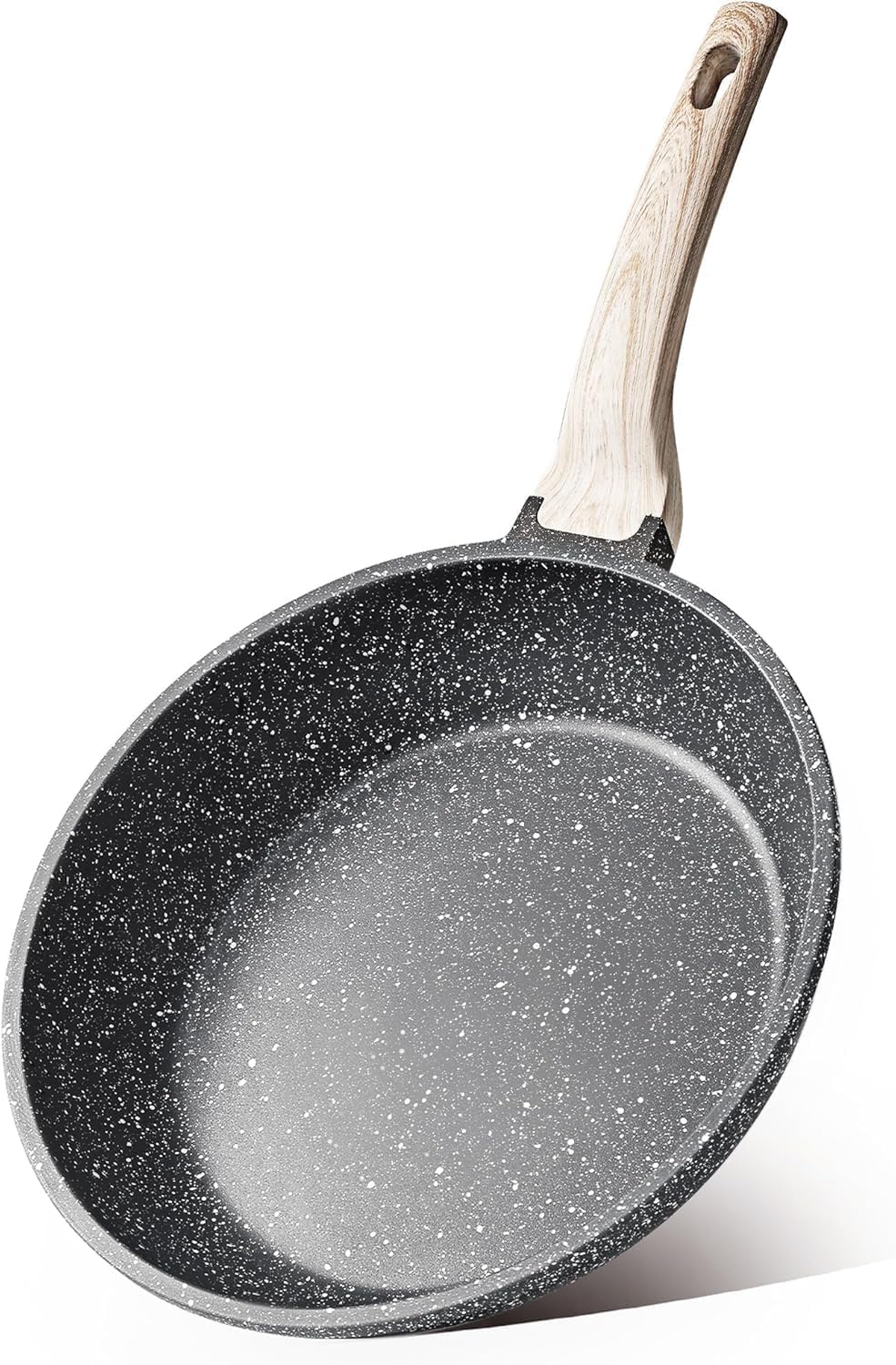
CAROTE 8-Inch Granite Skillet
Key Features
- Size: 8 inches
- Coating: Granite nonstick, PFOA free
- Stovetops: Gas, induction, and all cooktops
- Max temperature: 482 °F
- Price: Budget
Eight inches is not a family pan, and it’s worth being honest about that before you buy. The CAROTE’s surface fits two eggs comfortably, a chicken breast with room to spare, and not much else. It’s an egg pan, a pancake-for-one pan, a reheat-last-night’s-rice pan.
What it does, it does well. The granite-flecked coating releases eggs with barely a film of butter, and at about 1.3 pounds it’s light enough to tilt and swirl one-handed. The Bakelite handle stays cool on the burner, and the magnetic base means it works on induction as well as gas and electric.
Heat is quick and even, which suits eggs and pancakes better than a hard sear. This is a medium-heat pan with no fond to build a pan sauce on, so it’s a different job from the Lodge or the D3 rather than a cheaper version of them. Against the other small pans here, it’s the least expensive by a clear margin.
For the money, it earns a spot as a second pan: the one that lives on the stove for breakfast and gets rinsed while the coffee brews. It won’t be the last pan you own, but it may be the one you use most before noon.
Pros
- Eggs release with almost no fat
- Light 1.3-pound body
- Works on induction and gas
- Lowest-priced pan in this group
Cons
- Coating can flake with daily heavy use
The cheapest way into a granite nonstick egg pan, and a good second skillet, as long as you’re not cooking for four.
Best for Oven-Finished Eggs
Cuisinart Chef’s Classic 8-Inch

Key Features
- Size: 8 inches
- Coating: Ceramic nonstick
- Warranty: Limited lifetime
- Oven safe: 500 °F
- Price: Budget
A 500 °F oven rating is unusual on a coated pan, and it’s the first thing worth knowing about this Cuisinart. It’s an 8-inch hard-anodized skillet with a ceramic nonstick interior, a riveted stainless handle, and a limited lifetime warranty, and it’s rated to go from the burner straight into a hot oven.
Ceramic coatings have a reputation for slickness that fades with time, but on eggs and pancakes this one does what it promises: a fried egg slides with a little butter, and cleanup is a rinse and a wipe. The 8-inch size is right for a two-egg breakfast or a small frittata for two.
The stainless handle stays cool on the stovetop and isn’t the piece that sets the oven limit, which is what makes the 500 °F figure useful rather than decorative. At 1.3 pounds it’s light enough to handle with one hand while you slide an omelet onto a plate.
Where it fits: it’s the small pan for anyone who wants a coated skillet that can take oven heat, and the ceramic surface is the alternative if you’d rather avoid PTFE. For a frittata, a baked egg dish, or a breakfast that doesn’t need a second pan, it’s the one we choose.
Pros
- Oven safe to 500 °F
- Ceramic coating releases eggs cleanly
- Riveted stainless handle stays cool
- Limited lifetime warranty
Cons
- Hand wash only
- 8-inch surface suits one or two servings
The small ceramic skillet we like for oven-finished eggs and frittatas, and one of the few coated pans here rated to 500 °F.
How We Tested 12 Frying Pans Over Six Months
We started with roughly 60 pans from brands we’ve cooked with before and narrowed them by material, handle construction, the sizes each line offers, and whether the price felt defensible for how the pan was actually built. Twelve made the final cut, and each one lived in a real kitchen for six months rather than a lab.
Sunday mornings were the great equalizer: we cooked a single egg in each pan with no butter or oil, then a three-egg omelet, noting how cleanly food released on the first use and again in month five. Weeknights meant searing chicken thighs, browning ground beef, and building pan sauces, so we could see how each pan handled high heat and deglazing. To map hot spots, we scattered a spoonful of dry flour across a preheated pan and watched where it browned first.
We weighed every pan empty, then lifted it one-handed full of food and tried tossing vegetables, since a pan you can’t maneuver is a pan you avoid. Handles were grabbed bare-handed at the stovetop and again with an oven mitt at 400 degrees. For durability and scratches, we deliberately used metal tongs and spatulas in every pan and dragged a fork across each surface at the ten-cook mark.
Cleaning was its own test: we left cooled grease to set overnight, then hand-washed each pan and ran the dishwasher-safe ones through a full cycle. To check for warping, we heated pans empty on high and ran them under cold water, then set them back on the burner to see if they spun. We compared what each pan cost against how it looked and performed at six months, because a pan’s real price is the number of years you get out of it.
How to Choose a Frying Pan
The right pan has less to do with price than with the surface you like cooking on and the size of your burners, because a nonstick skillet and a cast iron one are different tools rather than better and worse versions of the same thing.
Start with the cooking surface
The coating decides what a pan is good at. Nonstick, whether the label says granite, titanium, or Swiss, is the easiest place to cook eggs and delicate fish, and it is a wear item: the coating, not the metal, determines how long the pan lasts. Bare cast iron and stainless steel have no coating to fail. Cast iron holds heat for a hard sear and slides into the oven; stainless builds the browned fond that becomes a pan sauce.
Most kitchens end up with more than one. A cheap nonstick for eggs, plus either a cast iron skillet or a stainless fry pan for everything that needs real heat, covers more ground than any single pan at any price.
Match the diameter to the burner and the portion
An 8-inch pan is an egg pan; a 10-inch pan cooks for two; 12 inches is where four chicken thighs fit without piling up and steaming. Two traps sit inside those numbers. Measured diameter is not usable surface, since sloped sides give back an inch or more and the flat base is what actually touches food. And a 12-inch pan on an 8-inch burner heats in a ring, so measure your largest burner before you buy the biggest pan.
Check the stovetop before anything else
Induction needs a magnetic base, and not every pan has one. A fridge magnet is the fastest test: if it won’t stick to the base, the pan won’t heat on an induction cooktop. The All-Clad HA1, the All-Clad D3, and the CAROTE granite pan here are all built for it.
Gas and electric coils are far less fussy, but glass-top ranges deserve a little care. A rough or warped base can mark the surface, so lift rather than slide a heavier pan across it.
Weigh it in your hand, not on the spec sheet
Weight changes how a pan feels more than how it cooks. The T-fal pair together weighs about 3.4 pounds; the 12-inch Lodge is 7.5 pounds on its own. If you flip and toss food, light wins. If you want a pan that sits still on the burner and doesn’t lose temperature when food lands, heavy wins.
Handle shape matters as much. A long handle gives leverage on a heavy pan and gets in the way on a small one, and a light pan set down off-center can tip on the burner.
Decide how much oven time you need
Oven ratings separate pans that look alike on the shelf. The T-fal set is rated to 400 °F, the All-Clad HA1 and the Cuisinart to 500 °F, the D3 to 600 °F. Handles and lids carry their own lower limits, so a pan rated to 600 °F with a plastic handle is a stovetop pan in practice.
If you finish frittatas, sear and roast, or move the pan from burner to oven, buy for the rating. If everything happens on the stovetop, don’t pay extra for oven capability you won’t use.
Frequently Asked Questions
How long should a nonstick frying pan last?
With moderate heat, silicone or wooden utensils, and hand washing, a good nonstick coating gives you a few years of daily cooking before the release starts to go. The aluminum body outlives the coating by a long way, which is why the cost of replacing it belongs in your math.
The practical signal is simple: when a fried egg needs oil to slide out, the coating is finished. Retire the pan at that point rather than fighting it with more fat and higher heat.
What is the difference between a frying pan and a sauté pan?
The sides. A frying pan has low, flared walls that let moisture evaporate and give you room to toss. A sauté pan has straight, higher walls and a wide flat base for holding liquid through a braise or a shallow fry.
For searing, stir-frying, and eggs, the frying pan shape is more useful. When a recipe wants something simmered covered in the pan, a lid on a deep skillet does most of the same work.
Can I use metal utensils in a nonstick pan?
No, and the damage doesn’t always show up right away. Metal spatulas and tongs leave fine scratches that break the release surface, and a fork or whisk can chip the coating outright. Silicone, wood, and nylon are the safe set.
Heat matters just as much: nonstick is a medium-heat tool, and an empty coated pan left on a hot burner is the fastest way to ruin one.
Why does food stick to my stainless steel pan?
Usually because the pan wasn’t hot enough when the food went in. Heat the empty pan over medium for a minute or two, then flick a few drops of water at it. If they bead and skate across the surface, the pan is ready; if they sizzle away, give it more time.
Dry the pan, add oil, and let the food sit undisturbed until it releases on its own. If you have to pry it, it needed longer.
Final Verdict
We recommend the T-fal two-pack to almost everyone. A 10-inch and a 12-inch pan cover eggs through a family dinner, the heat is even, and the release is the best combination of performance and cost in this group. If you cook on induction, take the All-Clad HA1 instead, which is the same idea built around a magnetic base.
If you want pans to keep for decades, buy the Lodge for searing and the D3 for pan sauces. Both earn their shelf space, and neither replaces a cheap nonstick on egg duty.