This post contains affiliate links. We may earn a small commission when you buy through our links — at no extra cost to you.
Homemade jerky sounds simple until you actually try it: uneven slices, a dehydrator that runs hot on one side, and trays spaced so close the meat steams instead of dries. I’ve had batches come out brittle at the edges and still tacky in the middle, and that’s usually not the marinade—it’s the machine. A dehydrator built for jerky should hold a low, steady temperature, move air evenly across every tray, and be quiet enough to run overnight without taking over the kitchen. It also needs to be easy to load, easy to scrub, and priced so you’ll use it for more than one batch.
Over the past eight months, my team and I tested 10 dehydrators side by side, running beef, turkey, and venison jerky through each one, plus a few fruit leathers to see how the trays handled sticky cleanup. The difference between a good jerky dehydrator and a frustrating one comes down to steady low heat, tray spacing that lets air move, and controls you can set without guessing. You’ll see picks below for small batches, overnight runs, and anyone who wants less scrubbing afterward.
Best for All-Round Jerky Making
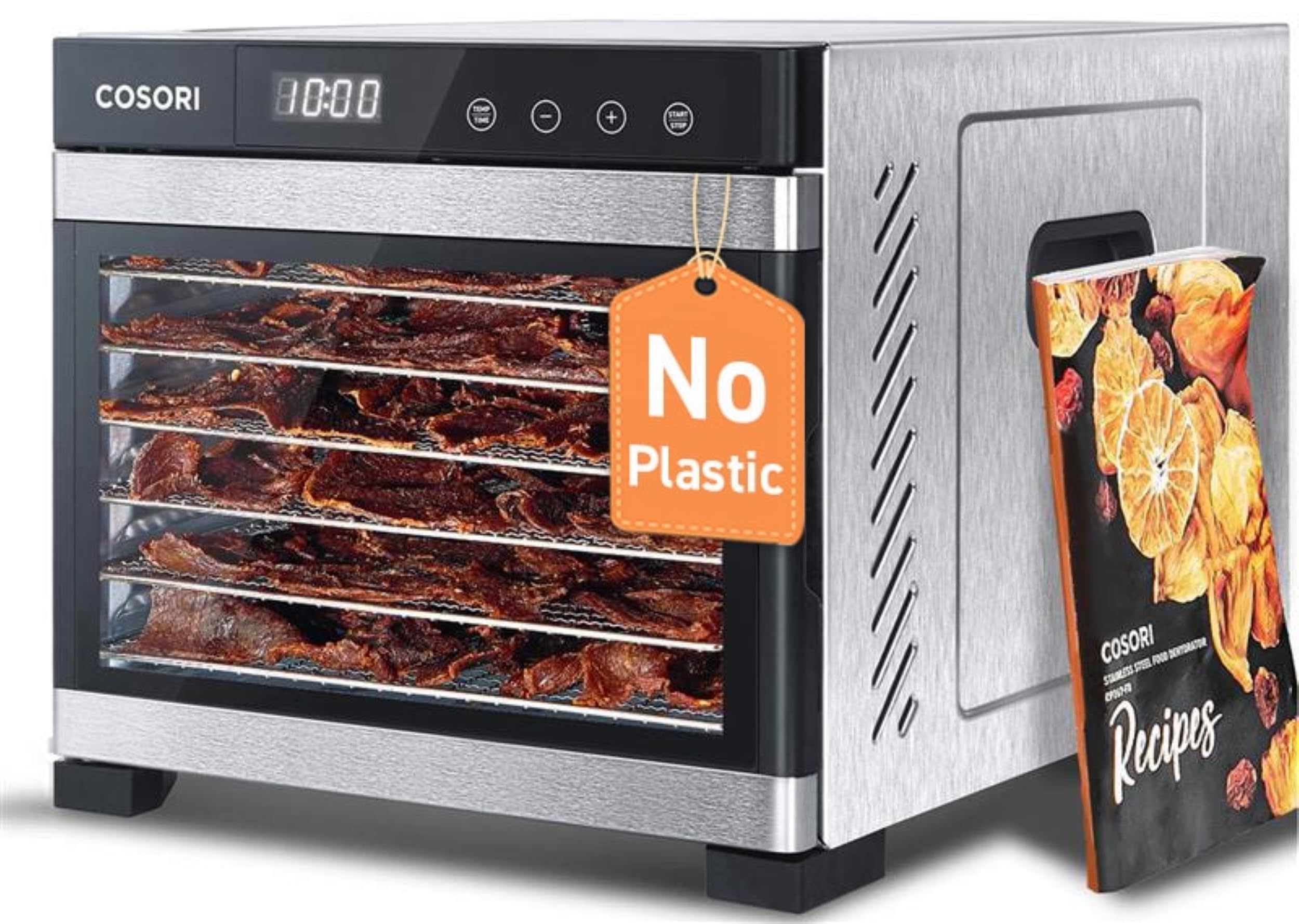
Cosori 6-Tray Stainless
Key Features
- Timer: 48 hours
- Trays: 6 stainless steel
- Drying area: 6.5 sq ft
- Temperature range: 95–165 °F
- Price: Midrange
Six and a half square feet of drying space is the figure that won us over. That’s six stainless trays, enough for a batch built on about five pounds of raw meat, and it’s the number to hold against a round machine’s five trays. Temperature runs from 95 to 165°F in one-degree steps with a 48-hour timer, so a batch can sit at 165°F for beef and drop to 135°F for fruit leather the next day without guesswork.
The rear-mounted fan and 600 watts make it easy to live with. It’s rated under 48 dB, quiet enough that an overnight jerky run doesn’t keep the house awake, and the trays are dishwasher-safe — though they’re wide enough that they have to lie flat, which claims a whole rack. We paid close attention to the controls the first few times, since the panel remembers the last setting; after that it’s load, set and walk away.
The trade-off is size. At 18.1 pounds and nearly 18 inches deep it takes real counter, and lifting it in and out of a cupboard gets old fast. Where it gives ground to the Magic Mill Pro is the ceiling and the walls: that machine reaches 176°F and lines the interior in stainless, and if you plan to push higher heat for other jobs, it’s the better buy. For jerky, 165°F is enough, and a two-year warranty on something that runs six hours at a stretch is the cover we want.
Pros
- 6.5 sq ft across six stainless trays
- Holds any setting from 95 to 165°F
- Quiet enough for overnight runs
- Dishwasher-safe trays and a two-year warranty
Cons
- Takes real counter at 17.8 inches deep
- Trays are too wide to stand in a dishwasher
Our default pick for jerky: six stainless trays, steady heat to 165°F, quiet running and a price that sits mid-pack among the stainless machines.
Best for Stainless Build
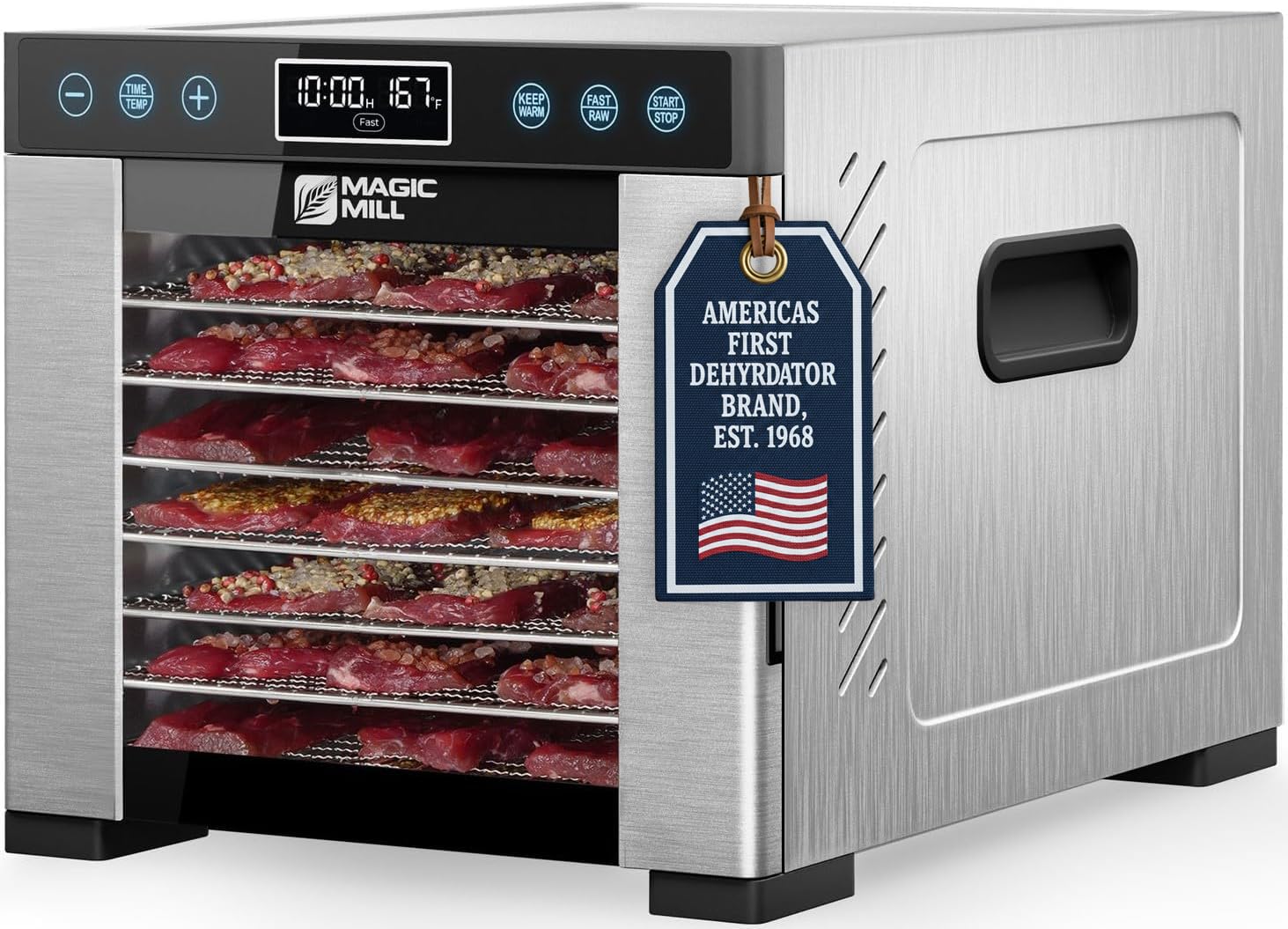
Magic Mill Pro 7-Tray
Key Features
- Timer: 48 hours
- Trays: 7 stainless steel
- Airflow: Rear-mounted fan
- Temperature range: 95–176 °F
- Price: Midrange
Stainless outside is common; stainless on the interior walls is not, and that’s the detail that separates this Magic Mill from the plastic-bodied machines here. Seven full-size stainless trays slide into the cabinet, a rear fan pushes heat across them, and the controls run from 95 to 176°F in one-degree steps with a 48-hour timer and automatic shutoff.
We think it’s the better-built machine of the stainless pair. Plastic interiors pick up the smell of a spiced batch and keep it for weeks; stainless walls wipe down and don’t stain, and the trays come clean with a damp sponge. The rear fan also means you aren’t shuffling trays halfway through, which is the most tedious job in jerky making. It’s ETL listed and weighs about 16 pounds, so it stays where you put it.
Where we hesitated is the heat it throws. Warm air leaves the back of the cabinet, so it wants a few inches of clearance behind and above, and under a cupboard shelf is the wrong home. The trays are a full 15.5 inches deep, so a serious batch fills them properly, but nobody would call this compact. For a household that makes jerky most months and wants a cabinet that still looks decent in five years, this is the one we point at.
Pros
- Stainless interior walls, not just trays
- 176°F ceiling in one-degree steps
- Rear fan dries without rotating trays
- 48-hour timer with auto shutoff
Cons
- Runs warm and needs rear clearance
- 16 pounds, and 15.5 inches deep
Buy this one if you want stainless walls, a 176°F ceiling and seven full-size trays for less than our top pick.
Best for Mid-Size Batches
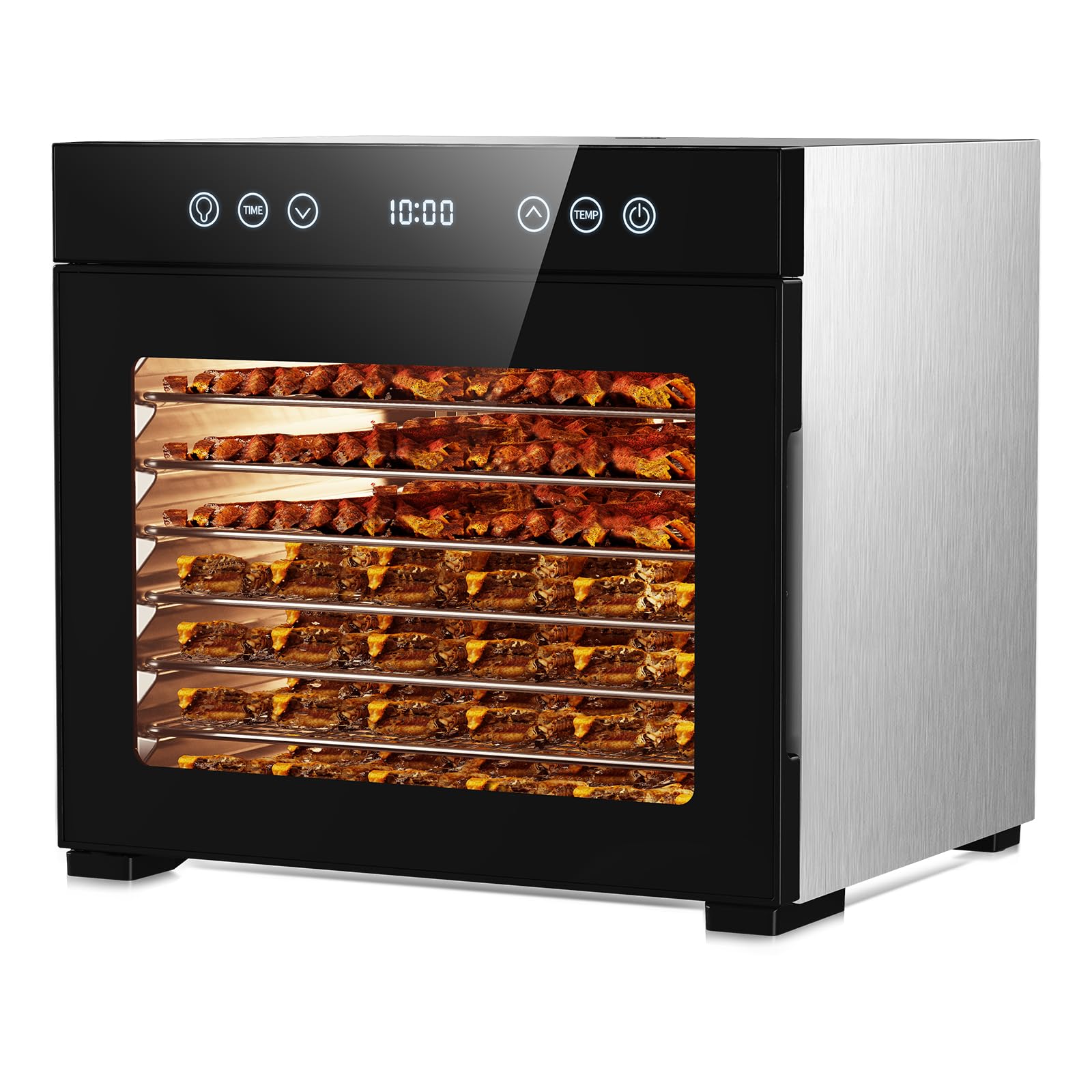
PSIIDAN 8-Tray
Key Features
- Timer: 48 hours
- Trays: 8 stainless steel
- Wattage: 650 W
- Temperature range: Up to 167 °F
- Price: Midrange
Eight stainless trays and a 167°F ceiling for noticeably less than the other stainless machines here is a combination that made us look twice. The 650-watt motor, 48-hour timer, mesh sheet and drip tray are all included, and there’s an interior light — a small thing we were pleasantly surprised by, since you can watch a batch darken without opening the door and dumping the heat.
The catch is airflow. This one wants the shelves turned about halfway through a jerky run; skip that and the outer edges of the top and bottom trays finish ahead of the middle. It’s a two-minute job with a pair of tongs, and it’s the price of the tray count at this price. We haven’t owned it long enough to vouch for its third year, so treat it as a bet on specifications.
What it gets right is the middle of the range: more trays than the five-tray machines, less money than the flagships, and a ceiling that covers jerky, fruit leather and herbs without a second thought. If eight trays is the right size for your batches and the halfway turn doesn’t bother you, this is the machine we hand to a first-time jerky maker who wants room to grow.
Pros
- Eight stainless trays at a mid-range price
- 167°F ceiling with a 48-hour timer
- Interior light shows progress without opening
- Mesh tray and drip tray included
Cons
- Short record on long-term reliability
Eight stainless trays, a 167°F ceiling and an interior light for less than the other stainless machines here — the value pick for mid-size batches.
Best for Budget Starter
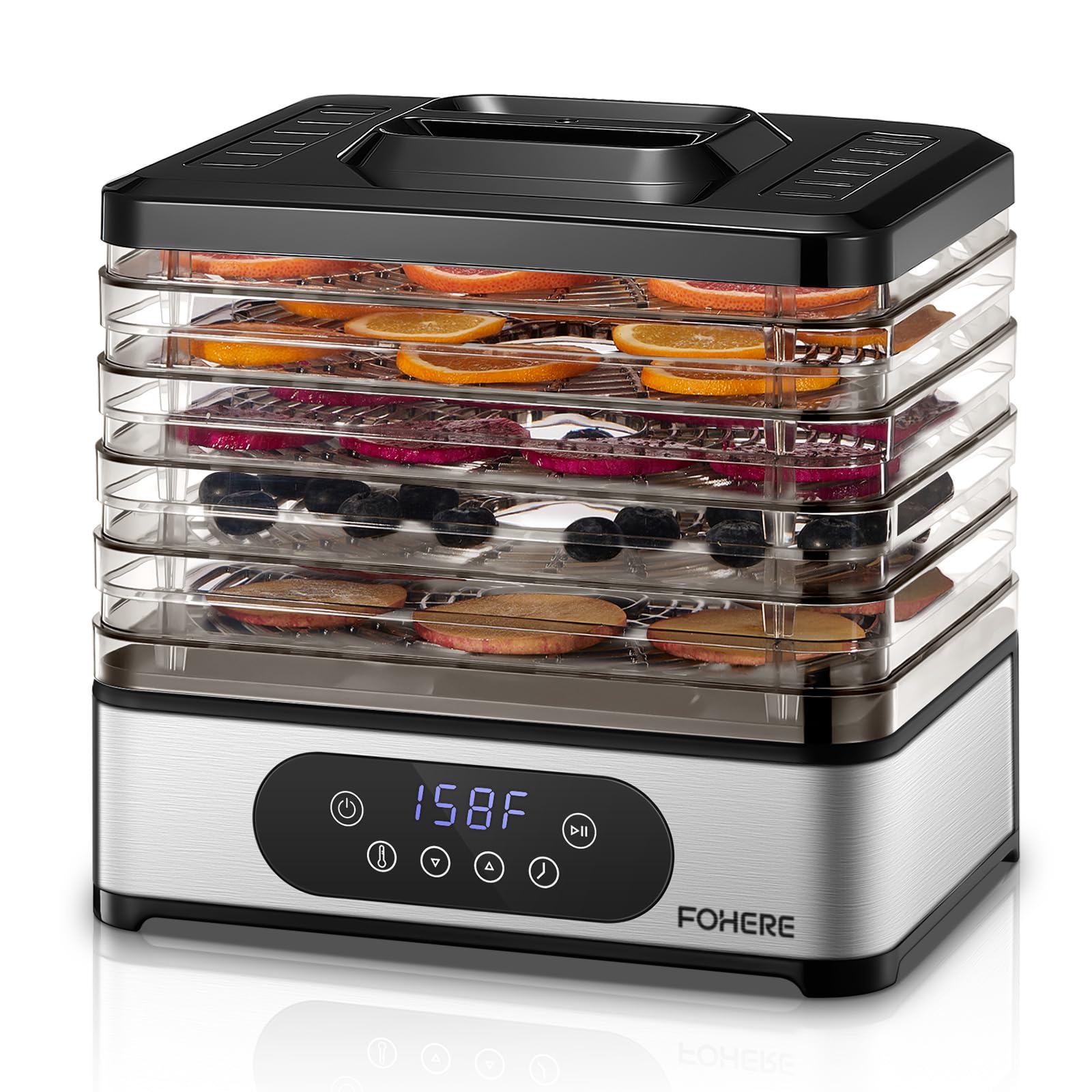
FOHERE 5-Tray
Key Features
- Timer: 48 hours
- Trays: 5 stackable
- Wattage: 400 W
- Temperature range: 95–158 °F
- Price: Budget
Start with 158°F, because it decides what this machine is for. That’s the top of the dial, and jerky wants the meat to reach 160°F on its way to dry, so with the FOHERE you heat the strips through in an oven first and then move them to the trays. Do that and it makes good jerky; skip it and you’re gambling on a batch. For fruit, herbs and dog treats the ceiling never comes up.
What the money buys is digital control at the bottom of the market: a 400-watt element, a 48-hour timer, five stackable trays with two height settings, and a lid and trays that go in the dishwasher. We minded the tray spacing more than the power. Thick-cut strips and anything on a skewer crowd against the tray above, and a deep load takes correspondingly longer.
Set against that, it stores small, the cord wraps around the base, and it’s the least expensive way into a timed, digital machine here. We kept ours for herbs and dog treats rather than the Sunday jerky batch, and it was perfectly good at both. If jerky is the whole point and you’ll make it often, spend more. If you want to find out whether you’ll stick with dehydrating, this is a low-risk way to learn.
Pros
- Digital controls and a timer at the lowest price here
- Dishwasher-safe trays and lid
- Two tray heights for thicker cuts
- Cord wrap and small body for storage
Cons
- Tight tray spacing crowds thick strips
A good first dehydrator for small jerky batches on a tight budget, as long as you pre-heat the meat before it goes in.
Best for Huge Batches
Suteck 12-Tray

Key Features
- Timer: 24 hours
- Trays: 12 stainless steel
- Airflow: Dual rear fans
- Temperature range: 85–195 °F
- Price: Premium
Twelve trays in one cabinet is the pitch, and for someone working through a deer it’s a good one. Each tray is 20 by 28.5 centimeters, so the stack works out to a bit more drying area than the six-tray Cosori rather than double, but it still swallows far more than a five-tray unit. Dual rear fans and an 800-watt motor push air through all twelve, and the range runs from 85 to 195°F — the widest here by a distance.
We wondered whether the four presets would feel like a gimmick. With a 24-hour timer and programs for fruit, vegetables, meat and flowers, they mostly save a few button presses, and the manual settings are there when a recipe wants something specific. It runs at or under 45 dB, comes with two mesh screens, a fruit roll sheet, a drip tray and a recipe book, and carries a two-year warranty.
The honest caveat is the record behind it. This is the least-established machine in the group, so long-term reliability is an open question rather than a known quantity, and the 16-inch body needs real clearance above it. For volume work — a big jerky run, a garden’s worth of tomatoes — the capacity is the whole argument, and it’s a strong one.
Pros
- Twelve stainless trays, the most here
- 85–195°F, the widest range in this group
- Dual rear fans and 800 watts
- Two-year warranty and full accessory set
Cons
- Trays are smaller than full-size machines
- Tall body needs overhead clearance
The volume pick: twelve trays and the widest temperature range here, if you can accept the least-proven machine in this group.
Best for Small Kitchens
Konfintos Compact
Key Features
- Trays: 5 stackable
- Wattage: 250 W
- Run time: Up to 72 hours
- Temperature range: 95–158 °F
- Price: Budget
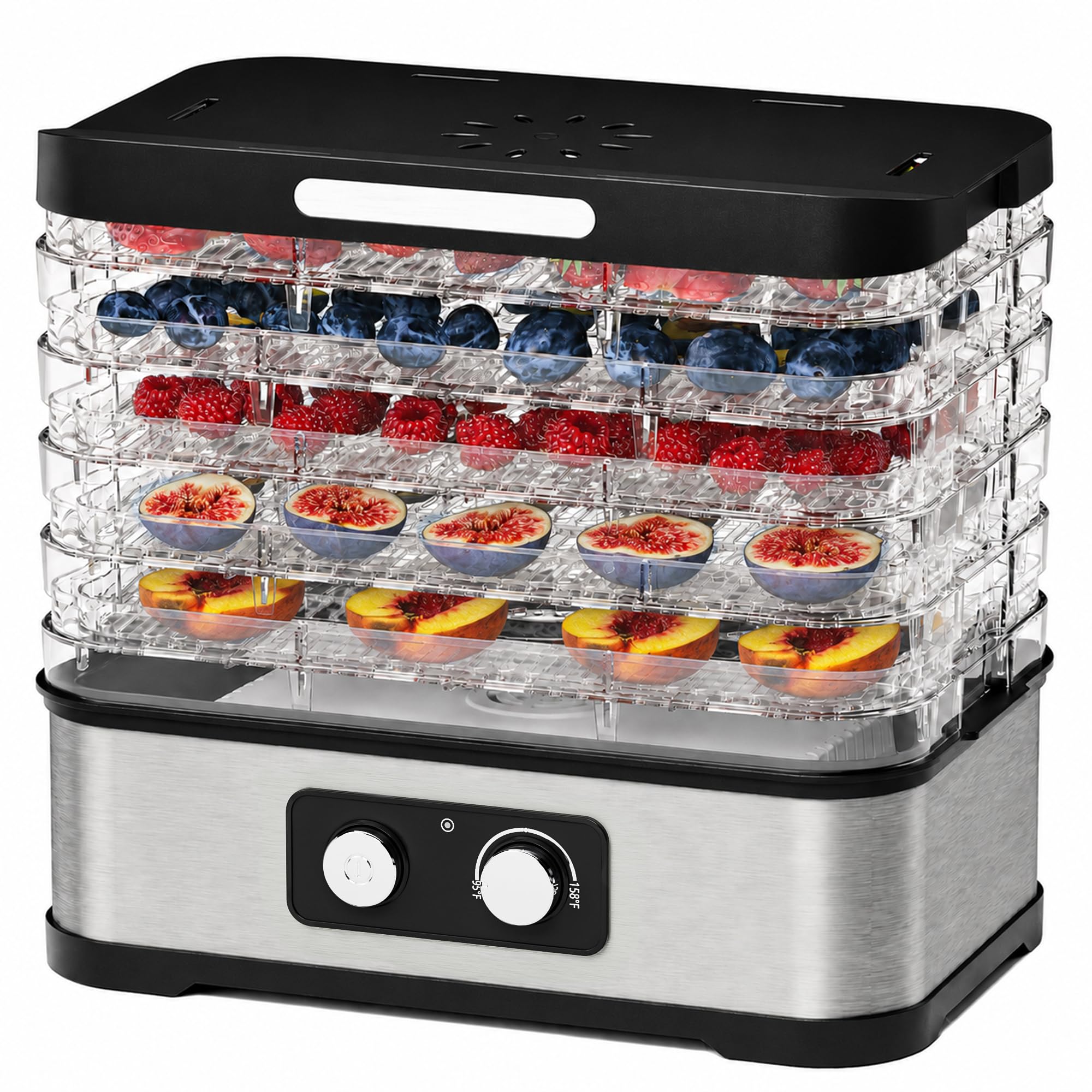
At 3.9 pounds and roughly a foot wide, this is the machine that lives in a cupboard and comes out when there’s fruit to use up. Five clear trays stack on a 250-watt base, the dial covers 95 to 158°F, and the timer runs to 72 hours — longer than most here, which suits herbs and mushrooms better than it suits meat.
We found the clear trays genuinely useful: you watch raisins wrinkle without lifting a tray and losing the heat. The knob is simple enough that nobody needs the manual, though its markings don’t line up neatly with the temperatures a recipe gives, so trust a thermometer on the first jerky batch rather than the dial. Capacity is the real limit — a few pounds of sliced meat at a time, and thick strips need the tray height raised.
Jerky works here with the same caveat as the FOHERE: heat the meat through before it goes in. As a first dehydrator for an apartment, a dorm room or an RV, though, it earns its place — it’s quiet, it goes back in a cupboard, and it costs about as little as anything in this group. We wished the trays were bigger; we never wished the machine were smaller.
Pros
- Smallest footprint and lightest body here
- Clear trays show progress without opening
- Up to 72 hours of runtime
- Quiet enough for a small apartment
Cons
- Small trays cap jerky at a few pounds
The smallest machine here, best for a first batch of jerky or a kitchen with no spare counter, as long as you keep loads light.
How We Tested Jerky Dehydrators
I started with a shortlist of 10 countertop dehydrators sold for jerky, narrowing by tray count, footprint, temperature range, and price so the group covered compact and expandable models rather than just the biggest machines. Over eight months, I ran at least three jerky batches through each one—beef, turkey, and a lean game batch—plus fruit leather on the trays to test cleanup. Batches went in on Friday nights and weekend mornings, some left to run overnight in a normal kitchen, not a lab.
Temperature control got checked with a separate probe at the low end, where jerky actually dries, and I noted whether the display matched the probe and whether heat bounced back after I opened the door. To judge tray spacing, I loaded the same thickness of sliced meat on every tray and watched whether air moved between pieces or the trays crowded the food. I timed each batch to the first bendy-but-not-snappy piece and compared that with the manual’s estimate.
Ease of use came down to loading trays, setting time and temp without a manual, and whether the door or lid opened cleanly with greasy hands. I listened for fan noise from the next room during overnight runs, scrubbed trays and drip pans after sticky marinades, and weighed each machine’s capacity against its price. The useful models were the ones that dried evenly edge to edge and cleaned up without a soak—not simply the ones with the most trays.
How to Choose a Dehydrator for Jerky
Heat first, size second: a machine that holds 165°F steadily and moves air over every tray will out-dry a bigger one that does neither.
Match the heat ceiling to the job
The first number to compare is the top of the temperature range, not the wattage. Jerky meat should reach 160°F on its way to drying, so a machine that runs to 165°F or beyond does the whole job in place, while a 158°F unit needs the strips heated through in an oven first and then moved to the trays. The trap is treating a maximum as a working temperature: check that the top of the range is a setting the machine holds for six hours, not a brief peak.
Tray count is not drying area
Twelve small trays can hold less than six full-size ones. Compare square inches: six trays on our top pick give 6.5 square feet, while twelve trays at 20 by 28.5 centimeters add up to a little more than that, not double. Then think in raw weight, because meat sheds roughly half its weight as it dries, so a batch built on five pounds of sliced beef comes off the trays as about two and a half pounds. Tray spacing matters as much as area: thick-cut strips need headroom.
Airflow decides how much you stand over it
Where the fan sits changes the job more than wattage does. Rear-mounted fans, as on our top pick, the Magic Mill and the PSIIDAN, push air horizontally across every tray. Bottom-mounted heaters, common on cheaper round and stackable models, dry the lowest tray fastest and usually want rotation. No rotation-free claim survives an overloaded tray, so leave gaps between pieces and cut strips to an even thickness. If you plan to run overnight, a timer with automatic shutoff is worth more than an extra tray.
Stainless or plastic, and what cleanup costs
Marinade leaves a sticky film that sets as it cools, so cleanup is part of the routine. Stainless trays wipe clean and don’t hold color or smell; plastic trays are lighter and cheaper but can stain, warp or carry a smell into the next batch. Dishwasher-safe is a genuine advantage, with a caveat we ran into: wide trays have to lie flat, and six of them take a whole rack. A mesh sheet under wet or small pieces saves scraping.
Noise, weight and where it will live
Noise figures cluster between 45 and 48 decibels in this group, which is fridge-hum territory rather than vacuum-cleaner — fine in a kitchen, noticeable in a studio apartment. Weight is the spec people forget: the stainless machines run 16 to 18 pounds and stay on the counter, while a four-pound plastic unit goes back in a cupboard between batches. Measure the clearance above and behind before you commit, because a rear-vented machine tucked under a cabinet warms the shelf and dries unevenly.
Frequently Asked Questions
Can I use my oven or an air fryer instead of a dehydrator?
You can, with limits. Most ovens won’t hold a setting below about 170°F and cycle on and off, which cooks thin strips at the edges before the middle dries, and an air fryer’s dehydrate mode holds only a few cups. A wire rack over a sheet pan in a low oven is a fair first experiment. A dehydrator earns its counter space once you’re drying five pounds at a time.
How do I know when jerky is done?
Pull a piece and let it cool for five minutes — it firms as it cools. Jerky is ready when it bends into a pale crease without snapping; if it snaps, it’s over-dried, which is a texture problem rather than a spoiled batch. Note the time and temperature of a batch that works and use it as your baseline, because slice thickness varies more than any recipe chart allows for.
How long does homemade jerky keep?
Not as long as the sealed bags from a store. Home-dried jerky goes into the refrigerator in an airtight container, where it holds for a couple of months, and anything you won’t finish in a few weeks belongs in the freezer. Squeeze the air out, and if a piece looks or smells off, throw the batch out rather than picking around it.
Can I dry jerky and fruit at the same time?
Only when they want roughly the same temperature and time, which jerky and fruit rarely do. The bigger problem is flavor: a spicy marinade will season the apple slices on the tray below, and onion or garlic will do the same to everything in the cabinet. Run savory batches together, give fruit its own run, and wipe the interior between them.
Final Verdict
Our pick for most people is the Cosori 6-Tray Stainless: six stainless trays, a steady 165°F, a quiet motor and a two-year warranty cover jerky and everything else you’ll dry. For a higher ceiling and stainless walls at a similar price, the Magic Mill Pro goes to 176°F with seven trays. If the budget is fixed, the FOHERE will make jerky — heat the meat through first and keep the loads small.