This post contains affiliate links. We may earn a small commission when you buy through our links — at no extra cost to you.
Electric skillets sound convenient until you find burned patches in your scrambled eggs or watch the nonstick flake off after a few months. Most models share a common flaw: circular heating elements that create a hot ring in the center while the edges stay cool.
The difference comes down to the heating element shape and wattage. An embedded M-shaped element spreads heat more evenly, and 1500 watts maintains temperature better for big batches. Nonstick coatings vary widely – ceramic can be fussier than PTFE, but both need careful handling.
This guide focuses on the models that get the fundamentals right – even heat, durable coating, and a shape that fits your cooking and storage needs. No hype, just what works.



Best for Family Cooking
Presto 06857 Foldaway
Key Features
- Cooking Surface: 16 in, 3.5in depth
- Wattage: 1500 W
- Nonstick Type: PFAS-free ceramic
- Temp Control: Dial, variable
- Price: $$
Heats evenly across the full 16-inch surface and reaches cooking temperature faster than most electric skillets. The 1500W element delivers consistent heat for browning, sautéing, and simmering without cold spots, and the 3.5-inch sidewalls hold enough liquid for braises or one-pot meals for four to six people.
The foldaway legs collapse and the pan nests inside the base, reducing the stored footprint to roughly the height of a dinner plate. That space savings matters in cramped cabinets or dorm kitchens. Cleaning is straightforward: the nonstick pan releases food easily, and the base detaches for sink washing — no need to wrestle a bulky appliance around the faucet.
This skillet fits households that cook family-sized batches and don’t have dedicated counter space for a large appliance. The temperature dial is analog and can drift from the set point on some units — not an issue for most stovetop-style cooking, but worth noting if you expect precise digital control. The nonstick coating holds up well under normal use, though heavy scraping or abrasive cleaning can accelerate wear along the sidewalls.
Other skillets with similar cooking area take up a full cabinet shelf when stored. The foldaway design here makes the space tradeoff nearly invisible, which is why it stands out among large electric skillets. The tradeoffs — temperature drift on some units and coating longevity under hard use — are clear and manageable for the buyer who prioritizes storage and even heating above all else.
Pros
- Heats quickly and evenly across the full surface for consistent cooking results.
- Nonstick coating releases food easily and simplifies cleanup with a removable base.
- 16-inch surface and high sidewalls handle family-sized meals for four to six people.
- Foldaway design collapses the pan into the base for compact storage in tight cabinets.
Cons
- Temperature dial can drift from the set point, causing occasional overheating during long simmers.
- Nonstick coating may peel or wear along the sidewalls after months of use, especially with metal utensils.
If you need a large skillet that stores flat and heats evenly, this is the one to buy — just be aware that temperature consistency isn’t digital-precise and the coating benefits from gentle care.
Best for Deep Dishes
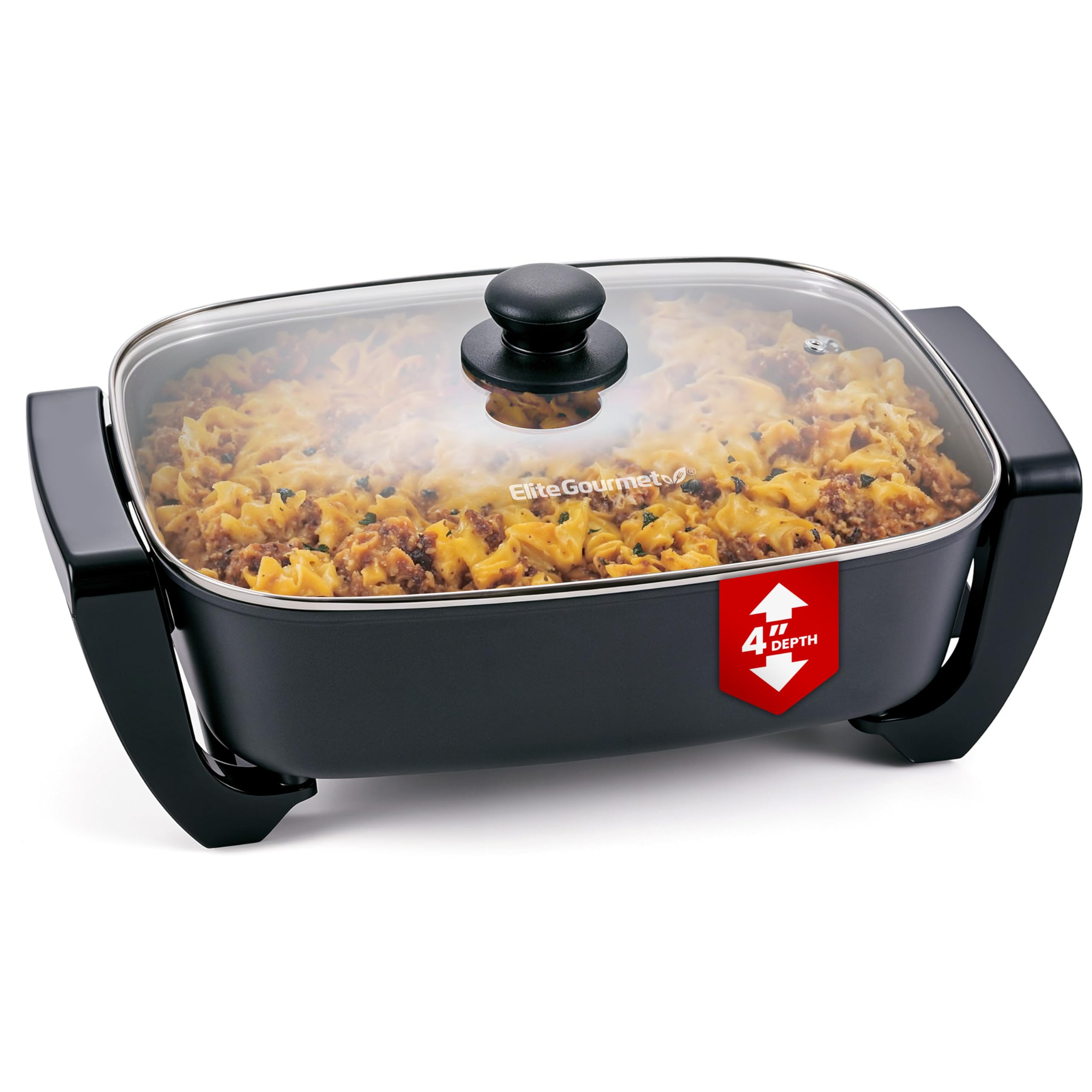
Elite Gourmet EG2615 Deep
Key Features
- Cooking Surface: 15×12 in, 4in depth
- Wattage: 1500 W
- Nonstick Type: PFAS-free ceramic
- Temp Control: Dial, variable
- Price: $$
Elite Gourmet’s EG2615 stands apart with its 4-inch depth, letting you braise large cuts, deep-fry chicken, or simmer chili in a single pan. The 1500W element brings oil to temperature quickly, and the PFAS-free ceramic coating releases food cleanly.
The nonstick surface lives up to its ceramic promise: scrambled eggs slide off, and stuck-on sauces wipe away with little effort. Combined with the large 15×12-inch cooking area, cleanup is notably faster than with traditional PTFE pans.
This skillet suits home cooks who regularly prepare stews, soups, or fried chicken for a crowd, as well as campers who want a portable deep pan. The tradeoff is that the temperature dial offers less precision than digital models — expect some drift, and the plug may warm up during long sessions. Additionally, a portion of units may cease to heat within the first year, so this is better suited for moderate use rather than daily heavy rotation.
Pros
- Extra 4-inch depth handles large batches, braising, and deep frying with room to spare.
- PFAS-free ceramic nonstick releases food easily and simplifies cleanup.
- Heats up quickly and cooks evenly for searing and simmering alike.
Cons
- Temperature probe may drift from the set level; the plug can become warm during extended cooking.
- A portion of units may stop heating after several months of use.
If your kitchen revolves around big batches and deep dishes, this skillet offers rare capacity at a mid-range price — just stay mindful of the temperature dial during long cooks.
Best for Small Kitchens
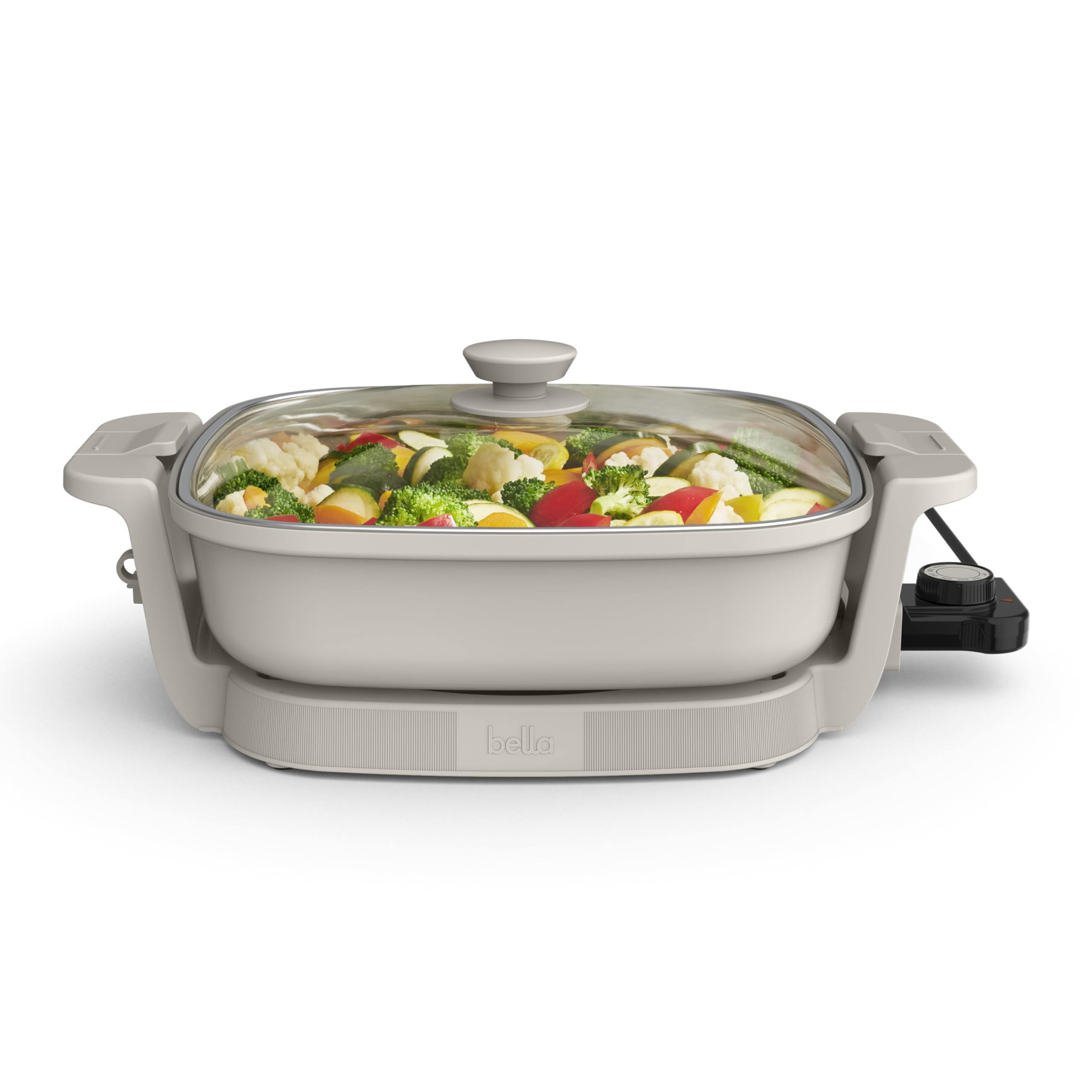
BELLA 35256 Side-Store
Key Features
- Cooking Surface: 12×12 in, 3in depth
- Wattage: 1200 W
- Nonstick Type: Ceramic PFAS-free
- Temp Control: Dial, variable
- Price: $
The BELLA side-store skillet carves out its niche with a vertical storage design that locks the lid in place, letting it slot into tight gaps where traditional skillets won’t fit. This approach frees shelf depth in a way foldaway models (like the top pick) cannot match. The tradeoff appears on the stovetop: the heating element creates a persistent hot spot near the center, which can char foods in that zone unless you stir or rotate frequently.
This skillet fits apartment dwellers with minimal cabinet space and those who need a portable option for potlucks (the lid clamps secure it for transport). The ceramic nonstick handles delicate foods well — eggs and fish release easily. That said, the cooking surface can develop hot spots, and the ceramic coating plus temperature control may show wear over time, making it better suited for occasional, moderate-heat cooking than daily high-temperature use.
Pros
- Innovative vertical storage – the lid locks to store sideways, freeing cabinet space.
- Nonstick ceramic coating releases delicate foods like eggs and fish without oil buildup.
- Available in light oatmilk and other colors that match modern kitchen aesthetics.
Cons
- Hot spot near the center can over-brown food unless you stir or adjust placement.
- Ceramic coating may peel and the temperature knob can become unreliable after extended use.
Choose this if cabinet space is your top constraint and you cook mostly delicate foods at moderate heat. If even browning or heavy daily use matters more, the foldaway alternative delivers better consistency.
Best for Versatile Cooking
Zojirushi EP-RAC50
Key Features
- Cooking Surface: 15×17.5in (2 pans)
- Wattage: 1250 W
- Nonstick Type: Titanium-ceramic
- Temp Control: Dial, uniform
- Price: $$$$
Two interchangeable pans and a steamer give this Zojirushi the ability to switch from a flat griddle for teppanyaki to a deep skillet for hot pot or steaming — flexibility no single-pan skillet can match. The titanium-ceramic nonstick surface and even heat distribution mean consistent results whether you’re searing meat or gently simmering broth.
This setup demands significant counter space and a premium budget. It suits gourmet cooks who regularly host tabletop cooking sessions and want one device to handle griddle, stir-fry, and steaming without pulling out multiple appliances. For anyone with limited kitchen space or a tight budget, the large footprint and high cost make it a specialized tool rather than a daily workhorse.
Pros
- Two interchangeable pans and a steamer let one appliance handle griddle, deep-fry, and steaming.
- Even heat distribution across the entire cooking surface eliminates hot spots.
- Solid construction with titanium-ceramic nonstick coating that holds up to frequent use.
Cons
- Large footprint demands substantial counter space and storage — less suitable for small kitchens.
- Premium price places it above most single-pan electric skillets, so the versatility must be actively used to justify the investment.
A specialized multi-pan system for serious cooks who value versatility over simplicity and have the space and budget to accommodate it.
Best for Ceramic Lovers
Presto 06856 Ceramic
Key Features
- Cooking Surface: 16 in, 3.5in depth
- Wattage: 1500 W
- Nonstick Type: Ceramic nonstick
- Temp Control: Dial, variable
- Price: $$
The Presto 06856 offers a 16-inch ceramic nonstick surface free of PFAS coatings, with a removable base that makes cleaning straightforward. It shares the same cooking capacity as the foldaway Presto model but costs less — the tradeoff is that this skillet doesn’t have foldaway legs, so it takes up cabinet space when stored.
This skillet fits families who want to avoid PFAS and cook large batches — up to a pound of bacon in one go. The ceramic coating delivers easy wipe-down cleaning initially, but its nonstick properties can diminish within months if exposed to metal utensils or harsh scrubbing. Buyers comfortable with hand washing and gentle care will get the most life out of it.
Heat distribution is even across the 16-inch surface, which helps with consistent frying and sautéing. Some units may show minor temperature dial drift over time, causing the skillet to run slightly hotter than the setting — that’s worth checking if you rely on precise simmering, but for most general cooking it won’t disrupt results.
Pros
- Large 16-inch surface cooks a full pound of bacon in one batch.
- Even heat distribution supports consistent cooking results across the pan.
- Ceramic nonstick wipes clean quickly without scrubbing.
Cons
- Temperature dial can drift over time, causing the skillet to run hotter than the setting.
- Ceramic coating may lose nonstick properties within months with abrasive cleaning or metal utensils.
A solid choice for families who want a large PFAS-free surface and are willing to hand wash and avoid metal utensils to preserve the coating.
Best for Budget Singles
Elite Gourmet EG2212 Compact

Key Features
- Cooking Surface: 12×12 in, 2.15in depth
- Wattage: 1200 W
- Nonstick Type: PFAS-free ceramic
- Temp Control: Dial, variable
- Price: $
At under $35, the Elite Gourmet EG2212 nails the basics for solo cooks who need a compact electric skillet. Its 12×12-inch surface and shallow 2.15-inch depth fit snugly in small kitchens, and the ceramic nonstick releases eggs or grilled cheese with minimal effort — a quick wipe usually suffices. The tradeoff comes with the circular heating element: hot spots develop in the center, so larger items like a full batch of stir-fry may cook unevenly unless you rotate food. Also, the nonstick coating can wear faster than pricier models if you cook daily, which limits this skillet’s appeal to occasional or light use. For bigger meals or even heating, a mid-range option like the deeper Presto alternative is a better fit.
Pros
- Cleans up in seconds thanks to a nonstick surface that releases food easily.
- Compact footprint saves counter and cabinet space for small kitchens.
- Budget-friendly price delivers decent cooking performance for the cost.
Cons
- When cooking larger portions, the circular heating element produces hot spots that leave edges undercooked.
- The ceramic nonstick may lose its release over a few months with daily use.
Best for solo or couple cooks who need a compact, low-cost skillet for quick meals and don’t require even heating across the full surface.
Best for Style, Small
GreenLife 5QT Ceramic

Key Features
- Cooking Surface: 12×12 in, 2.5in depth
- Wattage: 1200 W
- Nonstick Type: Ceramic PFAS-free
- Temp Control: Dial, variable
- Price: $$
The GreenLife 12-inch square skillet brings a splash of color to the countertop while delivering ceramic nonstick that releases food effortlessly. The PFAS-free coating appeals to health-conscious cooks, and the 5-quart size handles meals for two to four people. However, the 1200-watt element can cook more aggressively in the center, and heating reliability varies between units—some may become unreliable after limited use. This skillet suits style-focused buyers who cook moderately and prioritize aesthetics over long-term durability.
Pros
- Nonstick surface releases food cleanly – cleanup takes seconds.
- Room enough for 2–4 servings – fits typical family recipes.
- Available in vibrant colors that complement modern kitchens.
Cons
- Heating may become intermittent in some units over time.
- Center temperatures run higher than the edges – noticeable when cooking larger quantities.
Best for someone who wants a stylish everyday skillet for light-to-moderate meals and is willing to accept some performance variation.
Best for Occasional Use
Blue Diamond 7QT

Key Features
- Cooking Surface: 20.9x14in, 3in depth
- Nonstick Type: Diamond-infused ceramic
- Temp Control: Dial, variable
- Price: $
The Blue Diamond 7QT delivers an enormous cooking surface for the money – a 20.9 x 14-inch ceramic nonstick pan that can handle large batches of fried rice, pancakes, or a whole chicken. Initial nonstick release is good, and the skillet is lightweight enough to move around. That said, build quality is where the budget tradeoff shows: the legs can snap under stress, the ceramic coating may wear faster than thicker pans, and heat concentrates in the center rather than spreading evenly across the full surface. Stirring helps mitigate the hot spot, but these limitations make the skillet a better fit for camping, temporary kitchens, or one-off large meals than for daily family cooking.
Pros
- Very large cooking area at a budget price – fits big batches and whole proteins.
- Ceramic nonstick performs well for the price, releasing food easily in early use.
- Lightweight construction makes handling and storage simpler than heavy alternatives.
Cons
- Legs can break under heavy loads and nonstick coating may degrade sooner than expected.
- Heat concentrates in the center, requiring stirring for even cooking across the surface.
Best for budget shoppers who need a giant skillet for occasional large batches, camping, or temporary cooking setups – not a daily workhorse.
How to Choose
The most important factor in an electric skillet is the shape of its heating element – M-shaped elements spread heat evenly; circular ones create hot spots.
Cooking Surface Size & Depth
Larger surfaces (16 inches) handle family meals but need more wattage to heat evenly. Depth determines versatility: shallow pans (2–2.5 inches) work for eggs and pancakes; deep pans (3.5–4 inches) allow braising, stews, and deep frying without splatter.
Deep pans sacrifice storage space. If you cook large batches weekly, depth beats footprint. For quick weekday cooking, a shallow skillet stores easier and heats faster.
Wattage
Wattage directly affects preheat time and temperature recovery. 1200W models heat slowly and struggle to maintain temperature when you add cold ingredients – expect uneven results with large batches. 1500W skillets bounce back quickly and sear better.
For singles and couples, 1200W is sufficient for basic meals. Families or anyone cooking more than two servings should prioritize 1500W.
Nonstick Coating Type
Two coating types dominate: PTFE (traditional nonstick) and ceramic (PFAS-free). PTFE lasts 2–3 years with proper care but releases fumes if overheated. Ceramic is non-toxic at high heat but loses its slickness faster – often within 6–12 months of daily use.
Ceramic requires gentle utensils and hand washing. PTFE tolerates more abuse but scratches easily. If longevity is key, choose PTFE. If avoiding PFAS is your priority, accept that ceramic will need replacing sooner.
Temperature Control
Most electric skillets use a dial with a bimetallic strip – this is inexpensive but prone to drift: the actual temperature can swing 20–30°F around the setting. Digital control offers precise 5-degree increments and holds temperature more consistently.
Dial models work fine for simmering and frying where a few degrees don’t matter. For delicate tasks like melting chocolate or holding oil at a specific temp for deep frying, digital control is worth the extra cost.
Cleaning & Maintenance
Many skillets claim the pan is immersible, but the temperature probe must never be submerged. Hand washing the pan with a soft sponge preserves the nonstick coating. Dishwasher detergent can degrade coating bonds over time.
Models with detachable bases (like the foldaway Presto) make cleaning easier – the base stays dry while the pan washes. Avoid abrasive scrubbers on any coated surface.
FAQ
Why does my electric skillet have hot spots even though it says even heating?
Most ‘even heating’ claims are marketing. Skillets with a circular heating element create a hot ring in the center – the center runs 20–30°F hotter than the edges. Look for models with an embedded M-shaped element (common in Presto and some Elite Gourmet models) to get truly uniform heat across the pan.
Can I put the glass lid of an electric skillet in the dishwasher?
In general, no. The rapid temperature change in a dishwasher can shatter tempered glass lids. Hand wash the lid with warm soapy water and let it cool to room temperature before cleaning. This also protects the lid seal from detergent damage.
How long do ceramic nonstick coatings last on electric skillets?
With gentle hand washing and silicone utensils, ceramic coatings typically last 6–12 months before food starts sticking. Heat accelerates wear – avoid preheating on high and never use cooking spray, which bakes onto ceramic. Once it loses its slickness, it’s time to replace.
Is 1200 watts enough for an electric skillet or do I need 1500?
1200 watts works fine for singles or couples cooking small portions. For families or large batches, 1500 watts provides faster preheat and better temperature recovery – essential when adding cold ingredients to a hot pan. If you often cook for 4+ people, choose 1500W.
How do I prevent temperature drift on a dial-controlled skillet?
Temperature drift occurs because the bimetallic strip expands and contracts slowly. To minimize it, set the dial slightly lower than your target and allow 5–10 minutes to stabilize. Avoid leaving the lid off for long – heat loss triggers overcorrection. Digital control models eliminate this issue entirely.