This post contains affiliate links. We may earn a small commission when you buy through our links — at no extra cost to you.
Enameled cast iron makes a simple trade: heat that stays exactly where you put it, in exchange for a pot you lift with both hands. What that buys you is one vessel that sears short ribs, simmers a pot of beans, fries chicken, and bakes a loaf at 450 degrees — stovetop to oven to table without reaching for a second pan.
It’s also a purchase where money goes wrong quietly. My team cooked in eight Dutch ovens over the past seven months, banging lids, scorching rims, and scrubbing out overnight tomato sauce, and the differences had surprisingly little to do with price. Here’s something nobody tells a first-time buyer: interior color is a practical choice, not just a pretty one — pale cream enamel shows every braise stain, while a black interior hides them but makes it harder to judge how fast your fond is darkening. The picks below sort the workhorses from the shelf decoration.



Best for Everyday Braising
Lodge Essential Enameled 6-Quart
Key Features
- Weight: 13.5 lb
- Capacity: 6 quarts
- Material: Enameled cast iron
- Oven safe: 500 °F
- Price: Midrange
Six quarts is the number that settles it. That’s enough pot for a chicken with vegetables packed around it, a double batch of chili, or a loaf of sourdough with room for steam, and it’s still a size that sits on one oven shelf without crowding the pan of roasting vegetables next to it.
Cooking in it is the least dramatic part, which is the compliment. Onions went soft and brown at the edges without scorching in the middle, a short-rib braise came out with the liquid reduced and the meat giving way, and the enamel released the stuck layer at the bottom after a warm soak rather than a scrub.
The lid is the detail we ended up appreciating most: it seats with no wobble and comes off without a fight, which sounds like nothing until you’ve wrestled a warped lid over a hot roast. The two side handles are wide enough for a thick mitt and set far enough apart to keep a full pot balanced.
Two practical things. At 13.5 pounds empty, a full pot is a two-handed lift, so a middle oven shelf beats the floor of the oven. And if your cooking is batch-shaped, stock and chili for a party, the seven-quart Crock-Pot below does that job with more room.
What earns it the top spot is the whole package rather than a single figure: a 500 °F oven rating that covers bread, six quarts that match most recipes written for a Dutch oven, and an enamel finish that has needed nothing more than warm water and a cloth. The pots below beat it on one dimension each; none of them beats it across all of them.
Pros
- Oven safe to 500 °F for bread
- Enamel releases stuck food after a soak
- Six quarts suits most Dutch oven recipes
- Wide dual handles take a thick mitt
Cons
- Enamel chips with rough handling
Buy this one if you want a single Dutch oven that braises, bakes and cleans up easily without a premium price; it’s the best all-rounder we tested here.
Best for Value and Induction
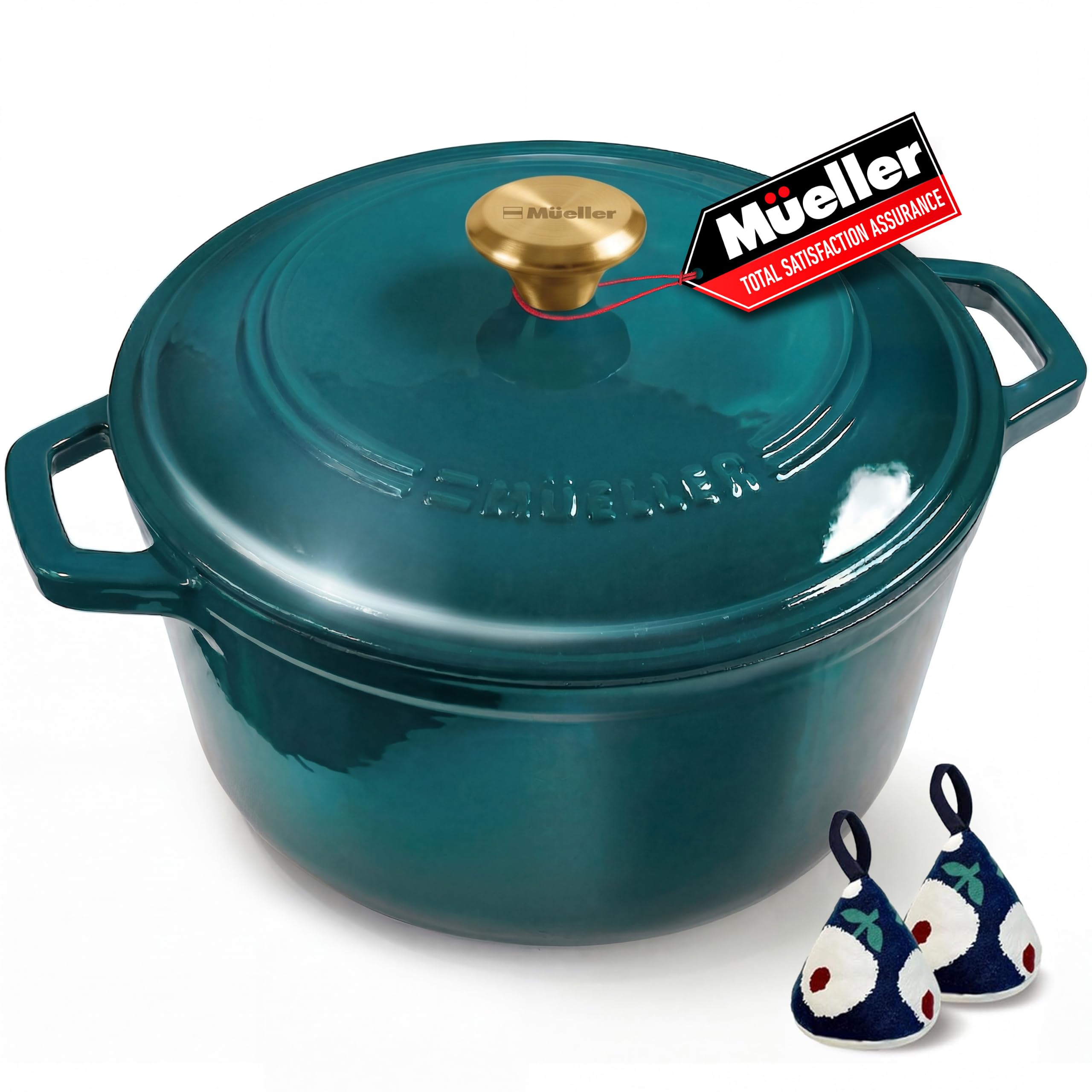
Mueller DuraCast 6-Quart
Key Features
- Weight: 12.5 lb
- Capacity: 6 quarts
- Cooktops: Gas, electric, ceramic, halogen, induction
- Oven safe: 500 °F
- Price: Midrange
Against the Lodge at the top of this list, the DuraCast gives up nothing on size, since both are six quarts, and it comes in lighter at 12.5 pounds, which we noticed most while lifting a full pot out of a deep oven. Where it separates itself is durability: this is the best enamel record in the group.
That’s why it’s our value pick. You get the 6-quart size, a 500 °F rating, a lid with raised nodes that drip condensation back over the food, and a coating that stands up to more than pots costing noticeably more. It’s also listed for induction along with gas, electric, ceramic and halogen, worth having in writing if you’re buying for an induction range.
The finish is where it makes its bid for the countertop: a deep emerald exterior and a knob shaped like a rooster, which is either exactly your taste or not at all. Hand wash it, as with every enameled pot here. If you regularly cook for six, the Crock-Pot’s extra quart is the difference between a comfortable braise and one that reaches the rim.
Pros
- Best enamel durability record in this group
- Listed for induction and every other cooktop
- Self-basting nodes under the lid
- Lighter than the top pick at 12.5 pounds
Cons
- Hand wash only
We recommend it to anyone who wants the top pick’s size with a better durability record and induction in writing, for less money.
Best for Bread and Braises
Staub 7-Quart Round
Key Features
- Weight: 16.8 lb
- Capacity: 7 quarts
- Interior: Matte black enamel
- Oven safe: 500 °F with lid
- Price: Premium
This is the most expensive pot here, and the money buys something specific: browning. The interior is matte black rather than glossy, and chicken thighs we seared in it built a darker, more even crust than the glossy enamels gave us. If the crust on a braise is how you judge a Dutch oven, this is the best one in the group.
The lid is the other half of the argument. Spikes on the underside send condensation back down over the food instead of letting it run to the walls, and the fit is tight enough that a long braise barely reduces. The pot is rated to 900 °F without its lid and 500 °F with it, worth knowing because most bread baking happens with the lid on.
Seven quarts serves seven or eight, which is more pot than a household of two needs on a Tuesday; the six-quart picks are the saner choice there. For a table of six, the size plus the lifetime warranty makes the outlay easier to justify.
Pros
- Matte interior browns more deeply
- Spiked lid returns moisture to the food
- Oven safe to 900 °F without the lid
- Lifetime warranty
Cons
- Heaviest pot here at 7.6 kg
If browning is what you’re chasing and the price doesn’t frighten you, this is the pot we point to; nothing else here sears quite like it.
Best for Feeding a Crowd
Crock-Pot Artisan 7-Quart
Key Features
- Shape: Round
- Finish: Porcelain enamel
- Capacity: 7 quarts
- Oven safe: 500 °F
- Price: Budget
Four pounds of chuck, two onions and a bottle of stout is a lot to ask of a six-quart pot. This one answers with seven quarts, wide enough that a party-sized batch of chili sits an inch or two below the rim instead of threatening to boil over.
The sapphire blue porcelain enamel is the sort of finish that goes from oven to table without a serving dish in between, and we used it for both bread and stew in the same week. It’s rated to 500 °F, and a layer of tomato that caught at the bottom came away after a warm soak.
What it offers is the most capacity here for the money, and if your cooking is batch-shaped, stock, chili, a turkey breast with the vegetables around it, that’s the trade to make. Plan the lift, though: a full seven quarts is a two-handed carry from oven to counter, and the wide handles are made for mitts rather than bare hands.
Pros
- Seven quarts for batch cooking
- Most capacity here for the money
- Sapphire enamel goes to the table
Cons
- Enamel chips with use
For stock pots, chili for a party and anything cooked in quantity, this is the capacity we reach for at the lowest price here.
Best for Whole Chickens
Velaze 7.5-Oval
Key Features
- Shape: Oval
- Weight: 16.5 lb
- Capacity: 7.5 liters
- Oven safe: 500 °F
- Price: Midrange
An oval pot is the one shape upgrade worth paying for if you roast whole birds. A chicken, a small turkey, a shoulder of lamb: they’re all longer than they are round, and an oval takes them with the vegetables down the sides instead of piled on top. That’s the case for this one, and it makes it well.
The lid borrows the idea from the expensive pots, with a raised interior that lets condensation run back over the food rather than down the walls, and the enamel is smooth enough that a roast releases without a fight. Heat spreads evenly across the base on the stovetop and holds through a long oven braise.
It’s heavy at 7.5 kg and long, so we had to clear a wider shelf for it than a round pot needs; measure the cabinet before you commit. And look the finish over when it arrives, because enamel chips and cracks are the weak point on this pot, so check the rim while the return window is still open.
Pros
- Oval fits whole birds and long roasts
- Circulating lid returns condensation
- Even heat on stovetop and in oven
Cons
- Long oval needs a wide shelf
- Heavy at 7.5 kg
Roast whole birds more than you braise? This oval is the one we recommend, as long as you check the shelf width.
Best for Bread Baking
Lodge Double Dutch 5-Quart
Key Features
- Lid: Doubles as a skillet
- Weight: 13.1 lb
- Capacity: 5 quarts
- Oven safe: 315 °C
- Price: Midrange
The lid is the whole idea. Flip it over and it’s a shallow skillet, so the pot arrives as two pieces of cookware: braise in the base, brown the next batch of meat in the lid, or use the lid alone for a couple of eggs. The loop handle on top makes it usable, though it isn’t the same as a real skillet handle and takes some getting used to when it’s hot.
Bare seasoned cast iron means there’s no enamel to chip, and the heat ceiling is higher than the enameled pots here, rated to 315 °C, which is what makes it a bread pot and a frying pot as much as a braise pot. Sourdough came out with a proper dark crust, and there’s something satisfying about a pot that can go from the oven to a grill without anyone worrying about the finish.
Five quarts and 13.1 pounds make this the pot we reach for when the bake is the point, or when we want one vessel that can sear, braise and fry with no coating to protect. It isn’t the everyday pot for a family, since the Lodge Essential at the top does that with less upkeep, but it covers the jobs enamel can’t.
Pros
- Lid doubles as a skillet
- No enamel to chip
- Oven safe to 315 °C
- Lifetime limited warranty
Cons
- Needs seasoning and drying after every wash
We recommend it for bread bakers and anyone who wants a pot with no coating to protect, and who doesn’t mind seasoning it.
Best for First Kitchens
Overmont 5.5-Quart
Key Features
- Lid: Self-basting bumps
- Care: Hand wash
- Capacity: 5.5 quarts
- Oven safe: 260 °C
- Price: Budget
The cookbook and the pair of cotton potholders in the box aren’t why anyone buys a Dutch oven, but they say something about how this one is pitched: a first pot for someone putting a kitchen together who doesn’t want to buy the accessories separately.
At the bottom of the price range, it does the job that matters. Heat sits evenly across the base, the lid seats without a wobble, and the enamel released a braise without needing a soak, the same behaviours we looked for in pots costing twice as much.
What you give up is capacity: at 5.5 quarts it’s a pot for three to five people, and a whole chicken with vegetables around it is a squeeze, so the seven-quart Crock-Pot is the answer there. For a couple or a small family making stew, rice and the occasional loaf, it’s plenty.
Pros
- Cookbook and potholders included
- 5.5 quarts suits three to five people
- Enamel wipes clean
Cons
- Tight for a whole chicken
Buy it as a first Dutch oven or a gift: it does the core job for three to five people at the bottom of the price range.
Best for Budget Enameled Start
Amazon Basics 6-Quart

Key Features
- Shape: Round
- Weight: 13.1 lb
- Capacity: 5.7 liters
- Oven safe: 500 °F
- Price: Budget
Whether a budget enameled pot is worth owning is the question this one answers, and the answer is yes, with one caveat that shows up in the coating rather than in the cooking.
It behaves the way cast iron should: even heat across the base, a 500 °F rating that covers bread, a lid that sits flat, and an enamel interior that lets a stuck sauce lift with warm water. Braises, chili, no-knead loaves, we cooked all of them in it, and none of them asked for a pricier pot.
It’s also heavy at 13.1 pounds, and the 6-quart size serves four to six comfortably, so it’s a pot you lift with both hands and set down deliberately rather than slide across the counter.
For a first enameled Dutch oven, a rental kitchen, or a cabin that gets weekend use, this is the sensible buy, since it cooks like the midrange picks for less. The pot we point people to when they want one Dutch oven for the next decade is the Lodge at the top; this is the one for right now.
Pros
- Even heat across the base
- 500 °F oven rating
- Sits at the bottom of the price range
Cons
- Coating chips sooner than pricier pots
Our recommendation for a first enameled pot or a second kitchen: it cooks like the midrange picks and asks less of your budget.
Best for Small Kitchens
Umite Chef 5-Quart

Key Features
- Care: Hand wash
- Handles: Wide stainless steel
- Capacity: 5 quarts
- Oven safe: 500 °F
- Price: Budget
The first thing we noticed lifting it out of the box was the handles: wide stainless loops you can get a thick mitt around, rather than the small cast ears that make a loaded pot feel precarious.
Cream white enamel is a choice with a payoff, since browning shows against it, so you can see how a roux or a pan of onions is coming along without tilting the pot toward the light. It’s rated to 500 °F and takes a hard sear without complaint.
The mitts in the box are a small thing that saves a purchase, and the enamel wiped clean after a braise. Where it stops is capacity: five quarts is fine for two or three and tight for four once you’re cooking a one-pot dinner with sides.
As a second pot, the one for bread or for nights when the big pot is already dirty, it earns its place, and at the bottom of the price range it’s an easy yes for a small kitchen. The durability record is the thinner part of its case, so buy it for the size and the price rather than as the last pot you’ll ever need.
Pros
- Wide stainless handles clear a mitt
- Cream enamel shows browning
- Oven mitts included
Cons
- Five quarts fills fast for four
A good small-kitchen pot with genuinely useful handles and a finish that flatters browning; buy it as a second pot rather than the only one.
How We Tested the Best Dutch Ovens
We built a shortlist of roughly 30 pots from brands we’ve cooked with for years plus a few newer direct-to-consumer names, then filtered by size (4 to 7 quarts), shape, lid fit, and price, and asked each maker how the enamel was applied rather than assuming. Eight made the cut. If a pot cost three times another, we wanted to see whether that money showed up in the cooking or only on the box.
Every one went through the same rotation: a Sunday short-rib braise, a weeknight pot of beans, a no-knead loaf baked at 450 degrees, fried chicken, and rice pilaf. We moved each pot from burner to oven to a cold counter and back, and noted which lids rattled, which handles forced us to grab a second mitt, and which interiors stained after one tomato-heavy dinner and a night of soaking.
We weighed every pot empty on a kitchen scale, then again full of chili, and lifted each one-handed in oven mitts to see how the handles actually carried the load. For durability, we used metal utensils where the maker allowed it, nested pots in a cabinet the way real kitchens store them, and ran a hot pan under cold water to check whether the enamel crazed. We also lived with the colors against real cabinets and checked the rims monthly for chips.
How to Choose a Dutch Oven
The right Dutch oven is the one you can lift when it’s full, fit on an oven shelf, and clean without a fight; get those three right and the rest is finish and flavour.
Enameled or bare cast iron
There are two families here and the choice is about upkeep, not results. Enameled cast iron has a glass coating fired onto the iron, so it needs no seasoning, shrugs off tomatoes and wine, and wipes clean. The trade is that the coating is the part that wears: chipping is the one fault almost every enameled pot in this group has attached to it somewhere.
Bare cast iron, like the Lodge Double Dutch, can’t chip because there’s nothing to chip, and it takes higher heat, but it needs seasoning and thorough drying. Choose enamel for weeknight braises and acidic sauces; choose bare iron if you bake bread hot and often or want a pot that shrugs off a grill.
Capacity and shape: what the quarts actually hold
Capacity is measured to the brim, and a pot filled to the brim doesn’t braise: you want an inch or two of headroom with the lid on and a simmer going. In practice, 5 to 5.5 quarts feeds four with leftovers, 6 quarts covers most recipes written for a Dutch oven and bakes a standard loaf, and 7 quarts is for stock, chili for a crowd or a turkey breast with the vegetables around it.
Shape matters as much as volume. An oval takes a whole chicken with the sides down the length of the pot, where a round pot of the same capacity makes you pile them on top. Measure the shelf or cabinet you plan to store it in, because an oval this long doesn’t tuck away like a round one.
Weight and handling
Even the lightest pot here is 12.5 pounds empty, and a full one roughly doubles that; the heaviest is a good deal more. Those figures look abstract until you’re pulling dinner off a low oven rack. Two things help: handles wide enough for a thick mitt, and a pot you can hold with both hands at arm’s length.
If more than one person cooks, have them lift the pot before you commit. The commonest regret in this category is buying the biggest pot the budget allows rather than the one that gets used on a Wednesday.
Lids, basting and oven ratings
The lid does more work than it looks like it does. Raised bumps or spikes on the underside catch condensation and drip it back over the food instead of letting it run down the walls; several pots here have them, and they earn their keep on a long braise.
More importantly, check the temperature rating and whether it applies with the lid on. One pot here is rated to 500 °F with its lid and 900 °F without it. Since bread baking happens with the lid on, the with-lid figure is the one that matters, and the knob is often what sets it.
Frequently Asked Questions
Why does my Dutch oven rust around the rim?
Even an enameled pot leaves a thin band of bare iron at the rim where the lid meets it, and that band rusts if it stays wet. Dry pot and lid by hand rather than leaving them in the rack, warm the empty pot on low for a minute to drive off moisture, then wipe a trace of neutral oil on the exposed rim and store with the lid slightly ajar.
How do I keep food from sticking to an enameled Dutch oven?
Heat the pot with the oil already in it rather than adding oil to a hot dry pan, keep the burner at medium, and let meat release on its own before you move it; enamel grips when the pot is too hot or the food is still cold. When something does stick, deglaze while the pot is hot with wine, stock or water, then soak with warm water instead of reaching for steel wool.
Can you deep-fry in a Dutch oven?
Yes. Cast iron holds heat better than a thin pan, so the oil recovers quickly when food goes in. Fill it no more than a third full so there’s room for the oil to bubble, clip a thermometer to the side, keep the lid off, and dry the food before it goes in. Set the pot down on a dry surface and move it with both hands.
Final Verdict
For most kitchens the Lodge Essential Enameled 6-Quart is the Dutch oven to buy: six quarts covers the recipes people actually cook, the 500 °F rating handles bread, and its enamel has the most consistent record on cleaning and looks in this group.
If you want the best odds on the coating holding up, or you cook on induction and want the listing to say so, the Mueller DuraCast is the smarter buy. Cook for a crowd and the seven-quart Crock-Pot is the one; bake bread more than you braise and the bare-iron Lodge Double Dutch never chips.