This post contains affiliate links. We may earn a small commission when you buy through our links — at no extra cost to you.
I resisted cast iron for years. It was heavy, it seemed fussy, and the nonstick pan in my cabinet was right there. Then I cooked one steak in a friend’s well-used skillet and understood it in four minutes — hard, even heat that keeps going after the burner’s off, and a surface that moves from stovetop to oven without complaint. What a good pan really fixes is consistency: the same sear on the hundredth steak as the first, and cookware you hand down rather than replace.
The catch is that cast iron varies more than the shelf suggests. Two pans the same size can differ by three pounds, and one arrives with a factory seasoning that sheds an egg while another grabs at it. My team and I have cooked with 12 of them over the past eight months, and the ones that earned a spot shared a few traits: honest dimensions, even heat, and a surface that got better rather than worse. Cast iron isn’t nonstick out of the box — it becomes nonstick, and how fast a pan gets there is the real test.
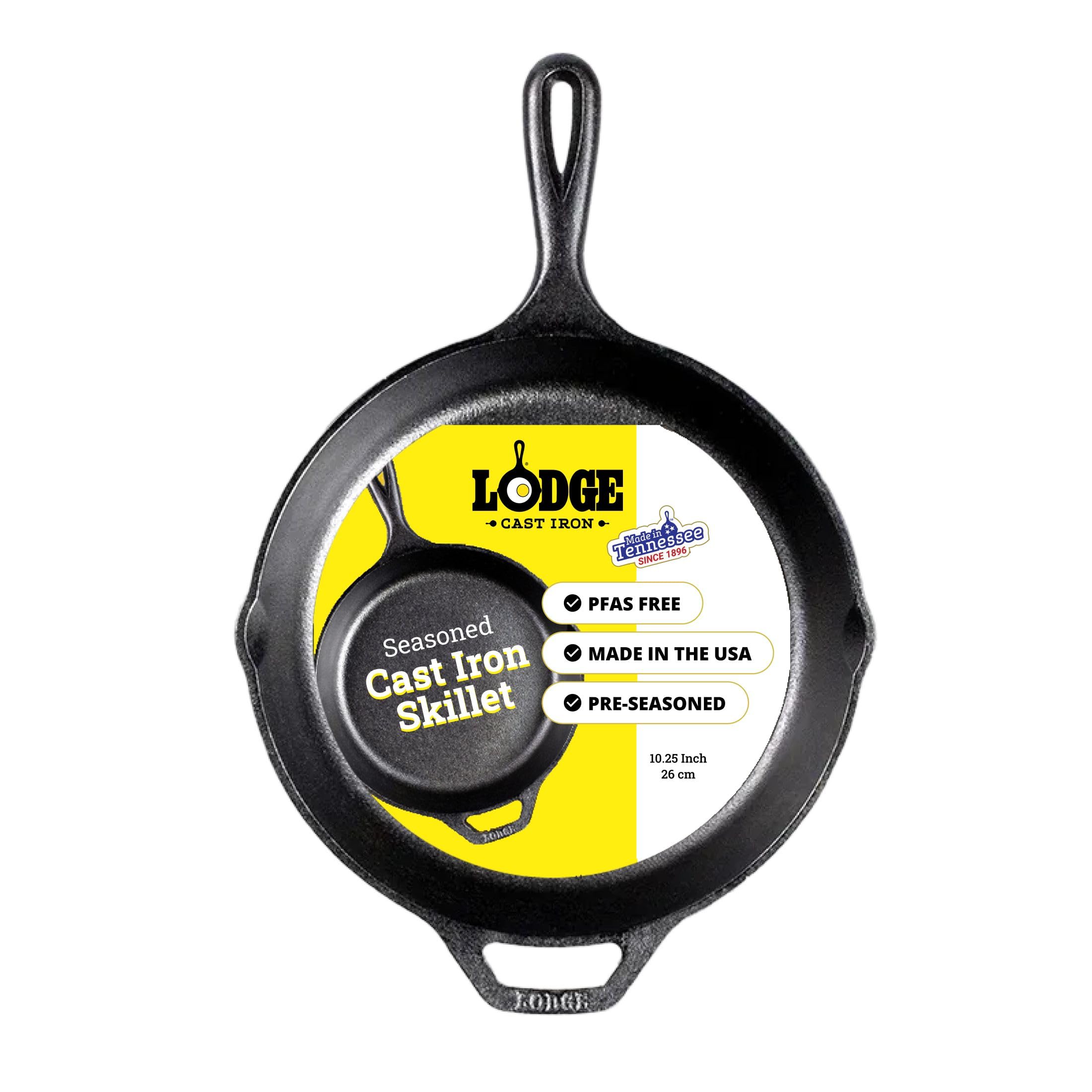


Best for Everyday All-Rounder
Lodge 10.25-Inch Cast Iron Skillet
Key Features
- Weight: 5.4 lb
- Diameter: 10.25 inches
- Oven-safe max: 500 °F
- Cooktop compatibility: Electric coil, gas, smooth-surface induction
- Price: Budget
Ten and a quarter inches answers most of the questions. It is wide enough for two ribeyes or a spatchcocked chicken, shallow enough that a spatula slides under a fried egg, and small enough to leave the back burner free on an ordinary range. That is the short version of why this Lodge is our top pick, and it does not hurt that it is the least expensive full-size skillet in this group.
What we did not expect was how much of our cooking it would take over. Cast iron holds heat instead of dumping it when cold food lands, and this pan comes back fast enough that a crowded batch of chicken thighs browns rather than steams. The teardrop handle is better than it looks, too: long enough to grip comfortably, and shaped so your knuckles stay off the iron when you tip the pan to pour off fat.
Pre-seasoned is worth understanding before you buy. The factory layer of baked-on oil is a rust barrier and a head start, not a nonstick coating, so eggs and fish will want butter for the first few weeks while the surface fills in. Then it stops being an issue. What you get in exchange is a cooking surface with nothing to flake or peel, rated to 500 °F and listed for gas, electric coils and induction, so it moves from a hard sear to a hot oven without a second pan.
At 5.4 pounds it lifts comfortably one-handed with dinner in it. Wash it, dry it on a low burner and wipe on a film of oil, and it stays black rather than orange. That small habit is the whole maintenance bill, and it is why this pan ends up living on the stove instead of in the cupboard.
Pros
- Holds heat for hard sears and recovers fast
- 10.25 inches suits most everyday meals
- Oven safe to 500 °F and induction compatible
- Least expensive full-size skillet here
Cons
- Bare iron handle heats up fast on the stovetop
We recommend it to anyone buying a first cast iron pan: 10.25 inches covers most meals, the 5.4-pound weight stays manageable, and it goes from burner to oven.
Best for Oven-To-Table Cooking
Lodge Dual Handle 8-Inch Pan
Key Features
- Weight: 3.1 lb
- Handles: Two cast iron assist handles
- Diameter: 8 inches
- Cooktop compatibility: Gas, smooth-surface induction
- Price: Budget
The second handle is the whole point, and it changes how you use the pan. At 3.1 pounds this 8-inch skillet is the lightest one here, but a pan holding cornbread batter or a roast chicken for two is a two-hand object, and two cast iron assist handles give you a grip on each side instead of one long lever that wants to rotate your wrist. We ended up keeping it for oven work — cornbread, a small roast, a frittata finished under the broiler — because the twin handles turned every transfer out of a hot oven into a routine move.
There is no long handle, so a wrist-flick sauté is out; you move this pan with both hands or not at all. In an 8-inch pan that is a fair trade, since the size is built for two portions anyway: a pair of chops, a hash for two, a skillet cookie. It is listed for gas and smooth-surface induction, and there is no coating to worry about at oven temperatures.
Ours has ended up doing side work we did not plan for — toasting spices, melting butter for a pan sauce, holding a round of cornbread — which is what a small, heavy pan is genuinely good at. It also goes to the table as it is, so there is one less dish in the sink.
Pros
- Two handles make a loaded pan controllable
- 8-inch size suits one or two portions
- Lightest pan here and oven ready
Cons
- No long handle, so no one-handed tossing
The pan we reach for when something goes into the oven: two handles make a loaded 8-inch skillet far easier to control than one long lever.
Best for First Set
Cuisinel 3-Piece Cast Iron Set
Key Features
- Weight: 4 lb
- Oven-safe max: 500 °F
- Skillet sizes: 6, 8 and 10 inches
- What’s included: Three skillets and three silicone grips
- Price: Midrange
A 6-inch skillet sounds like a novelty until you have fried a single egg in one and realized nothing else in the cupboard does that job as neatly. That is the logic of this set: the 6 handles eggs, a garlic-and-butter baste or a lone chop; the 8 takes two pork chops or cornbread for two; and the 10 does dinner for three or four. Three pans, three silicone grips, one box.
All three arrive pre-seasoned with oil and no synthetic coating, and they are rated to 500 °F, so the trio covers the same ground as the Lodge pans here with more sizes in play at once. The grips are the sleeper feature: they slide on and off, make a hot handle easy to move, and are the reason we stopped hunting for a towel mid-cook. Take them off for oven and broiler work, though — silicone has its own heat limit and the pan does not.
Where the set gives ground is the seasoning itself. Pre-seasoned here means a starting layer, and the smaller pans are the slowest to come around because they get used least — expect a few rounds of bacon, cornbread or shallow frying before eggs release cleanly. What you trade for three useful sizes is a little more time spent building surfaces, and a set that never gets bigger than a dinner for four.
Pros
- Three sizes cover eggs through dinner
- Silicone grips make hot handles manageable
- Pre-seasoned and rated to 500 °F
Cons
- Stops at 10 inches, so no big-batch pan
A sensible first set: three seasoned skillets and three grips cover eggs to dinner, and we think it beats buying pans one at a time.
Best for Crowd-Size Batches
Amazon Basics 15-Inch Skillet
Key Features
- Weight: 11.5 lb
- Capacity: 5.9 quarts
- Diameter: 15 inches
- Oven-safe max: 500 °F
- Price: Midrange
Eleven and a half pounds is not a typo, and it is the first thing to understand about this pan. That mass is why 15 inches of iron holds temperature when a whole chicken or a pound of sprouts lands on it, and why you will want a hand on the helper grip at the far side every time you take it off the burner.
For the right cooking it is a joy. Pizza for four comes out with a blistered base, a frittata for a crowd sets evenly across the whole surface, and fried chicken for a tableful fits in one batch instead of three. It is oven safe to 500 °F and holds 5.9 quarts, so it doubles as a roasting pan. We think of it as a specialty rather than a daily driver, and we are glad to spend the cupboard space on it.
The pan’s own description is refreshingly blunt: pre-seasoning does not make it nonstick, it is a rust barrier and a start. We appreciated that, because it sets the right expectation. This one wants a long, unhurried preheat before the outer ring catches up with the middle, and on a small burner it may never quite get there. Give it a big burner or a grill and the whole surface comes up even.
Pros
- Huge surface for pizza and big batches
- Holds heat through a full load
- Oven safe to 500 °F
Cons
- 11.5 pounds, and a two-hand lift once loaded
For pizza nights and big batches, 15 inches of iron earns its cupboard space; we happily trade the 11.5-pound lift for that surface.
Best for Large Family Meals
Utopia Kitchen 12-Inch Skillet

Key Features
- Weight: 7.58 lb
- Diameter: 12 inches
- Oven-safe max: 450 °F
- Cooktop compatibility: Gas
- Price: Budget
Ours took a few rounds of seasoning before a fried egg came out in one piece, and that is the honest trade with this pan. The factory seasoning is thin — thinner than on the Lodge pans here — so the first week of cooking is also a week of building the surface. Once it came up, it seared a steak as well as anything in this group, with a wide flat base that keeps the crust even from edge to edge.
Twelve inches is the draw. It takes four chicken thighs without crowding them, and it sits in the same price bracket as the smaller Lodge skillet while giving you two more inches of cooking surface. The 3.44 kg of iron keeps it planted when you are moving a big piece of meat around, and it is rated to 450 °F for oven use. It gave up nothing in the sear.
Rust spots appear fast on a pan whose seasoning is still thin, so dry it on the burner and oil it after every wash — that habit matters more here than on a well-seasoned pan. It is a good pan that asks more of you up front and pays that back in surface area. Ours now lives next to the 10-inch Lodge and comes out whenever the pan has to be bigger than the burner.
Pros
- Wide 12-inch surface for family portions
- Sears and browns as well as anything here
Cons
- Listing names gas cooktops only; check before ordering
- Oven ceiling of 450 °F sits below the Lodge pans
The biggest 12-inch surface in this group if you will finish the seasoning yourself; we found it rewards the effort once the surface builds.
How We Tested Cast Iron Pans in a Real Kitchen
To build the shortlist, we started with the pans cooks keep mentioning — in forums, in restaurant kitchens, in my mother’s cabinet — then filtered by size range, price, whether the seasoning was applied at the factory, and how the main handle and helper handle actually felt in a hot, dry hand. Twelve pans made the cut, and each one stayed in rotation for eight months.
Testing looked like dinner, not a lab bench. Every pan seared a steak on a weeknight and went straight into a 450-degree oven for cornbread; every pan fried eggs on a Saturday morning, which told us fast how well the factory seasoning was holding. We weighed each one empty on a kitchen scale, then again loaded with a couple of pounds of food, since the line between a pan you reach for and one you avoid has a lot to do with how it feels when it’s full.
For heat distribution, we dusted the dry surface with a thin layer of flour and set it over a medium flame, watching where it browned first — an isolated ring near the edge told a different story than an even toast across the center. Cleaning got logged after every meal: scrubbed with a chainmail pad, a stiff brush, and a nylon scraper, noting which pans released stuck bits and which needed a soak. Rust resistance we checked bluntly — washed, left damp on the counter overnight, inspected in the morning — and durability showed up on its own by month eight, when some cooking surfaces had gone patchy and others had quietly built a slicker finish.
How to Choose a Cast Iron Skillet
Most of what separates one bare cast iron skillet from another comes down to two numbers — the diameter and the weight — plus what the pan is rated to sit on and inside.
Match the diameter to the meals you actually cook
The sizes here run from 6 inches to 15, and the gap between them is bigger than it sounds. The listed figure is rim to rim, and the flared sides eat into the flat area you actually sear on, so a 10-inch pan holds two ribeyes comfortably rather than four. Buy for the portion you cook most: 8 inches for one or two people, 10 or 10.25 for two to four, 12 when four is normal, and 15 only if you have the burner and the cupboard to match.
Then look at your range. A pan that overhangs your largest burner heats in the middle and lags at the rim, which is exactly what you notice on the first batch of pancakes.
Weigh the pan, then think about the handle
Cast iron is heavy because the mass is the whole mechanism, and the spread here — 3.1 pounds to 11.5 — is the difference between a pan you grab with one hand and one you plan around. A loaded pan is heavier still; full of stew or chicken, a 12-inch skillet becomes a two-hand object for most of us.
Handle shape decides how that feels. Dual assist handles, as on the Lodge dual handle pan and the 15-inch Amazon Basics, split the load across two grips and make oven work calmer. A single long handle gives you leverage and a place to rest your forearm, but it is a longer lever to fight when the pan is full. Either way the handle is bare iron and will get hot, so keep a mitt or a silicone grip within reach.
Check the cooktop list and the oven ceiling
Plenty of bare iron sits happily on gas, electric coils and induction, but not all of it is listed for all three. If you cook on induction or a glass top, start with a pan whose compatibility line names those surfaces; a pan listed only for gas is one to check before ordering, not after.
The other ceiling is the oven. Ratings here run from 450 to 500 °F, which matters little for cornbread and a lot for broiler work and high-heat roasting. Grips and removable handles always have a lower limit than the iron, so strip them off before the pan goes in.
Treat pre-seasoning as a starting line
Pre-seasoned means a thin layer of oil has been baked onto the iron so the pan ships without rust and you can cook in it tonight. It does not mean nonstick. Lean foods — eggs, fish, a skinless breast — will want butter or oil for the first few weeks, and the surface fills in fastest if you cook fatty, sticky things: bacon, chicken thighs, cornbread, shallow frying.
Wash with hot water and a brush, dry it on a low burner, and wipe on a film of oil before it goes away. Moisture is what makes rust; the iron is fine.
One skillet or a set?
A single 10-inch skillet does more than three small pans if you cook one meal at a time and would rather not spend the cupboard space. A set earns its place when you genuinely cook at different scales — an egg in the morning, a pan sauce at noon, dinner at night — and the Cuisinel set here covers that in one purchase.
What no set does is the job of a pan bigger than its largest size, so decide whether you need a 12- or 15-inch surface before you buy three of anything.
Frequently Asked Questions
Can I cook tomato sauce or other acidic food in a cast iron skillet?
A quick pan sauce built on wine or tomatoes is fine in a seasoned pan: deglaze, simmer a minute or two, and serve. Long simmers are the problem, because an hour of acidic sauce eats into the seasoning, and a young pan can leave the food tasting metallic.
Keep the iron for the sear and move the long cook to stainless or enameled steel.
What should I do if my skillet rusts?
Scour the spots off with steel wool or a stiff brush, wash and dry the pan thoroughly on a low burner, then rub a thin film of oil over the entire surface — inside, outside and handle — and heat it until it just smokes. One session usually brings it back.
Rust means moisture sat on bare iron. Dry the pan on the stove after every wash and oil it before it goes away, and it will not return.
Can I use metal utensils in a cast iron pan?
Yes, and it is the better choice. There is no coating to scratch, so a metal spatula or tongs will not hurt anything, and scraping the surface as you cook actually helps level the seasoning over time.
A chainmail scrubber or coarse salt handles stuck-on bits. What you want to avoid is soaking the pan or leaving it wet.
Final Verdict
The Lodge 10.25-inch skillet is the one we tell people to buy first. Its size covers most meals, 5.4 pounds stays manageable with a towel over the handle, and the 500 °F rating takes it from burner to oven without a second pan. Nothing else here does as much of the everyday job for as little.
Buy the Lodge dual handle 8-inch pan instead if you cook for one or two and want an easier lift into and out of the oven, and step up to the 15-inch Amazon Basics when pizza night or a crowd is the regular occasion rather than the exception.