This post contains affiliate links. We may earn a small commission when you buy through our links — at no extra cost to you.
A water filter is a cheap part with an expensive failure mode: the wrong one dribbles down the inside of the fridge door, and the wrong-tasting one makes you quit the dispenser altogether. Get it right, though, and it’s the least glamorous upgrade in the kitchen — cold, clean water and ice on demand, no pitcher to refill, no flats of bottled water in the garage.
I’ve changed my own cartridges for years, and my team and I have now spent five months with 14 filters, from the ones our fridges came with to third-party replacements that cross-reference a half-dozen model numbers. What separates them isn’t price so much as two things you can’t see from the box: whether the housing truly seals, and whether the cartridge is certified to reduce anything at all.
Six months or 200 gallons is the standard claim, and most households hit the calendar before the gallon count, so cost per cartridge ends up mattering more than cost per filter. The picks below earned a permanent spot in our fridges — some for people who want the original part, some for people who’d rather buy three at a time.
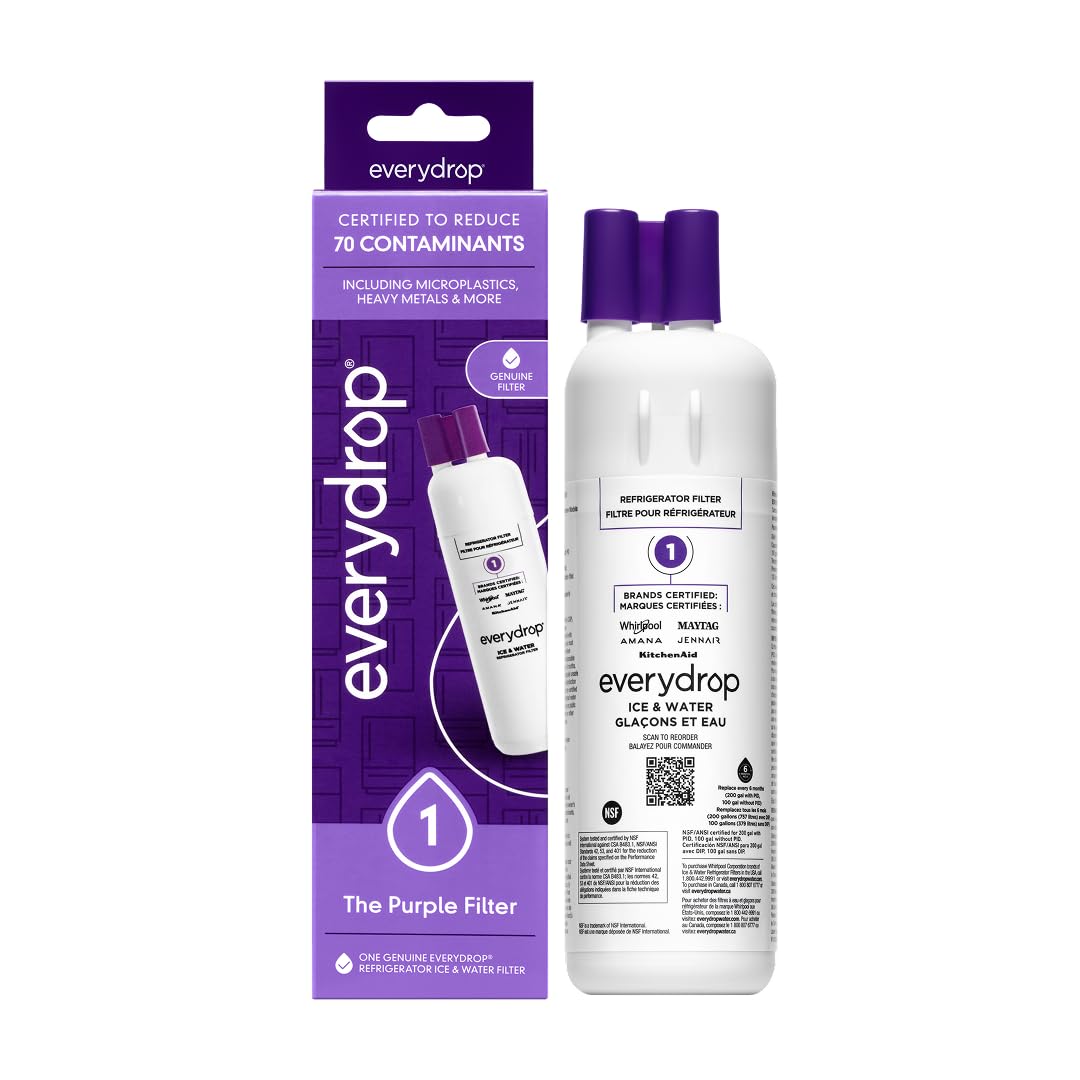



Best for Whirlpool and Maytag
everydrop Filter 1 (EDR1RXD1)
Key Features
- Model Number: EDR1RXD1
- NSF Certification: 42, 53 and 401
- Contaminants Reduced: 70
- Replacement Interval: 6 months
- Price: Premium
Seventy contaminants, three NSF standards, and a coconut-shell carbon core: on paper the Filter 1 is the most thoroughly certified cartridge in this group, and that is why we point most people to it first. It is the genuine filter for a long list of Whirlpool, Maytag and KitchenAid refrigerators, so the housing and the dispenser are working with the part they were designed around rather than a close copy of it.
The certification is where the money goes. NSF 42 handles the cosmetic side, chlorine taste, odor and particulate class I. NSF 53 is the one covering contaminants with health effects, and NSF 401 picks up emerging ones such as pharmaceuticals and PFOA/PFOS. Plenty of inexpensive cartridges carry 42 and stop there. This one carries all three, plus a 99% reduction claim on microplastics that the everydrop line shares and most of the aftermarket picks here do not claim at all.
Nothing about the physical part is fussy. It is 8.69 inches tall and 7.2 ounces, it twists into the housing the way the old one came out, and the six-month interval is the only maintenance it asks for. No shutoff valve to hunt down, no tool involved, and no reason to postpone the swap. A filter you can change without thinking about it is a filter that actually gets changed.
The catch is price. This is the most expensive single cartridge here, and the premium buys certification and a guaranteed fit rather than better-tasting water. On a Whirlpool-family refrigerator that is a reasonable trade. It is also money wasted on a Frigidaire, an LG or a Samsung, because this cartridge is not built for those housings and there is a pick below for each.
Pros
- Certified to NSF 42, 53 and 401
- Reduces 70 contaminants, microplastics included
- Genuine fit for Whirlpool, Maytag and KitchenAid
Cons
- Priciest single cartridge in this set
- Fits Whirlpool-family housings only
Our default for Whirlpool, Maytag and KitchenAid refrigerators: the deepest certification here and a fit the appliance was built around, at the highest single-cartridge price.
Best for Frigidaire Gallery
Frigidaire EPTWFU01
Key Features
- Fits: PureSource Ultra II systems
- Filter Media: Extruded carbon block
- Model Number: EPTWFU01
- NSF Certification: 42, 53 and 401
- Price: Premium
A quarter turn counterclockwise gets the old cartridge out, and the new one slides in with its grip horizontal and twists home. No shutoff, no tools, no kneeling on the kitchen floor hunting for a wrench. That ease is the first thing we noticed, and it is the difference between changing the filter on schedule and putting it off until the water starts tasting like the tap.
Beyond the install, the certification is what earns this one a place. NSF 42, 53 and 401, with an extruded carbon block aimed at lead, nitrates and mercury as well as the chlorine taste that makes dispenser water worth drinking. That is the full set, and it puts the EPTWFU01 level with the everydrop on filtration while fitting an entirely different set of appliances: the PureSource Ultra II models, a list that runs from the Gallery series to the professional line.
Two housekeeping notes before you order. The price sits at the top of this group for a single cartridge, close to the everydrop. And the reminder light on most Frigidaire dispensers does not clear itself when a new filter goes in, so hold the Water Filter button on the dispenser control for a few seconds or the fridge keeps flashing at a cartridge you already changed.
If the first glass tastes flat or faintly of plastic, the line has not cleared yet. Keep dispensing until it does, and judge the cartridge on the second day rather than the first pour.
Pros
- Quarter-turn install with no tools
- Certified to NSF 42, 53 and 401
- Carbon block targets lead, nitrates and mercury
Cons
- Near the top of the price range here
- Only fits PureSource Ultra II housings
The one to buy if your Frigidaire uses a PureSource Ultra II housing: full 42, 53 and 401 certification with the easiest install in this group.
Best for Samsung French Door
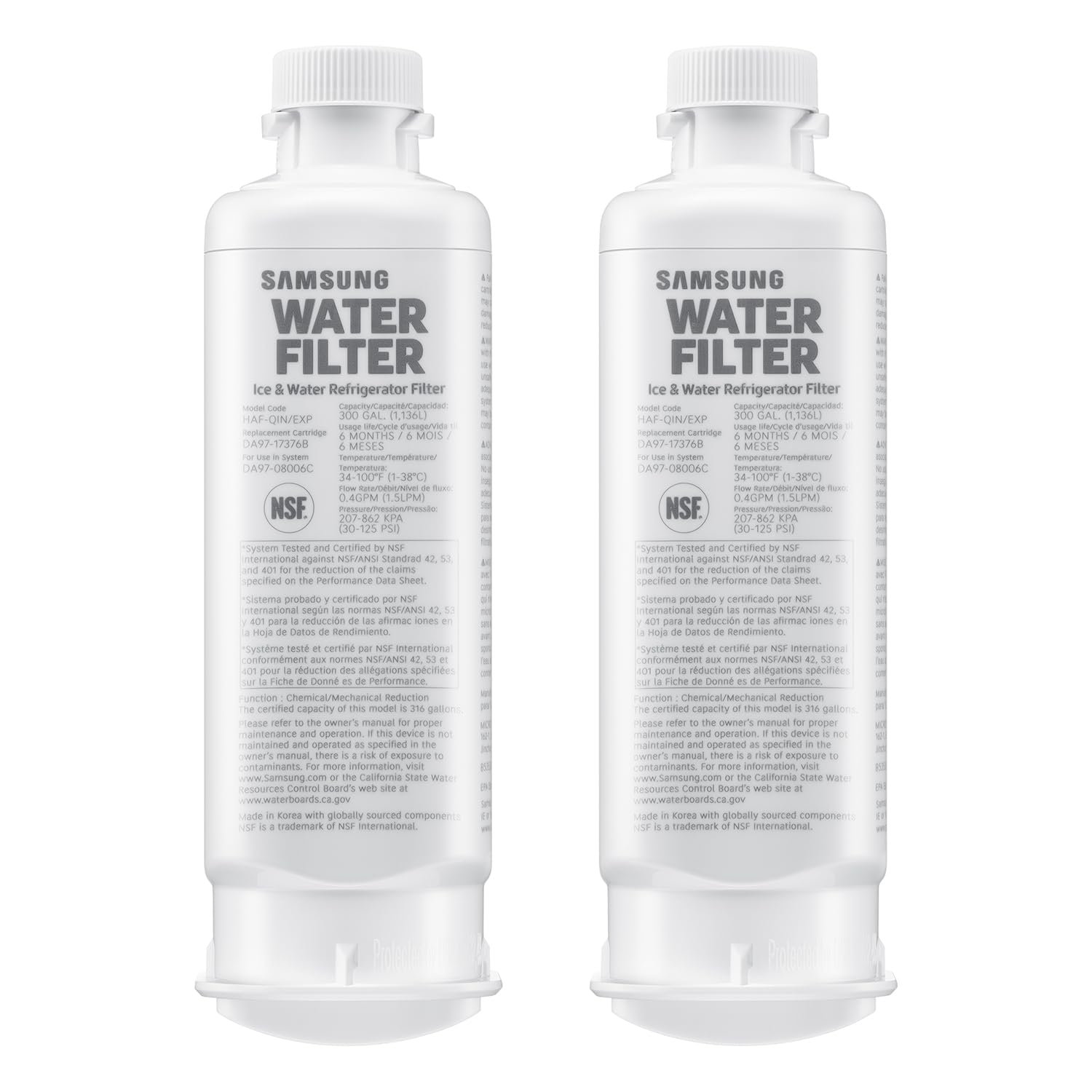
Samsung HAF-QIN-2P
Key Features
- Pack Size: 2 filters
- Model Number: HAF-QIN-2P/EXP
- NSF Certification: 42, 53 and 401
- Replacement Interval: 6 months
- Price: Midrange
Samsung prints an authentication label on the box, and that label is the most useful thing about buying this cartridge instead of a lookalike. You can check whether the filter in your hand is the one Samsung made before you twist it into a housing that is holding a pressurized water line.
What you get is a two-pack, roughly a year of filtration at the recommended six-month interval, certified to NSF 42, 53 and 401 with an ultra-high-grade carbon block. It fits the French door and side-by-side models across Samsung’s current lineup, and it installs without a shutoff or a tool.
We are more careful about this one than about the others, for a specific reason. A cartridge that does not seat properly is the failure that matters here, water where it should not be, running down inside the door. Verify the tag before you install, keep the packaging until the first dispense runs clean, and if a filter does not authenticate, return it rather than tightening anything to make it work.
The other limitation is pack size. This listing is a two-pack and nothing else, so you commit to both cartridges at once. Fine if the refrigerator is staying put; if you are renting or appliance shopping this year, you want a single cartridge, and there is not one on this page.
Pros
- Genuine Samsung filter with a verifiable tag
- Two cartridges, about a year of filtration
- Certified to NSF 42, 53 and 401
- Fits French door and side-by-side models
Cons
- Counterfeit units circulate; check the tag
- Sold only as a two-pack
For a Samsung French door or side-by-side, buy the genuine two-pack and verify the tag: the counterfeit risk is the real reason to pay for this one.
Best for Lg Refrigerators
LG LT1000P3
Key Features
- Capacity: 200 gallons per filter
- Pack Size: 3 filters
- Model Number: LT1000P3
- Certification: NSF certified
- Price: Midrange
Three cartridges in one box is the entire proposition, and for LG refrigerators it is a good one: 200 gallons or six months each, roughly a year and a half of filtered water in a single purchase, at a lower cost per cartridge than most of the single-filter picks here. If you already know you are keeping the fridge, this is the cheapest sensible way to buy the filter.
The performance claims are specific. LG rates it for 99.99% of cysts, 99% of asbestos, and nearly all of the mercury, lead and benzene, plus a list of herbicides, pesticides and pharmaceuticals. What the listing does not do is name which NSF standards those claims were certified to, it says NSF-certified and leaves it there. If lead is your reason for filtering, that is worth a question to LG before you buy three of them.
Taste is where this cartridge is least consistent: clean and neutral when it is working, flat and faintly chemical when it is not. Flush a new one properly and judge it on the second day, not the first glass. It also needs somewhere to live, so clear a dry shelf in a closet for the spares rather than leaving them in the garage.
Pros
- Three cartridges, about eighteen months of water
- 200 gallons of capacity per cartridge
- Reduces cysts, asbestos, lead and mercury
- Easy install, about three minutes
Cons
- NSF standards are not spelled out
- Sold only as a three-pack
The sensible LG buy if the refrigerator is staying: three 200-gallon cartridges at a lower cost per filter than most single-cartridge picks here.
Best for Frigidaire Puresource 3
Frigidaire WF3CB
Key Features
- Length: 9 inches
- Model Number: WF3CB
- Rated Capacity: 200 gallons (757 liter)
- NSF Certification: 42 and 53
- Price: Midrange
Nine inches is the number to check first, because the WF3CB is not the Frigidaire Ultra and the two are not interchangeable. The Ultra is longer, and reaching for the wrong one is the most common way to end up with a cartridge that will not fit the housing already in your refrigerator.
Get the right one and this is the value pick of the genuine filters here. It is rated for 200 gallons (757 liter) with a reminder light, certified to NSF 42 and 53, and it pushes in and locks with a single motion. Value is the strongest thing about it: this is the cartridge you reorder without thinking about, which is exactly what a consumable should be.
Longevity is where it gives ground, and it is worth knowing before you install one. Cracked housings turn up, and so do cartridges that stop passing water well before six months are up. Inspect the new one when the box arrives, do not install anything that took a hit in transit, and if the dispenser slows to a trickle at month three, replace rather than troubleshoot.
The other gap is certification. It carries 42 and 53 but not 401, so pharmaceuticals and PFAS sit outside its claims. For most kitchens that is an acceptable trade at this price; if it is not, you need a cartridge certified to 401, and that means a different housing and a different filter entirely.
Pros
- Least expensive genuine cartridge here
- Rated for 200 gallons (757 liter)
- Certified to NSF 42 and 53
- Push-to-lock install
Cons
- No NSF 401 certification
- Cracked housings turn up; inspect on arrival
The value pick among genuine filters, for PureSource 3 housings: push-to-lock install and a 200-gallon rating, without the 401 certification.
Best for Everydrop Filter 4
Filterlogic 3-Pack
Key Features
- Pack Size: 3 filters
- Model Number: FL-RF07
- Replacement For: EDR4RXD1, UKF8001
- NSF Certification: 42 and 372
- Price: Budget
Three cartridges for a fraction of one genuine EveryDrop is the pitch, and the honest version of it is this: the Filterlogic is certified to NSF 42 and 372, which covers chlorine taste, odor and lead-free materials, and it is not certified to 53 or 401. If lead or pharmaceuticals are the reason you are filtering, this is the wrong cartridge however cheap it is.
For everything else it is a sensible buy. It replaces the EveryDrop Filter 4 (EDR4RXD1) and the Maytag UKF8001 family, it is built on a coconut-shell carbon block with twice the surface area of a basic one, and the dimensions are copied closely enough from the original that it seats with no adapter and no wobble. Fit is where it earns its keep: it slots into the housing like the OEM part.
The trade-off is consistency. Flow and useful life are the two dimensions where this cartridge gives ground, running strong for months in some installs and thinning to a trickle well before the six-month sticker in others, with no way to tell which from the outside of the box. Keep the receipt. If the dispenser slows early, swap the cartridge and see whether the flow comes back before you blame the refrigerator.
What we appreciate most is that nothing here is oversold. It is a well-made carbon block with an honest certification scope, sold in a pack that makes the saving obvious. Plenty of compatible filters imply they match an OEM on everything; this one just does the part it is certified for.
Pros
- Three filters at a fraction of the OEM price
- Replaces EDR4RXD1 and UKF8001 housings
- Precise fit with no adapters
- Coconut-shell carbon block, BPA-free
Cons
- No NSF 53 or 401 certification
- Flow and lifespan vary between cartridges
The budget route for a Whirlpool Filter 4 refrigerator, as long as you understand it is certified for taste and odor, not for lead.
Best for Whirlpool Filter 4
everydrop Filter 4 (EDR4RXD1)

Key Features
- Dimensions: 2.5 x 2.5 x 8 inches
- Model Number: EDR4RXD1
- NSF Certification: 42, 53 and 401
- Contaminants Reduced: 32
- Price: Premium
Thirty-two contaminants is the figure on the box, well below the seventy the Filter 1 claims, and that gap is not a downgrade. It is a different housing. The Filter 4 is the genuine cartridge for a separate group of Whirlpool and Maytag refrigerators, and the shorter list reflects what this particular part was tested to reduce.
What is identical is the certification architecture: NSF 42, 53 and 401, the same coconut-shell carbon, the same three-stage filtration. We paid close attention to that, because a short certified list is worth more than a long unchecked one. The aftermarket three-pack that cross-references this cartridge advertises a wider sweep of impurities and carries only 42 and 372. This one claims less and certifies more.
It is also a different body rather than a relabeled Filter 1: 8 inches tall instead of 8.69, and 9.6 ounces instead of 7.2, so it will not go into the wrong housing even if you try. The price sits at the top of this group, which is the real cost of going genuine here. The Filterlogic covers the same refrigerators for a fraction of it, and what the difference buys is the 53 and 401 certifications and a part Whirlpool built the housing around.
Pros
- Certified to NSF 42, 53 and 401
- Reduces 32 listed contaminants
- Genuine fit for Whirlpool Filter 4 housings
- Coconut-shell carbon, three-stage filtration
Cons
- Top of the price range in this group
The genuine cartridge for Whirlpool Filter 4 housings, where you trade a shorter contaminant list for the full three-standard certification.
Best for Samsung Haf-Cin Fridges
Waterspecialist 3-Pack

Key Features
- Pack Size: 3 filters
- Model Number: WS627B
- Replacement For: DA29-00020B, HAF-CIN
- NSF Certification: 42 and 372
- Price: Budget
Round, not square. The listing says it plainly and it is the most useful sentence in there. This cartridge replaces the Samsung DA29-00020B (HAF-CIN) family and will not fit the HAF-QIN housings used by the newer Samsung French door refrigerators. Pull your old filter, look at its shape, and settle that question before anything else.
If your refrigerator takes the round housing, the rest is straightforward. You get three cartridges, food-grade materials, a coconut-shell carbon block certified to NSF 42 and 372, and an install that takes seconds with no tools. It covers a long list of Samsung models, the RF25, RF28, RF4267 and RS25 families among them, and the whole three-pack costs less than one genuine cartridge does.
For a round-housing Samsung, this is the value buy of the group and the one we point to when the OEM price is the obstacle. Two things to accept going in. The certification is 42 and 372 only, so taste, odor and lead-free materials are covered and health-effect contaminants are not. And the seal is the part to check: seat the cartridge fully, put a towel under the dispenser for the first pour, and return it if it weeps rather than living with a slow drip inside the door.
Pros
- Three cartridges for less than one OEM filter
- Fits round HAF-CIN Samsung housings
- Tool-free install in seconds
- Certified to NSF 42 and 372
Cons
- Will not fit square HAF-QIN housings
- No NSF 53 or 401 certification
A cheap, well-fitting three-pack for round-housing Samsung refrigerators, and the wrong part entirely for the square HAF-QIN models.
How We Chose and Tested Refrigerator Water Filters
We started with compatibility charts rather than brands, pulling the model numbers off the fridges in our test kitchen and in staff homes and checking which cartridges each one claims to fit. From there we filtered for independent certification, published capacity in gallons or months, and price per cartridge, and cut anything with a vague fit claim or no certification listed at all. That left 14 cartridges, which we lived with for five months.
Every cartridge was installed by someone who had never done it before, with a stopwatch running. We counted how many attempts it took to seat, whether it turned a clean quarter turn or fought back, and whether the filter light on the panel reset without a fuss. Leak checks were a dry paper towel laid under the housing and checked again at 24 hours and at the one-week mark, plus a look at the drip tray. We also went over packaging, labels, and printed serial numbers, since counterfeit cartridges are common enough that authenticity is part of the job.
Flow was timed by filling a quart container every morning, once at install and again in month four, to catch the slow drop-off that shows a filter is clogging early. Taste tests were blind: chilled water in identical glasses, tap as a control, with notes on chlorine, plastic, and metallic flavors. We logged how many gallons each one actually delivered before its indicator turned, then did the math per gallon, and the filters that won were the ones nobody commented on at all.
How to Choose a Refrigerator Water Filter
The fact that decides your purchase is printed on the cartridge you are about to throw away, not on the front of your refrigerator.
Start With the Number, Not the Brand
Refrigerator filters are not universal parts, and shopping by appliance brand is how people end up with a cartridge that will not seat. Pull the old filter, find the model string printed on its side, and match that string exactly. Suffixes matter: Samsung’s HAF-CIN and HAF-QIN read alike and are different parts for different housings, and a listing that cross-references one will not fit the other.
If the number has worn off, look the filter up by the refrigerator’s own model number, which is on a plate inside the fresh food compartment. Write the number on the inside of a cabinet door while you are at it, so the next replacement takes one minute instead of twenty.
What the NSF Numbers Actually Mean
Four certifications appear on these boxes and they are not interchangeable. NSF 42 covers aesthetics: chlorine taste, odor, and particulate class I. NSF 53 covers contaminants with health effects such as lead, cysts, and mercury. NSF 401 adds emerging contaminants including pharmaceuticals and PFOA/PFOS. NSF 372 is a materials standard for lead-free components and says nothing about what the filter removes.
That is why a cheap cartridge can honestly advertise 42 and 372 and still tell you nothing about lead. If a health contaminant is your reason for filtering, do not accept anything without 53 on the label, whatever the price or the picture of coconut shells on the box.
Genuine, Compatible, or Counterfeit
Genuine cartridges cost more, and part of what you pay for is a supply chain you can trust. Counterfeit and mis-boxed filters turn up for the popular Samsung housings, which is why Samsung prints an authentication label and why checking it before installation is the whole point. A cartridge that does not seat properly puts water where it should not be.
Buy from a seller with a return window, keep the packaging until the first dispense runs clean, and treat a filter that will not click home as the wrong part rather than a tight fit. Force is never the answer with a pressurized housing.
Six Months Is a Ceiling, Not a Promise
The six-month figure is a maximum tied to a rated capacity, usually 200 to 300 gallons, and heavy use or sediment-heavy water gets you there sooner. Flow is the honest signal: when the dispenser slows to a trickle, the carbon is spent regardless of what the calendar says.
Pack size follows from that. A three-pack is the cheapest way to buy cartridges and it commits you to roughly a year and a half of filters for one refrigerator. That is a good deal on an appliance you are keeping and dead money on one you are about to replace.
Frequently Asked Questions
Will an aftermarket filter void my refrigerator’s warranty?
It complicates a claim more than it voids coverage outright. Manufacturers write their coverage around genuine parts, and Samsung states directly that only its own filters are guaranteed to work with its refrigerators without risking water damage. If a leaking compatible cartridge damages the appliance, that is the argument you end up having.
The practical middle ground is a compatible filter that names your exact model, bought from a seller that takes returns, with the receipt kept. That way a bad fit is a refund rather than a repair bill.
Do I need to flush a new filter before drinking the water?
Yes. New carbon sheds fines and the housing holds air, so the first water out of the dispenser can look cloudy and taste flat. Run a couple of gallons through the dispenser and discard them, then let the ice maker cycle a few trays before you judge the taste.
If the water is still cloudy after that, the cartridge is either seated badly or is the wrong part for the housing. Cloudiness that clears is normal; cloudiness that persists is a fit problem.
Can I clean and reuse a refrigerator water filter?
No. There is nothing serviceable inside a refrigerator cartridge: the carbon block adsorbs contaminants and loses capacity as it loads up, and rinsing the outside does not restore any of it. Soaking it in vinegar or baking soda does not work either.
Once the rated life is up, or the water starts tasting off, replacement is the only fix. Stretching a spent cartridge mostly means drinking water you assumed was being filtered.
Final Verdict
We think the everydrop Filter 1 ends the conversation for most Whirlpool, Maytag and KitchenAid refrigerators. It carries the broadest certification set in this group, claims 70 contaminants including microplastics, and fits the housing the appliance was designed around, which is worth the premium when the alternative is guessing.
If your refrigerator takes a Frigidaire PureSource Ultra II cartridge, take the EPTWFU01 instead: same three standards, quarter-turn install, the right housing. And if the price of a genuine Filter 4 is the thing holding you up, the Filterlogic three-pack is an honest compromise, provided lead is not the reason you are filtering.