This post contains affiliate links. We may earn a small commission when you buy through our links — at no extra cost to you.
Cast iron has a reputation problem: beginners hear “seasoning” and picture a ruined pan and a scrubbing marathon. The truth is simpler — a skillet that starts with a solid factory coat and a smooth cooking surface will fry an egg without sticking by the second week, and it only gets better from there. The right one removes the guesswork: even heating, manageable weight, and a surface that forgives a stray splash of dish soap.
Over the past six months, I cooked with a dozen cast iron skillets — everything from bare-bones 10-inchers to heavier, sanded-surface models — making eggs, cornbread, and pan-seared steaks on repeat. I also paid attention to the unglamorous stuff: how each one felt in my hand, how much oil the surface needed, and whether it rusted after a normal wash. The best ones for beginners share a few traits: a size that fits a standard burner, a factory seasoning that actually holds, and a cooking surface that doesn’t fight you on day one. The picks below are the ones I’d hand to someone buying their first skillet without a second thought.



Best for First Cast Iron
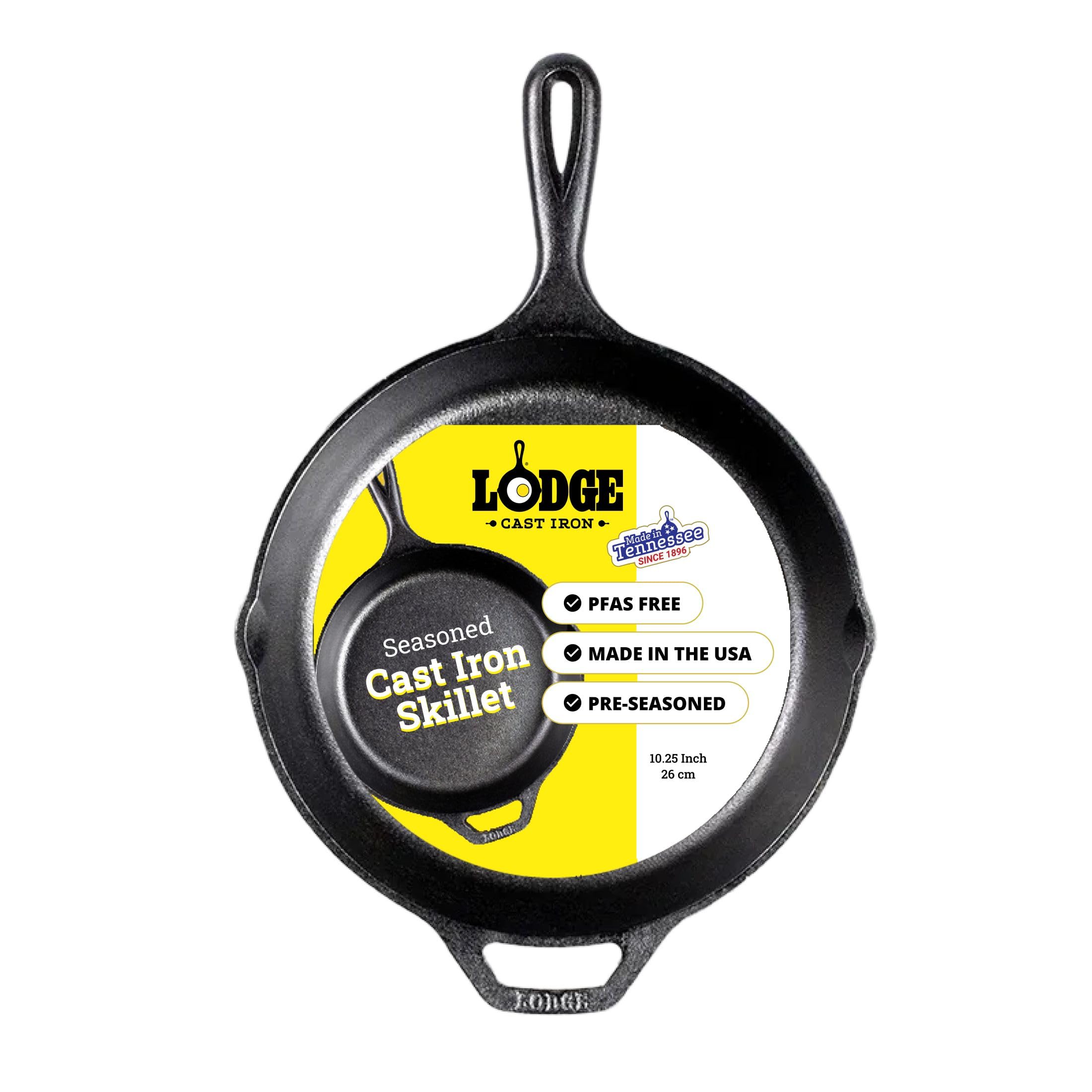
Lodge Pre-Seasoned 10.25-Inch
Key Features
- Weight: 5.4 lb
- Diameter: 10.25 inches
- Oven-safe to: 500 °F
- Cooktop compatibility: Gas, electric, induction
- Price: Budget
Ten and a quarter inches is the size most beginners land on and then keep: wide enough for two chops or a small pan pizza, small enough that an ordinary burner heats the whole base rather than leaving a cold ring at the edge. The teardrop handle sits in the hand instead of digging into it, and the base is flat enough that it doesn’t rock on the grate.
The 5.4 pounds is the trade you’re making. That mass is why a steak sears instead of steaming, and it’s also why you’ll bring both hands when the pan is loaded. The handle is comfortable dry and scorching after ten minutes on the burner — same as every cast iron pan here — so a mitt or a slip-on grip is part of the kit, not an optional extra.
‘Pre-seasoned’ is the phrase that trips up first-time buyers, so it’s worth being blunt: it means the pan won’t rust on the shelf, not that eggs will slide. Ours needed a couple of weeks of bacon, cornbread, and stirred onions before a fried egg released cleanly. What got it there is three moves — hot water and a stiff brush, half a minute on a warm burner to dry, a smear of oil wiped almost all the way off.
What earns it the top spot is that nothing about owning it is fussy: oven-safe to 500 °F, at home on gas, electric, or induction, covered by a lifetime warranty, and modest enough in price that a handle grip and a good spatula don’t feel like an extravagance. Beginners make mistakes with iron — leave it wet, scorch it, cook tomatoes in it — and this is the pan that comes back from all of it.
Pros
- Even heat and strong heat retention on any burner
- 10.25 inches suits most everyday meals
- Gas, electric, and induction, up to 500 °F
- Lifetime warranty and US manufacturing
Cons
We point beginners to the Lodge first: 10.25 inches, pre-seasoned, oven- and induction-ready to 500 °F, and priced so early mistakes don’t feel expensive.
Best for Cooking for One
Victoria 6.5-Inch
Key Features
- Handle: Long, contoured cast iron
- Weight: 2 lb
- Diameter: 6.5 inches
- Oven-safe to: 750 °F
- Price: Budget
The handle is the first thing you notice, because it’s longer than the stubby teardrop most iron pans come with — and on a 6.5-inch pan that’s the whole point. You can hold it with one hand while you work a spatula under an egg with the other, and at 2 pounds it lifts and pours without the two-mitts ritual. The walls are deep for a pan this size, and the pour spouts on each side make it useful for a small pan sauce or cornbread batter.
What it won’t do is feed a family. Two eggs, a grilled cheese, one steak that actually fits — that’s the remit, and 6.5 inches is the wrong choice if you’re cooking for three. It’s rated to 750 °F, the highest ceiling in this group, which makes it a good small oven pan for a crumble or a couple of cornbread muffins. As a second skillet next to a 10-inch, it earns its drawer space; as an only skillet, it doesn’t.
Pros
- Long contoured handle keeps a hot pan controllable
- Just 2 pounds — as light as anything here
- 750 °F oven rating, the highest in this set
- Deep walls and pour spouts on both sides
Cons
Cooking for one? The Victoria’s long handle and 2-pound body make it the easiest small skillet here to move, and it’s rated to 750 °F.
Best for Lidded Braising
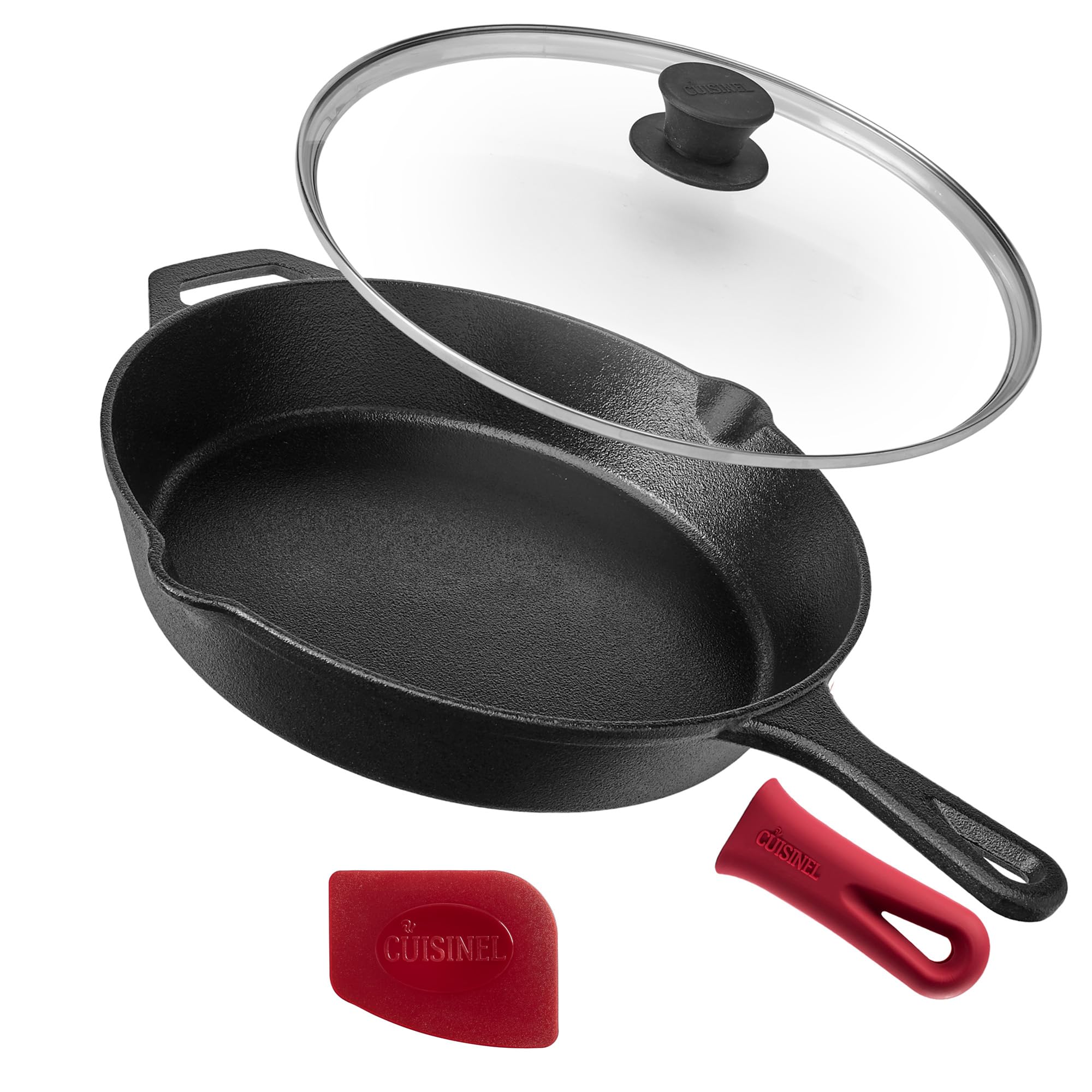
Cuisinel 12-Inch with Lid
Key Features
- Weight: 11.4 lb
- Capacity: 3 quarts
- Diameter: 12 inches
- Included: Glass lid, silicone handle holder
- Price: Midrange
A tempered glass lid is a genuinely different proposition from a bare pan. You can brown chicken thighs on the stove, clamp the lid on, and let them finish without dirtying a second pot — and the glass means you’re not lifting it every two minutes to check. The silicone handle holder that comes in the box is the other small nicety; a 12-inch iron handle gets hot enough that a bare grip is a real problem.
For anyone feeding three or four, this is the pan that does the work of a sauté pan and a Dutch oven at once. Twelve inches and 3 quarts take a whole cut-up chicken or a big batch of chili, and the iron holds steady heat on gas, electric, induction, and glass, in the oven, on the grill, and over a campfire. That breadth is what earns it a place: one pan, most of the jobs.
The weight is the honest cost of that capacity — 5.15 kg of iron before the lid goes on. It’s a two-hand pan, and if you have wrist or grip trouble it’s the wrong choice no matter how good the lid is. The trade is heat that doesn’t waver when a cold chicken goes in, and cast iron underneath that will outlast the glass.
Pros
- Tempered glass lid for braising and simmering
- 12-inch, 3-quart capacity for family meals
- Silicone handle holder included
- Gas, electric, induction, oven, grill, campfire
Cons
- Glass lid is the fragile part of the kit
Buy the Cuisinel if braising matters: 12 inches, a glass lid, and a silicone grip in the box — just expect to lift 5.15 kg.
Best for Smooth Surface
Stargazer 10.5-Inch
Key Features
- Weight: 5.2 lb
- Surface: Machined smooth
- Capacity: 2.3 quarts
- Diameter: 10.5 inches
- Price: Premium
Instead of pour spouts on two sides, the Stargazer’s whole rim is flared, so you can pour fat or pan sauce off at any angle without hunting for the spout. It sounds like a small thing until you’ve tried to drain a chicken thigh the wrong way and sent the grease down the outside of the pan.
The cooking surface is the bigger draw. Run a finger across this one and then across the Lodge and the difference is obvious: the Stargazer is machined smooth, where the cheaper pans are left as-cast and pebbly. Smooth iron wipes cleaner and reaches a slick surface sooner, and the pan is made in the USA with 5.2 pounds of heft and 2.3 quarts of capacity.
The factory seasoning is the weakest part of the package. It’s thin, and this is a pan that rewards an hour of your own seasoning before you trust it with eggs — an odd thing to ask of a beginner. Go in expecting to build the first few layers yourself and it stops being a problem; go in expecting a nonstick pan out of the box and the first fried egg will be a disappointment.
So who is it for? Someone who already cooks with iron most nights and wants the pan they’ll keep. The smooth surface is a real advantage with eggs and fish, the flared rim is easier to live with than spouts, and the weight is right for a 10.5-inch pan. A beginner gets less out of it, because a polished surface rewards technique that takes a while to build. Start on the Lodge and come back to this one when cast iron has become a habit.
Pros
- Machined-smooth surface wipes clean easily
- Flared rim pours from any angle
- Made in the USA with 5.2 pounds of heft
Cons
- Highest price in this set by a wide margin
The Stargazer is the pan to graduate to: a machined-smooth 10.5-inch surface that wipes clean easily and pours from any angle.
Best for Large Family Meals
Utopia Kitchen 12-Inch
Key Features
- Weight: 7.58 lb
- Diameter: 12 inches
- Seasoning: Vegetable oil, pre-seasoned
- Oven-safe to: 450 °F
- Price: Budget
Twelve inches of cooking surface for roughly what the 10-inch pans here cost is the whole argument for the Utopia, and it’s a good one if you’re feeding more than two people. Four chicken thighs fit without touching, and not touching is what separates a sear from a steam.
The weight is the other number to weigh. At 3.44 kg it’s a two-hand lift out of a hot oven when there’s a roast in it, and the pan is happiest when it stays on the burner rather than moving back and forth. On the stove it’s steady and even, with the kind of heat that keeps a crust going when you add the next batch.
The factory seasoning is the part to go in expecting less from. It’s a thin coat, and eggs will stick until you’ve built it up — plan on a few rounds of oiling and baking, or a week of bacon, before you judge the pan. Do that and you have a big, even-heating skillet at a budget price that will outlast most of the kitchen. Skip it and you’ll spend a month fighting the pan instead of cooking in it.
Pros
- 12 inches of cooking surface on a budget
- Even heat and strong sears
- Big enough for family-size meals
Cons
- 450 °F ceiling rules out broiler use
Budget buyers who need a big pan should take the Utopia — 12 inches of even-heating iron — and plan an evening of seasoning before the first egg.
Best for Pizza and Batches
Amazon Basics 15-Inch
Key Features
- Weight: 11.5 lb
- Capacity: 5.9 quarts
- Diameter: 15 inches
- Oven-safe to: 500 °F
- Price: Midrange
Fifteen inches is not a first skillet. It’s the pan you buy once you already know you love cast iron and want to cook a whole pizza, a frittata for six, or a sheet of cornbread in one go — and it’s very good at exactly that.
The flared side edges make it easier to get a spatula under something wide and flat, and the 500 °F rating means it goes from a stovetop sear straight into the oven without a second pan. Large-format cooking is the job: a spatchcocked chicken, a big tray of roasted vegetables, a batch of steaks without stacking them.
Before you commit, measure your oven. The pan is 15 inches across with 5.9 quarts of capacity, and it’s the kind of purchase that ends up in a cupboard if the shelf or the storage slot doesn’t take it. The factory coat is also thin enough that a couple of rounds of your own seasoning make a noticeable difference to how it releases.
Pros
- 15-inch surface for pizza and big batches
- Oven safe to 500 °F
- Flared side edges help with wide, flat foods
Cons
- Heavy at 11.5 pounds
- Crowds a standard burner at 15 inches
The Amazon Basics 15-inch is for oven work and big batches, not a first skillet: pizza, frittata, and a tray of vegetables in one pan.
Best for Tight Budgets
Mercer Culinary 10.25-Inch

Key Features
- Handle: Assist handle, hanging hole
- Weight: 5.31 lb
- Diameter: 10.25 inches
- Cooktop compatibility: Gas, electric, induction
- Price: Budget
The assist handle on the opposite side is the detail that makes the Mercer worth a look. At 2.41 kg a 10.25-inch pan full of potatoes is a two-hand lift, and somewhere to put the second hand matters more than a spec sheet suggests. There’s a hanging hole in the main handle too, which most pans at this end of the range skip.
What you’re buying is the shape and the handle at the lowest price in this group, and that’s a fair trade. The pan heats evenly, holds temperature, and takes the same lid and the same burner as the Lodge. Nothing about it feels flimsy.
It works on gas, electric, and induction, it’s hand wash only, and at this size it doubles as a small baking pan for cornbread or a single skillet cookie. If a helper handle and a low entry price matter more to you than the finish, this is the sensible buy.
Pros
- Assist handle makes a 2.41 kg pan manageable
- Lowest price for a 10.25-inch pan here
- Hanging hole and induction compatibility
Cons
- Rough cooking surface from the start
The Mercer is the cheapest way into a 10.25-inch skillet with a helper handle; budget an extra round of seasoning before eggs behave.
Best for Eggs and Camp
Commercial Chef 6.5-Inch

Key Features
- Weight: 2 lb
- Diameter: 6.5 inches
- Oven-safe to: 650 °F
- Cooktop compatibility: Gas, electric, induction, glass
- Price: Budget
Six and a half inches sounds like a novelty until you’re cooking two eggs, a single biscuit, or a small cornbread for one. That’s the job, and the pan does it: 2 pounds of iron that heats fast on a small burner and moves from stove to oven to campfire without complaint.
It’s rated to 650 °F, works on induction and glass as well as gas and electric, and has pour spouts on both sides plus a hanging hole in the handle — a useful set of details to find on the least expensive pan here. The integrated hanging opening costs nothing to add and gets used constantly if you keep your pans on a rail.
As a first and only skillet it’s the wrong shape. Six and a half inches won’t take two chops, so you’ll be cooking in batches, and that gets old on a weeknight. As the small pan in a kitchen that already has 10 or 12 inches of iron, or as the pan that lives in a camper or a one-person apartment, it’s honest, inexpensive iron doing a narrow job well.
Pros
- 6.5 inches is right for eggs and single servings
- 650 °F rating and induction compatibility
- Two pour spouts and a hanging hole
Cons
- Rust shows up if it isn’t dried right away
For eggs, a single biscuit, or a camp kit, the 6.5-inch Commercial Chef earns its place — as a second skillet, not an only one.
How We Tested Beginner-Friendly Cast Iron Skillets
We started by pulling together a shortlist of 12 skillets from brands known for cast iron, filtering out anything with a cooking surface too small for a family meal or a price that felt steep for a first pan. We weighed and measured each one out of the box, noted the factory seasoning and surface texture, and then put them into daily rotation in home kitchens for six months.
Testing looked like real cooking, not lab work: fried eggs and pancakes for even browning, cornbread and pan-seared steaks for searing and release, and a few acidic tomato sauces to see how the seasoning held up. After each meal, we washed by hand with a sponge and a chainmail scrubber, dried on the stovetop, and checked for sticking and rust the next morning. We also left one pan damp overnight on purpose to see how quickly rust flashed.
Weight and size got equal attention — we timed how long it took to move a full skillet from stove to oven with one hand, and whether the handle stayed comfortable through a 20-minute sear. We noted any casting flaws, wobbly bases, or handles that ran hot. The skillets that rose to the top were the ones that needed the least babysitting: consistent heat across the cooking surface, a factory seasoning that held through the first month, and a surface that released food without a long break-in.
How to Choose a Beginner-Friendly Cast Iron Skillet
The most useful thing to know before you buy is that pre-seasoned cast iron is rust-proofed, not nonstick — every pan here will grab at food for the first week or two, and the differences between them show up in weight, surface finish, and how patiently they come around.
Size and Weight Decide More Than Anything
Ten to 10.5 inches is the everyday size and the one we point beginners toward: it takes two chops or a four-egg omelette and still sits comfortably on a normal burner. Twelve inches buys family capacity along with mass — the Cuisinel is listed at 5.15 kg. A 6.5-inch pan is a single-serving tool rather than a smaller version of the same thing, and 15 inches is a specialty oven pan. Buy the size you’ll lift every day, not the biggest one that fits on the shelf.
What Pre-Seasoning Actually Gets You
Factory seasoning is a thin coat of baked-on oil. It stops rust and gives you something to build on; it does not make the pan nonstick, and none of these arrived that way. Two things separate them. Surface finish — a machined-smooth pan like the Stargazer releases food sooner and wipes cleaner than an as-cast one, and you pay several times as much for it. And coat thickness, which only changes how many rounds of oiling and baking you do before eggs behave.
Cooktop, Oven, and Temperature Ceilings
Every pan here is stovetop iron, but check induction compatibility on the listing rather than assuming it — several state it outright, others list gas only. The oven ceiling varies more than people expect, from 450 °F to 750 °F across these pans, and that number decides whether you can finish a steak in a hot oven or bake at high heat. A 450 °F limit rules out the broiler entirely. Whatever the rating, the handle comes out as hot as the pan.
Care: Three Minutes, Every Time
Rinse while the pan is still warm, scrub with a stiff brush — a little mild soap won’t hurt a seasoned pan — then dry it on a low burner instead of a towel and wipe on a thin film of oil. Never soak it, never put it in the dishwasher. Rust is what happens when iron stays wet, and it’s the one problem you’ll meet with any of these pans; a rusty spot scrubs off and takes a fresh coat of seasoning. The routine is short, but skipping it is what makes cast iron feel difficult.
Frequently Asked Questions
Can I use metal utensils in a cast iron skillet?
Yes — and a stiff metal spatula is genuinely useful, because the edge scrapes the cooking surface level over time and helps keep the seasoning even. Tongs, whisks, and serving spoons are all fine. What you want to avoid is leaving acidic food sitting in the pan for hours: plate it and rinse while the pan is still warm.
Can I use a cast iron skillet on a grill or over a campfire?
Most of these are built for it. Lodge and Victoria both name the grill and the campfire, and Commercial Chef sells its small pan on outdoor use. Two things to leave behind: the silicone handle grip, which belongs on a stovetop handle rather than in a flame, and the Cuisinel’s glass lid. Bare iron over coals is about as forgiving as cooking gets.
Why does food stick to a new cast iron skillet?
Usually heat, not the pan. Cast iron needs a slow preheat — three or four minutes on medium before anything goes in — and oil added to a cold pan is what welds an egg to the surface. Then let the food sit until it releases on its own; moving it too early is what tears it. Thin seasoning makes it worse, but technique is the bigger half.
Final Verdict
The Lodge is the skillet we point a beginner to. Ten and a quarter inches handles nearly every meal, the factory seasoning is a fair starting point rather than a marketing promise, and 500 °F, induction compatibility, and a lifetime warranty mean you won’t need to replace it as you get better.
If you already cook with iron most nights and want a smoother, easier-wiping surface, the Stargazer is the step up. If you cook for one, buy the Victoria and keep the Lodge for company.