This post contains affiliate links. We may earn a small commission when you buy through our links — at no extra cost to you.
Every August the garden hands me more tomatoes than I can eat, and the empty jars in the basement start calling. Water bath canning turns that glut into shelves of salsa, pickles, and sauce — but a thin pot, a missing rack, or a jar lifter with no grip turns it into an afternoon of scalded fingers and lids that never seal.
I’ve improvised plenty over the years: tongs that slipped, a stockpot with no rack, a dish towel standing in for a trivet. This past season my team and I ran 12 canning kits through seven months of jams, pickles, and crushed tomatoes, and the good ones all shared the same traits — heavy-gauge stainless that spread heat instead of scorching, tools that gripped wet glass, and no rust at the seams by October.
What surprised me most is that a kit labeled complete usually means complete for one batch, not a whole season. The picks below are the ones I’d trust with a full harvest, whether you’re outfitting a first setup or replacing the bent lifter you’ve been cursing for years.
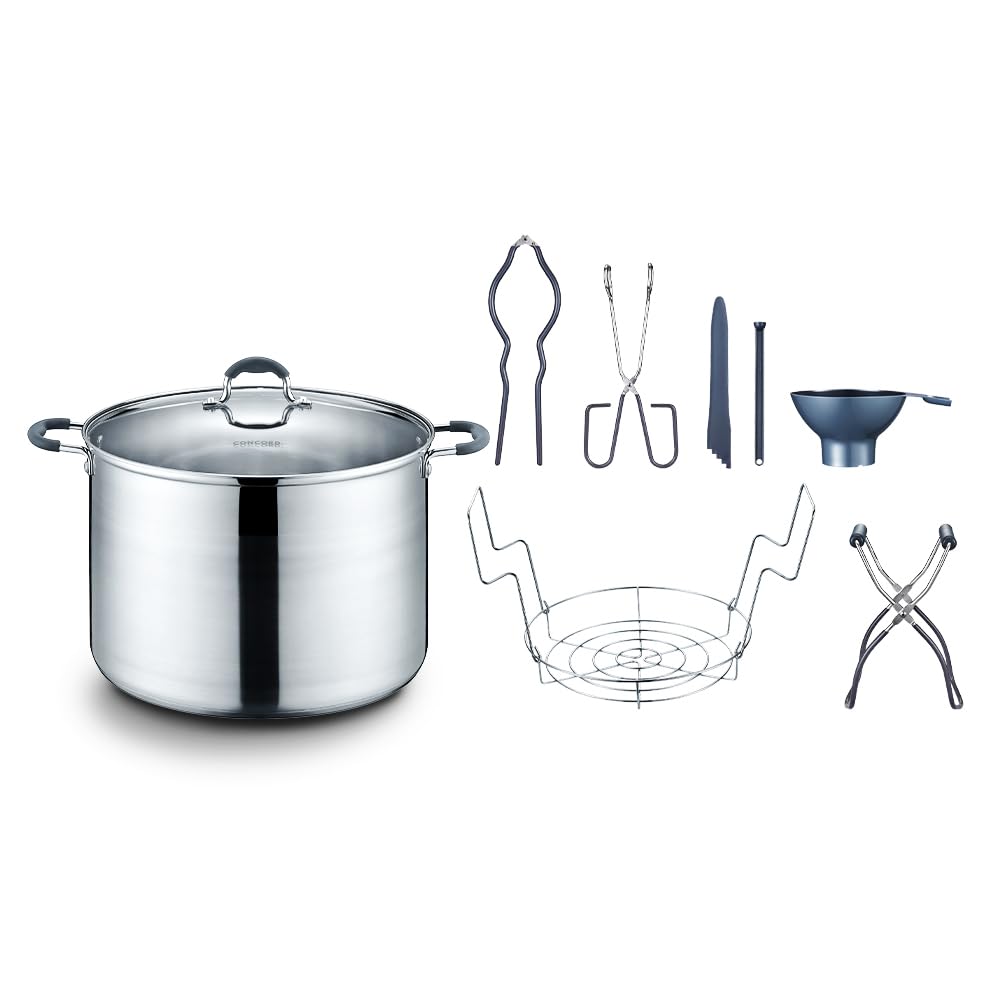


Best for First-Time Canners
Concord 20 Quart Canning Set
Key Features
- Cooktop: Induction compatible
- Jar Capacity: 7 quart or 8 pint
- Pot Capacity: 20 quarts
- Set Contents: Pot, rack, six tools
- Price: Premium
Stainless steel is the reason to start here. The Concord pot is 20 quarts of it with a triply bottom that spreads heat across the base, and it takes induction as readily as gas or electric — which is more than most of the enamel pots in this group can say.
That combination is why it is our pick. The canner is the one piece of a kit you cannot work around: it has to hold a rolling boil for 20 minutes, sit flat on your burner, and be deep enough to cover jars by an inch. Twenty quarts gets you seven quart jars or eight pints at a time, and the rack is 3mm stainless wire — noticeably heavier than the thin grids that let a full jar lean into its neighbor when you lift the handle.
The six tools are the standard set, and none of them feel like filler: jar lifter, tongs, jar wrench, funnel, magnetic lid lifter, and a mixer that doubles as a bubble remover. Off-season the pot earns its keep as a stockpot, and the rack flips over to work as a steamer insert.
Two things to do before your first batch. Check that the lid seats flat and that the base is smooth — a warped rim or a crack in the bottom is the failure to catch while you can still send the pot back. And know what you are buying: this is the least expensive route here to a stainless canner and a full tool set in one box.
Pros
- Triply stainless base works on induction
- 3mm rack holds 7 quarts or 8 pints
- Six usable tools included, no filler
- Pot doubles as a stockpot or steamer
Cons
- Heavier than the enamel sets at 11.2 pounds
We recommend the Concord set to anyone starting from scratch: a stainless 20-quart pot, a properly thick rack, and six tools that work on any cooktop, induction included.
Best for Tools-Only Buyers
Norpro Canning Essentials Set
Key Features
- Care: Hand wash recommended
- Tools: Tongs, jar lifter, lid magnet, funnel, wrench, bubble popper
- Pieces: 6
- Handle Coating: Vinyl coated
- Price: Budget
If there is already a canner in the garage, you do not need another pot — you need the six things that keep your hands out of boiling water. That is the contents of this box: long tongs, a vinyl-coated jar lifter, a magnetic lid lifter, an extra-wide funnel, a jar wrench, and a bubble popper with a measuring rule on the other end. Six pieces, no filler, and a box small enough to keep on the same shelf as the jars.
The coated handles are the part we appreciate most. Steam turns a bare metal handle useless in about ten seconds, and the vinyl on the lifter and tongs stays grippable through an afternoon of jars. The magnet lifts a flat lid out of simmering water without a second tool, and the funnel is wide enough to sit over a wide-mouth jar without an insert.
We hand this set to first-timers, because nothing in it is precious and everything in it gets used. The trade-off is upkeep: it is hand wash only, and the pieces are basic — a spring-loaded lifter with a one-hand release is an upgrade you buy later, not something this box includes. For a first season of jam and pickles, none of that will slow you down.
Pros
- Six tools that cover the whole process
- Coated handles stay grippable over steam
- Cheapest full tool set in this group
Cons
- Hand wash only despite the sturdy feel
Buy this one if the canner is already in your cupboard — six tools, no filler, and the set we hand to first-timers.
Best for Large Batches
Supa Ant 24 Quart Canner
Key Features
- Cooktop: Not for induction or glass top
- Item Weight: 10 lb
- Pot Capacity: 24 quarts
- Pot Material: Porcelain enamel on steel
- Price: Premium
Twenty-four quarts is the biggest pot on this page, and it is the reason to buy the set: fewer batches, fewer reloads, and a full rack in and out of the water in one lift. It is also the kit with the most in the box — the standard tools, a large ladle, and a set of measuring cups come with the pot and rack.
The ladle is the extra that earns its space. Pouring hot jam out of a saucepan and into a funnel with a measuring cup is how rims get sticky and seals fail; a big ladle puts the food where you aimed it. Measuring cups sound like padding until you are portioning salsa into pints and want the same amount in every jar.
The pot itself is porcelain enamel over a steel core, around 10 pounds empty, with a surface that shrugs off a dishwasher cycle without the chalky bloom bare aluminum picks up. Enamel rewards a little discipline: dry it completely before it goes away, and do not nest anything inside it between seasons.
Pros
- Largest capacity here at 24 quarts
- Ladle and measuring cups included
- Dishwasher-friendly enamel surface
Cons
- Not for induction or glass cooktops
- Enamel can chip at the rim
Choose the 24-quart Supa Ant if you want the fewest batches per afternoon; it is the biggest pot here and the tools come in the box.
Best for Timed Batches
Presto 7 Function Canning Kit
Key Features
- Timer: Digital, batteries included
- Pieces: 7
- Funnel Fit: Regular and wide mouth
- Item Weight: 8 oz
- Price: Budget
Every kit in this group has a funnel and a jar lifter. This one also has a digital timer, and after a season of canning we think that is the more useful addition: processing time is the one number you cannot eyeball, and a timer on the counter beats checking a phone with wet hands.
The timer is what makes this set more than another funnel-and-lifter box. It is a small countdown you can leave running through a whole afternoon of batches, and the batteries come in the box — no hunting through a drawer at the start of a session. Around it sits the standard arrangement: a funnel that fits regular and wide-mouth jars, a bubble remover, a magnetic lid lifter, tongs, a jar lifter, and a jar wrench.
At eight ounces the whole kit disappears into a drawer, which is either the point or a nuisance depending on how you work. The tongs and lifter are ordinary stamped steel, the sort that does the job for years if you dry them, and the funnel is the piece we reach for most.
Pros
- Digital timer takes the guesswork out of processing
- Seven tools including tongs and jar wrench
Cons
- Timer display can arrive dead
The Presto kit earns its place on the timer: seven tools including a digital countdown, for anyone who loses track of processing time.
Best for Stainless Tools
Supa Ant Stainless Tool Set
Key Features
- Pieces: 5
- Material: Food-grade stainless steel
- Item Weight: 9.6 oz
- Dishwasher Safe: Yes
- Price: Budget
Most kits here are plastic and vinyl with steel where it counts. This Supa Ant set is stainless throughout — the food-grade, corrosion-resistant kind — and that changes how it comes out of a boiling-water bath and a dishwasher cycle.
Five tools: an extra-wide funnel, a jar lifter, a jar wrench, a bubble popper that doubles as a measurer, and a magnetic lid lifter. They ship in a storage box, which matters more than it sounds — loose canning supplies migrate to the back of a drawer and stay there until the tomatoes are ready.
Under ten ounces for the lot, and dishwasher safe, so there is no hand-washing ritual after a long batch. The handles are coated in a bright green that makes them easy to find in a drawer full of steel utensils, which is a small thing until you are elbow-deep in a pot.
We keep this one in the rotation for anyone whose canner is stainless and who does not want to baby the accessories. Set against the plastic-and-vinyl boxes, it is the one that will still look new after a season.
Pros
- Food-grade stainless bodies resist corrosion
- Dishwasher safe, no hand washing
- Storage box keeps the set together
Cons
- Coated jar lifter can peel over time
We point stainless-steel shoppers to this set: five tools that go in the dishwasher and hold up like the pot they sit beside.
Best for Light Pot Lifting
Granite Ware 8 Piece Set
Key Features
- Cooktop: Not for glass or induction
- Item Weight: 4 lb
- Pot Capacity: 21.5 quarts
- Pot Material: Enameled steel
- Price: Premium
Four pounds is what the Granite Ware pot weighs empty, against eleven for our stainless pick, and that gap is the whole argument on the third batch of a long afternoon. Enamelware is thin, light, and quick to heat, and it is why this style has stayed the classic beginner canner.
It holds 21.5 quarts and comes with a rack and a five-piece toolset: a bubble remover with a ruler, a magnetic lid lifter, a jar funnel, a jar lifter, and a jar wrench. The speckled black finish is the look most people picture when they picture a canner, and the pot doubles as a boiling pot for corn and crab the rest of the summer.
Buy it for the lifting — this is the canner you can move off a hot burner with one hand — and for a kitchen where the pot lives on the stove all season. What it asks in return is care: dry the pot and the rack completely before they get stored, and do not nest anything inside it, because a damp rack is where rust starts.
Pros
- Four pounds empty, the lightest pot here
- Big 21.5-quart capacity with rack included
- Five tools plus pot and rack in one box
Cons
- Not for glass or induction cooktops
- Enamel chips at the rim
For a gas or coil stove and a canner you can move with one hand, the Granite Ware set is the lightest way into water bath canning.
Best for Small Kitchens
Vigamimn 20 Quart Canner

Key Features
- Base: Three-layer stainless
- Rack: Collapsible
- Item Weight: 11.5 lb
- Pot Capacity: 20 quarts
- Price: Premium
If cupboard space decides where your canner lives, this is the set to look at: the rack collapses flat, so a 20-quart pot stows on a shelf instead of camping on the basement floor between seasons.
The pot is stainless with a three-layer base, 12 inches across and 11 inches tall, and the kit fills it out with the rack and the usual tools. It weighs in at 11.5 pounds — the same weight class as our top pick — and the layered base is what keeps heat spread across the bottom instead of concentrated in a ring.
Set it beside the Concord and the difference is the rack and the base: same capacity, same stainless, a folding rack instead of a heavier-gauge grid. If your canner lives in a cupboard rather than on the stove, that trade makes sense.
Pros
- Collapsible rack stores flat between seasons
- Three-layer stainless base spreads heat
Cons
- Can arrive dented or rust at the base seam
The Vigamimn set is the stainless alternative for a small kitchen, with a rack that folds flat and a pot that matches a full-size canner’s batch.
Best for One-Hand Lifting
PrepWorks Canning Essentials

Key Features
- Funnel: Headspace markings
- Pieces: 3
- Jar Lifter: Spring-loaded, one-handed
- Item Weight: 15.8 oz
- Price: Midrange
Three pieces is not a starter kit, and PrepWorks does not pretend otherwise: a spring-loaded jar lifter, a magnetic lid lifter, and a canning funnel. What you are buying is the lifter.
The spring-loaded jaw is the detail that earns its space in the drawer. You squeeze to open, it stays open, and it releases with the same hand — which is what you want when the other hand is steadying a hot jar or holding a lid. Straight pincer tongs need two hands or a lucky grip.
The funnel is the second reason. It seats over both regular and wide-mouth jars and carries headspace marks, so you are not eyeballing half an inch of air space at the top of every jar.
Buy this as an upgrade, not as a first kit. If you have been hauling jars out with tongs and a towel, the spring-loaded lifter alone justifies the set, and the two accessories that come with it are the two you would have bought next anyway.
Pros
- Spring-loaded lifter opens and releases one-handed
- Funnel fits both jar sizes with headspace marks
Cons
- Only three tools; no tongs or wrench
- Lid magnet is weak
Buy the PrepWorks trio for the one-handed jar lifter, not for completeness — it is the upgrade for someone who already has the basics.
How We Tested Canning Kits Through a Full Season
We pulled every water bath canning kit we could find, from full sets with a pot, rack, and lid to smaller boxes of tools only, then filtered by what each one actually included rather than what the listing promised. Anything with plastic where the heat lives, or a pot too thin to hold a steady simmer, got cut early. That left 12 kits, ranging from bare-bones tool sets to full stainless starters.
Testing ran seven months, starting with spring strawberry jam and running through tomato season into holiday cranberry sauce. Each kit got the same jobs on rotation: a light load of pints, a full load of quart jars, and at least one session where we deliberately worked fast and sloppy — the way people actually can at 10 p.m. on a Sunday. We also counted completeness honestly, tracking how many pieces we reached for during a real batch versus how many stayed in the box.
Heat got judged by scorch marks and by how long a rolling boil took to come back after the jars went in. Jar lifters had to hold a full, wet quart without the jar rotating, a test we ran over the sink for obvious reasons. Funnels were tried on both wide- and narrow-mouth jars, and lid lifters had to pull a hot lid off a boiling pot without dropping it back in the water. A couple of sets included a timer, which sounds like a gimmick until you’re tracking a processing time with two other pots going.
Durability got checked the boring way: everything went through the dishwasher between batches, and by the end of the season we looked for rust at welded seams, pitting on rack bars, and tools that had gone loose at the hinge. The kits that survived without any of that are the ones worth your counter space.
How to Choose a Canning Kit
The pot and the jar lifter do most of the work, so settle those two first and the rest of the box sorts itself out.
Decide whether you need a canner at all
Half of the kits here are tools only, which is the right buy if a proper canner already lives in your basement and the wrong buy if it doesn’t. A water bath canner is not just a big stockpot: it is deep enough to cover jars by an inch, wide enough to take a rack, and sold with a rack that keeps glass off the bottom where the heat is concentrated.
If you are starting from nothing, buy the set that includes the pot. Buying the tools and the canner separately almost always costs more than the complete kit does, and you will spend an evening matching a rack to a pot diameter that nobody measured.
Check your cooktop before you fall for a big pot
Enamelware and many porcelain-finish canners are explicitly not rated for induction or glass-top ranges, which rules out some of the largest pots in this roundup. Stainless steel with a layered base works on everything, including induction.
Look for an explicit induction-compatible claim rather than assuming a flat bottom is enough, and if your range is glass-top, favor a pot with a base no wider than your largest burner. A 14-inch canner hanging over the edge of a small element heats unevenly and can scorch the enamel.
Read jar capacity, not quart capacity
Quart ratings describe the volume of the pot; jar capacity tells you what a batch actually produces. A 20-quart canner typically takes seven quart jars or eight pints in one run, and the rack matters as much as the number.
Thin wire grids let a full jar lean into its neighbor when you lift the handle, and slots cut too generously let pints tip sideways and take on water. Look for a rack described by wire thickness and by a specific jar count, not just a diameter.
Spend the money on the tools that prevent burns
Three tools do the safety work: the jar lifter, the magnetic lid lifter, and the tongs. A spring-loaded lifter that opens and closes with one hand is worth more than a vinyl-coated pincer, because your other hand is usually holding something hot, wet, or both. A weak magnet drops lids back into simmering water, and a strong one lifts a flat lid cleanly.
Coated handles are an advantage only while the coating is intact. Check the grips for splits at the start of each season, and retire anything where the metal is showing through where you grip.
Budget for what the box leaves out
No kit here includes jars, and none includes more than a handful of lids. Piece counts are also a poor guide to value: an 18-piece set may be counting labels and a storage box, while a six-piece set is six working tools. Compare the tools you will actually hold against the price, then add jars, lids, and a canner if you bought tools only. That total is the number that matters.
Frequently Asked Questions
Do canning kits include jars?
No. Every kit here is tools, and sometimes a pot; jars and lids are sold separately. Buy jars in the sizes your rack is built for — a rack with seven wide slots takes quart jars, a tighter grid is for pints and half-pints — and buy fresh lids each season, since the sealing compound does not store well.
Do I need a water bath canner or a pressure canner?
Water bath canning is for high-acid food: jams, jellies, pickles, fruit, and most tomato products. Vegetables, meats, soups, and stock need a pressure canner, which reaches a much higher temperature. Every kit on this page is a water bath set, so if green beans and broth are the plan, buy the pressure canner first and add these tools to it.
Can canning tools go in the dishwasher?
It depends on the materials. Bare stainless sets go in and come out fine. Vinyl- and rubber-coated lifters and printed funnels are better hand washed, because heat and detergent are what start coatings peeling and printed markings fading. If the care instructions say hand wash, follow them — a split grip is the point where a jar lifter stops being safe.
Final Verdict
We recommend the Concord 20-quart set for most people starting out: stainless steel, rated for induction, with a rack heavy enough to hold a full load and six tools you will not need to replace. If a canner is already in the house, buy the Norpro six-piece instead and put the difference toward jars.
And run one check before anything else: if your range is glass-top or induction, cross off every enamel pot here, including the two we like for gas. That single question eliminates more kits than any other.