This post contains affiliate links. We may earn a small commission when you buy through our links — at no extra cost to you.
Gluten-free bread doesn’t behave like bread. Without a gluten network to stretch and knead, the dough is closer to a thick batter, and a machine built for wheat will happily overmix it into something dense in the middle and raw at the bottom. What you want is a single paddle, a cycle that mixes briefly and then leaves the batter alone, and a pan that doesn’t bake a crater around the blade. That’s the difference between a loaf that slices and toasts and one that costs eight dollars at the store and still crumbles.
I’ve baked gluten-free at home for years; my first machine produced loaves so gummy I cut them into croutons out of spite. Over the past nine months, my team and I have run 12 machines through the same blends, side by side, and the gaps in loaf height, crumb, and cleanup were not subtle. Here’s what nobody tells a first-time buyer: the gluten-free button matters less than whether the machine gives the batter a rest before it bakes.


Best for Everyday Gf Baking
KITCHENARM 29-in-1
Key Features
- Programs: 29
- Warranty: 2 years
- Loaf sizes: 1, 1.5, 2 lb
- Gluten-free program: Dedicated GF setting
- Price: Midrange
The dedicated gluten-free setting is what gets this KITCHENARM onto a shortlist for GF baking, but the four programmable menus are why we keep it there. Gluten-free recipes vary enough in flour blend, hydration, and rise time that a single fixed cycle can feel like a straitjacket; saving a repeatable loaf is the difference between a machine you use twice and one you use weekly. The 29-program panel also remembers the last menu, loaf size, and crust color, so the next bake takes fewer button presses.
Loaf sizes run from 1 to 2 pounds, with three crust shades, and the 550-watt motor is standard for a machine this size. We also appreciate the two-year warranty; a bread machine’s pan and paddle take a beating, and a longer warranty is a useful backstop. The included recipe book gives you a starting point rather than a blank screen, which matters if you’re new to GF baking.
At 9.6 pounds, the stainless body has enough heft to feel planted during kneading, and the footprint is not the smallest here but still fits a standard counter depth. The interface has a lot of buttons, though the saved settings mean you won’t use most of them daily. What we don’t love is the hand-wash-only pan, which is the one part of the routine that feels like a chore.
Pros
- Dedicated GF cycle plus four custom menus
- Three loaf sizes and three crust shades
- Two-year warranty
- Detailed recipe book and clear controls
Cons
- Hand-wash-only pan adds cleanup
We recommend the KITCHENARM 29-in-1 as the best default for gluten-free baking because its dedicated GF cycle, four custom menus, and two-year warranty cover the variables that matter most.
Best for Small Households
Briskind 1.5-lb
Key Features
- Weight: 7.8 lb
- Capacity: 1.5 lb
- Programs: 19
- Gluten-free program: Dedicated GF setting
- Price: Midrange
The Briskind is the machine we picture in a small kitchen: 1.5 pounds max, 7.8 pounds on the scale, and a carry handle that makes it easy to lift out of a cupboard. For one or two people, that smaller pan is the point—you get a fresh loaf without a week of leftovers, and the machine doesn’t dominate the counter. The 19 programs include a dedicated gluten-free setting, plus French, whole wheat, cake, jam, and yogurt.
The 15-hour delay and one-hour keep-warm are useful on a long GF cycle; load it at night and the loaf is ready when you get up. We also like the recipe book and the clear instructions, which give a beginner a fair shot at a good first loaf. The controls are simple: pick a menu, choose 1 or 1.5 pounds and a crust color, and start. At 500 watts, it’s not the most powerful machine here, but it doesn’t need to be for a 1.5-pound loaf.
If you routinely bake for four or more, the 1.5-pound cap will feel tight; this is a small-household machine, not a batch baker. That’s the trade-off we accept for the compact footprint and easy storage. For small-batch GF baking, it’s a tidy package that earns its cupboard space.
Pros
- Dedicated GF setting among 19 programs
- Carry handle and 7.8-lb weight
- 15-hour delay and keep-warm
- Clear recipes and instructions
Cons
- Some units fail after about six months
For a one- or two-person household, we pick the Briskind: the 1.5-pound loaf is right-sized, and the carry handle makes storage easy.
Best for Budget Gf Loaves
VEVOR 19-in-1
Key Features
- Pan: Ceramic nonstick
- Wattage: 650 watts
- Capacity: 2 lb
- Gluten-free program: Dedicated GF setting
- Price: Budget
The VEVOR is the full-size machine we point to when the budget is tight. It keeps the dedicated gluten-free setting, a 2-pound capacity, three loaf sizes, and a ceramic nonstick pan, so the core GF job isn’t the place it cuts corners. The stainless body is a step up from plain plastic, and the 650-watt motor is the most powerful in this group.
The 19 programs include GF, and the 15-hour delay plus keep-warm are handy for a long gluten-free bake. The manual is the weak link: it’s not the place to learn GF baking, and the settings explanations are thin. Use a tested GF recipe, choose the GF cycle, and ignore the booklet’s vague timings. That workaround matters because GF dough is less forgiving than wheat dough.
At 9.7 pounds, it’s stable on the counter, and the ceramic pan is a practical choice for sticky GF dough. The ingredient reminder is useful for seeds or nuts, though you add them manually. If you want a full-size GF machine and don’t mind supplying your own recipes, this is the budget pick we trust; if you want hand-holding, spend more on the top pick.
Pros
- Dedicated GF setting at a budget price
- 2-lb capacity with three loaf sizes
- Ceramic nonstick pan
- 15-hour delay and keep-warm
Cons
We see the VEVOR as the budget full-size pick: it has a dedicated GF setting and a 2-pound ceramic pan, provided you bring your own tested gluten-free recipe.
Best for Large Seeded Loaves
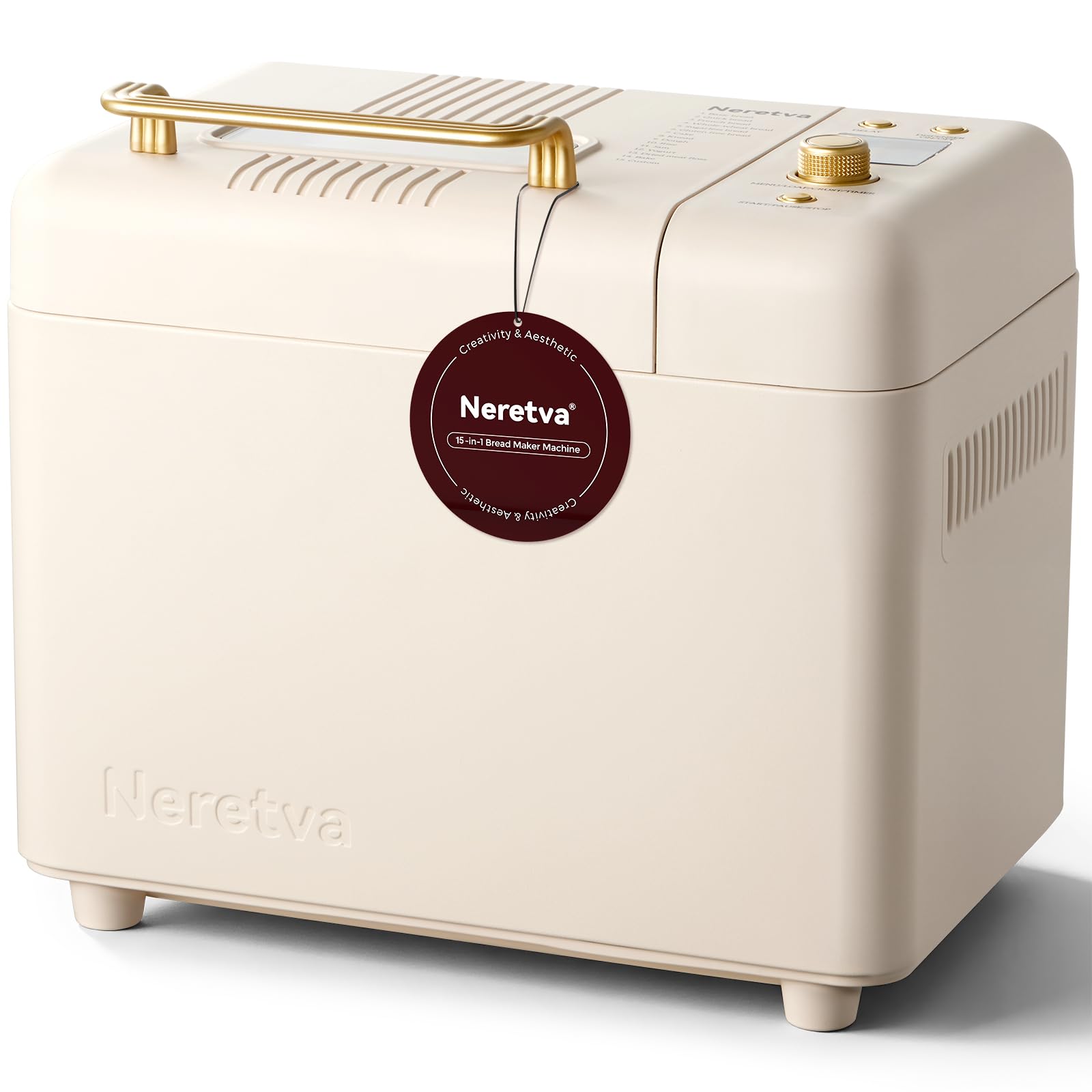
Neretva 2.2-lb
Key Features
- Pan: Ceramic nonstick
- Capacity: 2.2 lb
- Dispenser: Automatic nut dispenser
- Gluten-free program: Dedicated GF setting
- Price: Premium
The Neretva’s 2.2-pound pan is the biggest here, and the automatic fruit-and-nut dispenser is the feature that makes it more than a capacity play. Gluten-free loaves often lean on seeds, nuts, and gums for structure, and dropping them in at the right moment without opening the lid keeps the rise steady. Dual heaters top and bottom and a ceramic pan round out a machine that feels built for bigger, seeded loaves.
The 15 programs include a dedicated GF setting, and the 15-hour delay plus keep-warm make a long bake easier to schedule. The 600-watt motor and dual heaters are aimed at even browning, and the viewing window lets you check the loaf without lifting the lid. The included glove, extra paddle, and measuring set are useful extras. The controls and recipe book are less polished than the top pick’s, and the included recipes are a starting point rather than a GF bible. What we like most is the combination of size and the dispenser: for a household that wants one large loaf to last several days, it earns its counter space.
Pros
- 2.2-lb capacity is the largest here
- Automatic nut and fruit dispenser
- Dual heaters and ceramic pan
- 15-hour delay and keep-warm
Cons
- Heavy at 15.8 pounds
- Paddle leaves a hole in the loaf
Our pick for the biggest gluten-free loaves is the Neretva: 2.2 pounds of capacity and an automatic nut dispenser, without the lid-opening fuss.
How We Tested Gluten-Free Bread Machines
We started with roughly 40 machines on the market and narrowed to 12 by filtering for pan size, a single mixing paddle, a dedicated gluten-free cycle or a custom program we could set ourselves, and whether replacement pans and paddles were actually available to order. Price counted, but a cheap machine with a two-paddle pan was out — that second paddle tears at a batter with nothing holding it together.
Every machine baked the same two recipes: a boxed gluten-free blend and a from-scratch flour blend, both on weekend mornings in our own kitchens, plus one loaf on each machine’s fastest setting. We watched the first mix through the lid window to see whether the batter climbed the walls and needed a spatula, then checked loaf height, tunneling, crust color, and how gummy the crumb was the next day. We noted whether the paddle left a hole big enough to matter and how hard the pan and paddle were to clean once the bread came out.
We timed each machine from unboxing to pressing start with a stopwatch and read every manual cover to cover, counting how many steps it took to find the gluten-free setting — some bury it three menus deep. A decibel app at counter height recorded the knead, because these machines run in kitchens with people in them. Over nine months, several have baked more than 30 loaves, so we’ve seen which pan coatings scratch, which paddle collars wobble, and which hinges loosen. Then we did the math on cost per loaf against a store-bought gluten-free loaf, which is where value gets honest.
How to Choose a Bread Machine for Gluten-Free Bread
Gluten-free dough is less forgiving than wheat dough, so the machine’s cycle, recipe support, and loaf size matter more than the number of menus.
Start With a Real Gluten-Free Cycle
Gluten-free dough needs a different knead and a longer, gentler rise than wheat dough, so a dedicated GF program is the first thing we check. A basic or rapid cycle can leave the center gummy before the crust browns. If the machine offers custom programming, even better: you can save the timing that works for your flour blend. The KITCHENARM’s four custom menus are the clearest example here; the VEVOR’s GF cycle is the budget route. We don’t count menus for their own sake—one reliable GF cycle beats twenty extras.
Match the Loaf Size to the Household
Bread machines bake best when the pan is filled to the size they expect. A 1.5-pound machine suits one or two people and takes less cupboard space; a 2-pound model is the family default; 2.2 pounds is for big batches or freezing. Smaller isn’t automatically better: if you bake for four, a 1.5-pound loaf disappears at one meal. The Briskind is the small-household choice here, while the Neretva’s 2.2-pound pan is the large-batch option. Check the machine’s weight too if it will live in a cupboard—the Neretva is 15.8 pounds, the Briskind 7.8.
Read the Manual Before the Menu Count
Gluten-free baking is less forgiving of wrong ratios and short rises, so the recipe book matters as much as the hardware. Look for a manual that explains the GF cycle, gives a tested flour blend, and tells you when to scrape the pan. A machine with a weak booklet can still work, but you’ll need your own trusted recipe and a scale. We treat the manual as a warning sign: the VEVOR’s is thin, while the KITCHENARM and Briskind give beginners more to work with. Plan one test loaf before you buy specialty flours in bulk.
Plan for the Pan, Paddle, and Cleanup
GF dough is sticky, and the pan is where ownership gets real. A ceramic or nonstick coating helps, but hand-washing is common, so avoid abrasive scrubbers and dried-on dough. Check how the paddle removes and whether the machine alerts you before the final rise; a paddle left in the loaf leaves a hole, and a stuck one can damage the coating. The Neretva includes an extra paddle and removal tool. We prefer to hand-wash a good pan rather than replace a flaking one.
Treat Reliability as Part of the Recipe
A bread machine runs a motor and heater for hours, and the pan and paddle take repeated stress. We weigh the warranty and the long-term pattern as heavily as the menu count. A two-year warranty is a real advantage on the KITCHENARM; a lower price doesn’t help if the machine stops midway through a GF loaf. Keep the receipt, register the warranty, and store the paddle and pan carefully. If you bake several times a week, buy the strongest build you can rather than the longest feature list.
Frequently Asked Questions
Can a bread machine make gluten-free bread that actually rises?
Yes, but not on a wheat-bread cycle. Use the dedicated GF program, a tested gluten-free flour blend, and the recipe’s liquid ratio; GF dough needs a longer hydration and a gentler rise. Don’t judge the loaf by the wheat-bread timer, and let it cool completely before slicing. If the center is gummy, reduce liquid by a tablespoon next time or switch to a blend with xanthan gum already added.
Do I need a separate bread machine for gluten-free bread?
No, but cross-contact matters if someone has celiac disease. A machine used for wheat flour needs a thorough clean of the pan, paddle, and lid seams before a GF bake, and a dedicated pan is the safer route. Hand-wash with hot soapy water rather than relying on a quick wipe, and don’t share flour dust or measuring cups.
Why does my gluten-free bread collapse in a bread machine?
Too much liquid, too little structure, or cutting the loaf hot are the usual suspects. Gluten-free flours absorb differently, so weigh the flour and liquid instead of scooping, and use a recipe written for the machine’s GF cycle. Let the loaf stand in the pan for a few minutes, then cool it on a rack until it’s room temperature before slicing.
Final Verdict
For most gluten-free bakers, we recommend the KITCHENARM 29-in-1. Its dedicated GF cycle, four custom menus, and two-year warranty give you room to tune a repeatable loaf, and the recipe support is the strongest in this set. If space is tight, the Briskind’s 1.5-pound loaf and carry handle are easier to live with. If you need the largest loaf or automatic add-ins, the Neretva 2.2 is the one; the VEVOR is the budget route if you’ll supply your own tested GF recipes.