This post contains affiliate links. We may earn a small commission when you buy through our links — at no extra cost to you.
Iced coffee at home usually starts with a compromise: hot coffee, a glass of ice, and a drink that turns weak and watery before you reach the bottom. A good iced coffee maker fixes that by brewing cold from the start or chilling coffee fast enough to keep its flavor intact, so you get a smooth, strong glass without the grit or the dilution. I’ve brewed with 12 models over eight months, from compact cold-brew pitchers to countertop machines, and the difference between good and frustrating comes down to small things.
Ease of use matters more than extra features—you want a maker you can assemble before caffeine, not one that needs a manual. I also noted how each model handled cold brew: whether the coffee tasted smooth or woody, how much coffee grit slipped past the filter, and whether the lid sealed and poured without dribbling. Cleaning, capacity, and counter footprint separated daily drivers from cabinet clutter, and durability mattered because a cracked pitcher or warped lid ends the habit fast. The picks below earned their counter space and their price.
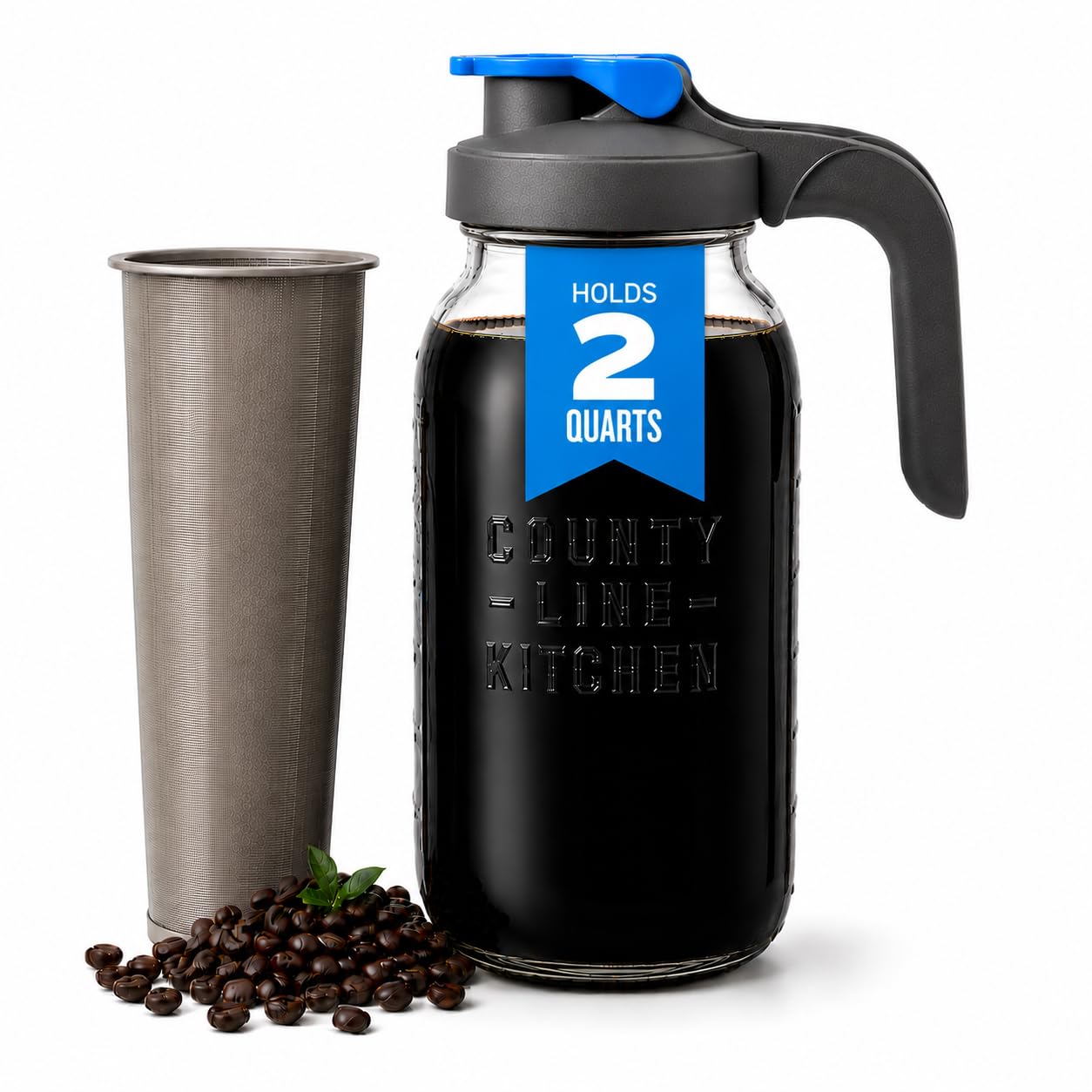


Best for Everyday Cold Brew
County Line Kitchen 64 oz Cold Brew Maker
Key Features
- Lid: Leak-proof flip cap
- Filter: Stainless steel mesh
- Capacity: 64 oz
- Material: Soda-lime glass
- Price: Midrange
A wide-mouth mason jar, a stainless basket and a flip-cap lid — that’s the whole County Line, and it’s the one that comes off the shelf most often in our kitchens. The 64-ounce jar fills straight from the tap, a bottle brush reaches every corner, and the handle is molded into the glass rather than bolted on, so there’s nothing to work loose after a few months of daily use.
What puts it at the top of this group is how little there is to get wrong between steeping and pouring. Grounds go in the basket, water goes around it, and the flip cap pours a clean stream without the lid coming away in your hand — a small thing that separates a pitcher you use every day from one you stop bothering with. The mesh is fine enough that what comes out is clear coffee rather than grit, though the last glass from the jar picks up a little sediment, which is what a mesh filter does and not what a paper filter would.
Glass is the other half of the argument, and it’s where this one differs from the Tritan pitchers here. It doesn’t hold on to yesterday’s coffee or the tea you brewed in it last week, it doesn’t stain, and it looks like a jar of coffee rather than an appliance. It also wants a shelf rather than a crowded door bin, where a plastic pitcher will happily live.
The only part that takes planning is the clock: grounds in, water in, twelve to twenty-four hours in the fridge. When the steep is done the basket lifts out with the spent grounds in one piece, which made it the least messy emptying of the jars we brewed in, and the jar goes straight back into service.
Pros
- Wide mouth is easy to fill and scrub
- Flip cap pours without removing the lid
- Glass doesn’t stain or hold odors
- Handle is molded into the jar
Cons
- Glass can crack if it takes a hard knock
Our pick for almost everyone: a 64-ounce glass jar that pours without drips, cleans in a minute, and makes cold brew without adding another appliance to the counter.
Best for Crowded Fridges
Takeya Deluxe Cold Brew Maker, 2 Quart
Key Features
- Lid: Airtight, leakproof
- Capacity: 2 quarts
- Material: Tritan
- Warranty: Limited lifetime
- Price: Midrange
The Takeya does the same job as our top pick in a body that won’t shatter. It’s Tritan, so the 2-quart pitcher is light when you lift it out of the fridge, shrugs off a knock against the door frame, and goes through the dishwasher whole. If your cold brew shares a shelf with lunchboxes and juice bottles, that’s the difference that matters.
The fine-mesh filter sits inside the pitcher and lifts out with the grounds, and the lid is genuinely airtight — that’s what keeps a batch tasting fresh on the third day rather than like the inside of a fridge. It’s sealed well enough that a tip-over on the shelf is an inconvenience rather than a cleanup, which is not something we can say for every pitcher here.
Where it gives ground to the County Line is the pour: the brewing basket has to come out before a full pitcher will pour, an extra step first thing in the morning. What we like better is the coverage — a limited lifetime warranty is the only one of its kind in this group, and it’s real comfort on the part that gets pulled in and out of the fridge twice a day.
Pros
- Shatter-proof Tritan body
- Airtight lid keeps a batch fresh
- Goes in the dishwasher
- Limited lifetime warranty
Cons
- Basket must come out before pouring
Buy it if your fridge is crowded or your cold brew travels: shatter-proof, dishwasher-safe, sealed tight, and backed by a limited lifetime warranty.
Best for Fast Iced Coffee
Ninja Hot & Iced XL Coffee Maker CM371
Key Features
- Capacity: 12 cups
- Brew sizes: Eight sizes, cup to carafe
- Brew styles: Classic, Rich, Over Ice, Cold Brew
- Cold brew time: As little as 10 minutes
- Price: Premium
Ten minutes is the number that earns the Ninja its counter space. Every jar here asks you to plan a day ahead; this machine runs a rapid cold brew cycle that has cold coffee in your glass before the ice has stopped cracking, and it uses ordinary grounds rather than pods.
Around that it’s a proper 12-cup brewer: four styles, eight sizes from a small cup to an XL travel mug, and quarter, half or full carafes. The over-ice setting is the sleeper. It starts the brew hotter and finishes it cooler so the ice isn’t doing all the chilling, which gets you closer to a café iced coffee than to the steeped concentrate the jars produce — a different drink, and worth having both.
What you give up is the simplicity of a jar. There’s a reservoir to fill, a filter basket to rinse, more surface to keep clean, and a footprint of roughly nine by twelve inches standing fifteen tall. The auto-metering reservoir is the quiet win: it senses how much water it has, so you’re not measuring a carafe half asleep.
Pros
- Cold brew in as little as ten minutes
- Over-ice mode resists dilution
- Eight brew sizes plus carafes
- Brews hot coffee too
Cons
- Needs a plug and real counter space
- Costs far more than any jar here
Our pick for anyone who drinks iced coffee on impulse: ten-minute cold brew, hot coffee from the same machine, and no overnight planning.
Best for Small Households
Primula Burke Deluxe Cold Brew Maker
Key Features
- Filter: Removable mesh
- Capacity: 1.6 quarts (6 cups)
- Cleaning: Dishwasher safe
- Material: Borosilicate glass
- Price: Budget
Six cups is the point of the Primula Burke, not an apology for it. The 1.6-quart carafe is small enough to live on a shelf without rearranging anything, and it suits the way a single person actually drinks iced coffee: a batch every few days rather than a gallon going flat at the back of the fridge.
The borosilicate glass is the reason to choose this over the plastic pitchers. It’s dishwasher safe, it doesn’t pick up flavor, the comfort-grip handle works with a full carafe, and the removable basket lifts out for washing so cleanup is a rinse rather than a scrub. For a compact brewer it also looks good enough to put on the table when people come over, which is more than most of this group manages.
Plan on a batch closer to four generous glasses than six cups once the basket and grounds are in, which is fine for one and thin for two. And glass is glass — the carafe is the part to treat carefully, and this is not the pitcher to hand a teenager or stack against a mixing bowl.
Pros
- Small footprint for tight kitchens
- Borosilicate glass is dishwasher safe
- Removable basket rinses clean
Cons
- Finished batch runs under the stated six cups
The right pick for one person who wants a fresh, small batch every few days, in glass that goes in the dishwasher.
Best for First-Time Brewers
Jrssae 64 oz Cold Brew Mason Pitcher
Key Features
- Filter: 160-micron stainless steel
- Capacity: 64 oz
- Cleaning: Dishwasher-safe parts
- Included: Mixing spoon
- Price: Budget
The Jrssae arrives with a mixing spoon and a three-step card. That reads like filler until you’re at the counter at eleven at night trying to remember how much coffee you used last time — and the spoon turns out to be the more useful half of the package, because a quick stir after the water goes in wets the whole bed of grounds and keeps the steep even.
The rest is a 64-ounce soda-lime jar with a deep conical stainless basket, a flip-top lid that stays where you put it while you pour, and parts that come apart for the dishwasher. The 160-micron weave is coarser than the 100-micron basket on one of the jars here, so expect a little more silt in the bottom of the glass — not grit, but you’ll see it if you drink the last ounce.
What we keep coming back to is how little fuss there is: fill, stir, wait, lift the basket, rinse. For a first cold brew maker that’s the whole game, and the conical filter is the part that earns it — it holds a full dose of grounds without the jar feeling crowded. Where it gives ground to the County Line is the pour; our top pick seals better and delivers a smoother stream, and this lid takes a firm push to seat before you trust it in the fridge.
Pros
- Conical 160-micron stainless filter
- Spoon and instructions included
- Dishwasher-safe parts
- Highest rating among the 64-ounce jars here
Cons
- Lid needs a firm push to snap shut
Our budget pick and the easiest place to start: a 64-ounce jar with a fine conical filter, dishwasher-safe parts, and a spoon in the box.
Best for Press-Style Brewing
Bodum 51 oz Cold Brew Coffee Maker

Key Features
- Lids: Brewing lid and plunger lid
- Filter: Reusable mesh
- Capacity: 51 oz
- Material: BPA-free plastic
- Price: Budget
The Bodum is a French press dressed for cold coffee: grounds steep loose in the carafe, then a plunger pushes a mesh screen down to trap them at the bottom. It’s the only plunger in this group and the least expensive way in, and the two-lid setup — a silicone lid for the steep, a plunger lid for after — is more thoughtful than the price suggests.
Fifty-one ounces is a good middle size: more than one sitting, less than a week of coffee sitting around. Because the mesh presses down through the grounds instead of a basket hanging in the middle, the full carafe is available for brewing, and the BPA-free plastic body is light enough to move with one hand.
Keep it cold-only. The carafe is plastic rather than tempered glass, so hot water isn’t what it’s built for, and that’s a fair trade for the weight and the price — this is the one here you can carry out to a picnic without worrying about a chip. The locking lid holds the whole thing together in transit, which is more than the mason jars manage.
Where it lands for us is the middle of this group. It brews a clean, full-bodied batch with less equipment than the basket-style jars, and the plunge is satisfying in a way that lifting out a soggy filter isn’t. It doesn’t seal like the airtight pitchers here and it won’t win any beauty contests next to the glass jars, but as a second brewer, or a first one on a tight budget, it holds its own.
Pros
- Plunger traps grounds at the bottom
- Two lids for brewing and storing
- Light plastic body travels well
- Lowest price in this group
Cons
- Lid is stiff and hard to remove
- Some grounds slip through the mesh
The pick for press fans and tight budgets: a plunger that traps the grounds, two lids, and a light plastic body that goes anywhere cold coffee goes.
Best for Long-Term Ownership
VA1KENE 64 oz Cold Brew Pitcher

Key Features
- Seal: Airtight silicone
- Filter: 100-micron stainless steel
- Capacity: 64 oz
- Warranty: 3 years
- Price: Budget
Three years of manufacturer warranty is the most interesting line on the VA1KENE, because glass is exactly the part of this category that lets people down. It won’t cover a drop, but it does cover the seal and the fittings, and it’s the longest coverage here by a wide margin.
The rest is a straightforward 64-ounce mason-style jar: a stainless basket, a flip spout, a silicone seal in the lid and a dishwasher-safe body. The 100-micron mesh is the finer of the two weaves used in this group, and it shows in the glass — less silt at the bottom than the 160-micron baskets, which matters if you drink your cold brew black and hate the last mouthful.
The handle sits on the lid rather than the jar, which is the one design decision we questioned. It’s fine for counter-to-fridge trips and the lid seals tightly enough to trust, but a full 64-ounce jar swinging from a plastic handle feels different from the glass-handled mason jars here.
Where it earns its place is long-term ownership: the quietest pour, the finest filtration of the big jars, and the only three-year warranty in the group. If you want to buy once and stop thinking about the thing, this is the one that behaves that way.
Pros
- Three-year manufacturer warranty
- 100-micron filter, the finest here
- Airtight silicone seal
- Dishwasher-safe jar
Cons
- Handle is mounted on the lid
A sound long-term buy: the finest mesh of the 64-ounce jars here, an airtight seal, and three years of coverage behind it.
Best for Counter Brewing
QHH 64 oz Cold Brew Mason Pitcher

Key Features
- Filter: 160-micron stainless steel
- Capacity: 64 oz
- Included: Cleaning brush
- Max temperature: 140°F (60°C)
- Price: Budget
QHH states a temperature limit on this pitcher — 140°F, no boiling water — and that honesty is the first thing we noticed. Soda-lime glass doesn’t like sudden heat, and a maker that says so up front is telling you exactly what the jar is for: cold water, room-temperature water, and coffee that has already cooled.
For everyday cold brew it does everything you need. The 64-ounce jar has a wide mouth for filling and cleaning, a 160-micron stainless basket, a silicone ring in the lid, and a spout molded into the handle lid so pouring doesn’t involve tipping the whole jar. The included brush is the detail we didn’t expect to use: it reaches into the spout and around the gasket, which is where a cold brew pitcher actually gets grubby.
Set the jar on the counter for the steep rather than in the fridge and the whole routine is easier, since you’re only opening it once to lift the basket out. What you get in return is a pitcher that pours neatly, cleans up with the brush it came with, and never pretends the glass is something it isn’t.
Pros
- States a clear 140°F maximum
- 160-micron stainless filter
- Cleaning brush included
- Spout lid pours without tilting
Cons
- Flip top is stiff and takes muscle
A sensible everyday jar with an honest temperature limit and a brush for the spout; buy it if you brew on the counter and want to know what the glass will take.
How We Tested Iced Coffee Makers
We started by gathering specs and customer reviews for more than 40 iced coffee makers, then narrowed the field by type, capacity, counter footprint, and price. The final shortlist was 12 models, which we used at home for eight months. We ruled out anything that needed a proprietary pod, hogged most of a counter, or cost far more than the coffee it produced.
During the week, we assembled each maker before the first meeting of the day and timed how long it took to go from opening the box to pouring a glass. We brewed the same medium-grind coffee in every model, then checked the cup for grit by pouring it through a fine-mesh strainer; we also noted whether the cold brew tasted smooth or woody after 12, 18, and 24 hours. We tried every feature that came with each model—measuring lines, reusable filters, timers, and brew-strength settings—and noted which ones actually helped.
After each batch, we disassembled the maker, hand-washed the filter and pitcher, and noted which parts trapped grounds or were awkward to rinse; dishwasher-safe pieces went through a cycle when the manufacturer allowed it. We filled each pitcher to capacity and counted how many 12-ounce glasses it yielded, checked whether the lid leaked when tipped, and stored each model on the counter to see how much room it claimed. Durability showed up over eight months of near-daily use—cracked lids, cloudy pitchers, and filters that stopped fitting were noted. At the end, we compared price against how often we reached for each maker and how well it brewed; the ones that cost more had to earn it with better taste, easier cleanup, or a smaller footprint.
How to Choose an Iced Coffee Maker
The first decision isn’t brand or size — it’s whether you want to plan a day ahead or drink iced coffee ten minutes from now.
A jar in the fridge or a machine on the counter
Manual cold brew is a 12-to-24-hour steep in the fridge: no power, no counter space, and a smooth, low-acid concentrate at the end. A machine like the Ninja shortcuts that to about ten minutes and brews hot coffee too, but it costs many times what a jar does, needs a plug and a patch of counter, and turns out a carafe at a time rather than a batch you can seal and keep.
If you plan ahead even slightly, buy the jar. If iced coffee is a daily impulse and the planning is the part that fails, the machine is the only thing here that solves it.
Glass, Tritan, or plastic
Glass is the default for good reasons: it doesn’t hold odors, it doesn’t stain, and you can see how much is left. It’s also heavier and less forgiving of a knock, and the soda-lime jars here are not built for boiling water — one of these pitchers carries a 140°F maximum, and that’s a fair rule for all of them.
Tritan, as in the Takeya, flips the trade: light, shatter-proof, dishwasher-safe, and a little more expensive. Cheap plastic press bodies are cold-only and best kept for a picnic. Choose by who handles the pitcher and where it lives, not by how it looks on the shelf.
Capacity and where it will live
Fifty-one to 64 ounces suits one or two people; a 1.6-quart carafe is a two-glasses-a-day brewer. Remember that the basket and grounds take up room, so the finished batch is always smaller than the number on the box.
Measure before you order. Tall, narrow pitchers — around four inches across and twelve high — slide into fridge-door bins, while short, wide mason jars need shelf height and a clear path to the front. A jar that doesn’t fit where you naturally reach for it stops getting used.
Filters, sediment, and the five-minute cleanup
Mesh fineness is measured in microns, and lower is finer: 100-micron baskets leave noticeably less silt than 160-micron ones. No mesh filter removes everything, so expect a little sediment in the last pour and grind coarser to reduce it.
The other half of the decision is cleaning. A wide mouth takes a bottle brush, removable baskets rinse in seconds, and dishwasher-safe parts decide whether this becomes a habit or a chore. Check that the gasket lifts out, because that’s where old coffee hides.
Frequently Asked Questions
What grind should I use for cold brew?
Coarse, roughly what you’d use for a French press. Too fine and the grounds clog the mesh, sludge up the jar and leave the batch bitter; too coarse and even a full day won’t extract much.
Ask for a French press grind at a coffee counter, or set a burr grinder to its coarsest notch. If you’re stuck with pre-ground, shorten the steep to about twelve hours and stir once.
How long does a batch keep in the fridge?
Days, not hours, provided you pull the basket out when the steep is done and seal the lid. The airtight pitchers here are built for exactly that.
The mistake is leaving the grounds in the jar: they keep extracting and the coffee turns woody by the second day. Lift the basket at eighteen to twenty-four hours and pour from the sealed jar all week.
Can I brew iced tea in these too?
Yes — most of the mason-style jars are sold for tea as well, and loose leaves or bags go in the same basket. Glass won’t hold on to bergamot the way a plastic carafe can.
Tea gives up its flavor faster than coffee, so start tasting at four hours rather than leaving it overnight. Wash the gasket and spout afterwards, or the next batch of coffee tastes of Earl Grey.
Is it cheaper than buying cold brew?
Almost certainly, if you drink it regularly. Grounds are the only recurring cost, one bag makes many 64-ounce batches, and the pitcher itself is a one-time purchase with nothing to descale and no pods.
What you spend instead is time: twelve to twenty-four hours of steeping, and about five minutes of filling and rinsing. Start a batch before bed and the effort disappears into the day.
Final Verdict
The County Line Kitchen 64-ounce jar is the one we point most people toward, because it makes the daily version of iced coffee almost effortless: fill, steep, pour, rinse. Pay the difference for the Takeya if the pitcher shares a fridge with kids or travels, since the Tritan body removes the breakage question entirely.
And if you know you’ll never plan a day ahead, the Ninja’s ten-minute cycle is the only thing in this guide that solves that — bought with machine money and machine footprint.