This post contains affiliate links. We may earn a small commission when you buy through our links — at no extra cost to you.
Sushi rice is a small-margin business: a splash too much water and the grains turn to paste; a splash too little and your rolls crack down the middle. A good rice cooker for sushi rice takes that margin off your hands, turning out grains that are glossy, distinct, and just sticky enough to hold a roll without turning gluey. It fixes the guesswork, not just dinner.
Over the past nine months, we’ve cooked our way through 12 rice cookers, from compact models to family-size machines, and the differences show up in more than the rice. Size and portion size matter because a cooker that hogs the counter or can’t handle a single cup evenly is a nuisance, no matter how good the rice tastes. Ease of cleaning separates the keepers from the cabinet clutter, and value, durability, and cook time decide whether you’ll still be happy with it next year. A machine that takes 20 minutes longer or whose nonstick coating starts to lift after a few months isn’t a bargain—the picks below earned their counter space.




Best for Sushi Purists
Zojirushi NS-ZCC10
Key Features
- Heating: Neuro Fuzzy logic
- Capacity: 5.5 cups uncooked
- Keep Warm: Automatic, extended, reheat
- Sushi Setting: White regular/sushi
- Price: Premium
The NS-ZCC10 is the one we reach for when sushi rice is the point, not just a side. Its white-rice menu separates regular from sushi, which sounds like a small distinction until you are trying to repeat the same texture every week. The spherical nonstick pan is the other half of the story: the shape is designed to spread heat evenly across the pot, so the rice at the edge cooks at the same pace as the rice in the middle. Add the 5.5-cup uncooked capacity and you have a cooker that suits a serious home sushi habit without taking over the kitchen.
What earns it our top pick is the combination of control and forgiveness. The sushi setting gives you a sensible starting point, and the extended keep-warm and reheat cycles let you hold cooked rice for a service window without rushing the rest of the meal. We also appreciate the retractable cord, which keeps the cord from becoming a drawer tangle. The controls are more involved than a one-button machine, but they are logical once you have cooked two or three batches.
The main boundary is capacity. The 5.5-cup pot is a household size rather than a party size; if you regularly make sushi for a crowd, a larger model makes more sense. The wall-mountable design is the detail that makes it easier to live with in a small kitchen: it can come off the counter without disappearing into a cabinet.
Pros
- Named sushi setting separate from regular white rice
- Spherical pan designed for even heating
- Extended keep-warm and reheat cycles
- Retractable cord and wall-mountable body
Cons
- Premium price relative to the set
We recommend the NS-ZCC10 for anyone who wants a dedicated sushi-rice setting and the most even, controllable cooking in this group.
Best for Small Kitchens
Zojirushi NS-LGC05XB
Key Features
- Cord: Retractable
- Handle: Fold-down
- Capacity: 3 cups
- Footprint: 11.8"D x 9.1"W x 7.5"H
- Price: Premium
Compact rice cookers often shrink the pot but keep the same bulky body. The NS-LGC05XB is genuinely small: 9.1 inches wide, 11.8 deep, and 7.5 tall, with a fold-down handle and a retractable cord. The 3-cup capacity is enough for two or three servings, and the half-cup minimum is the detail that makes it useful for a single sushi roll session rather than a week of leftovers.
The listed menus center on white rice, long-grain white, brown/GABA, and steel-cut oatmeal. For short-grain sushi rice, the white-rice program is the relevant one; this is not the cooker to choose if you want a named sushi cycle doing the thinking for you. What we like is the flexibility around small batches. You can cook a half-cup, cool it, season it, and not feel like you are running a full appliance for a tiny portion.
We think it earns its place when counter space is the real constraint. The 3-cup pot is easy to lift, the nonstick bowl cleans up quickly, and the fold-down handle makes it simple to move between counter and cabinet. It asks for a little more attention to water ratio than the top pick. The stainless-black body looks more at home on an open shelf than the plastic-bodied budget cookers here.
Pros
- Very small footprint for tight counters
- Cooks as little as half a cup
- Fold-down handle and retractable cord
- Easy-to-clean nonstick bowl
Cons
- Longer cook cycle than simple cookers
- Premium price for a 3-cup model
We choose the NS-LGC05XB when counter space is the constraint and a half-cup batch is more useful than a bigger pot.
Best for Small Households
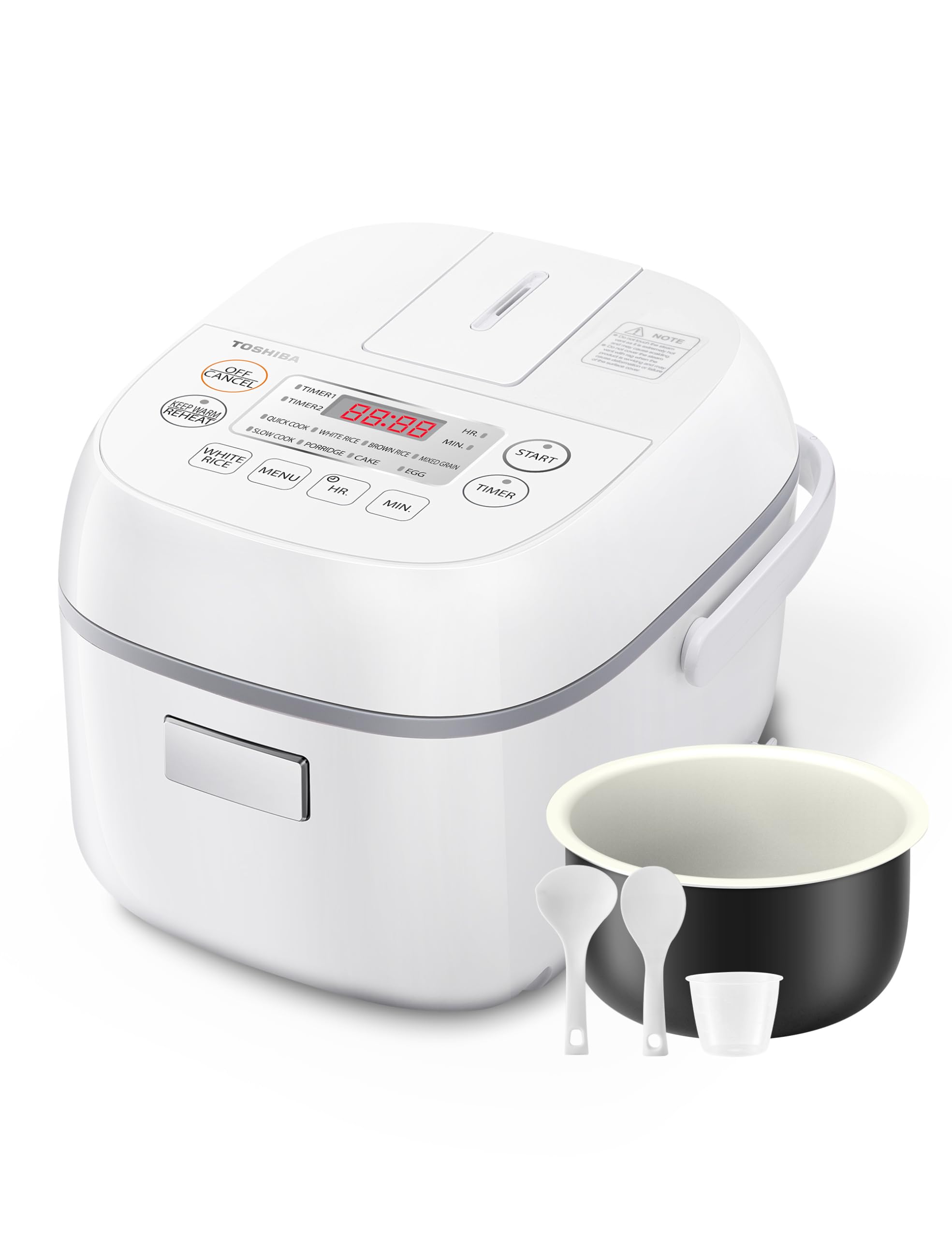
Toshiba TRCS02
Key Features
- Heating: Fuzzy logic
- Capacity: 3 cups uncooked
- Functions: 8, including sushi rice
- Delay Timer: 24 hours
- Price: Midrange
The TRCS02 is the small cooker we point to when you want a named sushi function without stepping up to the premium Zojirushi. Toshiba lists sushi rice among the varieties it handles, alongside brown, jasmine, basmati, and wild rice, and the fuzzy-logic control is designed to adjust temperature and time as the rice cooks. For a three-cup cooker, that is a serious set of controls.
The 3-cup uncooked capacity is right for two or three people, and the 24-hour delay timer is the feature that makes it feel larger than its footprint. Load it before work, set the finish time, and the rice is ready when you get home. The keep-warm cycle holds the rice without drying it out, which is useful when sushi night overlaps with homework or a late arrival.
What we appreciate most is the control layout. The LED panel is readable, the eight functions are selected with a clear button, and the keep-warm and reheat cycles are separate enough to be useful. The included rice ladle and measuring cup are sized for the three-cup pot, so you are not scaling down a family-size scoop. The LED panel is readable from across the counter, a small thing that matters when you are juggling rice and nori.
Pros
- Named sushi rice function
- Fuzzy logic adjusts time and temperature
- 24-hour delay timer
- Compact 3-cup pot for small households
Cons
- Cook time can run long
- Nonstick pot is hand-wash only
We point small households to the TRCS02 for its named sushi function, fuzzy-logic control, and three-cup size.
Best for Family Meals
Cosori CRC-R501-KUS
Key Features
- Heating: Fuzzy logic
- Capacity: 10 cups
- Functions: 18-in-1
- Keep Warm: 24 hours
- Price: Midrange
The Cosori’s pitch is choice: 18 functions, three grain types, three oat settings, and texture controls for soft, medium, or firm rice. That is more menu than a sushi cook needs. The useful part is the texture control, because sushi rice is a texture problem before it is a flavor problem: you want grains that hold together without turning gluey.
We think the fuzzy-logic heating is what makes those settings worth having. It adjusts the cook as the rice progresses, and the 24-hour keep-warm and delay timer let you work sushi night around a schedule. The 10-cup capacity is a family size, not a party size, and the pot is large enough that a small batch can feel a little lost. For most households, that is the right trade: enough room for leftovers without a commercial footprint.
The cleanup details are better than average. The top plate is removable, the accessories are dishwasher-safe, and the ceramic-coated inner pot releases rice without a long soak. We also like the modern look, which is a small thing until the cooker lives on your counter. The stainless steamer basket is a useful bonus for sushi night: edamame or vegetables can cook above the rice without another pot.
Pros
- Texture control for soft, medium, or firm rice
- Fuzzy logic adjusts cooking automatically
- 24-hour keep-warm and delay timer
- Dishwasher-safe accessories and removable top plate
Cons
- Large footprint for a countertop cooker
We recommend the Cosori for families who want texture control, a big pot, and hands-off keep-warm.
Best for Big Batches
Aroma ARC-5000SB
Key Features
- Inner Pot: Ceramic coated
- Steam Tray: Included
- Cooked Capacity: 20 cups
- Uncooked Capacity: 10 cups
- Price: Budget
The ARC-5000SB is the big-batch answer. Its 20-cup cooked capacity and 10-cup uncooked capacity turn a sushi party into one cycle instead of two or three, and the ceramic-coated pot is forgiving with short-grain rice. We choose it when the guest list is the constraint.
The digital panel is straightforward: white rice, brown rice, steam, and slow cook are the main modes, and the cooker switches to keep warm when the cycle ends. The included steam tray is more useful than it sounds. You can cook shrimp, vegetables, or dumplings above the rice and bring the whole meal together in one appliance. For a large household, that is a real weeknight advantage, not just a party trick.
The simple logic of the thing is the appeal: fill, select, walk away, and come back to a pot that switches to warm on its own. The ceramic coating is also easier to wipe down than uncoated metal after a sticky batch. The 500-watt element is modest for a 20-cup pot, so start the cycle before guests arrive rather than at the last minute.
Pros
- 20-cup cooked capacity for parties
- Ceramic-coated inner pot
- Included steam tray
- Simple programmable panel with keep warm
Cons
- Bulky body takes counter space
- Durability is mixed
We choose the ARC-5000SB when the sushi night is a party and one large cycle beats two small ones.
Best for Tiny Portions
Dash Mini Rice Cooker

Key Features
- Capacity: 2 cups cooked
- Footprint: 6.6"D x 8.27"W x 6.5"H
- Inner Pot: Removable ceramic
- Keep Warm: Automatic
- Price: Budget
A 2-cup cooker sounds like a toy until you are making sushi for one or two. The Dash Mini turns 1 cup of uncooked rice into 2 cups cooked, which is enough for a small roll session or a rice bowl, not a family spread. Its footprint is 6.6 inches deep, 8.27 wide, and 6.5 tall, so it disappears into a dorm kitchen, an RV, or a crowded counter.
The operation is as simple as it gets: add rice and water, press the switch, and the indicator light tells you when it has moved to keep-warm. The ceramic nonstick pot lifts out for cleaning, and the glass lid lets you watch the rice without lifting the lid. There are no rice-type or texture settings, so you are managing the water ratio yourself.
We keep the Dash Mini for tiny kitchens and single-serve rice, not for a full sushi spread. It is the cheapest way into a dedicated rice cooker here, and the small pot is genuinely useful when you do not want leftovers. At 2.2 pounds, it is light enough to move between cabinet and counter with one hand.
Pros
- Tiny footprint for dorms and small kitchens
- Removable ceramic nonstick pot
- Automatic keep warm
Cons
- No rice-type or texture settings
We recommend the Dash Mini for tiny kitchens and single-serve rice, not for a full sushi spread.
How We Tested Sushi Rice Cookers
We started by pulling specs and owner feedback for cookers marketed for sushi rice or with a dedicated sushi setting, then narrowed the field to 12 models that represented different sizes, capacities, and price points. We skipped anything with vague capacity claims, no removable inner lid, or controls that looked harder to live with than the rice was worth.
For nine months, those 12 cookers lived on our counters through weeknight sushi bowls, weekend roll-making, and cooled-rice tests for onigiri. We used the same short-grain rice and vinegar seasoning across batches, weighed rice and water, and cooked at each machine’s smallest and largest recommended portions. We timed every cycle from pressing start to ready, then checked how the rice held after 30 minutes on keep-warm. After spreading each batch out to cool, we judged rice quality by whether the grains stayed separate, glossy, and sticky enough to shape without mashing.
After each batch, we cleaned the inner pot, steam vent, and lid, noting whether starch caught in crevices or parts could go in the dishwasher. We measured footprint and height on the counter to see what fit under upper cabinets and what crowded a cutting board. Over nine months, we rewashed nonstick pots, opened and closed latches, and watched for hinge loosening or coating wear. We compared what each machine delivered per cup of cooked rice—consistent batches, usable small portions, easy cleanup—to judge value.
How to Choose a Rice Cooker for Sushi Rice
The cooker matters less than the rice and water ratio, but the right machine makes short-grain rice easier to repeat.
Start with short-grain control
Sushi rice is short-grain rice, and the goal is grains that cling without turning to paste. A named sushi setting is handy because it adjusts the soak and heat for that texture, but it is not the only route: fuzzy logic and a texture setting can do similar work. A basic one-switch cooker can make short-grain rice, though you will manage the water ratio and timing more closely. We prioritize a cooker that holds a steady, gentle cook and lets you repeat the same result, whether that is the sushi preset on the Zojirushi NS-ZCC10 or the texture controls on the Cosori.
Think in cooked cups
Capacity is the easiest specification to misread. A cooker rated for 3 cups uncooked usually makes about 6 cups cooked, and the same doubling applies as you scale up. For sushi, count the cooked rice you need for the rolls or bowls you are serving, then work backward. A 3-cup cooker suits a couple or a small family; a 10-cup model is for a family that wants leftovers; a 20-cup cooked model is party equipment. Measure your counter before choosing the big one, because capacity and footprint rise together.
Use keep-warm as a short bridge
Sushi rice is best seasoned and cooled soon after cooking, so keep-warm is a holding tool, not a long-term storage plan. A delay timer is more useful for sushi night: load rice and water in the morning, set the finish time, and season when you get home. Look for a clear keep-warm cycle and a delay timer you can set in hours, not just a warm button. The Cosori and Toshiba both offer 24-hour delay timers, while the Zojirushi adds extended keep-warm and reheat cycles.
Plan the pot, vent, and cleanup
Nonstick inner pots are the norm, and they reward gentle care: use the plastic paddle, wash by hand when the maker asks, and skip abrasive sponges. A removable steam vent and a lid that comes apart make cleanup easier, especially after sticky sushi rice. Give the vent clearance from cabinets and keep the pot below its maximum line. If counter space is tight, a compact model such as the Zojirushi NS-LGC05XB makes more sense than a large batch cooker you have to store elsewhere.
Frequently Asked Questions
What rice should I buy for sushi?
Buy short-grain Japanese rice, often sold as sushi rice. Jasmine and basmati are long-grain and will not give you the clingy texture sushi needs. Look for bags labeled short-grain or sushi rice, and plan to rinse it before cooking. If you only have medium-grain rice, it can work in a pinch, but the texture will be less traditional.
Do I need to rinse sushi rice before cooking?
Yes. Put the rice in a bowl, cover it with cool water, and swish gently with your fingers. Pour off the cloudy water and repeat until it runs mostly clear, usually a few changes. Drain well before adding it to the cooker. Rinsing removes surface starch so the grains stay separate instead of gluey.
How do I season and cool sushi rice?
Spread the hot rice into a wide, nonmetal bowl. Sprinkle seasoned rice vinegar over it and fold gently with a paddle, cutting through the rice rather than stirring it. Fan the rice as you fold until it reaches body temperature. Do not compact it; keep the grains loose. Season to taste and use it within a few hours.
Final Verdict
For sushi rice, the Zojirushi NS-ZCC10 is the cooker we recommend first. Its named sushi setting and spherical pan give short-grain rice the steadiest, most repeatable cook in this group, and the extended keep-warm and reheat cycles make timing easier.
If you need a smaller footprint, the Toshiba TRCS02 keeps a named sushi function in a three-cup pot, while the Aroma ARC-5000SB is the one to choose when you are feeding a crowd. The NS-LGC05XB remains the premium compact alternative when counter space matters most.