This post contains affiliate links. We may earn a small commission when you buy through our links — at no extra cost to you.
Many home espresso machines promise café-quality shots, but a significant number of owners find themselves dealing with pump failures or lukewarm coffee within months. That reliability gap is the single biggest frustration in this category. This guide focuses on machines that deliver consistent extraction and durability, backed by thousands of user experiences.
The choice often comes down to pod convenience versus bean-to-cup authenticity. Pod machines offer speed and simplicity but carry ongoing capsule costs; bean-to-cup machines require a learning curve but reward with fresher flavor. We’ve highlighted the trade-offs so you can match your routine.
No machine is perfect, but understanding where common weaknesses appear helps you avoid surprises. Whether you prioritize quick morning lattes or the ritual of dialing in fresh beans, the right pick is out there.



Best for Home Baristas
Breville Barista Express
Key Features
- Coffee Input: Whole beans
- Grinder: Integrated
- Milk System: Manual wand
- Pressure: 15 bar
- Water Tank: 67 oz
- Price: Premium
PID temperature control and an integrated conical burr grinder work together to deliver shots with consistent flavor and proper crema. The manual steam wand gives you control over milk texture, and after a short learning curve the controls become intuitive — no guesswork needed once you dial in your preferred grind setting.
This machine suits home baristas who enjoy experimenting with grind and milk technique, and are ready to work through an initial dial-in period. It is less ideal for those who want absolute reliability out of the box — pump and grinder issues can surface within the first year, and cosmetic wear like paint chipping has been noted over time. The all-in-one design saves counter space and avoids the cost of a separate grinder.
Pros
- Good espresso flavor with consistent extraction across grind settings
- Integrated grinder saves counter space and eliminates the need for a separate purchase
- Controls become intuitive after initial setup, with a helpful manual for guidance
Cons
- Pump or grinder failure can occur within the first year of use in some units
- Cosmetic wear such as paint chipping may appear after a couple of years of use
For those who value hands-on espresso craft and want a single machine that handles grinding, brewing, and steaming, this model delivers satisfying results — though an extended warranty can provide extra peace of mind.
Best for Small Spaces
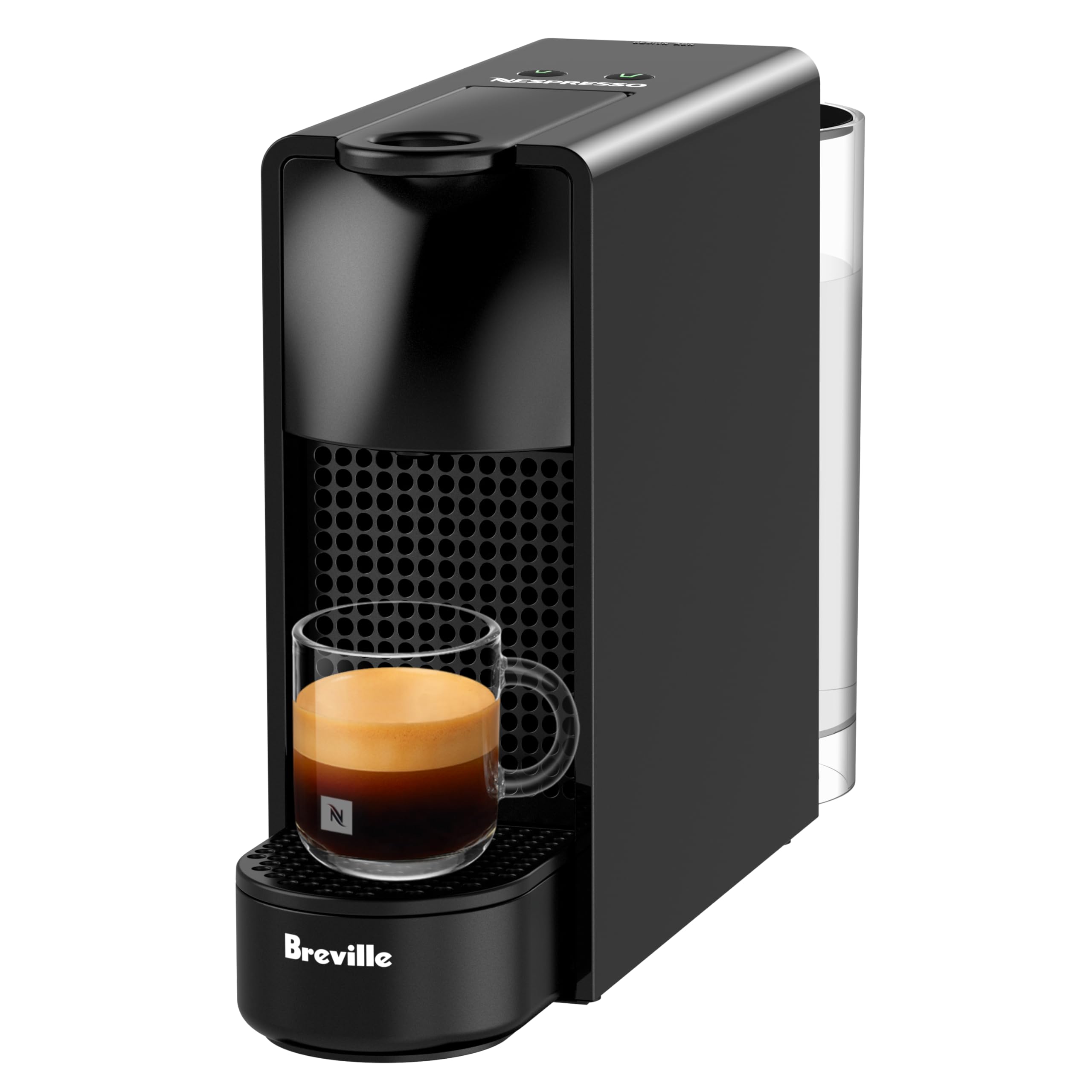
Nespresso Essenza Mini
At just 4.3 inches wide, this machine fits where almost nothing else will — on a crowded counter, a shelf, or even in a small camper. Despite the tiny footprint, it delivers consistent espresso with good crema using Nespresso Original capsules. The two-button interface (espresso or lungo) makes brewing as simple as it gets, with a 25-second heat-up time. This is a pure espresso-and-lungo machine: there is no built-in frother, no larger cup option, and no milk system. Buyers who want lattes or cappuccinos will need a separate frother. It suits individuals or couples who drink straight shots, value speed and simplicity, and have limited space — not those who want a one-machine milk drink solution.
Pros
- Consistent espresso with good crema from a compact pod machine
- Ultra-compact design fits countertops, shelves, or small kitchens
- Two-button operation makes brewing quick and simple
Cons
- Only brews espresso and lungo — no milk system or larger drinks without a separate frother
- The used-capsule bin fills quickly and requires frequent emptying for daily use
A straightforward espresso machine for small spaces and simple routines. If you drink straight shots or lungo and have minimal counter space, this is a cost-effective choice.
Best for Espresso Purists
Gaggia Classic Evo Pro
Key Features
- Coffee Input: Ground coffee
- Milk System: Manual wand
- Pressure: 9 bar
- Price: Mid-Range
The Gaggia Classic Evo Pro packs a 58mm commercial portafilter and brass boiler into a compact Italian-made frame, delivering espresso quality that competes with machines costing twice as much. Unlike the all-in-one top pick, it lacks a built-in grinder and PID control, but offers greater repairability and aftermarket modding potential.
This machine suits aspiring baristas who want to learn the craft and are willing to temperature surf and dial in grind. The tradeoff: a steep learning curve and occasional QC issues — some units have reported steam wand or pump problems — make it less forgiving for casual users.
Pros
- Rich crema and consistent shot quality from commercial-grade 58mm components.
- Sturdy build with Italian craftsmanship and easy repairability.
- Strong value for a prosumer machine with commercial internals at a mid-range price.
Cons
- Temperature surfing and careful grind adjustment required for consistent results — not ideal for quick use.
- Some units may experience steam wand or pump issues over time.
For the enthusiast willing to invest time in learning, this is the best value path to commercial-grade espresso. If you prefer plug-and-play convenience, consider the top pick with integrated grinder.
Best for Convenience Milk Drinks
Nespresso Vertuo Chrome
Key Features
- Coffee Input: Nespresso Vertuo capsules
- Milk System: Aeroccino included
- Water Tank: 40 oz
- Price: Mid-Range
This Nespresso Vertuo bundle pairs barcode-based brewing with an included Aeroccino3 frother, making it the straightforward choice for households that want espresso and milk drinks without dialing in grind or temperature. The chrome design fits neatly on a counter, and one-touch operation means minimal cleanup. Coffee temperature runs warm rather than hot, which matters if you prefer piping-hot drinks — and ongoing capsule costs add up over time. For anyone prioritizing speed and consistency over full manual control, this machine hits that sweet spot.
Pros
- Barcode-optimized brewing delivers consistent crema and a wide variety of flavor options.
- Included Aeroccino3 frother makes milk drinks simple with easy cleanup.
- Sleek, compact design fits neatly on most countertops.
Cons
- Coffee temperature can be warm rather than hot, especially when adding milk.
For households that value speed and simplicity over temperature control and low per-cup cost, this bundle delivers consistent results with minimal effort.
Best for Multi-Function
Ninja Luxe Café
Key Features
- Coffee Input: Whole beans
- Grinder: Integrated
- Milk System: Auto frother
- Price: Premium
The Ninja Luxe Café Premier brews espresso, drip coffee, and rapid cold brew from a single machine, assisted by an automatic tamper and a hands-free frother. Each drink comes out at a café-quality level that competes with separate appliances, and the guided interface removes most guesswork for someone new to espresso.
This setup suits households where one person wants a latte, another wants a pot of drip, and a third craves cold brew — all without switching machines. Early reports, however, note occasional grinder or frother glitches, and the product’s recent launch means its durability under daily use is still being proven. Buyers who prefer a well-established track record may want to look at the top pick instead.
Pros
- Produces espresso, drip, and cold brew to café quality from one appliance
- Guided brewing and assisted tamper reduce the learning curve for espresso newbies
Cons
- Some units may experience grinder or frother hiccups that require attention
- Long-term reliability under heavy use is unconfirmed given how new the model is
If variety across brew styles matters more than a single-purpose pedigree, the Ninja Luxe Café delivers that versatility — just keep an eye on its early reliability track record.
Best for Budget Starter
De’Longhi Stilosa
Key Features
- Coffee Input: Ground coffee
- Milk System: Manual wand
- Pressure: 15 bar
- Water Tank: 33.8 oz
- Price: Budget
With a 15-bar pump and manual steam wand, the Stilosa produces enjoyable espresso with good crema at a budget-friendly price. Its simple controls and included tamper make it easy for beginners to learn the basics. However, durability varies — some units may develop pump or heating problems within the first year, so an extended warranty is a prudent addition. This machine is best for occasional use by first-time espresso buyers who want to save on coffee shop costs without committing to a pricier machine.
Pros
- Reduces coffee shop spending with an affordable espresso entry.
- Simple controls and included tamper make it beginner-friendly.
Cons
- Some units may develop pump or heating problems within the first year.
This machine works well for occasional espresso learning on a tight budget, but consider an extended warranty to cover potential early issues.
Best for Compact Budget Semi-Auto
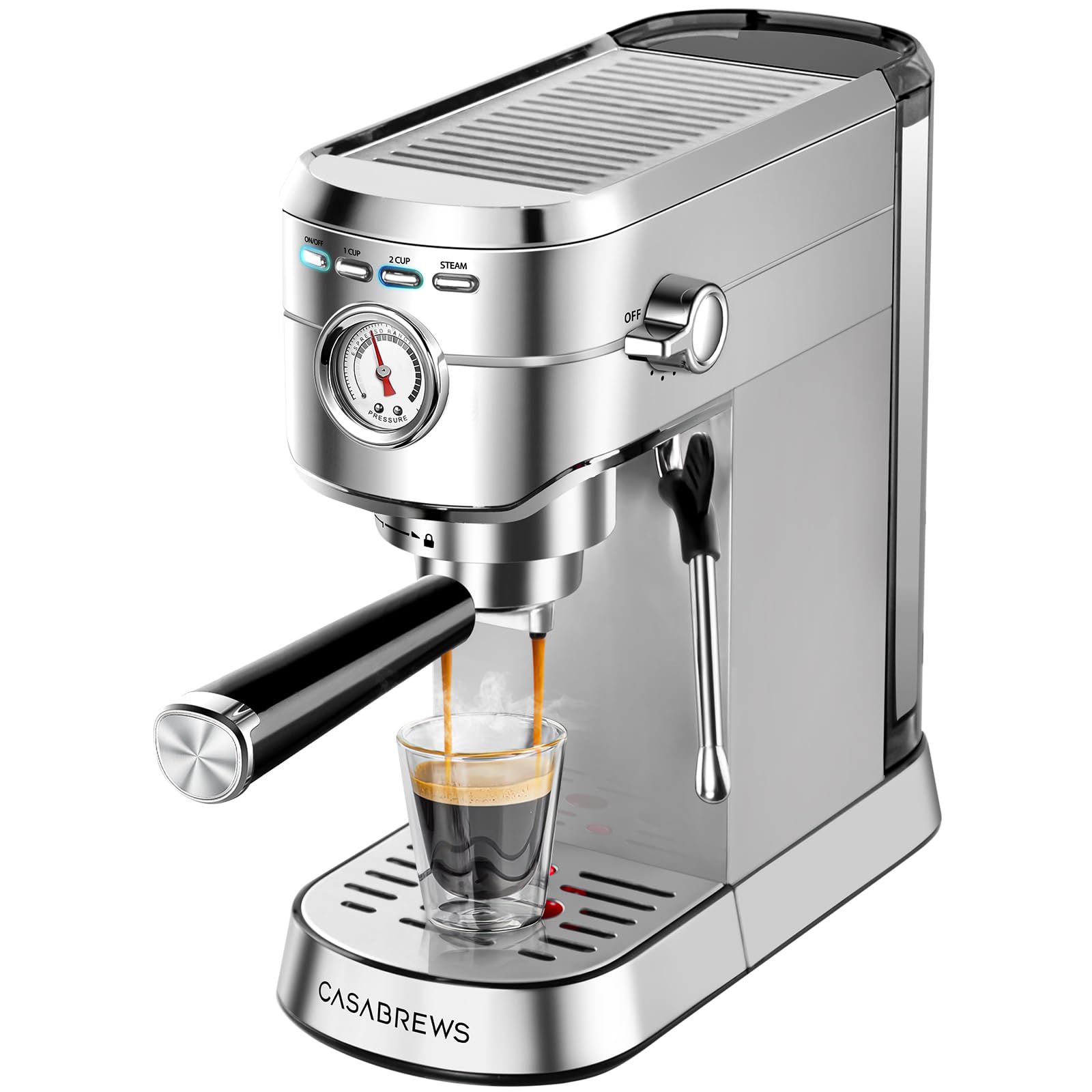
CASABREWS CM5418
Key Features
- Coffee Input: Ground coffee
- Milk System: Manual wand
- Pressure: 20 bar
- Water Tank: 34 oz
- Price: Budget
A compact budget semi-auto with 20-bar pump and pressure gauge for under $150. Produces decent crema for entry-level espresso. Reliability is uncertain — pump issues can occur within months. Accessories feel cheap, and steaming requires a cool-down pause. It doesn’t outperform the Stilosa, so only choose if the pressure gauge matters.
Pros
- Affordable entry into semi-automatic espresso with pressure gauge.
- Intuitive controls and quick heat-up for easy daily use.
Cons
- Pump failure can occur after several months of use.
Suitable as a starter machine for those who want a pressure gauge and accept that durability may be limited — consider an extended warranty.
Best for Bundle with Frother
VertuoPlus + Aeroccino

Key Features
- Coffee Input: Nespresso Vertuo capsules
- Milk System: Aeroccino included
- Water Tank: 60 oz
- Price: Mid-Range
The VertuoPlus with Aeroccino delivers rich crema and frothy milk with minimal effort, and its 60oz tank reduces refills. However, it costs more than the Chrome bundle without performance gains, and component reliability is uneven — individual units may exhibit leaks or pump trouble.
Pros
- Rich crema from Nespresso’s barcode-brewing system
- Included Aeroccino frother for quick milk drinks
Cons
- Some units may develop leaks or pump problems
Best for buyers who want the largest water tank in a VertuoPlus bundle and value the design, provided they can accept possible variability in long-term dependability.
Best for Budget Vertuo
Nespresso VertuoPlus

The most affordable Vertuo machine produces consistent coffee with simple barcode brewing. The compact design is kitchen-friendly. However, this variant has a higher risk of mechanical issues than other Nespresso models — best for occasional users who accept that a replacement may be needed.
Pros
- Consistent coffee and espresso with one-touch operation
- Lowest upfront cost to enter the Vertuo capsule system
Cons
- Some units may leak, jam, or cease to operate; plastic components can crack under normal use
Best for buyers who want the lowest upfront cost and plan to use the machine lightly — expect that a replacement or repair may be needed within the first year.
Best for Stylish Vertuo
Nespresso Vertuo Titan

This Nespresso Vertuo catches the eye with its titanium finish and delivers consistent espresso and coffee through barcode-optimized brewing. Operation couldn’t be simpler: drop a capsule, press a button, and the machine reads the code for the right size and parameters. Flavor variety is a genuine strength, with rich crema across multiple capsule options. The tradeoff comes in cup temperature – coffee emerges warm rather than hot, which may require microwaving for those who want piping hot drinks. Some units have also experienced water flow or reliability hiccups, so a warranty is worth considering.
Pros
- Rich espresso flavor and crema variety across many capsule options
- One-touch brewing makes daily use effortless and quick
Cons
- Coffee temperature can be too cool for those who prefer piping hot drinks
Best for style-focused Nespresso fans who value variety and ease and don’t mind warming their cup or adding milk.
Best for Budget Smart Bundle
Vertuo Next + Aeroccino

Key Features
- Coffee Input: Nespresso Vertuo capsules
- Milk System: Aeroccino included
- Price: Budget
The Vertuo Next bundle delivers tasty Nespresso coffee with an easy, one-touch brew and includes the Aeroccino frother at a low entry price. Its smart features and low cost come with a tradeoff: some units may stop working within weeks, making this better suited for occasional use or short-term rentals than daily reliance.
Pros
- Good coffee taste with many flavor options
- Great value when bundled with frother at low price
Cons
- Units may stop operating unexpectedly within weeks of use
This bundle fits best for experimental buyers who want a cheap introduction to the Vertuo system without long-term commitment, or as a temporary machine for a rental.
Best for Stylish Budget Semi
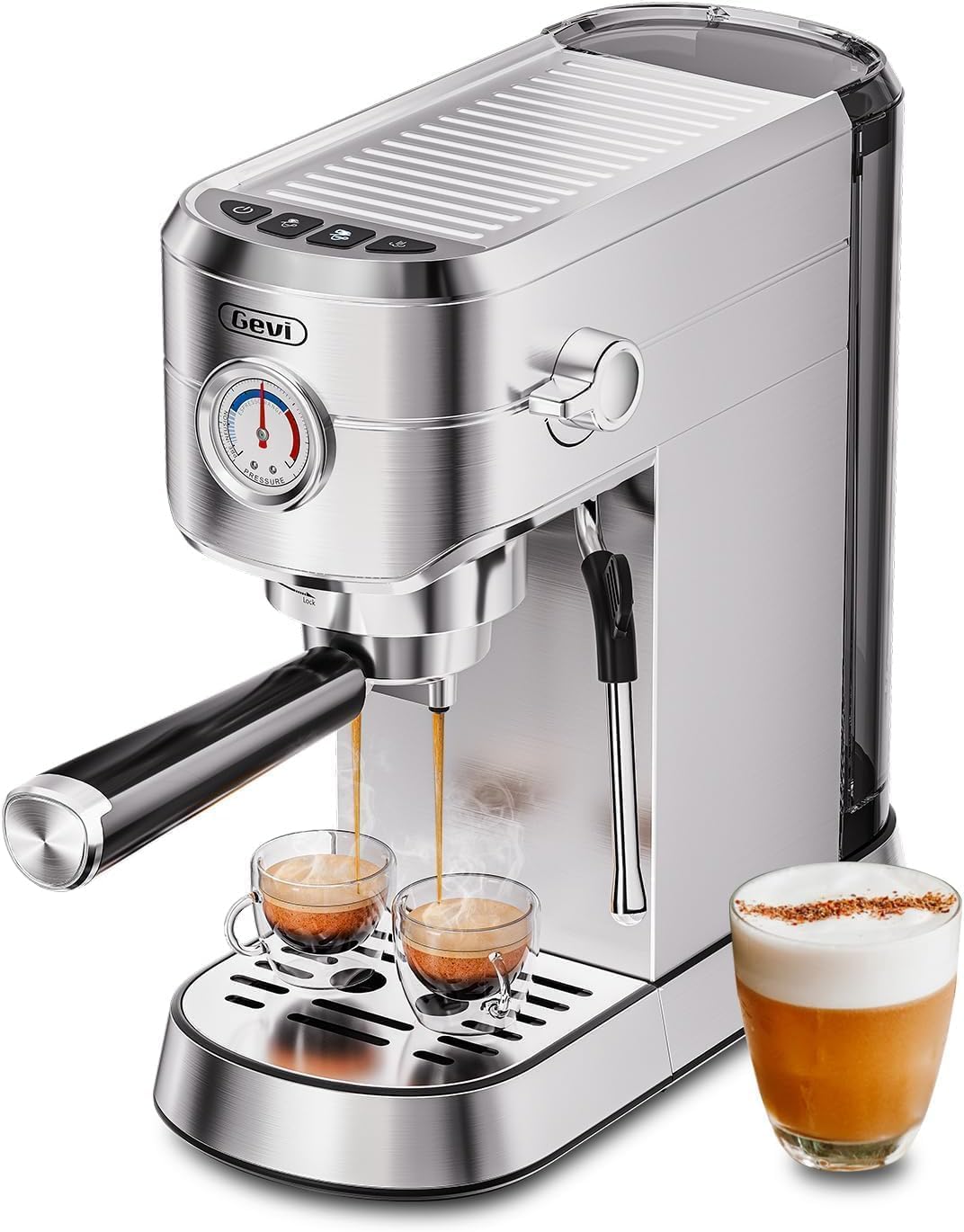
Gevi 20Bar Espresso
Key Features
- Coffee Input: Ground coffee
- Milk System: Manual wand
- Pressure: 20 bar
- Water Tank: 34 oz
- Price: Budget
This Gevi brings a 20-bar pump, pressure gauge, and compact stainless steel design at a budget-friendly price — a solid package for cost-conscious home baristas. The steam wand and removable 34 oz tank add everyday convenience, and the machine looks tidy on a countertop. Where it gives ground to better-established options: cleaning the group head and drip tray requires some hands-on effort, and long-term durability for frequent use is still unconfirmed. If you want a low-cost entry to espresso with a pressure gauge and are comfortable with a bit of manual cleanup, this fits the bill.
Pros
- Good value for money with solid performance for the price.
- Compact and stylish stainless steel build fits well on small counters.
Cons
- Cleaning the brew group and drip tray can be messy.
Best for budget-conscious buyers who want a pressure gauge in a compact stainless body and don’t mind occasional cleanup — but not for those expecting a long, trouble‑free track record.
Best for Premium Fast Heat-Up
Breville Barista Pro

Key Features
- Coffee Input: Whole beans
- Grinder: Integrated
- Milk System: Manual wand
- Water Tank: 67 oz
- Price: Premium
The Barista Pro heats up in 3 seconds and guides you through extraction on a clear LCD — ideal if speed and precision are priorities. However, it shares the same reliability concerns as the less expensive Barista Express, with some units experiencing grinder or pump issues. At a premium price, this trade-off makes sense only for those who prefer faster heat-up over saving money.
Pros
- Fastest heat-up among semi-automatics — ready to brew in 3 seconds.
- Intuitive LCD display simplifies shot timing and extraction adjustments.
Cons
- Long-term reliability can vary — grinder or pump issues may appear, making it a higher-risk investment than the price suggests.
Consider this if the fastest heat-up and guided interface matter more than long-term cost of ownership; otherwise, the Barista Express offers similar capability at a lower price.
Best for Luxury Touchscreen
Breville Barista Touch

Key Features
- Coffee Input: Whole beans
- Grinder: Integrated
- Milk System: Auto wand
- Water Tank: 67 oz
- Price: Luxury
The ThermoJet heating reaches brew temperature in three seconds, and the automatic steam wand handles milk texture with touchscreen precision. The premium price and reports of mechanical issues after several months mean this machine suits buyers who prioritize daily convenience and are comfortable with potential service needs.
Pros
- Cappuccinos and lattes come out well-balanced and flavorful
- Eight custom profiles let you save personalized drink recipes
Cons
- Mechanical issues can appear after several months of use
For those who prioritize automated convenience over manual control and are prepared for possible service visits, the Barista Touch delivers a polished daily espresso routine.
Best for Ultra-Budget Multi-Cup
IMUSA 4-Cup Espresso

Key Features
- Coffee Input: Ground coffee
- Milk System: Manual wand
- Price: Budget
This budget-friendly machine brews four cups at once with straightforward controls, ideal for getting started without a big investment. Its steam-driven system produces weak pressure and inconsistent heat, and durability under regular use may be limited — best reserved for occasional or starter use.
Pros
- Extremely affordable entry into espresso making
- Simple to operate and clean
Cons
- Weak pressure and inconsistent heating can produce lukewarm coffee with little crema
A viable option for budget-constrained buyers who want an occasional cappuccino and are prepared for a short lifespan and lukewarm results.
How to Choose
The reliability of an espresso machine is the single biggest factor determining long-term satisfaction, often outweighing features or brand.
Coffee Input
The type of coffee input defines your daily routine. Whole-bean machines with integrated grinders deliver freshest flavor but require dialing in and regular cleaning of the burr set. Ground coffee machines are simpler and cheaper, but you sacrifice aroma and consistency.
Pod systems offer convenience and zero mess, but proprietary capsules cost $0.75–$1.25 per drink. If you drink multiple cups daily, the ongoing expense quickly surpasses the savings from a cheaper machine.
Grinder
A built-in grinder saves counter space and eliminates the need for a separate purchase. However, entry-level integrated grinders often lack the fine adjustment range needed for truly dialing in espresso. They also add complexity and a potential failure point.
Separate grinders (not covered here) offer better control and longevity, but require an extra investment and counter space. For most home baristas, a mid-range integrated grinder is a fair compromise.
Milk Frothing System
Manual steam wands give you control over microfoam texture and are easier to clean and repair. They also tend to produce better latte art. The trade-off is a steeper learning curve and more effort per drink.
Automatic frothers (integrated or separate) remove the skill requirement and speed up mornings. However, they produce coarser foam, can be harder to deep-clean, and often fail before the rest of the machine. Choose based on your willingness to practice.
Pressure
Most machines advertise 15 or 20 bar pumps, but sustained pressure during extraction matters more than peak rating. Commercial standard is 9 bar at the group head. Budget machines often cannot maintain consistent pressure, leading to channeling or weak shots.
A 20 bar pump is useful only if the machine has an overpressure valve to regulate down to 9 bar. Without that, high pressure can over-extract and produce bitter shots. Focus on pump quality and temperature stability rather than the number alone.
Cleaning and Maintenance
Descaling frequency depends on water hardness and usage. Most manufacturers recommend every 3–6 months, but ignoring scale buildup is the leading cause of premature pump failure. Removable water tanks and accessible brew groups simplify the process.
Pod machines are generally easier to clean because there are no coffee grounds or oily residues. However, the capsule receptacle and drip tray need regular emptying. Manual machines require backflushing and wiping the group head after each session.
FAQ
Why does my new espresso machine only make lukewarm coffee?
Lukewarm coffee is often caused by insufficient brew temperature, which can happen with pod machines that don’t preheat properly or with semi-automatics if you don’t warm the portafilter and cup. Nespresso Vertuo models are known for warm (not hot) output, especially when adding milk. Preheating the cup and running a blank shot can raise the temperature by 10–15°F.
Can I use regular ground coffee in a Nespresso Vertuo machine?
No. Vertuo machines read a barcode on the capsule rim to adjust brewing parameters — spin speed, temperature, and volume. Using loose grounds will not work and may damage the mechanism. Only official Nespresso Vertuo capsules fit the system.
How often do espresso machines need to be descaled?
Descaling frequency depends on water hardness and usage. Most manufacturers recommend every 3–6 months. Hard water can cause scale buildup in the boiler and pump, leading to reduced flow and eventual failure. Using filtered water can extend the interval. Ignoring descaling is the most common cause of pump failure within the first two years.
Is a built-in grinder worth it on a home espresso machine?
A built-in grinder saves counter space and provides fresh grounds on demand, but entry-level integrated grinders often lack the fine adjustment needed for precise dialing. They also add a mechanical failure point. For casual use, they offer good value; for serious enthusiasts, a separate grinder is more reliable and consistent. Consider how much you’re willing to tinker before deciding.