This post contains affiliate links. We may earn a small commission when you buy through our links — at no extra cost to you.
Many home espresso machines promise café-quality shots but struggle to deliver them consistently after a few months. The real challenge isn’t just pulling a good shot once—it’s getting reliable performance day after day.
This guide focuses on machines that balance espresso quality with build longevity. Whether you prefer an all-in-one with integrated grinder or a separate setup that lets you upgrade components, the key is knowing which trade-offs matter for your routine.
We highlight the choices that affect long-term satisfaction: heat-up speed, steam power, and most importantly, how well the machine holds up under daily use.


Best for Home Baristas
Breville Barista Express
Key Features
- Grinder Type: Integrated burr
- Pump Pressure: 15 bar
- Steam Wand: Manual single-hole
- Tank Capacity: 67 oz
- Price: $$$
The integrated conical burr grinder offers 30 settings, letting you dial in dose and grind size without a separate appliance. PID temperature control keeps water stable through the shot, which helps produce crema-rich espresso consistently. The steam wand is manual and single-hole, giving you direct control over milk texture.
This machine suits home baristas who are willing to invest time in learning the workflow—grinding, tamping, and steam techniques. The tradeoff: some units may develop grinder or pump issues over time, and paint chipping has been reported on a few machines within two years. For buyers who want an integrated setup and are comfortable with occasional maintenance, the Barista Express offers a strong feature set at a premium price.
Pros
- Consistently produces espresso with rich crema
- Intuitive operation after a short learning curve
- Strong feature set for the price, undercuts comparable all-in-one machines
Cons
- Some units may develop grinder or pump issues over time
- Paint chipping and breakdowns within two years noted on a few machines
The Barista Express is for home baristas who want an integrated grinder and are okay with occasional maintenance—it delivers consistent espresso at a competitive price.
Best for Speed Seekers
Breville Barista Pro
Key Features
- Grinder Type: Integrated burr
- Pump Pressure: 15 bar
- Steam Wand: Manual high-perf
- Tank Capacity: 67 oz
- Price: $$$
3-second ThermoJet heat-up and a high-performance steam wand make this the speed champion among Breville’s all-in-one machines. The integrated conical burr grinder offers 30 settings, and PID temperature control ensures consistent extraction. While the Barista Express provides a better price-to-features ratio, the Pro’s faster heat-up and steam performance are meaningful upgrades for anyone who values a quicker morning routine.
This machine suits users upgrading from a basic model who want faster heat-up and better steam without moving to a separate grinder. However, like the Express, some units have experienced grinder or pump issues within months; durability under heavy use is a known vulnerability.
Pros
- Café-quality espresso with thick crema
- 3-second heat-up and intuitive controls speed up daily use
Cons
- Durability concerns: some units may show wear after several months
- Grinder or pump malfunctions can occur in some units
The fastest warm-up in the lineup, but the same reliability caveats as the Express mean it’s best suited for those who prioritize speed over long-term certainty.
Best for Enthusiasts
Gaggia Classic Evo Pro
Built around a 58mm commercial portafilter and 9-bar pump, the Gaggia Classic Evo Pro pulls shots that rival cafe espresso. The all-steel housing and Italian engineering provide a solid foundation for modifications, backed by a large aftermarket community. This machine is for baristas who already own a quality grinder and enjoy tinkering. The tradeoff: some units have reported steam wand or pump inconsistencies, and long-term durability under heavy use can vary. Beginners or those wanting an all-in-one should consider the top pick instead.
Pros
- Produces rich, well-structured espresso with thick crema.
- Solid steel construction with Italian components.
Cons
- Some units develop steam wand or pump issues over time.
- Durability may vary; signs of wear can appear sooner than expected.
Ideal for the hands-on enthusiast who values repairability and upgrade potential over convenience—if you want an all-in-one, the top pick is a better fit.
Best for Budget Reliable
atatix Espresso
Key Features
- Pump Pressure: 20 bar
- Steam Wand: Manual
- Tank Capacity: 44 oz
- Price: $$
The atatix espresso machine consistently pulls well-rounded shots from its 20-bar pump, and the build quality holds up better than many alternatives in this price tier. It’s a natural fit for first-time buyers who want a machine that stays functional over months of daily use, provided they don’t insist on scalding hot coffee from the portafilter. The manual steam wand is basic but gets the job done for typical milk frothing.
This machine suits casual daily drinkers and budget-conscious households who prioritize longevity over precision temperature control. If you routinely drink straight espresso and need it piping hot, consider a model with adjustable brew temperature instead.
Pros
- Simple controls let beginners pull decent shots without a steep learning curve.
- Shot quality remains consistent across multiple uses, with good crema and flavor.
Cons
- Espresso temperature may be lower than preferred, especially without preheating the cup.
If you can tolerate slightly cooler espresso, this machine leads the budget segment for consistent shot quality and durability without frequent hiccups.
Best for Temperature Control
CASABREWS Ultra
Key Features
- Pump Pressure: 20 bar
- Steam Wand: Manual
- Tank Capacity: 73 oz
- Price: $$
The LCD display with four temperature settings and a 73 oz water tank give this machine a customization edge over many budget semi-automatics. It uses ground coffee and a manual steam wand, so you control the shot completely. Best suited for users who want to adjust brew temperature and appreciate a large tank and clear display — those who need piping hot espresso above all may find the highest setting insufficient.
Pros
- Solid build and consistent performance for the price.
- Clear LCD guide and simple controls make daily operation easy.
- Strong feature set at a budget-friendly price.
Cons
- Espresso temperature may not reach piping hot even at the highest setting.
For home baristas who value brew temperature control and a large tank, this is a strong value pick — plan for a pre-heat routine if heat matters most.
Best for Compact Budget
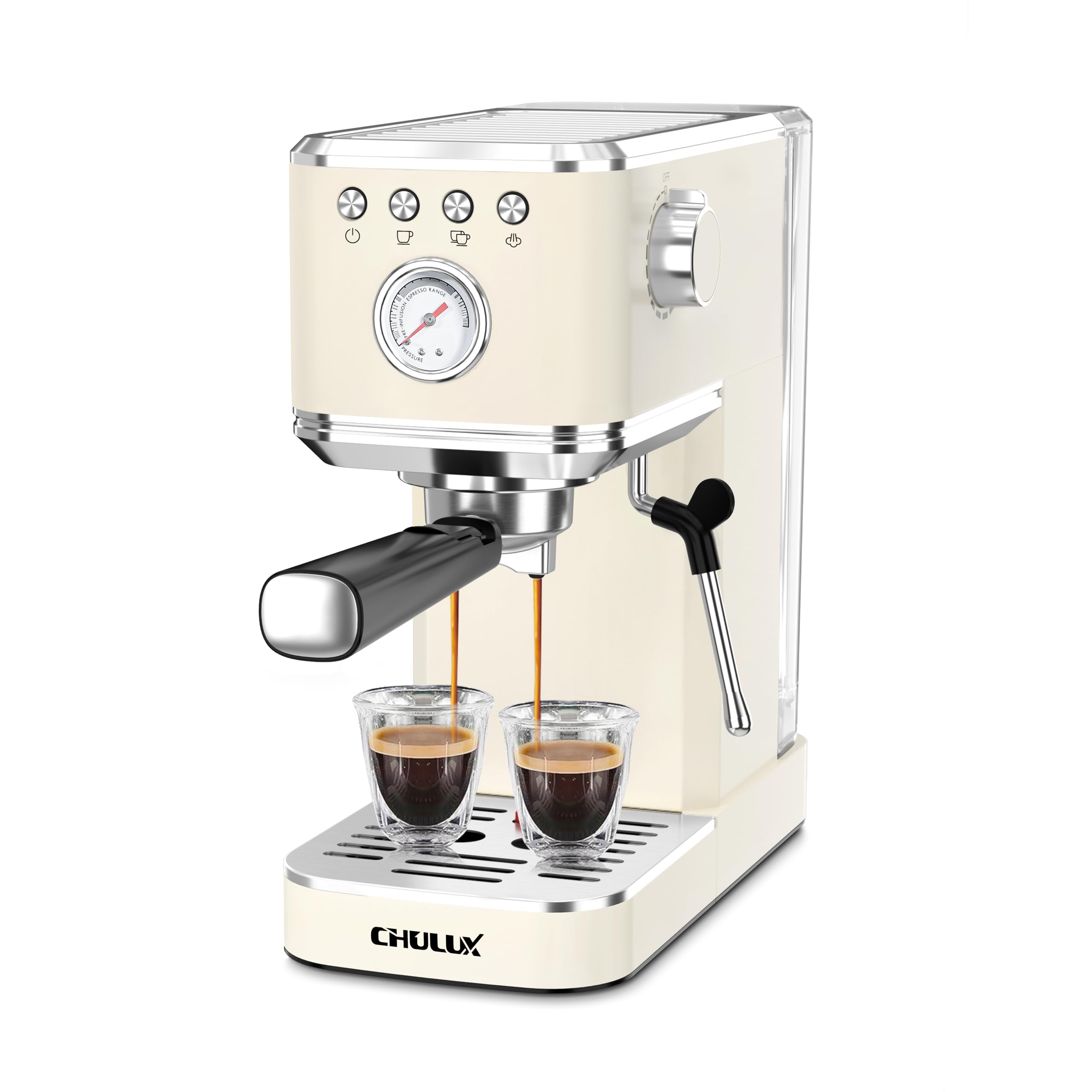
CHULUX Slim
Key Features
- Pump Pressure: 20 bar
- Steam Wand: Manual
- Tank Capacity: 40 oz
- Price: $
The CHULUX Slim’s 5.5-inch footprint slides into tight kitchen spots, and when operating correctly its 20-bar pump delivers rich crema from ground coffee. Build quality for the price is solid, but performance can vary between units—some may not heat or brew consistently. This makes it a practical choice for light, occasional use or as a low-cost entry point for beginners willing to test their machine, not a daily driver for heavy users.
Pros
- Ultra-slim 5.5-inch width fits compact countertops where full-sized machines won’t.
- Rich crema and flavor from the 20-bar pump at a budget-friendly price.
Cons
- Heating and brewing can vary between units; some may underperform or require replacement.
Best for tight-budget buyers who need a narrow machine for occasional espresso experimentation and are comfortable testing their unit’s performance.
Best for 3-In-1
Ninja Luxe Café

Key Features
- Grinder Type: Integrated burr
- Pump Pressure: 15 bar
- Steam Wand: Auto frother
- Tank Capacity: 70 oz
- Price: $$
The Ninja Luxe Café Premier delivers café-quality espresso, drip coffee, and cold brew from a single machine, with a guided assisted tamper and hands-free milk frother that simplify the process. However, the automated approach reduces manual control over grinding and tamping, and occasional grinder jams have been noted—tradeoffs that matter for anyone seeking a traditional semi-automatic workflow.
Pros
- Produces café-quality drinks across espresso, drip, and cold brew modes.
- Guided brewing and assisted tamper make operation approachable for beginners.
Cons
- Assisted tamper and automatic frother limit the tactile experience; grinder jams can interrupt a session.
This machine fits households that value three-in-one convenience and automated assistance over manual espresso technique.
Best for Budget Beginners
CASABREWS 3700

Key Features
- Pump Pressure: 20 bar
- Steam Wand: Manual
- Tank Capacity: 44 oz
- Price: $
This machine produces a rich crema that belies its low cost, making it an appealing entry point for newcomers. However, the espresso temperature may not be as hot as some prefer, and durability can vary between units—better suited for occasional use rather than daily heavy lifting. If you need consistent heat and long-term reliability, investing a bit more is advisable.
Pros
- Produces a creamy crema for a budget machine
- Affordable entry into espresso without a big commitment
Cons
- Lukewarm espresso and variable durability can surface under regular use
A suitable starter machine for those on a tight budget who brew occasionally and can tolerate lukewarm shots.
Best for Occasional Use
De’Longhi Stilosa

Key Features
- Pump Pressure: 15 bar
- Steam Wand: Manual basic
- Tank Capacity: 34 oz
- Price: $
This budget-friendly machine offers easy setup and decent espresso shots for the price. However, coffee temperature can be lukewarm, and some units may require replacement within a year. Best suited for occasional use or as a short-term entry point.
Pros
- Saves café costs with drinkable espresso at home.
- Simple to set up and operate right out of the box.
Cons
- Coffee temperature may be lukewarm even after preheating.
A low-cost option for infrequent use, but plan to upgrade within a year.
Best for Small Counters
Neretva Espresso

Key Features
- Pump Pressure: 20 bar
- Steam Wand: Manual
- Tank Capacity: 44 oz
- Price: $
The Neretva Espresso Machine’s small stainless steel body (9.1 inches tall) slips into cramped kitchens where larger machines won’t fit. It pulls acceptable shots for the price, but heating consistency can be uneven, and some units may develop steam wand issues or stop working — best suited for occasional use or travel.
Pros
- One of the smallest 20-bar machines — fits on tight countertops.
- Delivers decent espresso for its budget price point.
Cons
- Heating performance can be inconsistent, with occasional lukewarm shots.
A viable option for occasional espresso in a tiny space if you can accept some temperature variance and potential unit-to-unit quirks.
How to Choose
The most important factor in choosing a semi-automatic espresso machine is not the brew pressure but how reliably it performs over years of daily use.
Integrated Grinder or Separate
An integrated grinder saves counter space and simplifies your workflow—you grind, dose, and tamp in one spot. But built-in grinders on budget machines often lack the consistency of a standalone burr grinder, leading to uneven extraction. If you already own a quality grinder, skip the integrated model and invest that money in better machine internals.
Pump Pressure
Most home machines advertise 15 or 20 bar, but the actual extraction happens at 9 bar—the standard for proper espresso. Higher numbers are marketing fluff; a 20-bar pump with an over-pressure valve that regulates down to 9 is fine. The real difference is in temperature stability: PID-controlled machines hold a steady brew temperature, which matters more than peak pressure.
Steam Wand Quality
A manual steam wand with a single hole takes longer to texture milk but gives you control over microfoam. Panarello-style wands (plastic sleeve) aerate quickly but produce larger bubbles—fine for beginners but not latte art. For daily milk drinks, look for a commercial-style wand with at least a two-hole tip; it cuts steaming time in half.
Build Material
Stainless steel housings and brass boilers retain heat better and resist corrosion longer than plastic or aluminum. Machines with plastic portafilters and boilers are lighter and cheaper, but they lose temperature stability over a 4-shot session. If you plan to make multiple drinks back-to-back, prioritize metal internals—they cost more upfront but reduce scalding risk and extend lifespan.
Water Tank Capacity
A larger tank (60+ oz) means fewer refills—useful for households that brew several shots and steam milk daily. Smaller tanks (below 40 oz) are fine for occasional use but require topping off before each session. Also check if the tank is removable and easy to fill under a faucet; fixed tanks are a hassle to clean and refill.
FAQ
Why does my espresso machine coffee come out lukewarm even on the highest setting?
Many budget machines lack a PID controller and brew at inconsistent temperatures. The thermoblock heats quickly but may not sustain heat for a long pull. Preheating your portafilter and cup, and flushing a shot of hot water before brewing, can raise the final shot temperature by 5–10°F.
Is the Breville Barista Express worth it for a beginner?
Yes—the integrated grinder, dose control, and guided tamping reduce the learning curve. It produces very good espresso once you dial in the grind. The trade-off is that reliability is inconsistent: some users report grinder or pump issues after a year. Consider an extended warranty if you buy it.
How long do semi-automatic espresso machines typically last?
That depends heavily on build quality and maintenance. Higher-end models with brass boilers and stainless steel parts can last 5–10 years with regular descaling and backflushing. Budget machines often fail within 1–2 years, especially if used daily. The atatix Espresso is an exception—it has above-average reliability in the budget tier.
Can I use pre-ground coffee in a machine with a built-in grinder?
Yes, but most integrated grinders only allow you to bypass them by leaving the hopper empty and using a separate dosing funnel. The machine will still work with pre-ground coffee, but you lose the freshness benefit. For best results, grind beans immediately before brewing.