This post contains affiliate links. We may earn a small commission when you buy through our links — at no extra cost to you.
Burr grinders promise consistent coffee, but many electric models fail within months or grind noisily. The real challenge is finding a grinder that balances convenience with durability.
Manual grinders often deliver better grind quality per dollar but require arm strength, while electric options offer push-button ease at the cost of potential reliability risks. The right choice depends on your brew method and tolerance for manual effort.
This guide focuses on the models that quiet those trade-offs—consistent, durable for their price, and matched to your morning routine.



Best for Quiet Budget Electric
Ollygrin Burr Grinder
Key Features
- Burr Type: Stainless steel conical
- Grind Settings: 30
- Noise Level: Quiet
- Motor Power: Gear reduction
- Capacity: 10 oz
- Ease of Cleaning: Anti-static
- Price: Budget
The Ollygrin stands out for its remarkably quiet operation — a gear-reduction motor and anti-static bin deliver consistent grinds across 30 settings, from coarse to fine, without the rattle common in this price class. The clear container lets you see the dose, and the grind selector is numbered for easy repeatability.
The anti-static design minimizes mess when transferring grounds, and the hopper’s 10-ounce capacity handles typical home batches up to 12 cups. The grind uniformity holds up well across medium to coarse settings, producing even particles that suit drip, pour-over, and French press.
This grinder is a strong fit for budget-conscious coffee drinkers who want electric convenience without the noise penalty. Early-morning users will appreciate how little it disrupts a quiet kitchen. However, if you regularly brew larger quantities, the hopper will need refilling — and espresso enthusiasts seeking ultra-fine precision may find the finest setting slightly coarse for their needs. Some units have shown minor quality-control quirks, though these are isolated cases.
Pros
- Very quiet operation for an electric grinder
- Consistent grind with good uniformity across settings
- Intuitive dial and cup selector make daily use simple
- Great value for money with quality that exceeds its price point
Cons
- 10oz hopper requires refills for batches exceeding 12 cups
- Some units may have quality control issues like cracked portafilter inserts
For home users wanting a quiet, consistent electric grinder without spending a premium, the Ollygrin delivers on its promises with minimal compromises.
Best for Precision Manual Grinder
KINGrinder K6
Key Features
- Burr Type: Stainless steel conical
- Grind Settings: 60 clicks
- Noise Level: Manual (no motor)
- Motor Power: None (manual)
- Capacity: 25-35g
- Price: Mid-Range
The external adjustment ring with 60 distinct clicks and 16-micron steps makes dialing in for espresso or pourover straightforward and repeatable. The stainless steel conical burrs and dual-bearing assembly produce an even particle distribution that holds its own against grinders costing twice as much. That precision comes in a machined aluminum body that feels solid in hand—no plastic creaks or wobble.
This grinder fits travelers and home brewers who prioritize grind quality over electric speed. The 25–35g capacity handles a single pour-over or two espresso shots, but those brewing for a crowd should look at larger manual options. A small number of units have shown bearing corrosion after extended use—something to monitor in humid environments, though not a widespread issue. If you’re comfortable with manual effort, the K6 is a strong alternative to noisy electric grinders in the same price range.
Pros
- Grind consistency is even enough for both espresso and pourover without visible fines or boulders.
- Full metal construction with machined aluminum body feels durable and gives a reassuring weight.
- External adjustment ring with clear clicks makes switching between brew methods quick and repeatable.
Cons
- 35g maximum capacity limits to single-dose brewing; not suitable for multiple servings at once.
- Handle top may loosen after repeated turning; securing it periodically prevents detachment during grinding.
For anyone who values grind precision and is willing to turn the crank, the K6 offers professional-level results without the premium price—just keep an eye on the bearing in damp climates.
Best for Quiet Premium Electric
KitchenAid KCG8433
Key Features
- Burr Type: Stainless steel conical
- Grind Settings: 70
- Noise Level: Quiet
- Motor Power: 150W
- Capacity: 10 oz
- Ease of Cleaning: Anti-static
- Price: Premium
The KitchenAid KCG8433 stands apart from typical electric grinders by delivering ultra-quiet operation alongside 70 precise grind settings and an anti-static bin that keeps the counter clean. Professional-grade grinders like the Baratza Virtuoso+ offer better long-term reliability but are noticeably louder, making this model the quieter choice for home use.
This grinder suits home baristas who prioritize low noise and fine grind control—especially for espresso or pour-over. The premium price and the possibility that some units may stop working within months mean buyers should weigh convenience against durability. Those unwilling to accept any risk of early failure may prefer a simpler, more rugged option.
Pros
- Operates at a whisper, ideal for early morning brewing without disturbing others.
- 70 grind settings allow precise adjustment from Turkish to French press.
- Anti-static design minimizes mess when transferring grounds.
Cons
- Premium pricing may feel steep for buyers who don’t need the full range of settings.
- Some units can stop working within a few months, making a warranty a worthwhile consideration.
For home baristas who value whisper-quiet grinding and precise dose control over absolute long-term certainty, this KitchenAid delivers where it counts—just keep a warranty handy.
Best for Affordable Quiet Electric
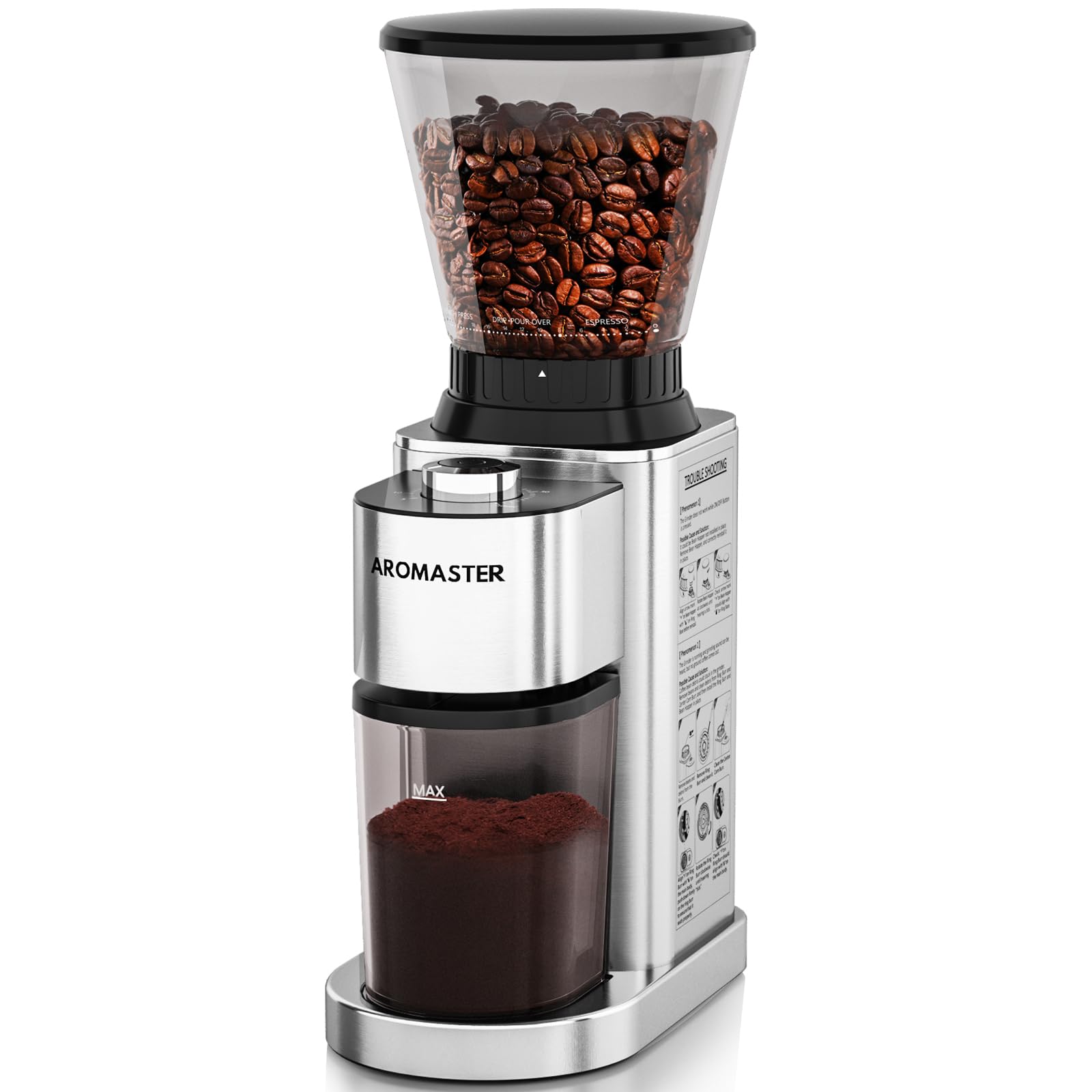
Aromaster Burr Grinder
Key Features
- Burr Type: Stainless steel conical
- Grind Settings: 48
- Noise Level: Quiet
- Capacity: 3.9 oz
- Ease of Cleaning: Anti-static, removable
- Price: Budget
The Aromaster delivers whisper‑quiet grinding that fits easily into a morning routine – a step up in noise control from most electric grinders at this price. Its 48‑setting conical burr produces consistent results for drip and French press, and the anti‑static chamber keeps mess to a minimum.
This grinder suits home users who brew one or two cups at a time and prioritize quiet operation and easy cleanup over batch capacity. The 3.9oz grind chamber holds enough for a single pour‑over or press, but grinding for multiple cups requires refilling and a brief cooldown to avoid heat‑triggered shutdowns. It’s a smart entry‑level choice for those new to burr grinding who don’t need to grind large quantities daily.
Pros
- Operates quietly enough for early‑morning use without disturbing others.
- Stainless steel conical burr delivers uniform grounds for drip and French press brewing.
- Removable burr and anti‑static design minimize coffee residue and static cling.
Cons
- When grinding multiple batches in quick succession, the motor may trigger thermal protection and pause.
- The 3.9oz chamber limits grinding to about one cup at a time; refilling is needed for larger batches.
For single‑cup brewers on a budget who want a quiet electric grinder, the Aromaster delivers good grind quality and easy maintenance – just plan for small batches.
Best for Quiet No-Fuss Electric
Capresso Inf. Plus
Key Features
- Burr Type: Steel conical
- Grind Settings: 16
- Noise Level: Quiet
- Motor Power: 100W gear reduction
- Capacity: 11 oz
- Ease of Cleaning: Removable upper burr
- Price: Mid-Range
The Capresso Infinity Plus stands apart from pricier electric grinders by delivering notably quiet operation through its gear-reduction motor—a feature rarely found at this price. Grind consistency is adequate for drip, French press, and pour-over, though it doesn’t match the uniformity of premium competitors or manual grinders at the coarsest settings.
This grinder fits home users upgrading from a blade grinder who want a no-fuss electric option without breaking the bank. The 16-step grind selector is simple to adjust, and the removable upper burr makes cleaning manageable. However, those needing precise fine adjustments for espresso or maximum particle uniformity for high-end brew methods will find the limitations frustrating.
Pros
- Operates quieter than most electric grinders in its class, thanks to gear reduction.
- Delivers a grind that works well for drip, French press, and pour-over without fuss.
- Controls are intuitive and setup takes minutes — ideal for everyday use.
Cons
- Grind uniformity drops at coarser settings, producing some fines that may muddle French press.
- Static cling can make a mess when transferring ground coffee from the bin.
This is the grinder to pick if quiet operation and reliable mid-range performance matter more than extreme grind precision or espresso capability.
Best for Large Capacity Manual
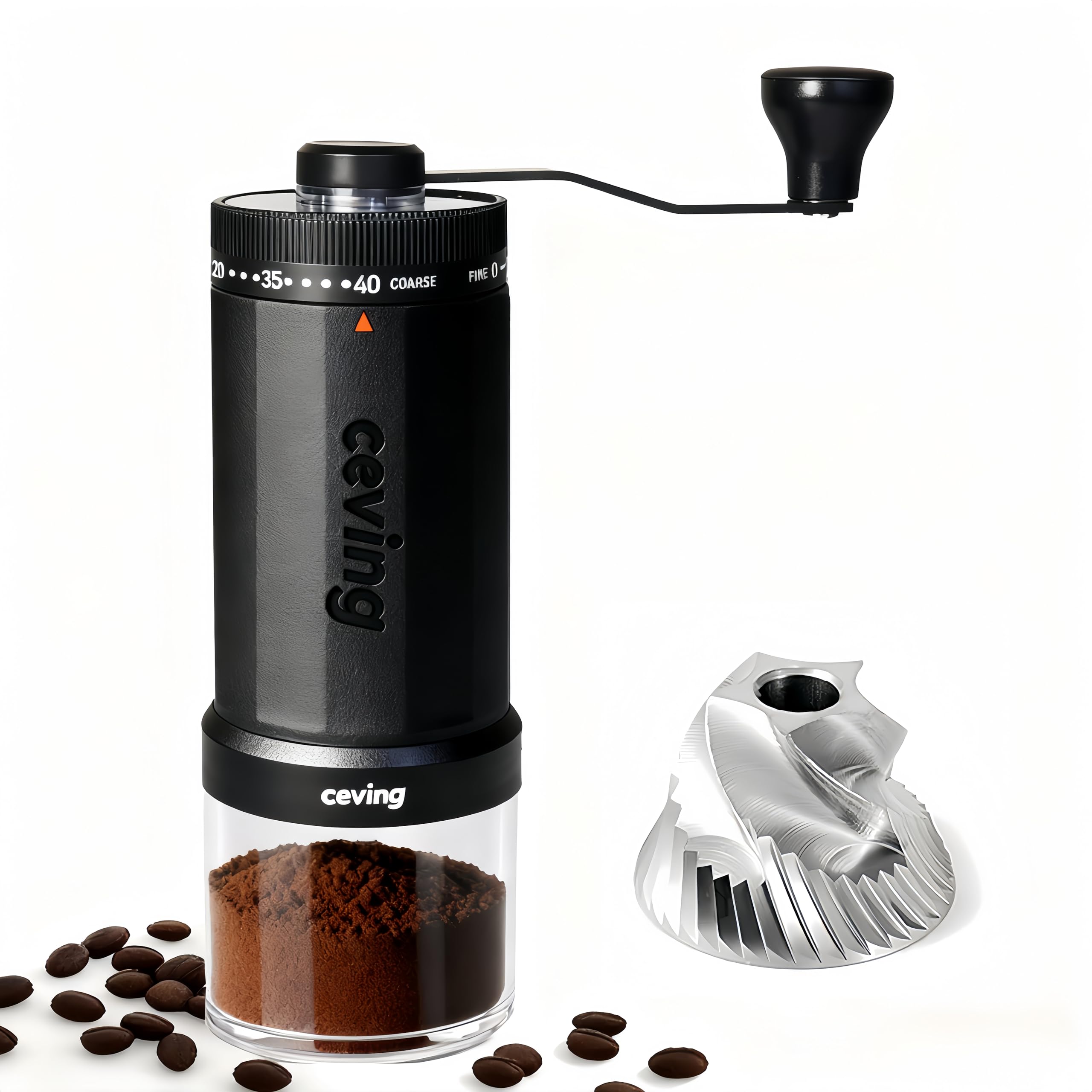
CEVING 60g Manual
Key Features
- Burr Type: Stainless steel conical
- Grind Settings: 40 settings
- Noise Level: Manual (no motor)
- Motor Power: None (manual)
- Capacity: 60g
- Price: Budget
With a 60g capacity that doubles most manual grinders, the CEVING can grind enough for a full pot or multiple cups without stopping to refill. The 40 external adjustment settings let you dial in from espresso to cold brew with clear clicks, and the stainless steel conical burr delivers consistent particle size for most brew methods.
This grinder suits campers, travelers, or anyone who wants a single manual tool for group coffee without paying for an electric model. The tradeoff is that the handle knob has shown signs of loosening or breakage after several months of regular use, so it’s worth checking the assembly and considering a spare if you rely on it daily.
Pros
- 60g capacity – enough for a full 12-cup brew or several servings at once
- External grind adjustment with 40 settings, clearly marked and easy to change
- Sturdy stainless steel and aluminum build for the price point
Cons
- Handle knob may loosen or break after several months of use, depending on unit variance
A practical choice if you need a large-capacity manual grinder on a budget, but plan to keep an eye on the handle hardware over time.
Best for Quiet Drip Electric
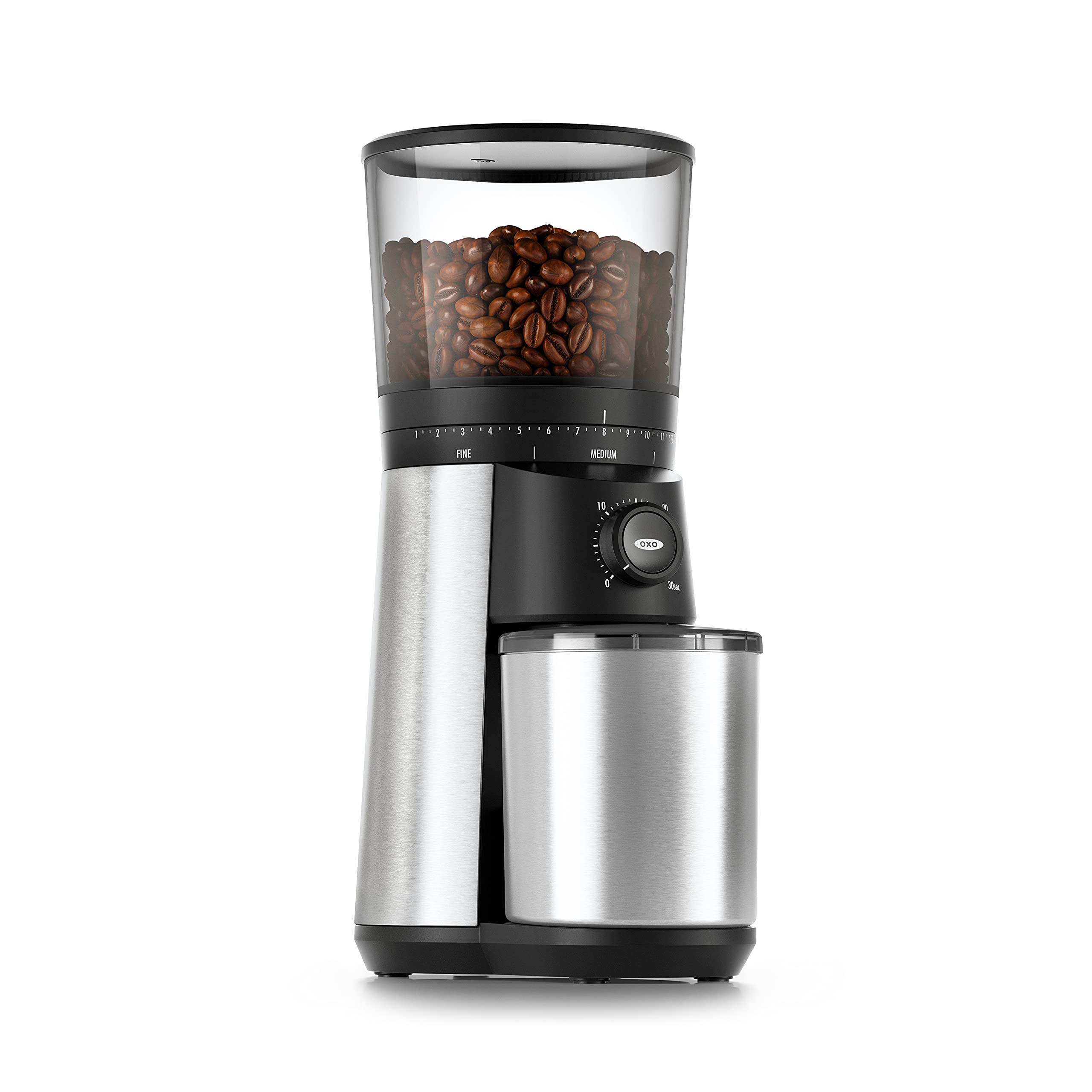
OXO Brew Conical Burr
Key Features
- Burr Type: Stainless steel conical
- Grind Settings: 15 + micro-adjust
- Noise Level: Quiet
- Motor Power: 100W DC
- Capacity: 12 oz
- Ease of Cleaning: Anti-static
- Price: Mid-Range
The OXO Brew Conical Burr grinder delivers quiet, consistent grounds for drip and French press brewing, with an anti-static bin that minimizes mess. The motor and burr assembly can jam after months of use, so an extended warranty is worth considering.
Pros
- Quiet operation for a low-distraction morning routine.
- Consistent grind for drip and French press brewing.
Cons
- Finest setting may be too coarse for espresso machines.
Best for drip coffee drinkers who value quiet and clean operation and are prepared for possible motor issues — an extended warranty is recommended.
Best for Precise Dose Control
Breville Smart Grinder Pro

Key Features
- Burr Type: Conical burr
- Grind Settings: 60
- Noise Level: Loud
- Motor Power: 165W
- Capacity: 18 oz
- Price: Premium
With 60 grind settings and precise programmable dosing, the Smart Grinder Pro gives home baristas fine control across brew methods. Burr consistency is good for most drip and espresso grinds. However, the motor is loud enough to disturb quiet mornings, and some units may develop motor or electronic issues after months of use. The premium price and potential reliability concerns keep it below our top picks, but for buyers who prioritize grind customization over longevity, it delivers.
Pros
- Wide range of grind settings for precise control from espresso to French press.
- Programmable dosing with intuitive controls simplifies daily use.
Cons
- Motor noise may disturb others during early-morning grinding.
- Some units may experience motor or electronic issues after several months of use.
Best for home baristas who value grind precision over quiet operation and long-term durability.
Best for Portable Manual Grinder
TIMEMORE Chestnut C2S

Key Features
- Burr Type: CNC stainless conical
- Noise Level: Manual (no motor)
- Motor Power: None (manual)
- Capacity: 25g
- Price: Mid-Range
The TIMEMORE Chestnut C2S offers a full metal body and consistent grind for pour-over and French press at a lower price than premium manual grinders. Its 25g capacity suits single servings, and the double bearings keep turning smooth. However, the handle can break after months of use, and the small capacity limits batch grinding. These issues push it behind the KINGrinder K6 for those wanting long-term durability or larger batches, but it remains a solid choice for budget-conscious coffee enthusiasts who prioritize grind consistency over handle longevity.
Pros
- Full metal body with CNC stainless steel burrs provides stable, consistent grinding.
- Uniform grind size for pour-over and French press often rivals electric grinders.
Cons
- Handle may break after several months of regular use, requiring replacement.
- 25g capacity limits grinding to single servings only.
Best for coffee drinkers who make one cup at a time and want a budget-friendly manual grinder with consistent results, provided handle wear is acceptable.
Best for Foldable Precision Manual
TIMEMORE C3S Pro

Key Features
- Burr Type: Hexagonal conical burr
- Grind Settings: 36
- Noise Level: Manual (no motor)
- Motor Power: None (manual)
- Capacity: 25-30g
- Price: Mid-Range
The C3S Pro combines a stainless steel S2C conical burr with 36 grind settings and a foldable crank, offering the precision and portability manual enthusiasts want. Grind consistency holds up well across brew methods, from espresso to pour-over. However, the plastic retaining ring beneath the lower burr can crack after months of use, leaving the grinder inoperable. At this price, the KINGrinder K6 delivers similar performance with fewer durability concerns.
Pros
- Solid stainless steel burr and robust construction feel premium in hand.
- Grind uniformity holds from fine espresso to coarse cold brew.
Cons
- Single-dose capacity (25-30g) means refilling for more than one cup.
- Plastic retaining ring under the lower burr can crack over time, potentially making the grinder unusable.
Ideal for coffee lovers who prioritize travel-friendly design and precise adjustment, provided they accept the risk of the plastic ring issue and don’t mind the higher cost versus alternatives like the KINGrinder K6.
Best for Professional Grind Uniformity
Baratza Virtuoso+

Key Features
- Burr Type: Conical steel burrs
- Grind Settings: 40
- Noise Level: Loud
- Motor Power: 70W DC
- Capacity: 230g
- Price: Premium
The Virtuoso+ delivers consistent grind quality across 40 settings, backed by a heavy-duty motor that handles daily use. The motor is audible in quiet spaces, which may be less of an issue in a busy kitchen. The price is high for a home grinder, but Baratza’s parts support extends its lifespan. These tradeoffs make it a niche choice for enthusiasts who value grind uniformity and repairability over quiet operation or budget.
Pros
- Consistent grind uniformity across all 40 settings
- Solid build quality with a heavy-duty motor that supports long-term use
Cons
- In quiet spaces, the motor noise is present – less noticeable in a busy kitchen
- The premium price reflects its build quality and support, but may be more than casual users want to spend
Best for home baristas who want precise grind control and will accept the noise and cost for consistent results and long-term repairability.
Best for Entry-Level Repairable
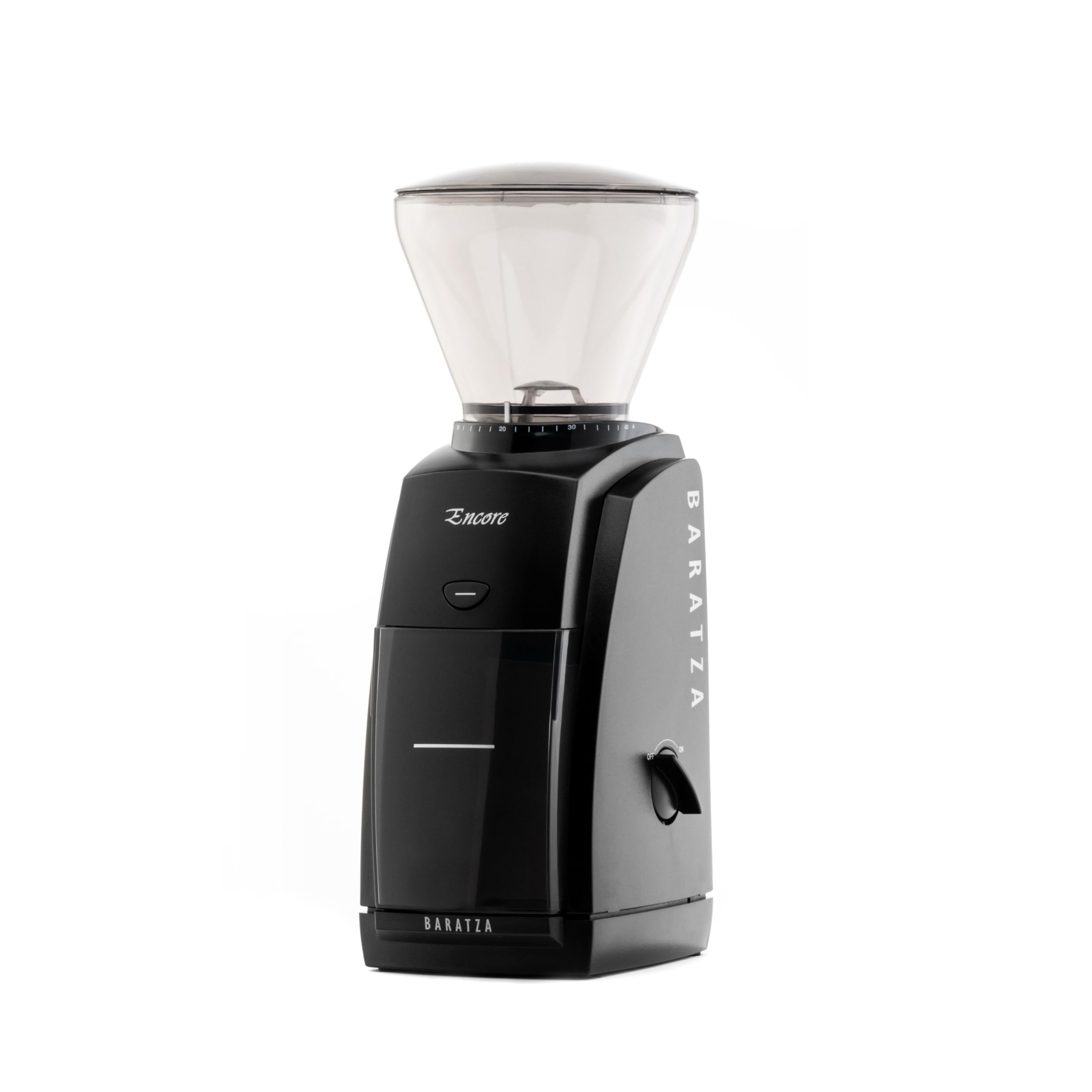
Baratza Encore
Key Features
- Burr Type: Commercial conical
- Grind Settings: 40
- Noise Level: Loud
- Motor Power: 70W DC
- Capacity: 5 oz
- Price: Mid-Range
The Encore delivers consistent grind quality for drip and pour-over brewing, with simple controls and a pulse button. Baratza’s part availability and support make repairs possible if needed. However, motor failure and clogging are possible, and the grinder is noticeably loud at finer settings—drawbacks that quieter and more consistent competitors like the Ollygrin address at a lower price. For those who prioritize repairability and brand support over silence and durability, this remains a functional entry-level choice.
Pros
- Consistent grind quality for drip and pour-over brewing.
- Simple pulse button and easy controls.
Cons
- Noisy operation, especially at finer grind settings.
- Motor failure and clogging can occur within months of use.
A suitable pick for budget-conscious buyers who prioritize part availability and simple operation over quietness and long-term reliability—best for drip coffee, not espresso.
Best for Budget Anti-Static Electric
SHARDOR Burr Grinder

Key Features
- Burr Type: Stainless steel conical
- Grind Settings: 48
- Noise Level: Quiet
- Motor Power: 150W
- Capacity: 9.7 oz
- Ease of Cleaning: Anti-static
- Price: Budget
The SHARDOR offers a touchscreen timer, 48 grind settings, and anti-static technology at a budget price — a compelling package for casual coffee enthusiasts upgrading from a blade grinder. Grind consistency is good for drip and French press, and it runs quieter than many similarly priced models. However, some units can display E3 error codes after months of use, and customer support response may be inconsistent. This makes it a better fit for those who don’t require years of daily service.
Pros
- Good grind consistency for drip and French press at this price point
- Quieter operation than similarly priced electric burr grinders
Cons
- After months of use, some units may display E3 error codes with limited customer support responsiveness
Best suited for casual coffee drinkers who want a feature-rich electric grinder at a low price and are comfortable accepting a potential reliability tradeoff for the value.
How to Choose
The most important buying insight is that grind consistency and durability depend more on burr type and motor design than on the number of grind settings.
Burr Type: Conical vs Flat
Conical burrs are the standard for home grinders because they produce uniform grounds with less noise and heat than flat burrs. Flat burrs, common in commercial setups, offer a sharper particle distribution but require more powerful motors and are louder.
For most home brew methods—pour-over, drip, French press, and even espresso—a conical burr grinder is the practical choice. Flat burrs only make sense if you’re chasing the final 5% of espresso consistency and have a higher budget.
Grind Settings
More settings don’t automatically mean better coffee. The actual range and step size matter: a fine 10-micron step per click allows precise dial-in for espresso, while a 50-micron step is fine for drip but frustrating for espresso.
Look for grinders with at least 30 settings if you switch brew methods, or 40+ if espresso is in your rotation. Manual grinders often offer finer adjustment (e.g., 16-micron steps) than electrics at the same price.
Noise Level
Electric burr grinders with direct-drive motors are typically loudest, while gear-reduction motors cut noise significantly. A gear-reduction motor spins slower with more torque, producing a low rumble instead of a high-pitched screech.
If you grind early in the morning or share a thin-walled apartment, prioritize grinders with gear-reduction motors or manual operation. Manual grinders are essentially silent beyond the sound of beans cracking.
Motor Power and Reliability
Motor power in electric grinders ranges from 70W to 165W. Higher wattage doesn’t guarantee durability—many 150W units fail faster than well-designed 70W motors with thermal protection. The weak link is often plastic gears or poorly shielded electronics.
Grinders with overheat shutdown and replaceable parts (like Baratza or some newer budget models) are safer bets. Manual grinders eliminate motor risk entirely, using steel shaft and bearings that can last decades with basic care.
Capacity
Bean hopper size dictates how many cups you can grind at once. A 10-ounce hopper holds about 280g of beans, enough for 20 cups of drip coffee. Manual grinders typically hold 25-35g—enough for one large French press or two espresso shots.
If you regularly brew for more than two people, an electric with a 12-ounce hopper saves time. For single servings or travel, a 25-30g manual grinder is more compact and delivers fresher grounds per batch.
Ease of Cleaning
Static cling makes grounds fly everywhere when you empty the bin. Anti-static coatings or metal bins reduce this mess significantly. Removable upper burrs allow you to brush out retained grounds without disassembling the whole unit.
For electric grinders, look for models where the upper burr twists off easily and the chute is accessible. Manual grinders are simpler to clean—just unscrew the catch cup and brush the burrs. Regular cleaning prevents stale oil buildup that affects flavor.
FAQ
Why does my burr coffee grinder stop working after a few months?
Most failures are due to motor burnout from overheating or plastic gear stripping. Grinders with gear-reduction motors and thermal protection last longer, but the surest way to avoid this is to buy a manual grinder—no motor to fail. If you prefer electric, check reviews for recurring motor failure patterns before buying.
Can a $60 burr grinder produce fine enough grind for espresso?
Rarely. Most budget electric grinders cannot grind fine enough for true espresso—they produce particles too large for proper extraction pressure. Manual grinders in the $60–$100 range, like the KINGrinder K6, can achieve espresso-fine consistency with enough adjustment steps. For electric, you need to spend at least $150 to get reliable espresso grind.
How much noise should I expect from a conical burr grinder?
It varies widely. Direct-drive electric grinders (e.g., Breville, Baratza Encore) measure 75–85 dB—similar to a vacuum cleaner. Gear-reduction models (e.g., Ollygrin, KitchenAid, Capresso) run 60–65 dB, comparable to a conversation. Manual grinders are nearly silent. If noise is a concern, prioritize gear-reduction electric or go manual.
Are manual coffee grinders better than electric for grinding consistency?
At the same price point, yes. A $100 manual grinder typically produces more uniform grounds than a $100 electric because it uses precision bearings and rigid metal construction instead of plastic parts and underpowered motors. The trade-off is physical effort and smaller batch size. For espresso, manual grinders under $150 often outperform electrics at $200.