This post contains affiliate links. We may earn a small commission when you buy through our links — at no extra cost to you.
Pour-over coffee demands a consistent medium grind – too fine and you get bitterness, too coarse and extraction is weak. Many electric burr grinders under $80 promise this but deliver motor failure or uneven grinds within months.
That’s where manual grinders often shine: they use simpler mechanisms that produce fewer fines and last longer. But not everyone wants to hand-grind every morning. This guide focuses on the grinders – both manual and electric – that actually hold up to daily use and deliver the uniform particle size pour-over requires.
Whether you prioritize speed or precision, the right choice comes down to understanding what each design sacrifices. Our picks reflect the real trade-offs between convenience and consistency.



Best for Pour-Over & Aeropress
KINGrinder K6 Manual
Key Features
- Grind Consistency: 16 micron steps
- Durability: All-metal body
- Grind Settings: External, 60 clicks
- Noise Level: Silent
- Cleaning & Anti-Static: Removable burr
- Price: $$
The KINGrinder K6 delivers consistently uniform grounds for medium-coarse pour-over brews, with the external 60-click adjustment providing precise control over particle size. The all-metal chassis keeps the stainless steel conical burrs steady, resulting in fewer fines than many electric grinders at similar prices. Static cling is minimal, so the grounds pour cleanly into the brewer.
Grinding a full 35g batch takes about 45 seconds with moderate effort – a reasonable trade-off for the grind quality. The straight handle offers a comfortable grip, and the assembly feels solid with no wobble. For larger batches, you’ll need to grind twice, but the grind retention is low enough that the second batch doesn’t noticeably differ.
This grinder is best suited for the pour-over enthusiast who values consistency and durability over speed. It’s not for someone who needs to grind a full pot each morning with one hand – the manual effort and batch size are clear boundaries. But if you’re willing to spend a minute per brew, the K6 offers the strongest grind uniformity at its price point.
Pros
- Produces exceptionally uniform grounds with minimal fines for better flavor extraction.
- Full aluminum alloy body resists wear and keeps burrs aligned over time.
- Competitively priced for the build quality and grind consistency it delivers.
Cons
- Batch size limited to 25-35g, requiring two grinds for a standard 500ml pour-over pot.
For the pour-over enthusiast seeking consistent grind without the expense of high-end electrics, the K6 delivers precisely what it promises.
Best for Pour-Over & French Press
Ollygrin Electric Burr
Key Features
- Grind Consistency: 40mm conical burr
- Durability: Plastic components
- Grind Settings: 30 settings
- Noise Level: Very quiet
- Cleaning & Anti-Static: Removable burr
- Price: $
Ollygrin’s electric burr grinder delivers unusually quiet operation for a budget electric—easily used early morning without waking the household. Its 30 grind settings span fine to coarse, with medium settings producing consistent, low-fines particles ideal for pour-over and French press. The 40mm stainless steel conical burr handles medium roasts efficiently, and the quiet motor makes it a standout in shared living spaces.
This grinder suits the budget-conscious home brewer who wants plug-in convenience and quiet mornings. The plastic construction keeps costs low but means the unit may show wear under heavy daily use over years—a tradeoff acceptable for moderate brewing. Those needing all-metal durability or espresso-grade precision should look to the manual top pick or higher-end electrics.
Pros
- Operates quietly enough for early-morning use without disturbing others.
- Grind consistency is good for medium settings, with minimal fines for pour-over and French press.
- Strong value for the price compared to other electric burr grinders.
Cons
- Plastic components may show wear over years of heavy daily use, limiting longevity versus all-metal grinders.
For pour-over brewers on a budget who prioritize quiet operation and electric convenience over all-metal durability, the Ollygrin delivers a satisfying balance of performance and cost.
Best for Pour-Over & Aeropress
TIMEMORE C3S Pro Manual
Key Features
- Grind Consistency: S2C burr 55-58 HRC
- Durability: Plastic retaining ring
- Grind Settings: 36 levels
- Noise Level: Silent
- Cleaning & Anti-Static: Removable burr
- Price: $$
The foldable handle and S2C conical burr set the TIMEMORE C3S Pro apart from entry-level manual grinders — it delivers noticeably more uniform particles in a package that slips into a bag. The all-metal body and 36 grind settings give it a premium feel that matches its mid-range price.
Pour-over and Aeropress users who value grind quality and portability will find the C3S Pro well-suited for daily brewing at home or on the road. Keep in mind that a plastic retaining ring inside can crack after months of use, which may render the grinder inoperable — a limitation worth weighing if you expect to grind several times a day for years.
Pros
- Superior grind uniformity from the S2C burr reduces fines and improves extraction consistency.
- Foldable handle and compact design make it easy to pack for travel without sacrificing performance.
- Aluminum alloy body and smooth adjustment mechanism give a solid, well-built feel.
Cons
- The plastic retaining ring inside can crack after extended use, causing the grinder to stop working.
For travelers and pour-over enthusiasts who prioritize grind quality and portability over heavy daily use longevity, the C3S Pro delivers where it counts.
Best for Espresso & Pour-Over
Breville Smart Grinder Pro
Key Features
- Grind Consistency: 40mm conical burr
- Durability: Brushed stainless steel
- Grind Settings: 60 settings
- Noise Level: Moderately loud
- Cleaning & Anti-Static: Removable burr
- Price: $$$
The Breville Smart Grinder Pro brings 60 grind settings and a digital timer to the counter, letting you dose directly into a portafilter or a pour-over cone with repeatable accuracy. The range covers everything from fine espresso to medium pour-over, and the grind quality holds up well across the spectrum — minimal fines and acceptable uniformity for the price point.
This grinder suits home baristas who switch between brew methods and want programmability over manual effort. The catch: some units may develop motor issues or jamming within the first year, so it’s a better fit if you value convenience and are comfortable with a degree of unit variance. Noise level is higher than some alternatives — noticeable in a quiet kitchen during early mornings.
Pros
- Digital timer and 60 settings allow repeatable dosing for espresso and pour-over.
- Grinds directly into portafilter or cone with included cradle — minimal transfer mess.
- Grind quality is suitable for most brew methods with limited fines at medium settings.
Cons
- In a quiet morning kitchen, the motor noise is present — less of an issue in busier spaces.
- Some units may encounter motor or jamming issues within the first year of use.
If your top priority is programmability across brew methods and you can accept the possibility of early mechanical issues, the Smart Grinder Pro delivers on feature depth. For those who prefer a no-worry experience with a consistent pour-over grind, a manual grinder in this price range is a steadier path.
Best for Pour-Over & Drip
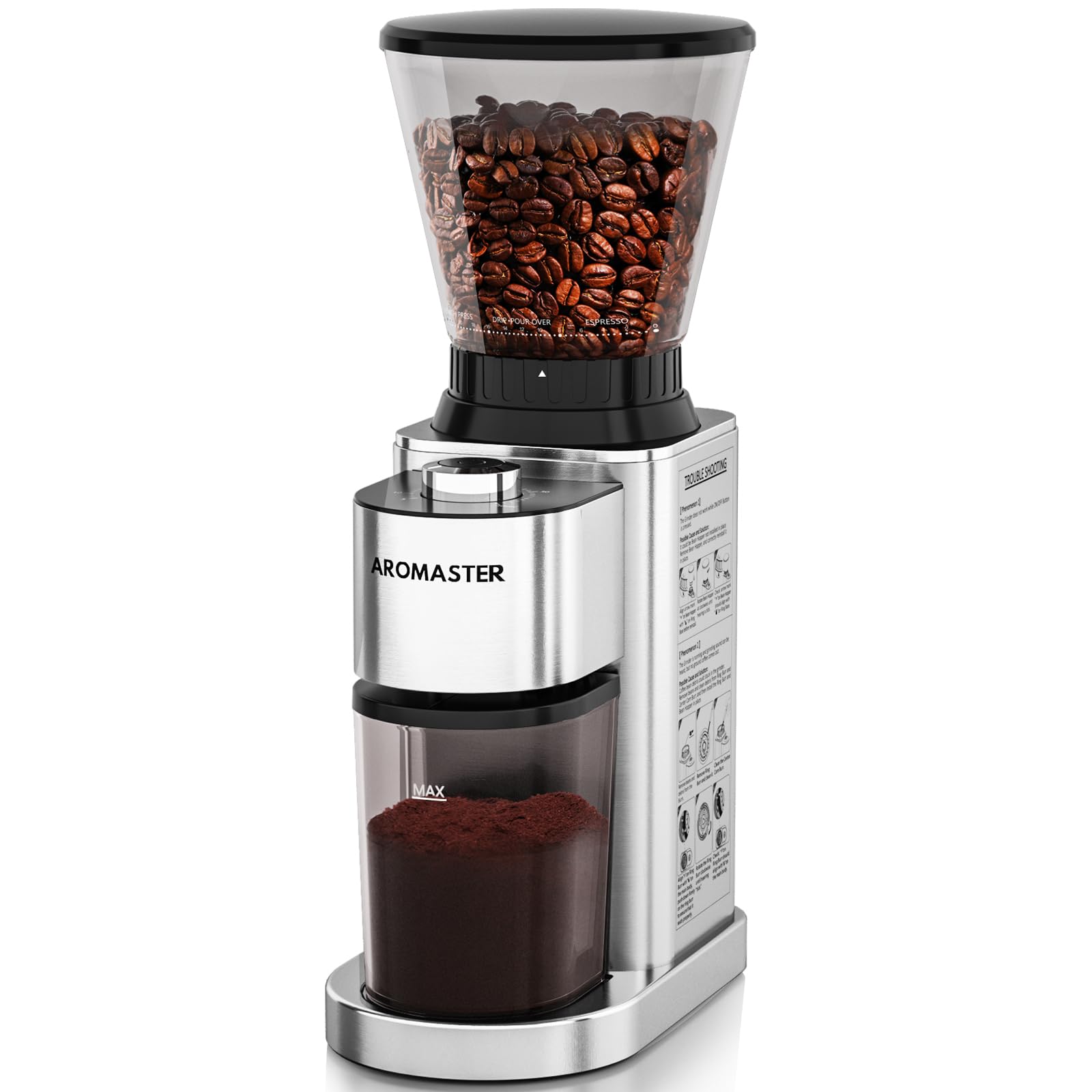
Aromaster Electric Burr
Key Features
- Grind Consistency: Stainless steel conical
- Durability: Stainless steel
- Grind Settings: 48 settings
- Noise Level: Very quiet
- Cleaning & Anti-Static: Anti-static, removable
- Price: $
Quiet enough to use while others are asleep, and the anti-static bin keeps coffee grounds from scattering across the counter — the Aromaster avoids two common annoyances of electric grinders. Its 48 settings cover pour-over and drip ranges well, though the finest end won’t satisfy espresso demands. The stainless steel conical burrs produce consistent medium grinds without the noise typical of budget models.
This grinder suits pour-over brewers who value a quiet morning routine and hate cleaning up static mess. The 3.9-ounce hopper handles a single pour-over batch (three to four cups) without refilling. During extended grinding sessions, the motor may overheat and pause temporarily — a known behavior that matters more if you grind multiple large batches back-to-back.
Pros
- Very quiet operation – won’t disturb a sleeping household during early morning brews.
- Anti-static container reduces coffee residue clinging to the bin and countertop.
- Easy to clean – accessible burrs and minimal retention simplify maintenance.
Cons
- Hopper holds only 3.9 oz – larger batches require multiple refills and cycles.
- Motor may shut down temporarily during prolonged grinding to cool off, interrupting workflow.
For pour-over drinkers who prioritize quiet and clean operation over manual-grinder build quality, the Aromaster delivers consistent medium grind at a budget price — just keep batch sizes modest to avoid thermal pauses.
Best for Pour-Over & French Press
TIMEMORE C2S Manual
Key Features
- Grind Consistency: 38mm conical burr
- Durability: Full aluminum alloy
- Grind Settings: 36 levels
- Noise Level: Silent
- Cleaning & Anti-Static: Removable burr
- Price: $$
The TIMEMORE C2S pairs a full aluminum alloy body with a 38mm CNC stainless steel conical burr that produces even medium grinds for pour-over and French press. At this price point, few manual grinders match its grind uniformity and solid build heft. The internal 36-click adjustment lets you dial in pour-over settings without guesswork.
Best suited for the home brewer making two to three cups daily, the 25g capacity handles single batches comfortably. Over months of regular use, some owners find the handle may loosen or wear—worth checking periodically if you grind daily. Travelers will appreciate the compact size, though the metal body adds weight compared to plastic alternatives.
Pros
- Full metal construction feels solid and resistant to wear over time.
- Grind consistency yields minimal fines, making pour-over and French press results predictable.
- Cost-effective entry point into precision manual grinding without sacrificing output quality.
Cons
- Handle assembly can loosen after extended daily use; occasional tightening may be needed.
For pour-over drinkers who want burr precision on a budget and don’t mind a minor maintenance check, the C2S delivers where many electrics fall short.
Best for Pour-Over & Drip
Baratza Virtuoso+

Key Features
- Grind Consistency: 40mm commercial-grade
- Durability: Metal top and base
- Grind Settings: 40 settings
- Noise Level: Loud
- Cleaning & Anti-Static: Removable burr
- Price: $$$$
The Baratza Virtuoso+ offers the grind uniformity that pour-over demands, with 40 settings and a digital timer for repeatable dosing. Its metal top and base feel substantial. However, the motor runs louder than many alternatives, and some units develop motor or electronic issues after a year or two — a risk that makes this a better fit for hobbyists who value the ability to swap burrs and mod the grinder, rather than buyers seeking a low-maintenance daily driver.
Pros
- Uniform grind across all 40 settings for consistent pour-over extraction.
- Solid metal construction that holds up to daily use without flexing.
Cons
- Noise level is higher than average, which may be noticeable during early morning grinding.
- Some units have displayed motor or electronic failures after one to two years of use, making long-term durability uncertain.
If you’re a dedicated home barista who values grind precision and intends to explore modding, the Virtuoso+ rewards your investment — but it’s not the quietest or most carefree choice in this range.
Best for Pour-Over & Drip
Capresso Infinity Plus

Key Features
- Grind Consistency: Solid steel conical
- Durability: Solid steel
- Grind Settings: 16 settings
- Noise Level: Very quiet
- Cleaning & Anti-Static: Removable burr
- Price: $$
The Capresso Infinity Plus combines a notably quiet operation with a solid steel conical burr that delivers consistent medium grinds suitable for pour-over. Its 16 settings cover the necessary range, and many owners find it holds up well over time. However, grind consistency becomes less uniform at coarser settings, and static buildup can scatter grounds when opening the bin. These limitations, while manageable for most pour-over brewers, explain why it falls short of top picks in grind precision.
Pros
- One of the quietest electric grinders at this price.
- Grind quality is solid for the price, suitable for medium-coarse pour-over settings.
Cons
- Static buildup can cause grounds to scatter when opening the bin, creating a messy counter.
A good fit for pour-over brewers who prioritize quiet operation and can tolerate occasional static mess in exchange for steady grind quality at a moderate price.
Best for Pour-Over & Drip
SHARDOR Electric Burr

Key Features
- Grind Consistency: Conical stainless steel
- Durability: Conical stainless steel
- Grind Settings: 48 settings
- Noise Level: Quiet
- Cleaning & Anti-Static: Anti-static
- Price: $
The SHARDOR delivers consistent medium grinds for pour-over and drip brewing with minimal mess thanks to its anti-static design. It runs quieter than most budget electrics. However, a portion of units may develop an E3 motor error after months of use, requiring disassembly to clear — a risk that makes this better suited for lighter use where long-term reliability is less critical.
Pros
- Good grind consistency for pour-over and drip brewing.
- Quieter than many budget electric grinders.
Cons
- Occasional E3 error may require disassembly to clear after months of use.
Best for pour-over and drip users on a tight budget who can accept the risk of a possible motor error down the line.
Best for Camping & Large Batches
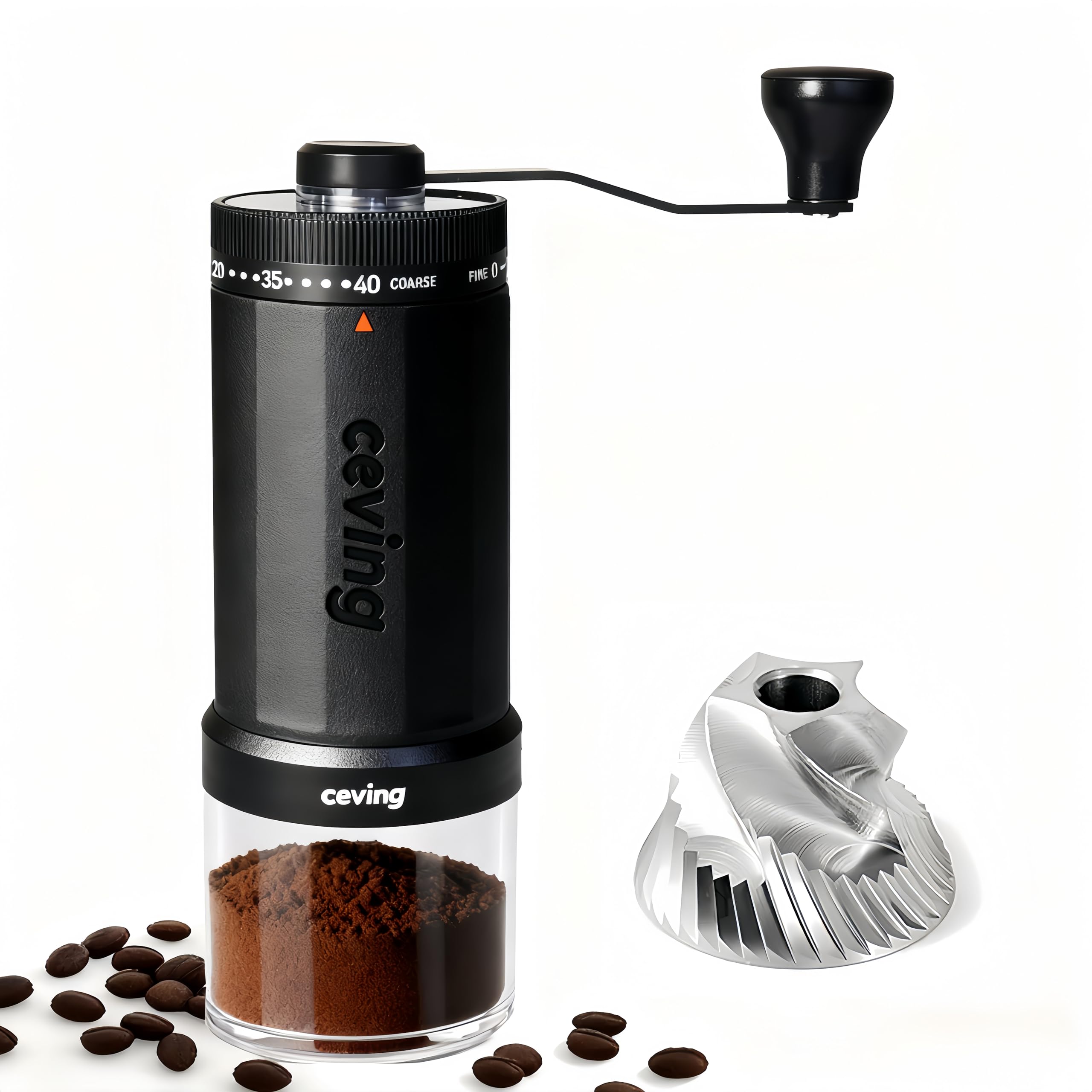
CEVING 60g Manual
Key Features
- Grind Consistency: CNC stainless steel
- Durability: Aluminum/stainless
- Grind Settings: 40 settings
- Noise Level: Silent
- Cleaning & Anti-Static: Removable burr
- Price: $
The CEVING 60g manual grinder delivers an unusually large capacity for a hand-crank model, making it possible to grind enough coffee for several pour-overs at once. Its 40 external settings and stainless steel burr provide sufficient adjustability for medium grind. However, the handle knob has been noted to break after the return window, and the overall fit and finish are less refined than pricier options. This grinder suits campers or households needing multiple cups without spending much, or anyone wanting to test manual grinding without a big investment.
Pros
- Huge 60g capacity for a manual grinder
- Great value for the price
Cons
- Handle knob can break after the return window
Best suited for those who want a large-capacity manual grinder for occasional use or camping, and who are willing to accept minor build compromises for the price.
Best for Travel & Camping
Alpaca Manual Grinder

Key Features
- Grind Consistency: 420 stainless steel
- Durability: Aluminum/steel
- Grind Settings: Internal dial
- Noise Level: Silent
- Cleaning & Anti-Static: Removable burr
- Price: $
This manual grinder offers solid grind consistency for its price, making it a capable option for occasional pour-over brewing. The aluminum and steel body feels sturdier than many similarly-priced competitors. However, grind precision is not on par with higher-end manuals, and some units may produce a squeaking noise or develop a loose handle over time. It’s best suited for travelers or beginners who want to try manual grinding without spending much.
Pros
- Decent grind consistency for the price
- Compact and lightweight for portability
Cons
- Grinding can produce a squeaking noise in some units
- Handle may loosen with extended use
Works well for the traveler or budget-curious beginner who can accept minor mechanical quirks and doesn’t need espresso-level uniformity.
How to Choose
For pour-over, grind consistency matters more than speed – manual grinders often deliver better uniformity than electrics at similar prices.
Grind Consistency
The most critical factor for pour-over is uniform particle size. Conical burrs with tight manufacturing tolerances produce fewer fines (dust) and fewer boulders, leading to even extraction. Manual grinders with external adjustment rings allow you to dial in the exact medium setting pour-over requires.
Electric grinders with gear reduction motors tend to produce more consistent grinds than direct-drive models. Look for a burr set rated above 55 HRC (Rockwell hardness) – softer burrs wear faster and create more variation over time.
Durability
The motor or crank mechanism is the first thing to fail in budget electrics. Gear reduction motors last longer than high-RPM direct-drive motors, but even they can jam if beans are oily or the burrs are misaligned. Manual grinders have fewer moving parts – a solid metal body and stainless steel shaft are signs of longevity.
Plastic components inside grinders (like retaining rings or gear housings) are common failure points. All-metal internals, especially in the adjustment mechanism, directly translate to years of trouble-free use.
Grind Settings
More settings don’t always mean better precision – what matters is the step size between clicks. External adjustment rings with numbered clicks (like 60 per revolution) let you repeat a specific setting easily. Internal adjustments require disassembly and are less convenient for switching between brew methods.
For pour-over, you need enough granularity to fine-tune between a 15 and 20 on most grinders. A range of 30+ settings with micro-adjustments gives you the ability to compensate for bean freshness and brew time.
Noise Level
Electric grinders with gear reduction motors are significantly quieter than direct-drive models. The Ollygrin and Aromaster are notably hushed, while the Breville and Baratza Encore are louder. Manual grinders produce almost no noise beyond the crunching of beans.
If you brew early in the morning or live with light sleepers, noise level becomes a practical constraint. A manual grinder or a quiet electric model prevents waking the household.
Ease of Cleaning
Coffee oils build up inside the burr chamber and can become rancid, affecting flavor. Models with removable burrs and a brush-accessible chamber are much easier to clean. Anti-static technology (like ionizers or conductive plastics) reduces the amount of coffee stuck to the container and counter.
Static is a common annoyance – it causes grounds to fly out when you open the bin. Look for grinders that explicitly mention anti-static design, often indicated by a metal catch cup or grounding mechanism.
FAQ
Why does my electric burr grinder keep jamming?
Jamming usually happens when oily, dark-roast beans stick to the burrs or when the grind setting is too fine for the motor to push through. Clean the burrs with a brush every week and run a handful of uncooked rice through the grinder to absorb oils. If jamming persists, the motor may be underpowered or the burrs misaligned.
Can a manual coffee grinder produce a consistent grind for pour-over?
Yes. Modern manual grinders with external step adjustment and high-hardness burrs (like the KINGrinder K6 or TIMEMORE C3S Pro) produce grind uniformity that rivals or exceeds electric grinders at twice the price. The trade-off is a minute or two of hand-cranking per cup.
What is the best grind setting for pour-over coffee on a burr grinder?
Start at a medium setting – typically around 15 to 20 on a 40-step scale, or 8 to 10 on a 16-step scale. Adjust based on brew time: if your pour-over finishes in under 3 minutes, go finer; if it takes over 4 minutes, go coarser. The ideal setting varies by bean and brewer, so keep a log.
How do I clean a conical burr coffee grinder without damaging it?
Unplug the grinder and remove the upper burr (most conical grinders allow this). Use a stiff brush to sweep out coffee oils and fines from the burrs and chamber. Never rinse the burrs or motor housing with water – use a dry brush or a vacuum. For electrics, grind a tablespoon of rice to absorb oils, then discard the rice.