This post contains affiliate links. We may earn a small commission when you buy through our links — at no extra cost to you.
A mandoline slicer for potatoes can mean two very different tools: a traditional V-blade slicer for thin chips or a push-down chopper for dicing. Many products blur the line, leaving you with uneven slices or safety concerns.
The right choice depends on your prep style – whether you’re making gratin or french fries. We’ve sorted through the options to find tools that deliver on their promise, balancing sharpness, durability, and safety.
Traditional blades offer precision but require caution; enclosed designs trade maximum thinness for peace of mind. This guide helps you pick based on what matters most for your kitchen.


Best for Thin Slices, Gratin
Mueller Austria Mandoline
Key Features
- Thickness Range: 1-9 mm
- Blade Variety: 5 blades
- Safety Features: Hand guard
- Ease of Cleaning: Dishwasher safe
- Durability: Sturdy plastic
- Price: Mid-Range
The Mueller Austria Mandoline features a V-blade system with a dial that adjusts from 1 to 9 mm, enabling precise control over slice thickness for everything from paper-thin potato chips to hearty gratin layers. The stainless steel blades cut through hard vegetables like potatoes with minimal effort, and the plastic body feels solid enough for regular use.
Cleaning is straightforward on the top rack of a dishwasher, though hand drying is advisable to maintain blade longevity. The included hand guard helps protect fingers during slicing, but the exposed blades demand attention — a category norm rather than a flaw.
This mandoline suits home cooks who value consistent slicing and don’t mind the lack of thickness markings on the dial. If you often switch between thickness settings, you’ll need to test and remember dial positions by feel — a minor inconvenience for the range it offers. Those who want a fully enclosed, cut-proof design should consider a safe slicer instead.
Pros
- Adjustable 1–9 mm thickness dial covers thin chips through thick gratin slices.
- Sturdy build with stable base stays in place during slicing.
- Sharp blades cut through potatoes and hard vegetables cleanly.
Cons
- Thickness dial has no markings, so resetting a preferred thickness requires trial and error.
For consistent potato slicing from chips to gratin without the complexity of a multi-blade system, this Mueller mandoline delivers exactly what a home cook needs at a fair price.
Best for Safe Prep, Fries
ONCE FOR ALL Safe Slicer
Key Features
- Thickness Range: 0.1-8 mm
- Blade Variety: 4 modes
- Safety Features: Enclosed blade
- Ease of Cleaning: Dishwasher safe, brush
- Durability: Sturdy plastic
- Price: Mid-Range
The enclosed blade system eliminates the risk of accidental cuts — a genuine advantage for anyone who has nicked a fingertip on a traditional mandoline. The three blade modes cover thick fries, matchstick, and dicing, though the 0.1–8mm range means thin chips are off the table.
This slicer suits home cooks who batch-prepare thick fries, vegetable sticks, or uniform slices for gratins and stir-fries. The tradeoff: cleaning requires more effort — food lodges in the blade mechanism, and the included brush is essential. If paper-thin potato chips are your goal, look to a classic adjustable mandoline instead.
Pros
- Hidden blade system eliminates finger contact – you never touch the cutting edge.
- Cuts prep time significantly for thick slices and julienne.
- Four interchangeable blade modes handle slicing, dicing, matchstick, and julienne.
Cons
- Food particles can become lodged in the blade housing, making cleaning more time-consuming than open-blade models.
If your priority is safe, fast potato prep for fries and chunky slices, the ONCE FOR ALL delivers — just be prepared for extra cleaning time.
Best for Versatile Dicing
Mueller Pro 12-Blade
Key Features
- Blade Variety: 12 blades
- Safety Features: Hand guard
- Ease of Cleaning: Dishwasher safe
- Durability: Plastic base may crack
- Price: Mid-Range
The Mueller Pro covers more ground than any dedicated slicer: dicing, julienne, standard slices, and even spiralizing come from the same unit. For someone who regularly switches between hash browns, stir-fry strips, and zucchini noodles, that flexibility cuts down on drawer clutter and setup time. The container catches everything directly, so cleanup is mostly a rinse in the dishwasher.
Where this differs from a traditional mandoline is in slice thickness and consistency. The push-down mechanism works best for medium-thick cuts (think 3–6 mm) and does not produce the paper-thin slices a potato chip or gratin requires. For uniform thin potato slices, the top pick Mueller Austria Mandoline with its 1–9 mm dial remains the sharper option.
This suits the home cook who values convenience and blade variety over ultra-thin precision. It handles potatoes, carrots, cucumbers, and soft vegetables capably for everyday meal prep, but the plastic base can crack under repeated heavy pressure – a consideration for anyone who processes large batches several times a week. The blades may also dull faster than stainless steel alternatives, so regular checking is wise.
Pros
- Twelve interchangeable blades for dicing, slicing, julienne, and spiralizing in one unit.
- Sturdy build with a heavy-duty feel that holds up to regular home use.
- Cuts prep time significantly by combining multiple functions and a catch container.
Cons
- Plastic base can crack under heavy pressure or when processing dense vegetables repeatedly.
- Some blades arrive dull or lose edge faster than expected for stainless steel.
A solid choice if you want one gadget to dice, slice, and spiralize without buying three separate tools – just don’t expect it to match a traditional mandoline for thin, uniform potato chips.
Best for Large Produce
Benriner Jumbo
Key Features
- Thickness Range: 0.5-10 mm
- Safety Features: Hand guard
- Ease of Cleaning: Dishwasher safe top rack
- Durability: Plastic body
- Price: Premium
The Benriner Jumbo stands out with a 5-inch-wide slicing surface that accommodates whole cabbages and large melons without repositioning. The Japanese stainless steel blade is sharp from the start, making short work of dense potatoes for chips or gratin. Thickness adjusts in small increments from paper-thin to 10 mm, giving you control over slice uniformity.
This model suits serious home cooks who regularly process large volumes of produce. The premium price reflects its build quality and capacity, though the 5-inch width may still be narrow for very large potatoes — you may need to halve them. It occupies more counter space than the slimmer Benriner standard model, so small kitchens should measure first.
Pros
- Extra-wide surface handles whole cabbages and melons without sliding off.
- Blade is very sharp out of the box, cutting through dense vegetables like taro with ease.
- Fine thickness adjustment from 0.5 to 10 mm with small increments for precise slices.
Cons
- When slicing very large round potatoes, the 5-inch width may require you to cut them in half first.
- The blade adjustment screw can feel stiff, making quick thickness changes less convenient.
Best for home cooks who slice large batches of vegetables and want a wide surface with precise adjustment, as long as counter space allows.
Best for Thin Slices Only
OXO Handheld Mandoline
Key Features
- Thickness Range: 1/2.5/4 mm
- Blade Variety: Fixed blade
- Safety Features: Hand guard
- Ease of Cleaning: Dishwasher safe
- Durability: Solid plastic
- Price: Budget
The OXO Good Grips Handheld Mandoline takes up minimal drawer space with its slim 0.5-inch profile. Where the top pick offers a continuous thickness dial from 1 to 9 mm, this model uses three fixed positions: 1, 2.5, and 4 mm. The rubber grip and stainless steel blade produce clean, even slices on softer vegetables.
This slicer suits light users who need thin slices for salads or garnishes and have limited storage. The fixed blade is not replaceable and can dull when used on hard vegetables like potatoes – it’s better suited for softer produce.
Pros
- Fits neatly in a small drawer with its slim profile and lightweight design.
- Three clearly marked thickness settings make it simple to dial in the slice you want.
- Rubber grip and stainless steel blade feel well-constructed for light periodic use.
Cons
- Thickest setting is only 4 mm – too thin for french fries or thick gratin slices.
A smart space-saving slicer for those who only need thin slices occasionally.
Best for Budget Dicing
Fullstar 6-in-1
Key Features
- Blade Variety: 6 blades
- Safety Features: Push-down safety
- Ease of Cleaning: Dishwasher safe
- Durability: Plastic, may break
- Price: Budget
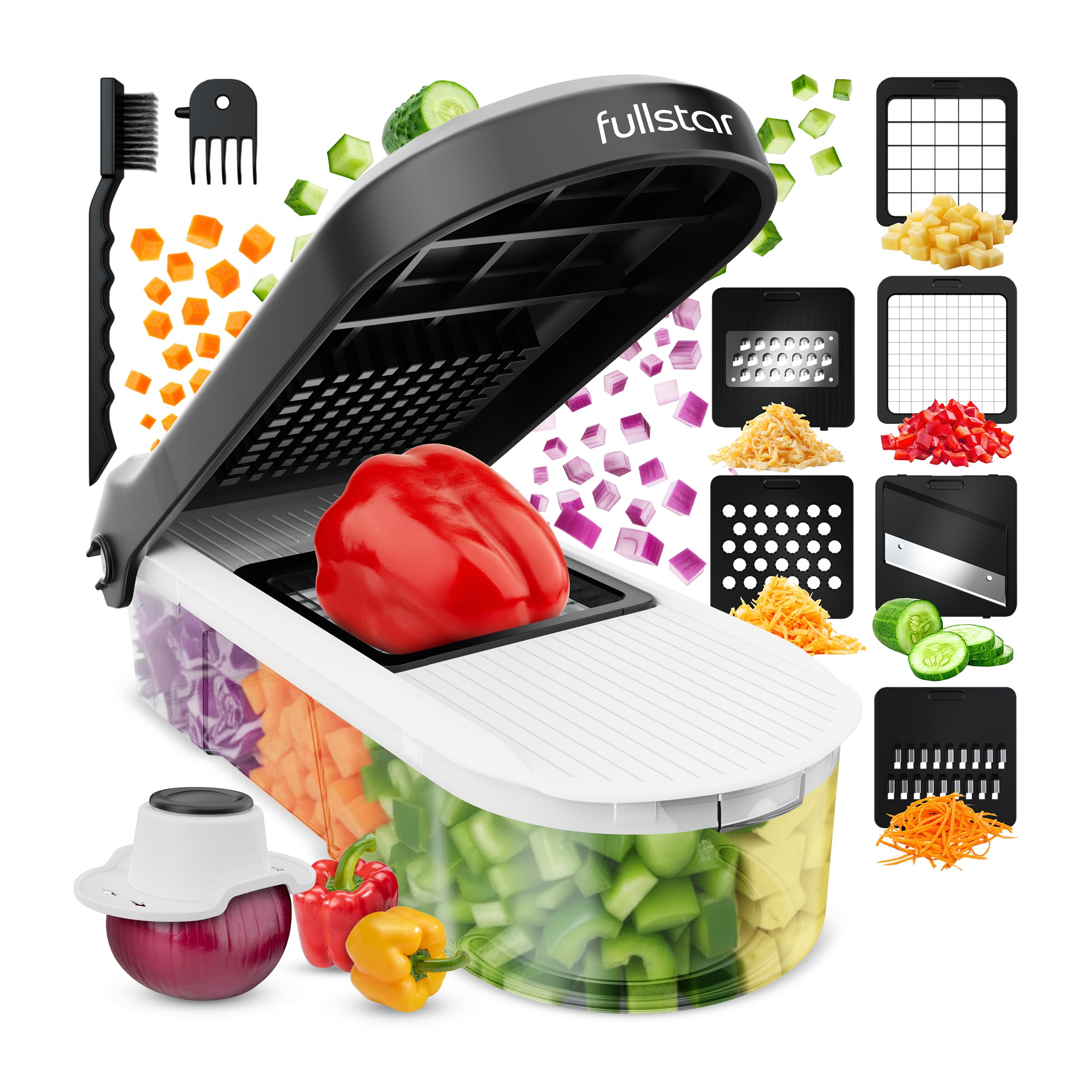
The Fullstar 6-in-1 is a push-down chopper, not a true mandoline, so it’s a poor fit for making uniform potato slices. As a budget option for dicing onions, zucchinis, or other soft produce, it gets the job done quickly. But its plastic parts can break with heavy pressure, and cleaning food out of crevices takes extra effort. Best kept as a backup for small prep tasks, not daily potato work.
Pros
- Low cost makes it an easy entry for new cooks
- Saves time on dicing soft vegetables for quick meals
Cons
- Plastic blade holders can snap under heavy use
- Food gets trapped in corners, making hand washing tedious
Works fine for occasional onion dicing in a budget kitchen, but skip it if you need a reliable potato slicer for regular use.
Best for Chef Thin Slices
Benriner Classic

Key Features
- Thickness Range: Up to 6.3 mm
- Blade Variety: Interchangeable
- Safety Features: Hand guard
- Ease of Cleaning: Hand wash
- Durability: Sturdy plastic
- Price: Mid-Range
The Benriner Classic delivers the precise thin slices professional chefs rely on, with interchangeable blades for julienne and adjustable thickness up to 6.3 mm. However, its 3.5-inch width means larger potatoes and cabbages won’t fit without pre-cutting. The included safety guard is small and can slip during use, making hand protection less assured. This tool suits those who prioritize precision over versatility and are comfortable with hand washing.
Pros
- Industry standard – widely used by professional chefs for consistent results.
- Extremely sharp blades produce paper-thin slices with minimal effort.
Cons
- Narrow 3.5-inch slicing surface requires pre-cutting large items like whole potatoes or cabbage.
- Safety guard is small and may slip during use, requiring extra caution.
Best for cooks who need consistent thin slices for small to medium produce and don’t mind hand washing; skip if you regularly slice large potatoes or cabbages.
Best for Safe Slicing
SupMaKin Safe Slicer

Key Features
- Thickness Range: 0.1-8 mm
- Blade Variety: 4 modes
- Safety Features: Enclosed blade
- Ease of Cleaning: Dishwasher safe
- Durability: Plastic
- Price: Mid-Range
The enclosed blade design removes any risk of cuts, ideal for families or cautious cooks. Setup is quick, and the sturdy feet keep it stable. However, the chute is small—larger potatoes must be halved or quartered before slicing. The price is also higher than the ONCE FOR ALL safe slicer, and cleaning requires extra attention as food can trap under the blade.
Pros
- Very safe – enclosed blade prevents finger contact
- Easy to use and quick setup
Cons
- Cleaning can be tricky – residue gets trapped under the blade
Best for safety-focused home cooks who are willing to pre-cut larger potatoes and put in a bit more cleaning effort.
Best for Soft Veggies Only
PrepSolutions Adjust-A-Slice

Key Features
- Thickness Range: 3 presets
- Blade Variety: Single ceramic
- Safety Features: Hand guard
- Ease of Cleaning: Dishwasher safe
- Durability: Plastic
- Price: Budget
The PrepSolutions Adjust-A-Slice offers an adjustable dial and ceramic blade at a budget-friendly price, making it easy to set thickness for soft vegetables like zucchini or cucumber. However, blade sharpness can be inconsistent from unit to unit, and the slicer struggles with firmer produce such as carrots and potatoes – cuts may be uneven. This is not a suitable tool for potato prep; it works best for occasional use with soft items when cost is the primary concern.
Pros
- Very affordable for basic slicing tasks on soft produce
- Simple dial adjustment for changing thickness
Cons
- Blade sharpness can vary between units, some arriving dull
- Uneven cuts on harder vegetables like carrots and potatoes
For occasional slicing of zucchini or cucumbers on a tight budget, the PrepSolutions works; for potato chips or gratin, look elsewhere.
Best for Paper-Thin Chips
Benriner Old Version

Key Features
- Thickness Range: Max 3 mm
- Blade Variety: 3 julienne inserts
- Safety Features: Hand guard
- Ease of Cleaning: Hand wash
- Durability: Plastic
- Price: Mid-Range
The Benriner delivers razor-thin, consistent slices for tasks like potato chips or salad garnishes, thanks to its sharp fixed blade and compact design. Its ABA plastic and stainless steel build holds up in light professional use, and the small footprint fits easily into a knife bag or drawer. However, the maximum thickness of 3 mm makes it unsuitable for fries or gratin, and the narrow 3.5-inch width requires you to halve or quarter large potatoes before slicing. This is a specialist tool for ultra-thin work, not a general-purpose mandoline.
Pros
- Sharp blade delivers paper-thin slices for precise garnishes and homemade chips.
- Compact and lightweight, easy to store or carry for travel and small kitchens.
Cons
- Max slice thickness of 3 mm limits use to thin cuts only – no fries or thick gratin slices.
- Narrow 3.5-inch width makes slicing large potatoes or cabbages awkward without pre-cutting.
A smart buy if your need is strictly paper-thin slices for small-scale prep, but pass if you want a mandoline that handles thicker cuts or large produce.
How to Choose
The key to choosing the right potato slicer is knowing whether you need thin, consistent slices (traditional mandoline) or fast, safe dicing (push-down chopper).
Thickness Range
Traditional mandolines with a continuous dial (0.5–10 mm) offer fine control but often lack markings, making repeatability tricky. Fixed-step models (1, 2.5, 4 mm) are simpler but limited. For potato chips, you need at least a 1 mm setting; for gratin, 3–4 mm; for fries, 6–8 mm. Enclosed safe slicers usually top out at 8 mm, which is fine for fries but not for paper-thin chips.
Blade Variety
More blades mean more cuts: slices, julienne, grating, dicing. But each additional blade adds complexity in swapping and cleaning. A basic slicer with one blade is simpler; a multi-blade chopper (12 blades) offers versatility but the blades can dull faster. For potatoes, you typically need a slicing blade and a julienne blade for fries. Dicing blades are a bonus if you make hash browns or soups.
Safety Features
Traditional mandolines have exposed blades and require a hand guard or cut-resistant gloves. The guard can slip on small items, so many users prefer enclosed-blade ‘safe’ slicers that eliminate finger contact. However, safe slicers often have a smaller chute, requiring pre-cutting large potatoes. The trade-off is between safety and convenience: enclosed models sacrifice thinness and speed for peace of mind.
Ease of Cleaning
Food particles get trapped in crevices, especially around blade assemblies. Models that fully disassemble or are top-rack dishwasher safe save time. Enclosed safe slicers are notoriously hard to clean because residue hides under the blade mechanism. If you prep potatoes daily, a traditional mandoline that rinses clean in seconds may be better than a safe slicer that requires a brush.
Durability
Many affordable mandolines use plastic hinges that crack under the pressure of dense potatoes. Look for metal reinforcement or a solid one-piece base. The cheapest models may break within months. Spending slightly more ($25–35) typically gets you a sturdier build that lasts years. Benriner models, though plastic, are known for longevity due to simpler design.
FAQ
Why does my mandoline slicer blade get dull so fast when cutting potatoes?
Potatoes are hard and contain starch that accelerates blade dulling. Use a sharp blade and avoid cheap steel. Some models allow blade replacement; for others, hand sharpening or replacement is not possible. If your blade dulls quickly, consider a model with replaceable blades or a premium stainless steel blade.
How do you clean a mandoline slicer without cutting yourself?
Use the included safety guard or cut-resistant gloves when washing. Disassemble the slicer and rinse immediately after use to prevent food from drying. For enclosed models, use the cleaning brush and run under hot water. Never touch the blade edge directly.
Can a push-down vegetable chopper replace a traditional mandoline for slicing potatoes?
No – push-down choppers dice or roughly slice, but cannot produce the thin, uniform slices needed for chips or gratin. For even slicing, a traditional V-blade mandoline is required. If you primarily need dicing, a chopper is fine; if you need thin slices, buy a mandoline.
What is the best thickness setting for homemade potato chips on a mandoline?
1–2 mm for crispy chips; 2–3 mm for thicker, kettle-style chips. Set the dial to the smallest setting and test a slice. Adjust as needed. Most mandolines with a 1 mm setting work well. For safe slicers that max out at 8 mm, you cannot achieve thin chips.