This post contains affiliate links. We may earn a small commission when you buy through our links — at no extra cost to you.
Replacement water filters put you in a mildly annoying spot: pay up for the manufacturer’s own cartridge, or save money on a third-party one and hope it clicks in without leaking. I’ve gone both ways and regretted exactly one of them. What separates a filter you reorder from one you tear out after a week is rarely the price — it’s whether it seats properly, whether the certification on the box is real, and whether your water still tastes clean two months in.
To sort that out, my team spent the past six months with 14 pitcher and refrigerator filters, installing each one, timing how fast a glass fills, brewing coffee with the output, and checking beneath the housing for drips. The gap between the best and the rest showed up early.
One thing worth knowing before you buy: a filter’s rated life and its real life aren’t the same thing. A cartridge rated for six months can go flat at month four in a household that drinks a gallon a day, so think in gallons, not calendar pages. The picks below held their taste, flow, and seal the longest.
Best for Most Brita Pitchers
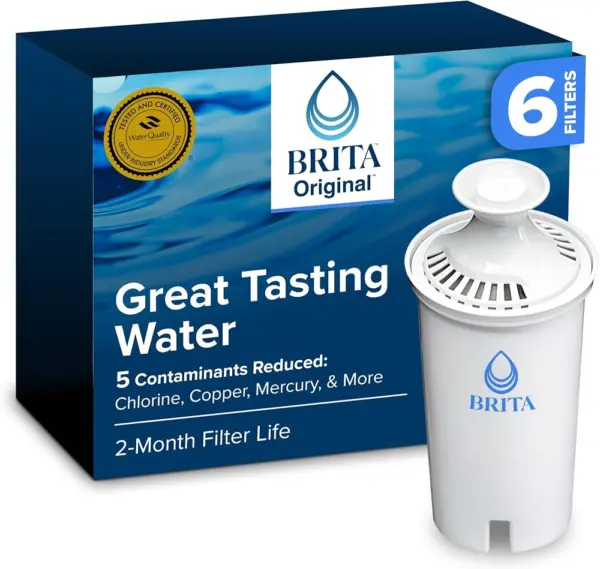
Brita Standard 6-Pack
Key Features
- Fits: Most Brita pitchers and dispensers
- Reduces: Chlorine, copper, mercury, cadmium
- Filter life: 40 gallons or 2 months each
- Certification: WQA and NSF/ANSI
- Price: Budget
More than two dozen Brita pitchers and dispensers take this cartridge — Capri, Monterey, Tahoe, the stainless model, the Ultramax dispenser — so there is a good chance it is the refill your counter already wants. Nothing needs soaking: rinse it, seat it, fill the reservoir, and the first batch runs clear. Each filter is rated for 40 gallons or about two months, which makes the six-pack roughly a year of changes for one or two people.
A year of unremarkable water is why this is our top pick. Nothing else here asks less of you: no model number to decode, no tools, no waiting on a cartridge before the dispenser works again. It pulls the chlorine taste and odor out along with copper, mercury, and cadmium, and it does that without leaving black flecks behind in the glass.
Fit is the one thing to watch. The cartridge seats with a push, and in most pitchers it clicks down flush; in some housings it sits slightly proud and takes a firm press before the lid goes back on. Check that before you fill, not after. The payoff is the first cold glass from a fresh filter, which tastes like almost nothing — that is the point.
The trade-off is ambition. Brita certifies this filter for chlorine, copper, mercury, and cadmium and makes no lead claim; the company’s Elite cartridge, which fits the same pitchers and runs 120 gallons, is the one carrying the 99% lead figure. If lead is why you are filtering, that is the cartridge to look at. If you want a year of better water with no fuss, this box is the simplest path here.
Pros
- Fits more than two dozen Brita pitchers and dispensers
- No presoak; rinse and seat
- Six filters cover about a year
- Reduces chlorine, copper, mercury, and cadmium
Cons
- No lead-reduction claim
- Can sit proud of the housing in some pitchers
We point anyone who already owns a Brita pitcher at this box: the widest fit of the pitcher filters here, no presoak, and about a year of better-tasting water.
Best for Small Households
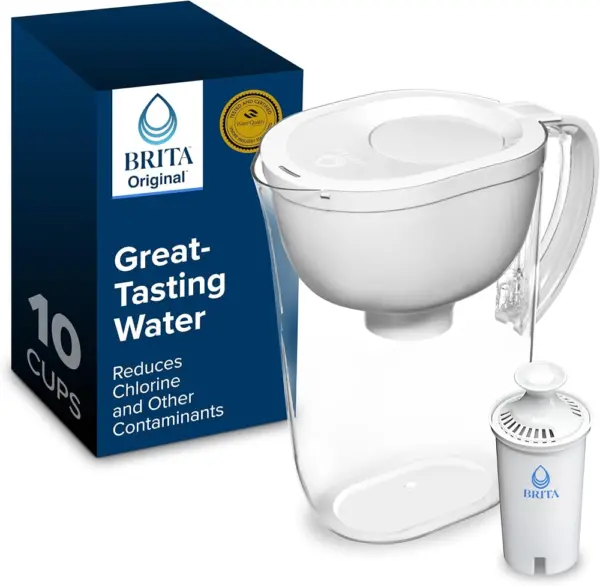
Brita 10-Cup Pitcher
Key Features
- Capacity: 10 cups
- Included: 1 Standard filter
- Cartridges: Standard and Longlast
- Dimensions: 10.7"L x 5.4"W x 10.1"H
- Price: Budget
Ten cups, 10.1 inches tall, and 5.4 inches wide — this is the water filter pitcher we reach for when the fridge shelf is already crowded or the door bin is full. It fills three 24-ounce bottles before a refill, which is the right size for one or two people who want cold water without thinking about it, and it is the only pick here that arrives ready to filter, with a Standard cartridge already in the box.
The weak spot is the plastic rather than the filtration. The handle is the piece that gives way, and the base can crack when the pitcher takes a knock on tile, so carrying it by the body instead of the handle is the habit worth forming. The lid locks for pouring and lifts off for filling, which sounds like a small thing until you have poured from a pitcher with a loose one.
It accepts both of Brita’s pitcher cartridges — the Standard it ships with and the longer-lasting Longlast — so you can decide later how often you want to think about this. For a first pitcher, a rental kitchen, or water in a bedroom, that combination of a small footprint, an included filter, and a locking lid is the argument.
Pros
- 10-cup capacity fits a fridge shelf
- Arrives with a Standard filter included
- Locking lid fills and pours cleanly
- Takes Standard and Longlast cartridges
Cons
- Handle and base crack under knocks
Buy it if you want a pitcher that fits a crowded shelf and filters from the first fill — it is the only complete setup here.
Best for Whirlpool-Family Fridges
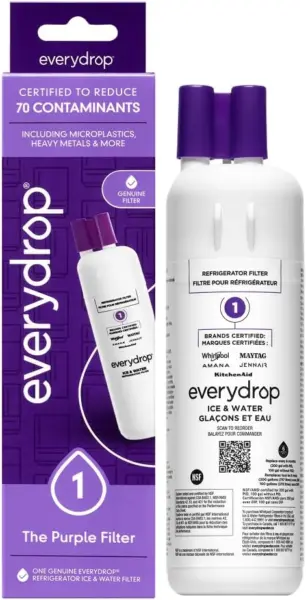
everydrop Filter 1
Key Features
- Fits: Whirlpool, Maytag, and KitchenAid
- Reduces: 70 contaminants, incl. microplastics
- Filter life: 6 months
- Certification: NSF 42, 53, and 401
- Price: Premium
Seventy contaminants, three NSF standards, and a claim to reduce 99% of microplastics, including particles 60 times smaller than a grain of sand — no other cartridge here puts up numbers like that. Everydrop certifies this one to NSF 42, 53, and 401, which covers taste and odor, contaminants with health effects, and a list of emerging ones that pitcher filters never touch.
It is the official filter for Whirlpool, Maytag, and KitchenAid refrigerators, and that matters more than brand loyalty suggests: a fridge cartridge is a small pressure vessel threaded into a water line, and a poor seal means a puddle under the crisper drawer. The core is coconut-shell carbon run through three stages, and the housing is the shape the machine was built around.
Six months per cartridge is the part we appreciate most — two changes a year, no reminder to set — and the breadth of what it removes gives it the edge over the compatible cartridges for a Whirlpool-family fridge. One caution: the Filter 1, 2, and 4 bodies look alike and are not interchangeable, so copy the number off the old cartridge, not off the fridge’s brand badge.
Pros
- Certified to NSF 42, 53, and 401
- Reduces 70 contaminants plus microplastics
- Six-month life, so two changes a year
- Official fit for Whirlpool, Maytag, and KitchenAid
Cons
- Premium price for a single cartridge
For a Whirlpool, Maytag, or KitchenAid fridge, this is our pick: certified for more contaminants than any other cartridge here and changed only twice a year.
Best for Frigidaire Fridges
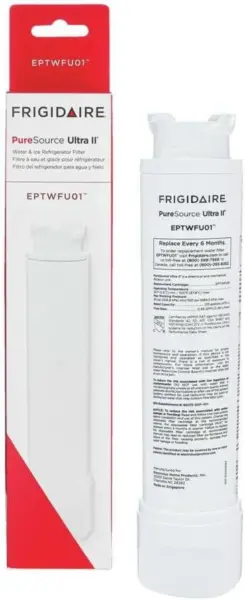
Frigidaire EPTWFU01
Key Features
- Fits: PureSource Ultra II systems
- Install: Push and twist, no tools
- Reduces: Lead, nitrates, mercury
- Certification: NSF 42, 53, and 401
- Price: Midrange
A quarter turn with your fingers and the old cartridge drops out; slide the new one in grip-side horizontal and it clicks home. No wrench, no shutting off the water line, no kneeling on the freezer door. Of the refrigerator filters here, this is the one to hand someone who has been putting off a change because the last one fought back.
Frigidaire certifies the PureSource Ultra II to NSF 42, 53, and 401 and lists lead, nitrates, mercury, and chlorine taste among what it reduces, which puts it near the top of this set on contaminant coverage. That listing is why we stopped thinking about this fridge between changes; the tool-free mount is why we do not dread the next one.
Two details are worth knowing. The reminder light does not clear on its own after a swap — hold the Water Filter button on the dispenser for about three seconds — and the first gallon can run cloudy, so flush it into the sink or a pitcher rather than a glass. If cloudiness lasts past a day or two, reseat the cartridge before you blame it.
Pros
- Push-and-twist install, no tools or shutoff
- NSF 42, 53, and 401 certified
- Reduces lead, nitrates, mercury, and chlorine taste
- Fits PureSource Ultra II Frigidaire models
Cons
- Premium price for one cartridge
If you own a Frigidaire with the PureSource Ultra II housing, this is the cartridge to buy: it installs in seconds and covers lead, nitrates, and mercury along with taste.
Best for Lg Fridges
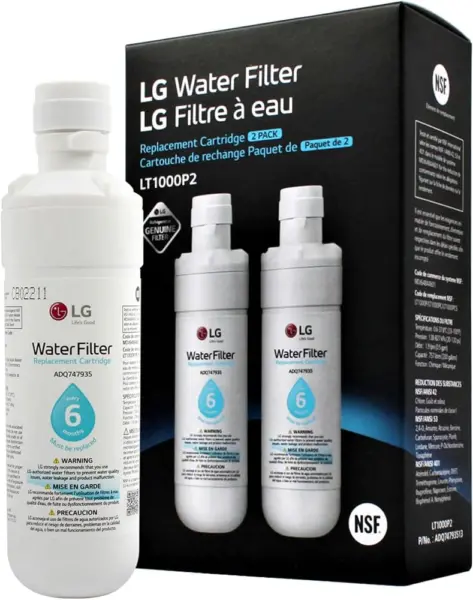
LG LT1000P2
Key Features
- Reduces: Cysts, asbestos, lead, benzene
- Cartridges: 2 per box
- Filter life: 200 gallons or 6 months each
- Certification: NSF 42, 53, and 401
- Price: Premium
Two cartridges, 200 gallons each: this box is built to cover a full year in an LG fridge before you order again, the longest stated life of anything here. For a kitchen where the dispenser runs all day, that math is the whole pitch, and it is why this is the pair we point at first for a busy LG.
LG certifies both to NSF 42, 53, and 401 and names cysts, asbestos, lead, mercury, and benzene among what they remove, along with some herbicides, pesticides, and pharmaceuticals. The cyst and asbestos figures — 99.99% and 99% — are the ones that stand out, because neither appears on the reduction lists of the pitcher cartridges here.
Taste is the loose end. The same cartridge that pours clean in one fridge can run flat or faintly plastic in another for the first few gallons, so flush generously and judge it on day three rather than day one. If the water still tastes off after a week of steady use, the cartridge is the suspect, not your plumbing.
Pros
- Two cartridges cover about a year
- 200 gallons per cartridge, the longest life here
- NSF 42, 53, and 401 certified
- Reduces cysts, asbestos, lead, mercury, and benzene
Cons
- Largest upfront outlay here
- 90-day warranty is short for the cost
For a busy LG fridge, this is the pair to buy: two cartridges, a year of water, and a contaminant list that includes cysts and asbestos.
Best for Newer Samsung Fridges
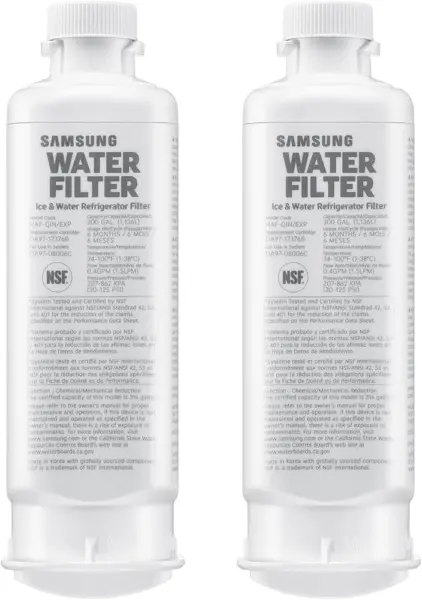
Samsung HAF-QIN-2P
Key Features
- Fits: Newer Samsung French-door and side-by-side
- Cartridges: 2 per box
- Filter life: 6 months each
- Certification: NSF 42, 53, and 401
- Price: Midrange
Genuine or not is the whole question with this cartridge, and Samsung knows it: the box carries an authentication tag you can scan to confirm the filter came from the company. Scan it the day the box lands, while the return window is open. A counterfeit is also the likeliest reason a filter weeps inside a fridge.
What you are buying is a two-pack rated at six months each, certified to NSF 42, 53, and 401, with an ultra-high-grade carbon block rated to reduce 99% of potentially harmful contaminants. It fits the newer French-door and side-by-side models — the RF23A, RF28R, RF29, and RS22T families among them — and installation is a push and a click with no tools.
Samsung’s position is that only its own cartridges are guaranteed to seat and perform correctly, and a filter that weeps inside a fridge can ruin the liner and the floor beneath it. So watch the housing for the first week. A slow drip or a puddle in the bottom of the fridge means pull it and reseat, not mop and hope.
Two cartridges is the sane way to buy Samsung’s own filter, and for a fridge still under warranty it is the version that keeps the conversation simple if something goes wrong. If your Samsung takes the older round DA29-00020B instead, this cartridge is the wrong shape entirely — the Waterspecialist three-pack is the one for that housing.
Pros
- Two cartridges, six months each
- NSF 42, 53, and 401 certified
- Authentication tag confirms it is genuine
- Fits newer Samsung French-door and side-by-side models
Cons
- Counterfeits circulate; scan the tag on arrival
- Can weep at the housing if it seats poorly
For a newer Samsung fridge, buy the two-pack and scan the tag the day it lands: genuine fit, six months a cartridge, no warranty argument.
Best for Budget Samsung Refills
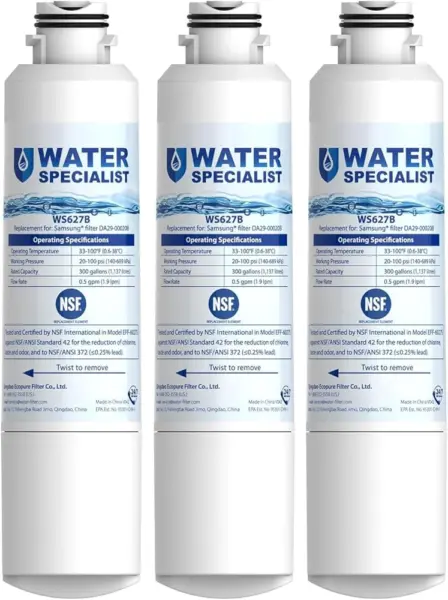
Waterspecialist 3-Pack
Key Features
- Shape: Round
- Replaces: Samsung DA29-00020B / HAF-CIN
- Cartridges: 3 per box
- Certification: NSF 42 and 372
- Price: Budget
Three cartridges for less than one Samsung-branded filter is the pitch, and it holds up: this is the cheapest way here to keep an older Samsung fridge pouring filtered water. The catch is on the certification line — NSF 42 and 372, which covers chlorine, taste, and odor plus lead-free materials, but not the NSF 53 health-contaminant standard the OEM cartridge carries.
It is round, not square, and it replaces the DA29-00020B and HAF-CIN family — the RF28H, RF26J, and RS25J models among them. Installation is a twist by hand, the stickers in the box let you date each change, and if you swap one every six months the box covers a year and a half.
Where we slow down is the seal. A cartridge that does not seat cleanly can weep at the housing, and the fix is almost always to pull it and reseat rather than to add anything. Do that check on day one, keep the receipt, and this is the value pick of the Samsung-compatible options: a fraction of the OEM price for the filtration a household actually uses.
Pros
- Three cartridges for less than one OEM filter
- NSF 42 and 372 certified
- Fits the DA29-00020B / HAF-CIN family
- Hand-twist install, no tools
Cons
- No NSF 53 health-contaminant certification
- Can weep at the housing until reseated
If your Samsung takes the round DA29-00020B cartridge, this three-pack is the budget buy we recommend for a year and a half of refills.
Best for Budget Whirlpool Refills
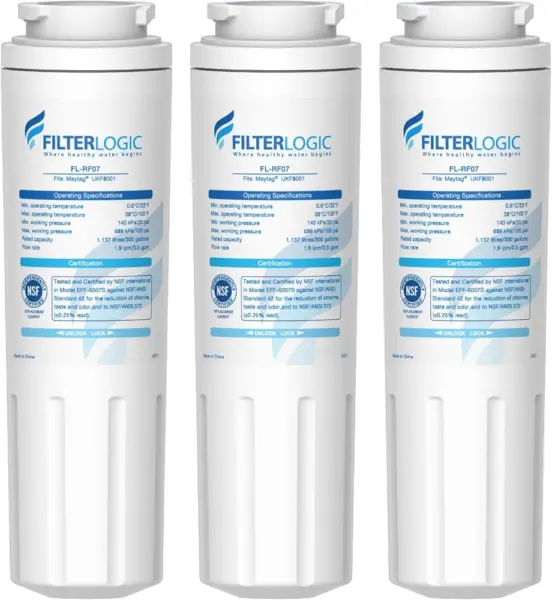
Filterlogic 3-Pack
Key Features
- Replaces: EveryDrop Filter 4 / UKF8001
- Cartridges: 3 per box
- Filter life: 300 gallons or 6 months
- Certification: NSF 42 and 372
- Price: Budget
This is the third-party stand-in for EveryDrop Filter 4 — the cartridge Whirlpool, Maytag, and Amana fridges ask a premium for — with the same fit and the same 300-gallon-or-six-months service interval. If the grille behind the crisper drawer hides an EDR4RXD1, this box is aimed at you.
The carbon is a coconut-shell block, the materials are BPA-free and food-grade, and month stickers come in the box. We like the stickers more than they deserve: a cartridge with a date on it gets changed on time, and one without gets changed when the water starts tasting like the tap.
Certification is where it steps back. NSF 42 and 372 cover chlorine, taste, odor, and lead-free materials, with no NSF 53 claim for lead or other contaminants with health effects. Flow is the other variable — a cartridge can taper off well before its six-month mark — so date the install and check the pour at month four.
For a Whirlpool-family fridge where the OEM cartridge feels like a lot to spend on a filter, this is the box to order: three cartridges, a year and a half of coverage at the rated interval, and a fit that matches the original. Know what you give up, though — the health-contaminant certification and the maker’s guarantee that the part was built for your machine.
Pros
- Three cartridges at a fraction of the OEM price
- Fits EveryDrop Filter 4 and UKF8001 housings
- NSF 42 and 372 certified
- Month stickers included for tracking changes
Cons
- Not certified for lead or other health contaminants
- Flow can fade before the six-month mark
For a Whirlpool or Maytag fridge that takes EveryDrop Filter 4, this three-pack is the value route: correct fit, clean-tasting water, and three cartridges in the box.
How We Tested (and Lived With) the Best Water Filters
We started by pulling every pitcher and refrigerator filter we could find that carried a current NSF/ANSI or WQA certification — 42 for taste and chlorine, 53 for health contaminants, 401 for emerging ones — and cross-checked each fridge cartridge against the model numbers it claims to fit. Listings with vague compatibility, missing certifications, or a price that only made sense if the filter was a counterfeit got cut before testing began. We also worked out cost per gallon across each filter’s rated life, so a cheap cartridge with a short lifespan didn’t get credit it hadn’t earned. That left 14 filters, which we bought ourselves from authorized sellers so we knew exactly what a shopper receives.
Installation came first, because a filter that won’t seat is a filter you’ll never use. I timed each install with a stopwatch, listened for the click that tells you a fridge cartridge is locked in, and ran five gallons through before setting a folded paper towel under the housing for a full day to catch any seep. Pitchers got filled to the line and carried across the kitchen to see whether the lid or spout wept. Two cartridges that dribbled or needed a second shove to lock were flagged.
Then the part you actually notice. We poured blind samples against tap water and against each other, drank them at room temperature where off-flavors hide least, and brewed the same coffee with each. Flow got timed with a quart jar — a filter that turns a glass into a three-minute wait is one nobody in the house keeps using. We also dropped ice from the fridge trays into plain water to check for that plastic-cube taste.
Finally, we lived with them. Each filter got a calendar date and a gallon tally, and we re-tasted at the halfway point of its rated life to see whether it was fading early. At the end of the run we pulled the pitchers apart and looked at the O-rings and housings for hairline cracks, then checked the certification mark on every cartridge against the certifier’s own listing to confirm we’d gotten the genuine article.
How to Choose a Water Filter
Start with the housing you already own — pitcher, dispenser, or the cartridge slot behind the fridge grille — because fit decides more of this purchase than price or brand ever will.
Match the Cartridge to the Machine
Three formats cover almost every kitchen: a pitcher or dispenser cartridge, a refrigerator cartridge keyed to your model, and a third-party compatible built to replace one specific OEM part. The trap is the word compatible. Samsung’s round DA29-00020B and the square HAF-QIN look nothing alike and fit different housings, and a Whirlpool Filter 1 will not seat where a Filter 4 belongs.
Read the number printed on the old cartridge — not the fridge’s brand badge — and match it against the replacement list before you order. With no old cartridge to read, the model plate inside the fridge door settles it.
Read What the Certification Covers
NSF standards do different jobs, and the number on the box tells you which one a filter earned. NSF 42 covers aesthetics: chlorine, taste, and odor. NSF 53 covers contaminants with health effects, including lead, cysts, and volatile organic compounds. NSF 401 adds emerging contaminants such as pharmaceuticals and herbicides. NSF 372 is not a performance standard at all — it certifies lead-free materials, which is how a cartridge can carry an NSF logo and still say nothing about lead.
If old plumbing is why you filter, look for 53 on the label. If taste is the only complaint, 42 does the work.
Do the Math on Filter Life
Life here runs from 40 gallons or two months on a pitcher cartridge to 200 gallons or six months on a refrigerator cartridge, and the cheaper filter is not always the cheaper year. A budget cartridge changed four times can cost more than a premium one changed twice, and every change is another chance to seat it wrong. Compare packs by how many months they cover, then decide.
Reminder lights are worth resetting, but treat them as timers rather than sensors: they count days, not the condition of the water.
Pitcher or Refrigerator Dispenser?
A water filter pitcher needs no plumbing, chills in the fridge, and holds about 10 cups — roughly three bottles — but somebody has to fill it. A refrigerator cartridge gives you filtered water and ice on demand, costs more per filter, and locks you to your model.
We reach for the pitcher in rentals, bedrooms, and small kitchens, and for the cartridge when the dispenser is where the household actually drinks from. Check the shelf before you buy: the 10-cup pitcher here stands just over 10 inches tall.
Frequently Asked Questions
Why is my fridge dispenser so slow after a filter change?
Air trapped in the line is the usual reason, and a new cartridge also has to be wetted out. Dispense into a pitcher until the flow steadies, which can take a gallon or more.
If the water is still a trickle after a week, pull the cartridge and reseat it. If that changes nothing, the filter is clogged or the wrong part, and a replacement is the fix.
Do I need a plumber to install a water filter?
No. Pitcher and dispenser cartridges drop into a housing you fill by hand, and refrigerator cartridges swap in place — a quarter turn or a push and click, with the water line still pressurized, because the housing seals once the cartridge seats.
The only tool worth having on hand is a towel. If a cartridge will not seat without force, it is the wrong part, not a tight fit.
Which Brita filter fits my pitcher?
Brita’s Standard cartridge fits most of its pitchers and dispensers, and the 10-cup pitcher here also accepts the longer-lasting Longlast. The Elite cartridge fits every Brita pitcher except the Stream.
Check the model name on the pitcher’s base or lid before ordering. That name, not the shape of the box on the shelf, is the reliable guide to which of the three fits.
Final Verdict
For most kitchens the Brita Standard six-pack is the answer. It fits more than two dozen pitchers and dispensers, needs no presoak, and covers about a year of changes — the least fuss of anything here, and the easiest recommendation on the page.
If the water comes from the refrigerator instead, the model number picks for you: the everydrop Filter 1 for Whirlpool, Maytag, and KitchenAid machines, and the Frigidaire EPTWFU01 for PureSource Ultra II housings. Those two cover the fridges most of us actually own.