This post contains affiliate links. We may earn a small commission when you buy through our links — at no extra cost to you.
A countertop water filter clamps onto the end of your faucet and does the work right there on the counter — no plumber, no under-sink gymnastics, no pitcher hogging a fridge shelf. What separates a good one from a maddening one has little to do with the box: it’s flow rate, how long the cartridge truly lasts, whether the housing stays put when you swing the spout, and, above all, whether the water actually tastes good. That’s the real reason most of us shop for one — you got tired of water that tastes like the inside of a garden hose.
I’ve had 11 of these on my kitchen sink over the past eight months, filling coffee carafes at 6 a.m. and topping off pasta pots at 7 p.m., and the differences showed up within a week. One thing first-time buyers don’t know: filter-life claims are quoted in gallons under lab conditions, so a cartridge rated for a few hundred gallons can be crawling by month four. The picks below are the ones that kept pouring at a decent clip and kept the water tasting clean long after the novelty wore off.
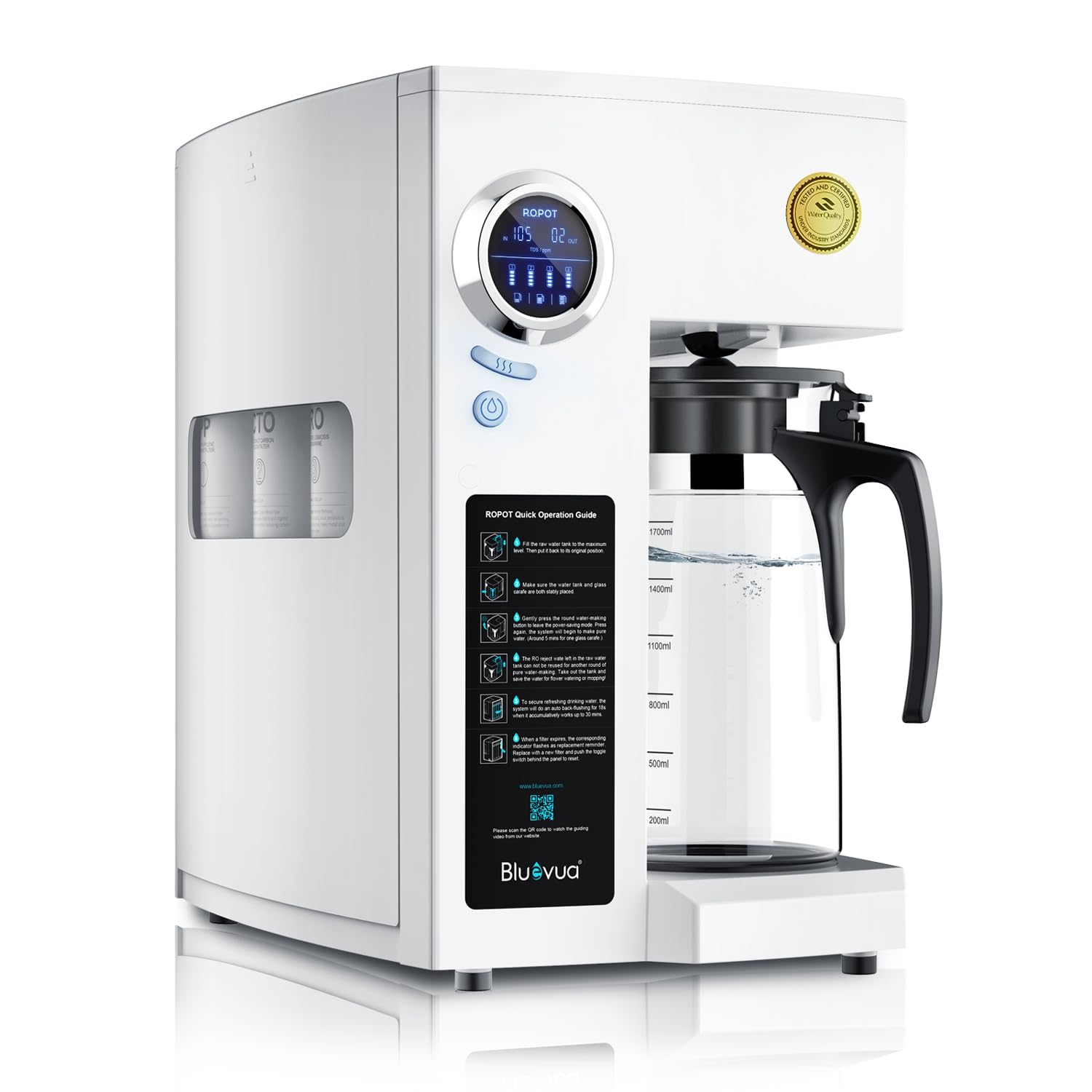


Best for Purest Everyday Water
Bluevua RO100ROPOT
Key Features
- Footprint: 10.9 x 15.4 x 14.3 in
- Filtration: 5-stage RO with remineralization
- Rated flow: 0.26 liters per minute
- Filter life: 12 to 24 months
- Price: Premium
Most of the filters on this page polish your tap water. This one rebuilds it. Five stages of reverse osmosis pull dissolved solids out — the minerals, the metals, the things a carbon block never touches — and a remineralization stage puts a little of the good back before the water lands in the glass carafe. If you have hard water, a well, or a municipal supply that still tastes off after a pitcher, that difference is the entire reason to spend more.
We came away convinced by the water itself. A reverse-osmosis membrane on its own can leave water tasting oddly flat, and the mineral stage is what fixes that — the carafe pours something that tastes like water rather than like nothing. The rest of the machine is built to be ignored: a filter-life readout on the front, a standby mode that cuts power when nobody is pouring, and certification listed for the filtration claims. Nothing about it needs a drill, a shutoff valve or a plumber.
The compromise is pace. Rated flow is 0.26 liters a minute, so a carafe is a start-it-and-come-back job rather than a stand-and-watch one, and the glass carafe in front is modest for a household that drinks water all evening. One or two people settle into the rhythm within a week. Four will be pouring constantly, and a gravity system sitting full on the counter suits that kitchen better.
What takes the sting out of the outlay is the filter interval. Bluevua rates the cartridges at twelve to twenty-four months, the longest in this group by a wide margin, so the running cost settles well below the dispensers that want a new filter every couple of months. For a household with decent tap water and doubts about what’s in it, that math works.
Pros
- Removes dissolved solids, not just chlorine
- Remineralization stops the flat RO taste
- Cartridges rated for 12 to 24 months
- No plumbing — plug in and pour
Cons
- Slow fill and a small carafe
- Needs an outlet within cord reach
We point anyone whose water still tastes wrong after a pitcher filter to this one: it’s the only pick here that strips dissolved solids without a plumber.
Best for Power-Free Filtration
Big Berkey 2.25 Gal
Key Features
- Power: None, gravity fed
- Capacity: 2.25 gallons
- Elements: Two Black Berkey BB9-2
- Footprint: 8.5 x 8.5 x 19.25 in
- Price: Premium
Two gallons of drinking water, no electricity, no plumbing, no noise. The Big Berkey earns its counter space by doing the one thing a power cut makes impossible for everything else here, and that self-sufficiency is worth the patience it demands.
The housing is polished 304 stainless rather than plastic, which is most of why it reads as equipment instead of a picnic jug, and two Black Berkey elements come in the box. We found the setup fussy and the payoff immediate: prime the elements, assemble the spigot, run a couple of batches through and throw them out. Give it an hour once, and after that it’s just filling.
Gravity is slow, and the rated maximum of 0.03 gallons a minute says so plainly — a full tank is an overnight job, not a dinner-party one. The other habit to learn is the lower chamber. Top up the upper tank while the bottom is still full and water can back up and find its way out at the seam; empty the bottom first and the system is untroubling.
It’s a lot of money up front, and the elements are the expensive part when they eventually come due. It’s also the pick that keeps working when the tap doesn’t, for years rather than months, with nothing to plug in and nothing to break.
Pros
- Two gallons ready with no power
- Polished stainless steel, not plastic
- Two Black Berkey elements included
- Nothing to install or plug in
Cons
- Slow gravity flow, 0.03 gallons a minute
- No tap connection — every drop is poured in
Buy it for water you can’t control — a well, a boil notice, a storm week — and for two gallons that are ready without a pump or an outlet.
Best for Value Countertop Ro
DREO RO Water Filter 113
Key Features
- Included: Two autofill pitchers
- Footprint: 15.7 x 6.7 x 13.4 in
- Filtration: 7-in-1 reverse osmosis
- Tank capacity: 5 liters
- Price: Midrange
Half the money of our top pick, and it performs the same trick: reverse osmosis on the countertop, no plumber, no shutoff valve. DREO squeezes seven stages of filtration into a body 6.7 inches wide, and it adds two autofill pitchers that make the whole thing feel less like plumbing and more like an appliance.
Those pitchers are the detail we kept noticing. Set one under the spout and the machine fills it to the line and stops by itself, so you’re not standing there watching a trickle. A TDS readout on the front tells you what’s coming out, and it self-cleans between runs with a three-to-one pure-to-drain ratio, which is thriftier than most reverse-osmosis systems of any size.
Where it gives ground is volume. Five liters is the whole tank and the pitchers are modest, so two people who drink water all day are comfortable while a family of four will hear it running constantly. Flow also sags as the tank empties, and the last glass of a batch comes out noticeably slower than the first. Neither is a defect; both are the arithmetic of a small machine.
What we appreciate most is how little maintenance it asks for. Cartridges swap in seconds, the display tells you when, and there’s no membrane housing to wrestle with. If you’ve priced an under-sink RO and balked at the install, this is that water carried home and plugged in.
Pros
- Two self-filling pitchers cut the waiting
- Slim 6.7-inch-wide body
- TDS readout and filter-life display
- Self-cleaning with a thrifty 3:1 drain ratio
Cons
- Five-liter tank is small for a family
- Flow slows as the tank empties
The RO system we suggest to most households: excellent water quality for far less than the Bluevua, provided five liters is enough to go around.
Best for Budget Fridge Dispenser
Waterdrop WFD-22L
Key Features
- Capacity: 40 cups
- Certification: NSF 42 and 372
- Filter rating: 200 gallons
- Price: Budget
The most useful line on this dispenser’s packaging is the admission that it does not lower TDS. That reads like a weakness and is really a boundary: Waterdrop built a carbon filter, not a purification plant. It is NSF 42 and 372 certified and it takes out chlorine, taste and odor, while the dissolved minerals that make water taste like water stay exactly where they are.
For a fridge dispenser, that boundary is fine. What we like is how little fuss the thing makes: forty cups in total, twenty-one of them in the body you carry, a handle in the right place and a shape that slides onto a standard shelf without a reshuffle. Fitting is not a worry here, which is rare for a container this size.
Filter life is the other reason it wins the budget slot. A 200-gallon rating is a long stretch between cartridges at this price, and the carbon fiber is built for throughput rather than torque — the claim is four times the flow of a standard carbon block. The first few fills take their time while the cartridge wets out, then it settles into a steady trickle.
Where it stops being the right answer is hard water or a contaminant worry: a carbon block leaves dissolved lead and minerals exactly where they were, and the label is honest about that. For everything else — the fridge, the kettle, the lunchbox fill — forty cups at this price is the easiest step away from bottled water in the group.
Pros
- 40 cups, 21 of them in the carry body
- 200-gallon filter rating
- Slides onto a fridge shelf without rearranging
- BPA-free, NSF 42 and 372 certified
Cons
- Does not reduce TDS or dissolved minerals
- Filtration can stall as the cartridge loads
Our budget pick: forty cups in the fridge, a long filter life and the smallest outlay here — as long as dissolved solids aren’t your problem.
Best for Lead and Pfas
ZeroWater 32-Cup
Key Features
- Capacity: 32 cups (7.5 liters)
- Included: TDS meter
- Filtration: 5-stage ion exchange
- Certified for: Lead, PFOA/PFOS, chromium, mercury
- Price: Budget
ZeroWater ships a TDS meter in the box, and that tells you most of what you need to know about the pitch. This isn’t a filter that makes your water taste nicer; it’s one that takes the measurement toward zero, pulling out lead, PFOA and PFOS, chromium and mercury by ion exchange along the way. IAPMO certification covers those claims, and the meter lets you check them.
For anyone on a private well, in an older house with unknown pipes, or simply uneasy about the municipal supply, that’s a genuinely different offer from everything else in the dispenser class. Being able to watch the number rather than trust a claim is what sold us — dip the meter, read it, know when the cartridge is spent instead of guessing from the taste.
The catch is appetite. Ion-exchange resin is finite and it has to grab every dissolved solid in the water, not just the ones you’re worried about, so hard water exhausts it fast. On soft municipal water a cartridge lasts a reasonable while. On hard well water the cost per gallon climbs steeply, and that is the number to work out before you commit.
The dispensing side is the least refined here. Thirty-two cups is plenty, but flow is slow and the unit is heavy and awkward once it’s full, so it stays put after you’ve found its spot. Seat the O-ring carefully when you assemble it — that’s where a drip starts.
Pros
- Cuts lead, PFOA/PFOS, chromium and mercury
- Included TDS meter verifies the result
- Holds 32 cups
Cons
- Filters wear out quickly on hard water
- Slow pour and awkward to lift when full
We hand this to anyone with a specific contaminant worry — lead, PFAS, a well — because it’s the one dispenser that shows you it’s working.
Best for Midrange Gravity System
Purewell 3-Stage
Key Features
- Body: 304 stainless steel
- Capacity: 2.25 gallons
- Filtration: 3-stage, 0.01 micron
- Element life: 3,000 gallons each
- Price: Midrange
A stainless drum on a matching stand, and the one pick here that looks deliberate on a kitchen counter rather than parked there. Underneath the finish it’s the same gravity idea as the Berkey — upper chamber, lower chamber, two elements — for a fraction of what the big name charges, and we think it looks better doing it.
The filtration is more than carbon. A hollow-fiber membrane rated to 0.01 microns handles the fine material, with carbon and silver ion doing the taste and odor work, and the two black elements are rated at 3,000 gallons each — 6,000 in total before replacements. It’s NSF/ANSI 42 and 372 certified, and both elements, the spigot and the stand come in the box.
Gravity is gravity, and no specification changes that: a full tank takes its time. The spigot is the part to watch, since a drip at the joint is what goes wrong most readily — seat it snug at assembly without forcing it. Check both elements when the box arrives, because a damaged one turns up now and then.
What the money buys is a long-lived system: no power, no cartridge every two months, and 6,000 gallons of capacity before you buy anything else. If the Berkey’s price is the obstacle, this is the same job done honestly.
Pros
- Three-stage filtration down to 0.01 microns
- 6,000 gallons across the two elements
- Stainless steel body with a stand
- No power or plumbing needed
Cons
- Slow to filter a full tank
- Spigot can drip at the joint
The gravity system we steer people to when the Berkey is out of reach: stainless, three stages, and 6,000 gallons of elements for a fraction of the money.
Best for Endless Tap Water
iSpring CKC1C

Key Features
- Footprint: 4.72 x 4.72 x 9.84 in
- Connection: Faucet diverter, no drilling
- Filtration: 5 micron carbon block
- Rated capacity: 10,000 gallons
- Price: Budget
This one never needs filling. A diverter valve screws onto the kitchen tap, a short hose runs to a housing on the counter, and flipping the lever sends tap water through a five-micron carbon block instead of straight down the sink. Flip it back and the faucet behaves normally again.
The clear housing is the detail we liked most: you can see the cartridge, see the sediment it’s collecting, and know when it’s spent instead of guessing from taste. The carbon block is rated to remove 95 percent of chlorine along with sand, silt and rust, the system carries a 10,000-gallon rating, and it takes standard 10-inch cartridges — the kind you can buy from anyone, which keeps running costs down.
The catch is the tap itself. It hangs off your faucet, so it suits some kitchens and not others, and the adapter has to match your aerator thread — check that before ordering, because a mismatch is the whole product wasted. It also does nothing about dissolved solids; this is a chlorine and sediment filter, not a purifier. And the diverter is the wear part, so heavy faucet pressure is unkind to it.
Where it shines is volume. Pasta water, stock, a big kettle, a dog bowl, a van’s tank — it keeps coming, and you never wait for a reservoir to refill. For a rental, an RV, or a kitchen where the tap is the only place water comes from, that’s the entire argument.
Pros
- Endless filtered water straight from the tap
- Clear housing shows the cartridge working
- Standard 10-inch cartridges keep costs low
- No drilling and no plumber
Cons
- Only fits faucets the adapter matches
- Diverter is the wear part under pressure
Unlimited filtered water with no reservoir to fill — our pick for renters and RV owners, provided the faucet adapter matches.
How We Tested 11 Countertop Water Filters Over Eight Months
We started by gathering every countertop model we could find from the established filtration brands and a handful of smaller names — roughly 40 in all — then cut anything without third-party certification for taste and health contaminants, anything whose replacement cartridges were hard to source or wildly expensive, and anything that wouldn’t fit a standard faucet thread. That left 11 units, which we installed on real kitchen sinks, including one in an apartment with notably hard water, and lived with for eight months.
Every unit ran the same daily gauntlet: coffee water first thing, a two-quart saucepan for dinner, bottles refilled before bed. We timed each fill with a stopwatch on day one and again in month six, because a filter that pours fast when new can trickle once the cartridge loads up. Taste got a blind side-by-side against unfiltered tap, served chilled and at room temperature, with notes on whether the water came out flat, faintly chlorinated, or genuinely crisp.
Leaks had their own check: we wrapped a paper towel around each connection, ran the tap full for a minute, then inspected again after a week of normal use. To judge filter life we tracked quarts, not calendar days — how much water went through before the stream visibly weakened — and weighed that against the manufacturer’s claim and the cartridge price to get a real cost per gallon. Ease of use came down to wet-hand details: could we flip the spout from filtered to unfiltered one-handed, did the housing swivel far enough to clear a stockpot, and how much water could we draw in one go before flow tapered off.
How to Choose a Countertop Water Filter
The decision that matters most isn’t capacity or brand — it’s whether you want chlorine and taste handled or dissolved solids and metals taken out entirely.
Start With What’s In Your Water
Every filter here deals with chlorine, taste and odor. Only some deal with what you can’t taste. Carbon blocks and carbon fiber — the Waterdrop, the iSpring, the big dispenser class — leave dissolved minerals and metals in the water. Ion exchange and reverse osmosis take them out, which is why the ZeroWater, the Bluevua and the DREO sit in a different bracket.
If your complaint is that the water tastes like a swimming pool, a carbon dispenser settles it cheaply and you can stop reading. If you have a well, an old house, or a utility notice about lead, spend for RO or ion exchange instead. Unsure? Get a TDS reading first; anything over 500 points you toward RO.
Power and Plumbing Decide Your Shortlist
Three designs, three commitments. Gravity systems such as the Berkey and the Purewell need no outlet and no plumbing, but every drop goes in by hand. Countertop RO needs a socket within cord reach and produces wastewater — the DREO runs a thrifty three-to-one pure-to-drain ratio. A diverter unit like the iSpring needs nothing but a matching aerator thread, and it takes over the tap while it’s in use.
Renters, RV owners and anyone without a free socket should start on the gravity side. If you have counter space and an outlet, RO gives you the best water here by a clear margin.
Filter Cost Is the Second Price
The cartridge is where the money goes. Dispenser filters are typically rated around 200 gallons or two months. RO cartridges run twelve to twenty-four months. The Purewell’s gravity elements are rated at 3,000 gallons each, 6,000 for the pair. Divide replacement cost by rated gallons before you compare anything else, because a cheap dispenser with a short filter can cost more per glass than a machine costing several times as much.
Hard water shortens every one of those intervals, and ion-exchange resin shortens fastest of all — it has to grab every dissolved solid, not just the ones you’re worried about.
Speed and Recovery Beat Tank Size
A big reservoir is not a fast one. Gravity systems move water at roughly 0.03 gallons a minute, so a full Berkey is an overnight job. Countertop RO runs near a quarter-liter a minute, which is a start-it-and-walk-away pour. What you feel daily is recovery: how quickly the unit makes more once you’ve emptied it.
Two people live comfortably with a five-liter RO tank. Four will hear it running all evening. Match the tank to the number of glasses in your house, not to the number in the listing.
Check the Spout, the Seal and the O-Ring
Nearly every complaint in this category lands on the same two parts: the spigot and the O-ring behind it. The filter keeps working perfectly while the seal weeps into your fridge shelf. Assemble slowly, seat the O-ring dry and flat, and don’t over-tighten a plastic spigot to chase a drip — that’s how threads crack.
Give any new unit a week on a tray before you trust it on a shelf, and check the joint each time you change a cartridge.
Frequently Asked Questions
Do I need to flush a new filter before drinking the water?
Yes, and for longer than you might expect. Carbon cartridges need a few minutes of running to shed loose fibers. Reverse-osmosis membranes and gravity elements need priming, and the first batch or two gets poured away. Diverter-fed units sometimes ask for a full day before the first glass.
Follow the sheet that comes in the box and don’t judge the taste until the second batch. The flat or chalky note in the first jug is the new cartridge, not your water.
Will a countertop filter cope with well water?
Up to a point, and the point is dissolved solids. The reverse-osmosis units here are rated for feed water up to 1,000 parts per million; above that you need pretreatment or you’ll burn through membranes. Ion-exchange dispensers work on well water too, but they exhaust faster as hardness climbs.
Test before you buy. A cheap TDS pen tells you which side of 1,000 you’re on, and that single number decides between a dispenser and an RO system.
How much counter space will one take up?
Less than the footprint suggests, and more than you think vertically. The DREO is only 6.7 inches wide but 13.4 tall. The Bluevua covers 10.9 by 15.4 inches. The gravity units run 19 to 20 inches high, which is what decides whether they fit under your upper cabinets at all.
Measure the clearance between counter and cabinet before anything else, then the free width. Height is the dimension that sends people back to the listing.
Final Verdict
The Bluevua RO100ROPOT is the one we recommend first, because it answers the question most people are really asking: is there something in this water I can’t taste? It’s one of only two picks here that removes dissolved solids, and it pairs that with the longest filter interval in the group and a mineral stage that keeps the glass tasting right.
If that’s more machine than you need, the DREO 113 makes RO water for a lot less and asks only that five liters covers your household. And if cold water in the fridge is the whole goal, the Waterdrop does that job for less than anything else here.