This post contains affiliate links. We may earn a small commission when you buy through our links — at no extra cost to you.
A vegetable chopper should make short work of an onion: no tears, no uneven chunks, no wrestling with a dull blade. But the wrong one turns a five-minute prep into a frustrating cleanup project—or worse, a mushy mess that ruins the texture of your salsa. I’ve been there with a chopper that turned an onion into pulp and another that was so fiddly I went back to my knife.
Over the past four months, my team and I put 14 choppers to work in our home kitchens, prepping onions for everything from weeknight curries to Sunday chili. We paid attention to the things you’d notice after a few weeks: whether the blades stayed sharp, how easy the parts came apart for washing, whether the whole thing felt sturdy enough to last, and whether it was worth the counter space and the cost. The best ones made chopping an onion a thirty-second job—and the worst ones made me want to cry for reasons that had nothing to do with the onion.
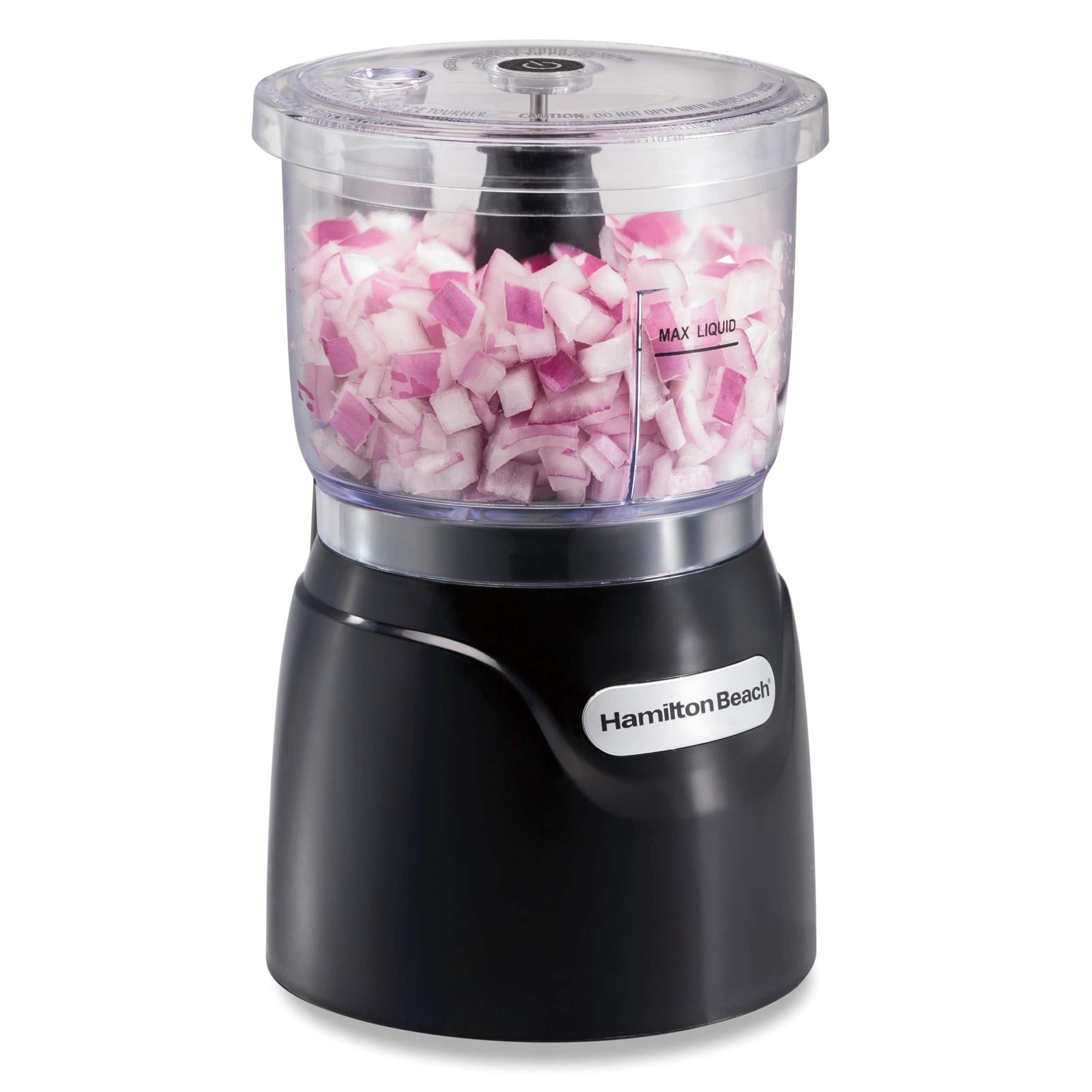


Best for Everyday Onion Prep
Hamilton Beach 3-Cup Electric Chopper
Key Features
- Motor: 350 watts
- Capacity: 3 cups
- Cleaning: Bowl, lid and blade dishwasher safe
- Operation: Electric stack-and-press
- Price: Midrange
An onion is the honest test of a chopper: dense, layered, and slippery enough to slide off a blade. This is the one we reached for when onions were the job rather than a garnish. Stack the bowl, drop the blade on the spindle, seat the lid, press; let go and the blade stops. Nothing about that asks for grip strength or a steady knife hand, and it is why this one took the top spot for the ingredient this search is actually about.
The 350-watt motor is the reason it copes. Halved onions go to a usable dice in seconds and the blade does not stall halfway through a stubborn layer. What it will not do is give you cubes. Short presses produce a loose, respectable dice for a sauce or a stew; hold the lid down and you are making onion paste instead. If square pieces are the point, the fullstar further down is the tool.
Three pieces come apart for washing, and all three are dishwasher safe. That matters more with onion than with carrot, because the smell lingers on plastic, so a quick rinse and a top-rack cycle is the difference between using it on a Tuesday and leaving it in the cupboard. It is compact too — 8.5 inches tall, a shade over 2 pounds — so it stows under a cabinet, though it does need an outlet within reach.
The 3-cup bowl sets the boundary. It suits a household that cooks with onions two or three times a week, and it handles a double batch of soup base in two goes. For a big preserving day, or a full pan of onions at once, a 5-cup manual dicer is the better fit.
Pros
- Chops a whole onion in seconds
- 350 watts powers through dense onion layers
- Bowl, lid and blade are dishwasher safe
- Small enough to store on a shelf
Cons
- Lopsided pieces rather than square dice
Our pick for onions is this one: 350 watts and a press-and-release lid give you diced onion in seconds, with no tears and no knife work.
Best for Even, Square Dice
fullstar Pro Core 6-in-1 Chopper
Key Features
- Blades: Six interchangeable
- Capacity: 5 cups
- Cleaning: Top-rack dishwasher safe
- Dice sizes: 1/4 in and 1/2 in
- Price: Midrange
Two dice grids, a quarter inch and a half inch, are the reason this one is on the list. An onion half goes under the press plate, the plate goes down, and what lands in the 5-cup container is a tray of square, even cubes — the result you get from a good knife on a good day, not the loose mince an electric chopper leaves. For salsa, a curry base, or anything where the onion should still be visible on the plate, that difference is the whole purchase.
We used the half-inch grid for onions almost every time. The quarter-inch is there when you want a finer dice, and it takes noticeably more force to push through. Expect to lean on it: onions are dense, the press is manual, and a whole half needs a firm, even shove. Cut the onion into pieces that sit flat on the grid first and the press does the rest.
The rest of the kit is what a six-blade set should be: two graters, a mandoline, a julienne blade, a finger guard, and a brush and scraper for the grid. The guard matters on the slicer rather than the dicer, and the brush earns its place every single time, because onion packs into the squares and a rinse alone will not move it. Everything is top-rack dishwasher safe once the grid is clear.
The blades stack inside the container, so the set is one object on the shelf instead of seven, and at a pound and a half it lifts down easily. Five cups is generous for onions: two medium ones, diced, with room left over.
Pros
- Square, even dice from two grids
- 5-cup container catches everything
- Top-rack dishwasher safe with a grid brush
- Blades store inside the container
Cons
- Takes a firm press on dense onions
We recommend this one when square onion cubes matter more than speed: two dice grids, five cups, and pieces that hold their shape in the pan.
Best for Slicing and Dicing
Mueller 10-in-1 Chopper & Mandoline
Key Features
- Blades: Eight interchangeable
- Cleaning: Dishwasher safe
- Footprint: 11.18"L x 5.47"W x 5.2"H
- Operation: Manual press
- Price: Premium
The electric chopper at the top of this list makes onion bits; this one makes onion slices. Eight blades cover two dice grids, a slicer, a julienne, graters and a shredder, and the slicer is the one that earns the shelf space: a halved onion goes through into thin, even half-moons in a single pass, which is what a stir-fry, a pickle or a pizza wants. It is the most complete blade set here, and for prepping a whole meal it is the one we kept reaching for.
Range has a cost. Eight blades mean eight things to keep track of, and this is a heavier, bulkier unit than the fullstar at 2.5 pounds with an 11-inch footprint. Dicing the onion, shredding the cheese for the top of it and grating the carrot for the side is one tool and one wash-up, which is the argument. The rubber pads underneath are the other: they keep it planted while you lean on a big onion half.
Where it gives ground is the washing up. Onion lodges in the grids, more parts means more time at the sink, and the blades are sharp enough that swapping them by hand deserves care — use the holder on the slicer and keep your fingers behind the plastic when you change grids. In a kitchen that cooks one onion dish at a time, the fullstar is simpler and cheaper. In one that preps several components at once, this earns its size.
Pros
- Eight blades cover dicing, slicing and grating
- Slicer turns onions into even half-moons
- Rubber pads hold it steady while pressing
Cons
- More parts to wash than a plain dicer
- Blades need care when swapping
Buy this one if you want a chopper that also slices onions into rings and petals; it is the most versatile blade set here, at the cost of more washing.
Best for One-Onion Batches
Kuhn Rikon Pull Chop
Key Features
- Weight: 14.1 oz
- Capacity: 2 cups
- Footprint: 5.5"L x 5.25"W x 4.25"H
- Operation: Pull cord
- Price: Premium
For one onion, this is the tool we keep coming back to. It is a 2-cup bowl with a cord in the lid: load the onion in rough chunks, seat the lid, pull the handle and the blade spins. Ten to fifteen pulls gives a fine chop, fewer leaves it coarse, and there is no outlet, no press plate to lean on, and nothing to assemble beyond the lid.
The non-slip base is what makes the pulling work. You can hold the bowl with one hand and pull with the other without chasing it across the counter, which is not true of every pull chopper here. It is quiet — no electric on this page manages that — and the blade cover lets it store with the blade inside the bowl. It is also the best finished of the pull choppers and the most expensive of these picks: the extra buys a mechanism that does not feel like it is about to bind.
Capacity is the boundary. A medium onion cut into wedges fills it about right; two onions means two batches. A dozen or so pulls gives an even, fine chop for a sauce or a stuffing, and the sooner you stop pulling the more the pieces vary in size. It sits about 5 inches across and 4 inches tall, so it can stay out on the counter without claiming much of it.
Pros
- One onion chopped in a dozen pulls
- Non-slip base keeps it steady
- Quiet and free of cords
- Blade cover stores inside the bowl
Cons
- Bowl is hand wash only
- Uneven pieces at coarse pulls
For a household that dices an onion or two at a time, we think this is the one: quiet, cord-free, small enough to stay out, and better finished than the other pull choppers.
Best for Small, Quick Jobs
OXO Good Grips Chopper

Key Features
- Blade: Stainless steel, rotating
- Cleaning: Dishwasher safe
- Footprint: 8.9"L x 4.1"W x 3.9"H
- Operation: Manual pump handle
- Price: Midrange
Soft vegetables are where this chopper struggles: tomatoes and cooked carrot crush before they cut, and you end up with a purée nobody asked for. Onion is the exception. Firm and layered, it holds up to the pump handle and comes out in small, usable pieces, which is why it stays in this guide for the ingredient the search is about.
We found it quicker than a knife for a single onion and easier to clean than any grid dicer: the blade and catcher cup separate, go straight to the top rack and click back together without a fight. The pump wants a few firm strokes rather than one press, and you can feel the blade catching instead of slicing when you rush it. Slow down and the cut is clean.
The compact build is the appeal. Under 9 inches long and a little under a pound, it fits a drawer or a crowded counter, and the handle locks down for storage. The catcher cup carries measurement marks, which is genuinely useful when a recipe asks for a cup of diced onion.
Where OXO earns its reputation is the assembly. Parts that come apart this easily usually do not go back together this easily, and this one does, every time.
Pros
- Quick for a single onion
- Comes apart and reassembles easily
- Dishwasher safe parts
- Compact enough for a drawer
Cons
- Crushes soft vegetables instead of dicing
- Small catcher cup limits batches
A good small-batch chopper that we found quicker than a knife for one onion, provided you are dicing firm vegetables rather than soft ones.
Best for Budget Full Kit
Yusshn 12-in-1 Vegetable Chopper

Key Features
- Blades: Seven, including two dicers
- Cleaning: Hand wash only
- Container: Drain basket and container
- Dice sizes: 14 mm and 6.5 mm
- Price: Budget
Twelve pieces arrive in this box, and the one that matters for onions is the drain basket. It doubles as the container, so you can rinse the diced onion, let it drain and tip it straight into the pan without dirtying a colander. Two dice grids (14 mm and 6.5 mm), a slicer, a wave slicer, a grater, a fine mill, an egg separator, a hand protector and a brush fill out the rest.
The 14 mm grid is the onion grid: roughly half-inch cubes, even and clean, and it takes a whole onion half without much complaint. The 6.5 mm grid is for a fine dice, and it is where the set feels least sturdy — the smaller openings need more force and more onion sticks in them. If your cooking calls for a coarse dice, you will use one blade and ignore the other eleven pieces.
Twelve pieces is a storage decision as much as a buying one. They stack inside the container, which keeps the kit together, but you are committing shelf space to it. It is hand wash only and the grids need the brush, so this is not the chopper for someone who wants to rinse three parts and be done. If you will use the slicer and grater as well as the dicer, the value is real; if onions are all you chop, a simpler tool serves you better.
The drain basket surprised us most. It reads like a bullet-point extra and turns out to be the piece we used every time: a prep bowl, a strainer and a container in one.
Pros
- Even cubes from the 14 mm grid
- Drain basket doubles as a prep bowl
- Twelve pieces cover slicing and grating
- Everything stores inside the container
Cons
- Hand wash only, part by part
- Small 6.5 mm grid clogs and flexes
We think the drain basket and two dice grids make this the best-value kit here for anyone who dices, slices and grates rather than just chopping onion.
Best for Tiny Kitchens, Camping
Ibergrif 900 ml Pull Chopper

Key Features
- Blades: 420J2 stainless steel
- Capacity: 900 ml
- Footprint: 4.92"L x 3.26"W x 5.51"H
- Operation: Pull cord
- Price: Budget
Eleven ounces and no cord is the pitch: a 900 ml pull chopper that lives in a drawer and asks for nothing but a hand. The blades are 420J2 stainless steel, the string pulls smoothly, and the maker’s own pull counts — ten for coarse, fifteen for medium, twenty or more for a purée — are a fair guide to what comes out.
Size is the argument for it over the other pull choppers here. At 900 ml it takes a whole medium onion in wedges, where a 2-cup bowl needs it cut smaller, and it still packs down to roughly 5 by 3 inches at the base. It goes in a rucksack, a caravan drawer or a small kitchen cupboard without a second thought.
The lid is the catch. It needs a firm, square seat before the spindle engages, and after you empty the bowl for a second batch you are re-seating it with wet hands. Once it is on, the chop is even enough for a sauce and a touch coarse for a salsa — which is what a spinning blade gives you, rather than the cubes a grid produces.
Set against the Kuhn Rikon, it gives up finish for capacity and a lower price, and for a camper, a boat or a one-onion kitchen that is the right trade. It takes the least counter space of anything here and is the easiest of these to hand to someone setting up a first kitchen.
Pros
- 900 ml takes a whole onion in wedges
- No cord and only 0.32 kg
- Pull counts give coarse to purée control
Cons
- Lid needs careful seating each time
We rate it the pick for campers and small kitchens: 900 ml, no cord, and a bowl that takes a whole onion in wedges instead of forcing extra knife work.
How We Tested Vegetable Choppers for Onions
We began by researching the market and pulling together a shortlist of 14 choppers—manual pull-cord models, press-down styles, and small electric versions—all with reviews that specifically mentioned onions. We ruled out anything that looked flimsy or overly complicated, then bought each one at retail so we could test the exact version you’d receive.
For four months, these choppers lived on our counters and in our cupboards. We used them at least three times a week, dicing yellow, red, and white onions for soups, salsas, and scrambles. We timed how long it took to get a uniform dice from a halved onion, noted whether the blades crushed the onion into paste, and assessed ease of use by paying attention to how much force it took to press, pull, or crank—and whether the chopper stayed put on the counter.
After each session, we took the choppers apart and washed them by hand, noting any spots that trapped onion juice or needed a brush. Every few weeks, we tested blade sharpness by slicing a ripe tomato to see if it still cut cleanly, and we checked for cracks, loose handles, or wobbling parts. We also compared how much counter space each one hogged against how often we actually reached for it—value, in our book, is about whether a tool earns its spot.
How to Choose a Vegetable Chopper for Onions
An onion is the hardest everyday thing most of us put through a chopper, so the choice comes down to how much force a tool can put through dense, layered flesh — and what shape you want the pieces to take.
Match the mechanism to how much onion you cut
Three designs do the work. A grid dicer pushes onion through a square matrix and gives cubes; a pull-cord chopper spins a blade in a bowl and gives a mince; an electric chopper does the same with a motor. For anyone dicing onions two or three times a week, we put electric first — the motor replaces the grip strength a manual press demands, and onion is exactly the vegetable that exposes the difference.
If your hands are strong and cubes are what you want, a press dicer is the better tool. If you chop half an onion at a time for a sauce, a pull chopper is quicker to rinse than either.
Decide between cubes and mince before anything else
A grid gives distinct, square pieces; a spinning blade gives a loose chop with pieces of every size. That one difference decides more dishes than any specification. Salsa, pilaf, a salad that should look like a salad — cubes. A sauce base, stuffing, meatballs, a curry that cooks down — mince is fine and faster.
The common mistake is buying an electric chopper and expecting restaurant dice, or buying a single-grid dicer and expecting a fine mince. Check which grids a manual model includes: a half-inch grid for everyday onion and a quarter-inch for sauces covers almost everything you cook.
Size the bowl to the batch, not to the box
Rated capacity and usable capacity are different numbers. Food needs room to move; pack a container to the brim and the blade spins without catching, or the press plate cannot travel. Two cups suits a single onion, three cups a pan of soup base, five cups two or three onions with space left to work.
If you regularly cook for a crowd, the bigger container earns its shelf space. If you dice one onion for a weeknight dinner, a large bowl mostly means a larger thing to wash.
Plan for the washing up before you buy
Onion is sticky and it finds every gap in a dice grid. That is why a brush and scraper come with the better manual sets, and why a chopper that comes apart without tools beats one that does not. Three pieces — bowl, lid, blade — are the easiest to live with.
Care instructions vary more than you expect: some sets are top-rack only, some bowls are hand wash, and clear plastic can cloud with repeated hot cycles. Read the line for the part you will actually wash, not the one on the front of the box.
Frequently Asked Questions
Can you put a whole onion in a vegetable chopper?
No. A whole onion is bigger than any dice grid or bowl here. Halve it through the root, peel it, then cut each half into two or three pieces that sit flat on the grid or drop cleanly under the blade. A medium onion quartered is the right size for a 5-cup dicer and a 900 ml pull chopper alike.
Do you need a chopper if you already own a food processor?
Only if the processor is a hassle for small jobs. A full-size processor needs a certain volume to chop evenly — a single onion mostly rattles around the bowl — and its bowl and lid take more washing than a 3-cup chopper’s three pieces. If your processor has a small bowl that an onion will fill, use that and skip the purchase.
How do you get onion smell out of a chopper?
Rinse the parts in cold water the moment you finish, before the juice dries; warm water sets the smell into plastic. Don’t leave them soaking overnight. A top-rack dishwasher cycle handles the rest, and a paste of baking soda left on a stubborn lid for a few minutes will lift what remains.
Final Verdict
Buy the Hamilton Beach 3-cup electric if onions are what you chop most. It turns a whole onion into a usable dice without hand strength, tears or a knife to wash, and its three pieces are the least fuss to clean of anything here.
If you want cubes that survive the pan, the fullstar Pro Core’s two grids are the better tool. And if your onion habit is one onion at a time, the Kuhn Rikon is quieter, smaller and just as quick to rinse.