This post contains affiliate links. We may earn a small commission when you buy through our links — at no extra cost to you.
A stand mixer is the one appliance people actually build their counter around. It’s heavy, it’s wide, and if it lives in a cabinet you’ll never haul it out — which is why choosing one deserves more thought than it usually gets. The right machine turns creaming butter and kneading dough into something you can walk away from; the wrong one rattles across the countertop and leaves a ring of unmixed flour at the bottom of the bowl.
My team and I spent eight months baking with 12 stand mixers — cookie dough on Saturday mornings, sandwich loaves on weeknights, mashed potatoes for a crowd — and the gap between a good one and a frustrating one showed up almost immediately. Here’s something first-time buyers rarely hear: wattage is the least useful number on the box. How close the beater sits to the bowl, how the head locks, and whether the motor holds its speed under stiff dough tell you far more. The ones that got all of that right are below.


Best for Everyday Home Baking
KitchenAid Artisan 5-Quart
Key Features
- Power: 325 watts
- Speeds: 10
- Capacity: 5 quarts
- Included: Flat beater, dough hook, whip, pouring shield
- Price: Premium
The port on the front of the head is what sold us on this one: it turns the same motor into a pasta roller, a meat grinder, a spiralizer, or an ice-cream churn, and that line of add-ons is the widest of any machine here. The 5-quart bowl makes about nine dozen cookies in a single batch, the ten speeds start at a genuine stir that folds flour in without a cloud of it, and the head locks up and out of the way so you can scrape down the bowl with one hand.
We think the tilt head is the right call for a home kitchen, and the pouring shield in the box is one of those small inclusions that saves a real cleanup every time. The bowl handle matters more than it sounds when the bowl is full of stiff cookie dough.
It is 22.8 pounds and better than 14 inches deep, so plan on a permanent corner of the counter rather than a cupboard shelf. Early failures are the pattern worth guarding against, and the guard is simple: run a few stiff doughs through it while the return window is open. After that, nothing else in this group mixes as predictably.
Pros
- Widest powered-attachment line of any pick here
- 5-quart bowl handles nine dozen cookies
- True slow stir for folding in flour
- Pouring shield included, not an extra
Cons
- Coated beater and hook can chip
- One-year warranty is short at this price
For most home bakers this is the one: a 5-quart bowl, ten speeds, and an attachment hub that keeps earning its counter space.
Best for Bread, Big Batches
ZACME 8.4-Quart Commercial
Key Features
- Power: 800 watts
- Extras: Timer, bowl light, overload protection
- Capacity: 8.4 quarts
- Max dough: 3 kg (6.6 lb)
- Price: Premium
Eight and a half quarts and a stated three-kilo dough maximum put this in a different class from everything else here. That is four loaves at once, or enough cookie dough for a school bake sale, and the bowl has handles — which sounds trivial until you lift six and a half pounds of dough out of it.
For anyone who bakes bread on a schedule, this is the machine we point to first. Eight hundred watts and 33 pounds of cast body keep a full dough load planted, the low-gear noise figure is the lowest in this group, and the timer counts down and stops the motor on its own, so you can shape loaves while it works instead of standing over it. The bowl light is a small luxury until you find yourself mixing before sunrise.
The honest boundary is batch size: if you bake one cake a month, this is far more machine than you need, and a smaller mixer will be easier to live with. For a household that goes through several loaves a week, it is the strongest capacity-for-money proposition here, and the two-year warranty backs it better than most.
Pros
- 8.4-quart bowl takes 3 kg of dough
- Quietest machine in this group
- Timer stops the motor on its own
- Two-year limited warranty
Cons
- Deep 33-pound body needs a dedicated spot
If bread is why you are buying a mixer, this one kneads full loads quietly and stops itself when the timer runs out.
Best for Value-Minded Bakers
Cuisinart SM-50R 5.5-Quart
Key Features
- Speeds: 12
- Capacity: 5.5 quarts
- Included: Whisk, dough hook, paddle, splash guard
- Warranty: 3-year limited
- Price: Midrange
Roughly half the money of our top pick buys a bigger bowl — 5.5 quarts — and a three-year warranty instead of one. We think that is the sharpest value in this group, and it is why the Cuisinart is the machine we hand to anyone who wants to bake seriously without spending like a pro.
Twelve speeds on a die-cast metal body, a tilt-back head, and a splash guard with a pour spout that earns its place the moment you add flour to a running mixer. At 17 pounds it moves from cupboard to counter without a fuss, and it runs quietly enough to mix while somebody is on the phone in the next room. The single power outlet on the head takes Cuisinart’s pasta, grinder, and ice-cream attachments, though that line is smaller than KitchenAid’s.
The behavior to plan around is at the bottom of the bowl: thick batters can cling below the beater and need a pass with a spatula, and a scraper paddle fixes most of it. Where the machine earns its keep is long, slow mixing and full bowls of dough — it is the one we choose when a recipe rewards patience.
Pros
- 5.5-quart bowl with a splash guard
- Three-year limited warranty
- 17 pounds — easy to move and lift
Cons
- Optional attachments cost extra and the line is small
Our value pick: a 5.5-quart bowl and a three-year warranty for about half what the premium machines cost.
Best for Cakes and Cookies
VIVOHOME 6-Quart
Key Features
- Power: 660 watts
- Speeds: 10 plus pulse
- Weight: 11 lb
- Capacity: 6 quarts
- Price: Budget
A flex-edge beater and a splash guard you can pour through are the two accessories budget mixers usually skip, and both come in the box here. The beater scrapes the bowl as it turns, which spares you the stop-and-scrape routine that makes cheap mixers feel cheap. The bowl is 6 quarts — three loaves of bread or about 2.2 pounds of flour — and 660 watts is more motor than this price usually buys.
We recommend it to bakers who want capacity on a budget. At 11 pounds with suction feet it moves between cupboard and counter without a struggle, and ten speeds plus a pulse setting cover everything from folding to creaming. At 80 dB it is not the quiet machine in this group; that is the ZACME’s job.
Where it gets shaky is the long haul. This is a machine built to a price, and it will not be the mixer you hand down to anyone. For cakes, cookies, and frosting it is a genuine bargain and we accept that trade. For weekly bread, put the money toward a bigger motor.
Pros
- 660 watts and 6 quarts at a budget price
- Flex-edge beater scrapes the bowl as it mixes
- Splash guard with a pour-through opening
Cons
- Replacement whisk and bowl handle are hard to source
- Listed 18.8-inch height needs clearance above
Six quarts, a bowl-scraping beater, and a splash guard for budget money — the value pick if you mostly bake cakes and cookies.
Best for Large Batches
Kitchen in the box 8.5-Quart
Key Features
- Bowl: Stainless with handle
- Power: 900 watts
- Speeds: 10 plus pulse
- Capacity: 8.5 quarts
- Price: Budget
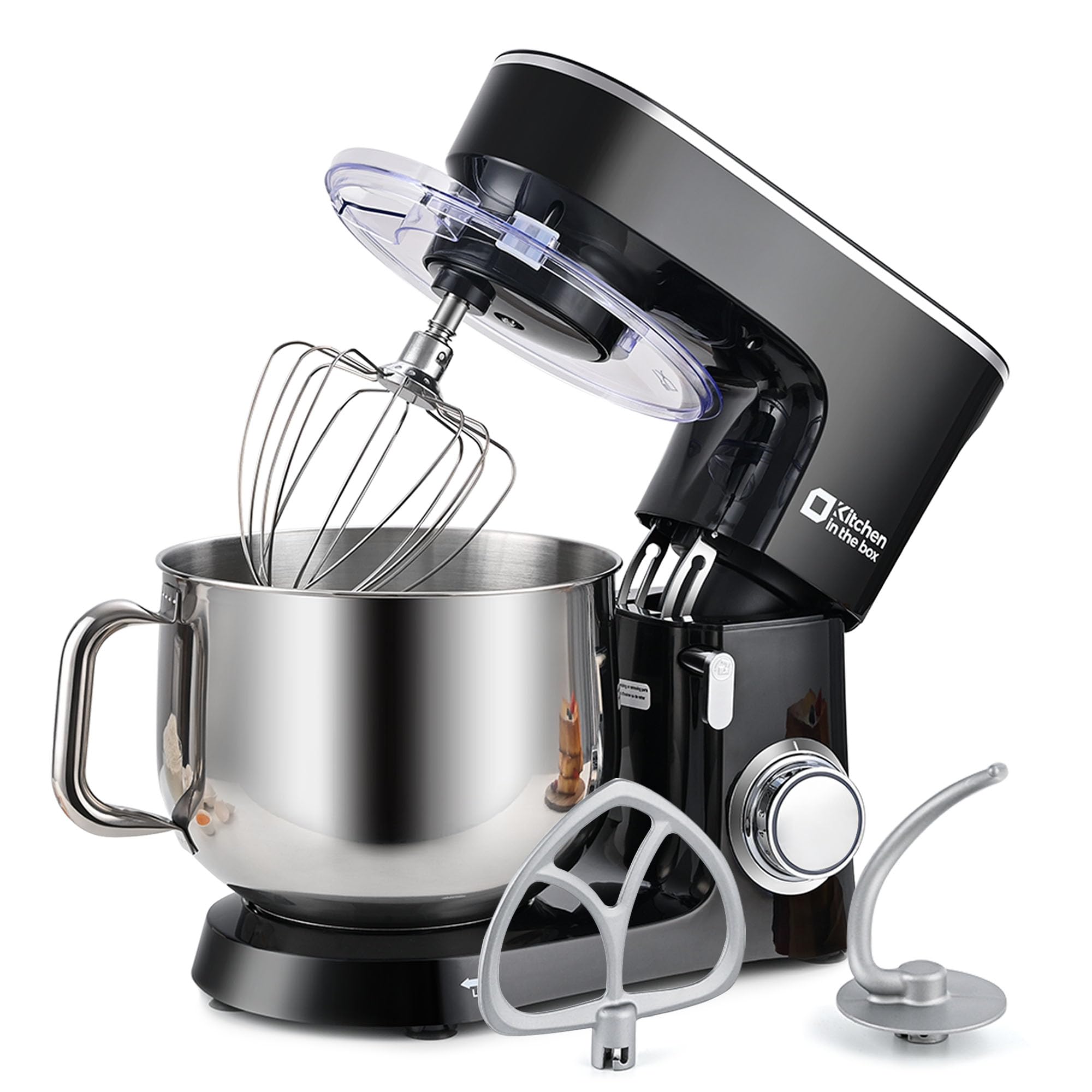
Nine hundred watts and an 8.5-quart bowl is commercial hardware in a home-machine body. The bowl has a handle, the head tilts, and there is a splash guard in the box, so the basics are all covered — and this is the second-largest bowl in this group, behind only the ZACME.
We like what the spec sheet promises: a copper motor pitched at heavy dough, ten speeds with a pulse function, and a tilt head that gives you room to scrape down a bowl this wide. For a household making two loaves and a tray of rolls in one go, that combination is exactly right. What we cannot tell you yet is how it behaves in year three.
This is a new model, so there is no long record of motors and gearboxes behind it, and that is the whole risk. Buyers who want certainty should pay for one of the established machines; buyers who need a big bowl now and can live with the unknown get a great deal of mixer for the money.
Pros
- 900 watts into an 8.5-quart bowl
- Tilt head with a handled stainless bowl
- Splash guard included with the three beaters
Cons
- New model with no long-term reliability record
Big-batch capacity at a budget price — the pick if you need 8.5 quarts now and accept that the long-term record is not written yet.
Best for Small Kitchens
Electactic 5.3-Quart
Key Features
- Power: 300 watts
- Speeds: 12 plus pulse
- Weight: 8 lb
- Capacity: 5.3 quarts
- Price: Budget
Three hundred watts is the number that decides this one. Under a 5.3-quart bowl it is fine for cake batter, buttercream, and whipped cream, and it is out of its depth the moment you ask for a stiff bread dough.
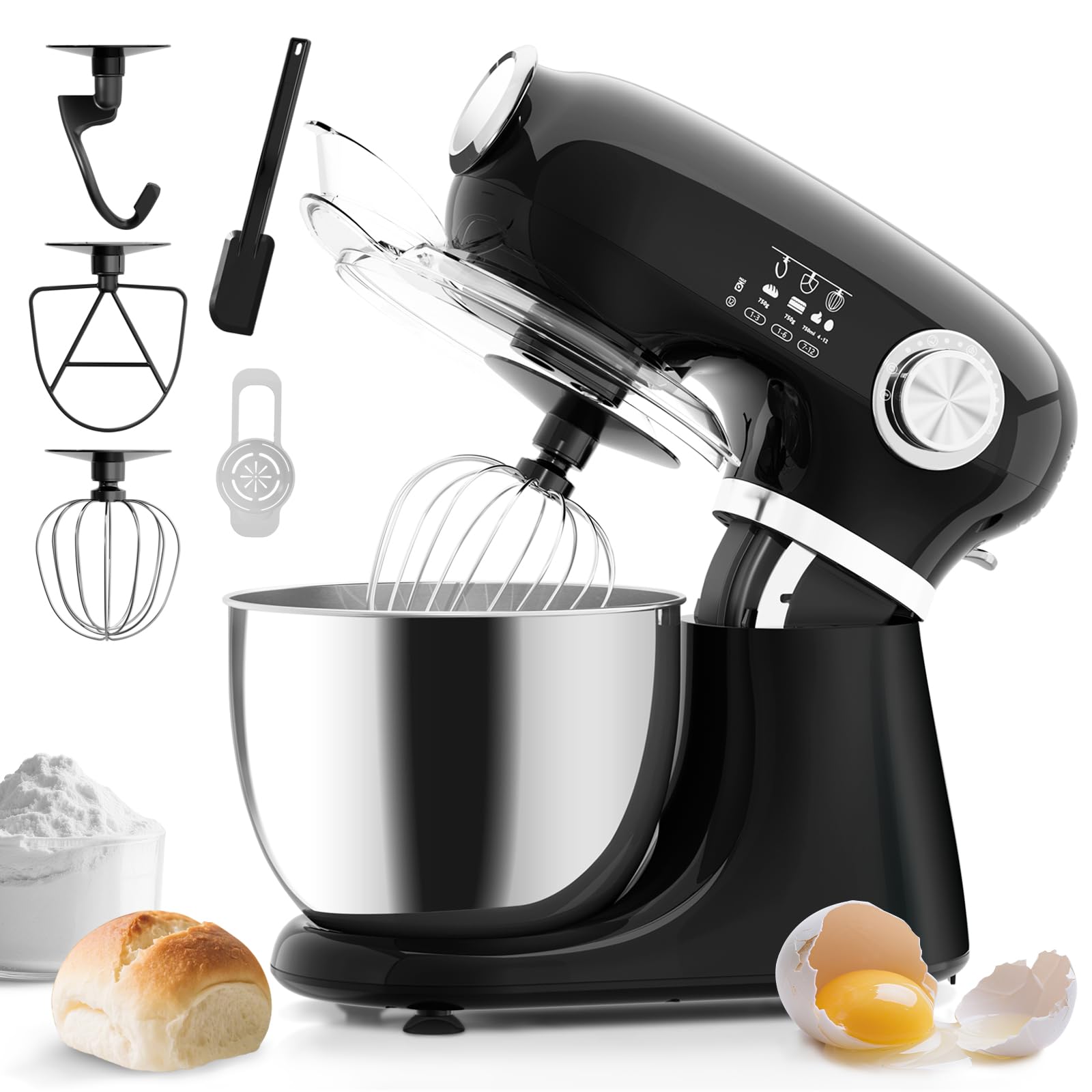
Everything else is sensible for a small kitchen. Twelve speeds plus a pulse setting is more control than most machines at this end, the head tilts, the suction feet hold it down, and at 8 pounds and under 16 inches deep it fits where a 22-pound mixer will not. The bundle includes a spatula and an egg-white separator, which is a nicer set than the usual three pieces.
We think of it as a starter mixer: it handles a birthday cake and a batch of cookies without complaint, and it teaches you whether you bake enough to want more. If bread is on the list, skip it and put the money toward the VIVOHOME or one of the bigger motors above.
Pros
- Twelve speeds plus a pulse function
- 8 pounds and a compact footprint
- Lowest-priced pick with a 5.3-quart bowl
Cons
- 300 watts is thin for bread dough
For small kitchens and cake-and-cookie baking, this is a light, compact, affordable option — just do not ask it to knead.
How We Tested 12 Stand Mixers Over Eight Months
We started by gathering every stand mixer we could find from major retailers, then narrowed by bowl capacity, attachment hub, motor type, and price until 12 remained — tilt-head and bowl-lift, small bowls and large, budget models alongside the ones that cost as much as a used car.
All 12 went into home kitchens for eight months, not onto a lab bench. Each machine made the same batch of chocolate chip cookie dough, the same sandwich loaf, and a small batch of whipped cream, and we noted what happened at every stage: did the beater actually reach the bottom of the bowl, or leave a ring of unmixed butter? Did the head drift or the base walk across the counter? For stiff dough we let it knead for ten minutes, then pressed a palm to the motor housing to feel how warm it got and listened for the motor dropping pitch under load. The disappointing ones announced themselves early, straining at dough a mixer in that price range should handle.
Ease of use got the same treatment. We timed how long it took to lock the bowl and attach the beater, how much force the head needed to tilt, and how awkward the whole thing was to lift off a shelf. Where a mixer came with a second beater, a pouring shield, or a front-hub attachment, we used it for a week rather than a single batch, since versatility only counts if it isn’t fussy to set up. Every machine was wiped down after each session, and we tracked how quickly the finish picked up fingerprints and scuffs and whether the color still looked like it did in month one.
Around month six we went back through each mixer looking for head wobble, oil seepage at the hub, and a beater that had begun scraping the bowl — the slow failures that decide whether a mixer is still working in five years.
How to Choose a Stand Mixer
The right mixer is the one that handles your heaviest regular recipe without complaint; everything else — speed count, color, extras — is a detail you can trade away.
Match the bowl to your biggest regular batch
Capacity is where most of us overshoot or undershoot. A 5-quart bowl makes about nine dozen cookies in a single batch, which covers a household that bakes most weekends; 8.5 quarts and a 3-kilo dough maximum is a bread-baking or bake-sale machine.
The trap is assuming bowl volume equals dough capacity. A wide 6-quart bowl may be rated for only about 2.2 pounds of flour, while a smaller kneading-focused machine can take more dough. Write down your largest recipe, convert the flour to weight, and compare that with the stated dough maximum rather than the quart figure on the carton.
Watts matter less than the dough rating
Motor ratings among these machines run from 300 to 900 watts, and the number alone does not tell you how one kneads — gearing, bowl shape, and the maker’s stated dough limit matter at least as much. What we look for is a published maximum dough weight, and any mention of bread at all.
A 300-watt motor under a 5.3-quart bowl is a batter machine, whatever the speed count says. If you bake bread weekly, look for 650 watts and up with a stated dough limit; for cakes, frosting, and whipped cream, 300 is plenty.
Where it will live: depth, height, and weight
These machines run from 8 pounds and under a foot deep to 33 pounds and 18 inches, and the heavy ones need clearance behind and above them. The VIVOHOME lists an 18.8-inch height, so measure the gap under your wall cabinets before you order rather than after.
Watch the word compact. In a listing it usually describes a small footprint, not a light machine. If you will lift the mixer out for every bake, weight comes before capacity; if it stays on the counter, depth and height decide.
Cleaning, wear parts, and the warranty
Stainless bowls and most beaters go in the dishwasher, and a splash guard turns an hour of wiping into a rinse. What wears out first is the coated beater, the bowl handle, and on budget machines the motor, so check that replacement whisks and beaters are actually available for the model before you commit.
Warranty length separates these machines neatly — one year on the KitchenAid, two on the ZACME, three on the Cuisinart. On a machine you will knead with, longer cover is worth more than an extra speed setting you never touch.
What the front hub can do
If you want a pasta roller, meat grinder, or ice-cream churn running off the same motor, the attachment system picks the brand before capacity does. KitchenAid has the widest line by a distance, Cuisinart offers a smaller set through a single power outlet, and the rest of these take no powered attachments at all.
Buy the hub you will actually use, then the bowl size. An ecosystem you never add to is not a reason to spend more.
Frequently Asked Questions
Is a stand mixer worth it if I already have a hand mixer?
Yes, if you bake bread or double batches more than once a month. The stand mixer holds the bowl and the beaters and leaves both hands free for adding flour, and it is the only one of the two that will knead.
For whipped cream, meringue, and a single cake, a hand mixer does the job with less counter space — keep it for the small jobs either way.
Why does my mixer move around the counter?
Almost always stiff dough plus a light machine. Press the suction feet onto a clean, dry counter, run dough on the lowest speed, and stay under the maker’s stated dough maximum.
A 33-pound machine stays put because of its mass; an 8-pound one depends entirely on its feet, so wipe them free of flour and re-seat the mixer if it starts to walk.
Can I whip one egg white in a 5-quart bowl?
Usually not well. A wire whip needs enough liquid to reach, and a single white or a cup of frosting sits below the whisk in a big bowl.
Use a hand mixer for anything under a couple of cups, and save the stand mixer for batches that fill at least a third of the bowl — that is also the point at which its steadiness starts to help.
Final Verdict
The KitchenAid Artisan is the mixer we recommend to most people, because it mixes predictably, kneads without complaint, and its attachment hub keeps it useful in ways the others cannot match. If that price is out of reach, the Cuisinart buys a bigger bowl and a three-year warranty for roughly half the money, and it earns the recommendation on its own.
And if bread is the whole point rather than part of it, the ZACME’s 8.4-quart bowl and 3-kilo dough capacity beat both of them.