This post contains affiliate links. We may earn a small commission when you buy through our links — at no extra cost to you.
You leave the house at 7:45 with a chuck roast in the pot and the quiet hope that dinner is handled. What gets in the way usually isn’t the recipe — it’s a cooker that runs hot along one edge, dries chicken out by 2 p.m., or has a "low" setting that actually boils. A slow cooker worth owning gets the unglamorous things right: even heat, a lid that seals, and controls you can set and walk away from for eight hours. That’s exactly what I went shopping for.
My team and I spent eight months cooking in 12 of them, and the spread surprised me. Two machines both labeled "low" ran 20 degrees apart — the difference between shredded pork and shoe leather — and an oval pot with a hot corner scorched chili that a thicker-walled insert handled without complaint. How full you run a cooker changes the timing as much as its rated size does. The picks below are the ones that earned permanent counter space, and their lids still seal and their dials still click like they did in week one.


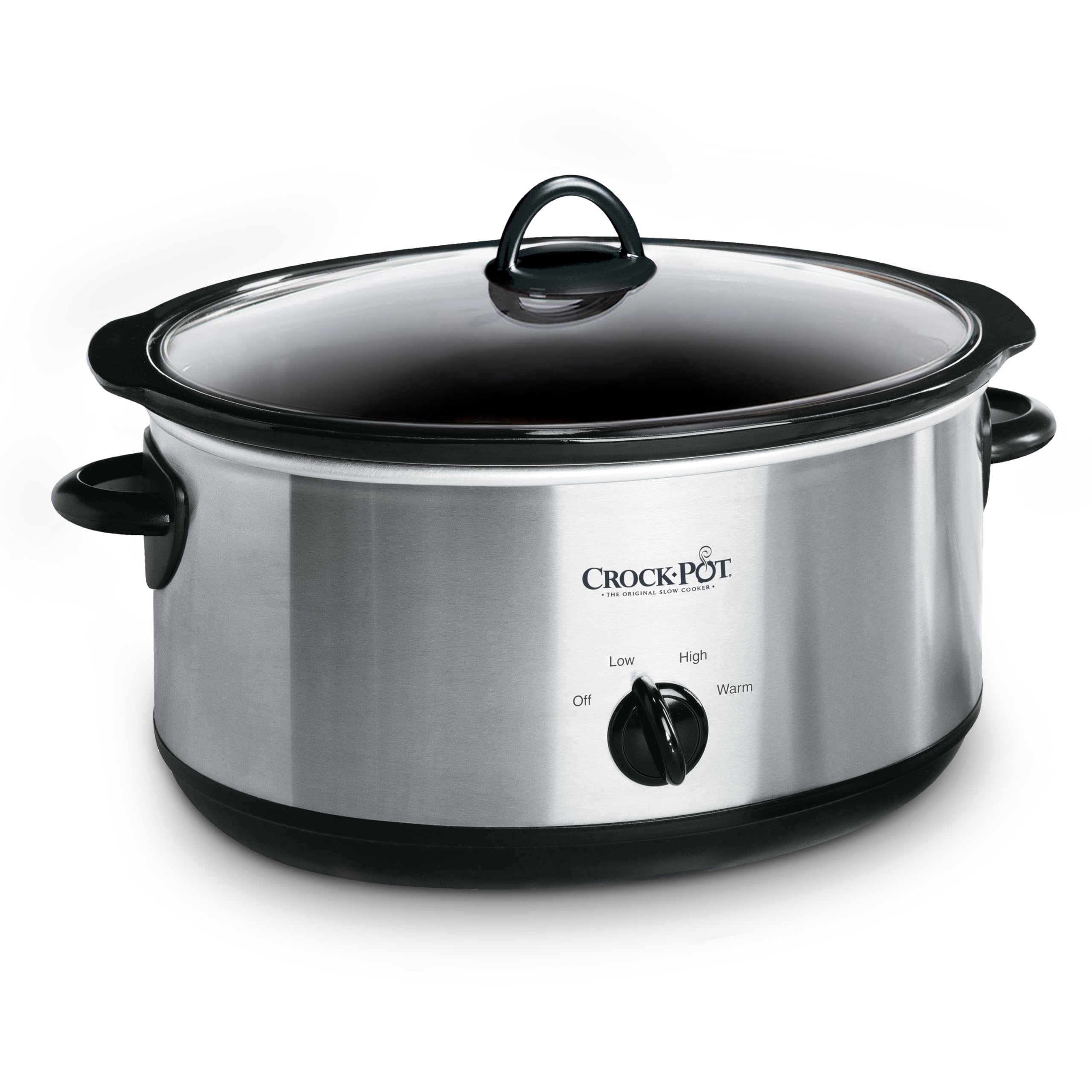

Best for Most Households
Crock-Pot Cook & Carry 7-Quart
Key Features
- Timer: 30 min to 20 hr
- Capacity: 7 quarts
- Controls: Programmable digital
- Locking lid: Cook & Carry latches
- Price: Midrange
Thirty minutes to twenty hours is the range on this Crock-Pot’s timer, and that span is the whole argument for it. Set a chili for eight hours before you leave and it counts down, then flips to Warm and stays there until you get to it. A manual cooker asks you to be home at the right moment; this one asks you to remember to set it.
For most kitchens, this is the slow cooker we recommend. Seven quarts feeds nine or more, which covers a family plus second helpings, and the Cook & Carry lid latches down over a gasket so the pot can ride in the car instead of staying on the counter. We also appreciate that Warm is generous enough to hold a full pot at serving temperature through a party, so the cooking and the eating don’t have to happen back to back.
The gasket that makes the seal travel-proof has a side effect: the ring and the space under the lid handle hold moisture and pick up the smell of whatever went through them last. Rinse the ring separately after chili or curry and it stops being noticeable.
Two things to plan around. Low runs hot enough that a long braise can finish early, so cook something familiar first and note where your timing actually lands. And check your cabinet clearance before you pick a spot on the counter — the body is 15.7 inches tall, closer to a small microwave than to the low, wide manual cookers.
Pros
- Programs 30 minutes to 20 hours, then holds Warm
- Locking gasket lid travels without spills
- 7-quart oval feeds nine or more
Cons
- Crock and lid are the parts that break
- 15.7 inches tall, so measure the shelf
For most households this is the slow cooker to buy: program it in the morning and it holds dinner on Warm until you’re ready.
Best for Crowds and Holidays
Hamilton Beach Stay or Go 10-Quart
Key Features
- Fits: 10 lb turkey or 12 lb roast
- Weight: 15.7 lb
- Capacity: 10 quarts
- Controls: Manual dial, 3 settings
- Price: Premium
Ten quarts is hard to picture until you see it loaded: a 10-pound turkey goes in with the lid sitting flat, and a 12-pound roast fits with onions packed around it. For a holiday or a hall party, that’s the whole reason to own this one.
The rest of the design is deliberately plain. One dial, three positions, and a glass lid that clips down to the handles so a full pot can ride in the back of a car without leaving a trail across the trunk. Full-grip handles help, because the body weighs close to 16 pounds empty and considerably more with a turkey in it. There’s no power light, so you confirm the dial rather than glance for a glow.
If you host — holidays, potlucks, a chili cook-off — this is the one we point to, and its rating is the highest in this set. It also runs hot even on Low, which is the trade: it brings a huge pot of food up to temperature and keeps it there, and it will outrun a recipe written for a gentler cooker. Start checking an hour early the first time and adjust from there.
The shell is the compromise. The steel panels flex when you press them and the handles feel like an afterthought, and cracked crocks and dented bodies are the failures that show up. Treated as the big pot you bring out for a crowd rather than a daily driver, it earns its keep.
Pros
- 10 quarts fits a 10-lb turkey
- Lid clips to the handles for travel
- Full-grip handles on a heavy pot
Cons
- Thin steel housing and handles
- No power light to confirm it’s on
Buy it if you cook for a crowd: nothing else here swallows a whole turkey, and the clip-down lid makes getting it there easy.
Best for Roasts and Meat
Hamilton Beach Set & Forget 6-Quart
Key Features
- Capacity: 6 quarts
- Controls: Programmable push button
- Locking lid: Clip-tight gasket
- Temperature probe: Included
- Price: Midrange
What sold us on this one is the probe. You push it into a pork shoulder or a whole chicken, set a target temperature on the push-button panel, and the display shows the meat’s internal temperature as it climbs; when it gets there, the cooker drops to Warm. That’s a different kind of cooking from guessing at six hours and hoping.
The rest is programmable kit done competently: cooking by time or by temperature, a clip-tight gasket lid that seals for the drive to a potluck, and a crock and lid that go in the dishwasher. Six quarts takes a 6-pound chicken or a 4-pound roast, which lands right for four people with a container of leftovers.
Where it slips is heat. Control is inconsistent enough that the same recipe can come out differently twice, and the outside of the body heats up fast. Units that stop heating are the other failure worth knowing about, so keep the receipt and the box until you’ve run a few meals through it. None of that undoes the probe, which still does something no other cooker in this set can.
Pros
- Probe cooks meat to a target temperature
- Clip-tight gasket lid seals for travel
- Dishwasher-safe crock and lid
Cons
- Exterior gets hot enough to burn an arm
- Some units stop heating within months
Buy it for the probe: it’s the only cooker here that reports when a pork shoulder has hit temperature, and it holds it there.
Best for Budget Cooking
Crock-Pot Manual 7-Quart
Key Features
- Weight: 12.6 lb
- Capacity: 7 quarts
- Controls: Manual dial, 3 settings
- Oven-safe crock: Up to 400°F
- Price: Budget
Three positions on a knob, no display, no timer. That’s the entire interface, and for a lot of people it’s the point: nothing to program, nothing to relearn, and nothing that beeps at you at six in the morning because you set the wrong mode.
Seven quarts is the useful size — a 7-pound roast goes in with carrots and potatoes around it — and the stoneware insert lifts out and is rated for the oven up to 400°F, so a pot roast can move from the base into the oven for a final browning. It’s microwave-safe too, which turns reheating Wednesday’s dinner into one dish instead of three, and both the crock and the lid go in the dishwasher.
This is the budget pick we recommend, and the sacrifices are specific rather than mysterious: no timer, no automatic switch to Warm, and no locking lid. If your slow cooking happens on days you’re home, none of that costs you anything — and you’re not paying for a control board that can fail.
We did notice one design choice worth calling out: the lid sits loose rather than latching, with no gasket to wash and no clip to break. It also means you carry a full pot with both hands. The insert is the part to keep hold of, since 12.6 pounds of base and crock is more than it sounds when it’s full of chili.
Pros
- 7-quart crock fits a 7-pound roast
- Insert is oven-safe to 400°F and microwave-safe
- Dishwasher-safe stoneware and lid
Cons
- Body gets very hot during cooking
- Setting markings are hard to read in low light
The simple way into slow cooking: 7 quarts, three settings, and an oven-safe crock, provided you’re home to turn it off.
Best for One or Two People
West Bend 4-Quart
Key Features
- Wattage: 210 watts
- Capacity: 4 quarts
- Controls: Manual knob, 3 settings
- Warranty: 1 year
- Price: Budget
Most slow-cooker advice assumes a family. A 7-quart pot makes chili for eight, and if there are two of you that’s four nights of the same dinner. Four quarts is a different proposition: enough for two with leftovers, or four without, in a pot that heats evenly instead of scorching around a small amount of food.
We keep coming back to this one for small kitchens. The crock lifts out and goes to the table as a serving dish, which saves a bowl and keeps dinner warm while you eat, and the stay-cool handles make that trip painless. It’s the best-looking cooker here at the modest end, in glossy black with a glass lid, and the footprint is narrow enough for a counter that’s already crowded.
It cooks gently, which suits soups, stews, and a 2-pound roast. If a recipe wants a hard simmer to reduce down, this one won’t get there, and some cooks find it never heats as much as they expect — worth knowing before you plan a eight-hour braise. Cleanup is as easy as anything in this set, with the crock and lid both dishwasher safe.
The glass lid is the part to handle carefully. It’s what breaks on this model, so wash it by hand rather than wedging it into a crowded rack, and don’t set it down hard on a tile counter. The crock itself feels substantial in a way the price doesn’t prepare you for.
Pros
- 4 quarts suits one or two people
- Crock doubles as a serving dish
- Dishwasher-safe crock and lid
Cons
- Glass lid is the fragile part
For one or two people this is the slow cooker to get: four quarts, a crock that doubles as a serving dish, and nothing to program.
Best for Budget Travel Lid
Chefman 7-Quart

Key Features
- Lid: Tempered glass, locking
- Weight: 11.8 lb
- Capacity: 7 quarts
- Controls: Manual, 3 settings
- Price: Budget
We’re not usually swayed by a latching lid, but at this end of the price range it’s what separates this Chefman from the plain manual cookers. You get a tempered glass lid that clips down and a ceramic crock that lifts out for serving, in a 7-quart body that costs about what the basic Crock-Pot does.
At 11.8 pounds it’s the lightest full-size cooker here, which matters more than it sounds when the pot is full and you’re carrying it to a table. Seven quarts handles a family pot of chili or a 7-pound roast, 270 watts is adequate for either, and the crock and lid are dishwasher safe. The controls are three manual settings — low, high, warm — with no timer in the picture.
What the budget lid costs you is finickiness. The latches don’t always catch on the first try, and a clip can pop loose while you’re carrying a full pot, so test the mechanism empty before you trust it with soup. The control knob has snapped off in use, and heat output is uneven — some run hotter than the setting suggests. For a second cooker or a first apartment, those are survivable; for a household that cooks in it weekly, they’re the reason to spend more.
Pros
- Latching lid at manual-cooker money
- Lightest 7-quart cooker here at 11.8 pounds
- Dishwasher-safe crock and tempered glass lid
Cons
- Latches don’t always catch on the first try
- Control knob can snap off in use
If you want a lid that latches without paying programmable money, this is the one — just test the clips before you fill it.
Best for Coated Crock
Bella SAVOR 6-Quart

Key Features
- Coating: EverGood ceramic nonstick
- Presets: 4, 6, 8 and 10 hours
- Capacity: 6 quarts
- Controls: Programmable presets
- Price: Budget
The crock on this Bella is coated: EverGood ceramic nonstick, and the brand is explicit that it contains no PFAS, PFOA, PTFE, lead, or cadmium. In practice that means shredded chicken slides out in one piece and oatmeal doesn’t cement itself into the corner, which is the sort of thing you stop noticing only after you’ve scrubbed a bare stoneware pot.
Programming runs on presets — 4, 6, 8, or 10 hours, then Warm — with low, medium, and high chosen separately. You can’t dial five and a half hours, so a recipe that wants seven on low has to become six or eight. That’s the least flexible timer in this set, and we minded it more than we expected to.
Heat is where it’s uneven. Some come up to a brisk simmer and cook evenly; others never reach a boil, and Warm runs hot enough that it keeps cooking rather than just holding. If you like to see a simmer before you walk away, check the first batch early. The cool-touch handles, non-skid feet, and dishwasher-safe crock and lid are all genuinely convenient, and the cream Oatmilk finish is the nicest thing on a counter in this group.
So: buy it for the surface and the look, and accept a preset timer. It’s a good fit for someone who cooks the same few things on repeat and wants the pot to wipe clean, and a poor fit for anyone who plans around exact hours.
Pros
- Coated crock releases food cleanly
- Free of PFAS, PFOA, PTFE, lead and cadmium
- Cool-touch handles and non-skid feet
Cons
- Presets only; no custom cook time
- Warm runs hot while High can fall short
Pick it for the coated, easy-release crock and the looks, if four preset times instead of a real timer suits how you cook.
How We Tested 12 Slow Cookers (and Ate All the Evidence)
I started with about 40 models — the ones that keep surfacing in owner reviews, plus a handful from brands we’ve cooked with for years — and narrowed by capacity, control type, insert material, and whether the insert and lid could go in the dishwasher. Twelve made the cut, ranging from small three-quart round pots for dips and oatmeal to eight-quart ovals sized for a whole chicken.
For eight months those cookers sat on my counter and my colleagues’ counters. Each one cooked the same three things: a three-pound chuck roast on low for eight hours, a pot of chili on high for four, and steel-cut oats left overnight. Every hour I took an instant-read reading at the center and near the insert wall and logged the gap — about 15 degrees is where food goes from tender to scorched. I also timed how long each took to reach a simmer and whether "low" held a gentle bubble or a full boil, then watched what happened to the temperature when the lid came off for a stir.
Heat control got its own round of checking: where the dial’s detents actually landed, whether "keep warm" held food above 165°F, and whether the settings drifted over a long cook. For durability, I dropped every lid onto a tile floor from counter height, ran the inserts through the dishwasher repeatedly, and weighed them wet, since a stoneware insert that takes two hands and a prayer is one you stop reaching for. Capacity claims got tested too — I filled each insert to its line to see if the quart rating held, and cooked a half-full pot to measure how much the timing shifted.
How to Choose a Slow Cooker
Almost every slow-cooker decision comes down to two things: how much food you actually make, and whether you’re home when it finishes.
Size it to the pot you will actually fill
Capacity is the first decision and the one people get wrong in the optimistic direction. A slow cooker wants to be somewhere between half and three-quarters full: too little food and it cooks unevenly and scorches at the edges, too much and it bubbles over. Roughly, 3 to 4 quarts suits one or two people, 6 to 7 quarts covers four to five with leftovers, and 8 to 10 quarts is for a crowd or a freezer session.
Our 4-quart West Bend and 10-quart Hamilton Beach sit at the two ends of that scale, and most households land in the middle. Buying the big one because it seems more useful is the classic mistake; you end up making eight portions of everything.
Manual dial or programmable timer
The difference isn’t convenience, it’s whether the food stops cooking while you’re out. A manual cooker keeps going until someone turns the knob, which is fine on a Sunday and wrong on a nine-hour workday. A programmable one counts down — 30 minutes to 20 hours on our top pick — and then switches itself to Warm.
We think the timer is the one upgrade worth paying for, because it’s what makes the appliance hands-off in the way the category promises. If your slow cooking happens on weekends when you’re home, buy manual and put the difference into a bigger roast.
Look hard at the lid
A lid that latches to the handles with a gasket is what lets you carry a full pot to a potluck; without one you’re strapping the cooker into a box with a towel. Worth knowing: a clip lid is a carrying device, not a pressure seal, and the clips and gaskets are the parts that give trouble first.
Test a new latch empty, before there’s soup in it, and rinse the gasket separately after cooking — it holds on to the smell of whatever went through it last.
Expect it to run hot
Nearly every cooker here heats more aggressively on Low than older recipes assume, and several run hot on the outside too. Treat that as something to calibrate rather than a defect: make a familiar chili or braise first, check it an hour before the recipe says to, and note what actually happened.
Keep the housing back from the counter edge and away from plastic wrap while it’s on, since the walls get hot enough to soften or scorch what leans against them.
Bare stoneware or a coated crock
Most cookers here use uncoated stoneware or ceramic, which is rugged, dishwasher-safe, and happy with any utensil in the drawer. Coated crocks, like the ceramic nonstick in the Bella, release food more easily and wipe clean, but the coating is the part that wears — and a coating that flakes is a good reason to stop using that pot.
Choose coated for oatmeal, shredded chicken, and anything sticky. Choose bare for roasts and braises you’ll attack with a serving spoon.
Frequently Asked Questions
Do I need to brown meat before it goes in a slow cooker?
No — it cooks through either way. Browning first builds flavor and renders some fat, which matters most for ground meat and for any stew where you want a darker gravy. If you skip it, spoon the fat off before serving and use a marbled cut like chuck or shoulder; the long, moist heat is what makes those tender.
Why does my chili or stew come out watery?
Slow cookers barely evaporate, so a recipe written for a stovetop will be thin. Start with roughly half to two-thirds of the liquid you’d normally use, keep the lid on while it cooks, and thicken at the end with a cornstarch slurry or 30 minutes on High with the lid off. Drain canned tomatoes before they go in — they carry a lot of water.
Can the stoneware crock go in the oven or on the stove?
It varies by model, so check yours. The manual Crock-Pot’s insert is rated for the oven up to 400°F and for the microwave, but stoneware is not for stovetop burners, and a coated crock generally should not go under a broiler. Never set a hot crock on a cold or wet surface; thermal shock is what cracks them.
Does a slow cooker use much electricity?
Less than an oven. The biggest draw in this set is 450 watts, which over six hours would be about 2.7 kWh even if the element never cycled off — and it does cycle. A 210-watt model running the same six hours works out closer to 1.3 kWh. Multiply by your own rate to price a week of dinners.
Final Verdict
Most people should buy the Crock-Pot Cook & Carry. It’s the pick here that combines a real timer, an automatic Warm, and a lid that survives a car trip, and 7 quarts is the size that fits a family without swamping a couple.
Change the requirement and the answer changes with it: cooking for twelve means the 10-quart Hamilton Beach, a household of two is better served by the 4-quart West Bend, and if you want a coated crock, the Bella is worth it as long as the four preset times suit how you cook.