This post contains affiliate links. We may earn a small commission when you buy through our links — at no extra cost to you.
A ripe tomato is the cheapest knife test there is. A straight edge stalls on the skin, then crushes the fruit underneath. Serrations solve that: the points bite first, saw through the tough part, and leave the soft part alone. What separates one serrated utility knife from another is how long that bite lasts and how the handle behaves when your hands are wet.
I’ve kept one within arm’s reach for years — it’s what I grab for tomatoes, citrus, crusty bread, hard salami, and the plastic clamshell standing between me and a new pair of scissors. We spent six months with 12 of them, from stamped budget blades to forged German steel with full tangs, and the gap between the best and the rest showed up within a week.
Here’s what nobody tells a first-time buyer: serrations don’t come back easily. A plain edge hones in ten seconds; a scalloped one needs a tapered rod, notch by notch, and almost nobody bothers. Buy the sharpest one you can justify and keep it out of the dishwasher. The picks below are the ones still biting in month six.


Best for Everyday Tomato Slicing
Victorinox Swiss Classic 4.3-Inch
Key Features
- Weight: 0.96 oz
- Blade Length: 4.3 inches
- Construction: Stamped
- Handle Material: Polypropylene
- Price: Budget
A ripe tomato is the honest test. A chef’s knife flattens it; the Victorinox Swiss Classic 4.3-inch bites the skin and finishes the slice without pressing down, and we ended up with rounds thin enough to read through. That is the whole case for this knife, and it holds up every time we pick it up.
The weight is what makes it work. The entire knife is about 27 grams, so nearly all of it is blade, and you steer with your fingertips instead of your wrist — the same reason it suits anyone whose grip isn’t what it used to be. The textured polypropylene handle holds firm with wet hands, and the red is bright enough to find in a drawer full of black-handled tools.
The limits are honest too. The blade is stamped and thin, so it flexes if you lean on it, and a crusty baguette belongs under a bread knife. A 4.3-inch blade also means more passes on a big head of cabbage. None of that matters for the jobs this knife is actually for.
It carries Victorinox’s lifetime guarantee against defects, and it costs little enough that we keep one in the block and one in the camping box. As a first serrated knife, or a second one for the drawer everyone uses, nothing here is easier to recommend.
Pros
- Thin blade slices ripe tomatoes cleanly
- Feather-light and easy to steer
- Non-slip handle grips when wet
- Lifetime warranty against defects
Cons
- Blade flexes under heavy pressure
- Not a stand-in for a bread knife
Our default: a featherweight 4.3-inch serrated blade that leaves tomatoes intact and costs little enough to buy twice.
Best for Forged All-Rounder
Cutluxe Artisan 5-Inch Serrated
Key Features
- Blade Length: 5 inches
- Construction: Forged
- Steel Hardness: 56+ Rockwell
- Handle Material: Pakkawood
- Price: Midrange
Pick this up after the Victorinox and it feels like a different class of tool. The Cutluxe is forged from a single piece of high-carbon German steel, full tang, with pakkawood scales under three rivets, and the balance sits under your palm rather than out at the tip. That is why we point forged-knife shoppers here first.
The 5-inch blade is tempered to 56+ Rockwell, so the scallops stay crisp through steady use instead of rounding off. They’re also deep enough to grab citrus peel and a tomato’s shoulder on the first draw, which is where cheaper serrations make you saw.
Two things to know. Pakkawood doesn’t want to soak, so this is a hand-wash-and-dry knife no matter what the listing suggests. And the handle is sized for smaller hands — comfortable for most of us, short for anyone with big paws, who should look at the Wüsthof or the Global instead.
Pros
- Forged full tang with real heft
- Pakkawood handle looks and feels premium
- Deep serrations handle citrus and rolls
- Lifetime warranty on materials
Cons
- Handle runs short for large hands
- Wood handle needs hand washing
We think this is the forged knife to buy if you want weight and a pakkawood handle without paying premium-knife money.
Best for Buying Once
WÜSTHOF Classic 5-Inch Serrated
Key Features
- Weight: 2.4 oz
- Blade Length: 5 inches
- Construction: Forged
- Handle Material: Polyoxymethylene (POM)
- Price: Premium
This is the most expensive knife in the group, and the money goes into the blade. It’s forged from one piece of high-carbon steel in Solingen, tempered to 58 HRC, with the full bolster and triple-riveted POM handle of the Classic line.
Slim is the surprise. At 2.4 ounces the blade is thinner and lighter than its forged construction suggests, and the bolster gives your index finger a perch exactly where you want one for a long draw through a sandwich. The scallops are fine and even, so the cut is clean rather than torn.
It’s still biting tomato skin without pressure, and when it does need attention the serrations want a tapered rod or a professional — a pull-through sharpener will flatten the teeth in a few passes. If you’re the kind of cook who buys once and keeps a knife for years, that maintenance is part of the deal, and it’s a fair one.
It also matches the other Wüsthof Classic knives, which matters if one is already in the block. It doesn’t match a picnic blanket, though — the Messermeister and its sheath are the ones that travel.
Pros
- Forged blade with a full bolster for control
- Fine, even scallops leave clean cuts
- Slim and light for a forged knife
- Matches the Wüsthof Classic line
Cons
- Most expensive knife in this group
- Serrations need a rod or a pro
Buy this if you want a single forged serrated knife and never intend to replace it; the edge and the balance justify the premium.
Best for Big Sandwiches
Global GS-14 6-Inch Serrated
Key Features
- Weight: 6.63 oz
- Blade Length: 6 inches
- Construction: Stamped
- Price: Premium
Six inches is long for this category, and that’s the argument for the Global. It’s the one here that halves a sub, opens a big lime, or cuts a sushi roll in one pass, and it’s the pick for anyone whose hands feel cramped by a 4.5-inch blade.
The blade is stamped, thin, and scalloped deep enough to hold a tomato skin, and the seamless stainless handle is dimpled along its whole length so your grip doesn’t slide when things get juicy. At 188 grams it has more presence than the Victorinox without the forward weight of a forged knife.
For a stamped blade the price is high, and the length is either the reason to buy it or the reason to skip it. If your serrated work is tomatoes and lunch prep, the 5-inch knives here are easier to control; if you cook for a crowd and cut big things, the extra inch is worth the money.
Pros
- Six-inch blade handles big sandwiches and citrus
- Dimpled seamless handle holds a wet grip
- Thin scallops cut with little pressure
- Light for its length
Cons
- Premium price for a stamped blade
- Length is awkward in small hands
Six inches of thin, sharp scallop for big produce and big hands, at a price that only makes sense if you’ll use the length.
Best for Drawer Backup
Cuisinart Triple Rivet 5-Inch Serrated
Key Features
- Weight: 3.2 oz
- Includes: Blade guard
- Blade Length: 5 inches
- Construction: Forged
- Price: Budget
This is the least expensive knife here, and the one we hand to guests without a second thought. The 5-inch blade has deep serrations that catch tomato skin, the extra-wide bolster puts your index finger somewhere useful, and a plastic blade guard comes in the box so it can live loose in a drawer.
It isn’t as refined as the knives above it — the edge may need a few passes on a rod before it bites the way you expect, and the fit and finish is workmanlike rather than elegant. But it’s forged, full tang, covered by a lifetime warranty, and it cuts. For a second knife, a rental kitchen, or a drawer that keeps losing its serrated blade, that’s enough.
Pros
- Blade guard included for drawer storage
- Deep serrations grab tomato skin
- Wide bolster steadies the grip
- Lifetime warranty
Cons
- Edge may need a touch-up when new
Our budget pick: a forged 5-inch serrated blade with a guard that does the job and costs almost nothing to replace.
Best for Slippery Hands
OXO Good Grips 5-Inch Serrated
Key Features
- Care: Hand wash only
- Handle: Soft non-slip grip
- Weight: 3.2 oz
- Blade Length: 5 inches
The handle is the reason to buy this one. OXO wraps a soft, non-slip grip around the 5-inch blade, and it stays put when your hands are wet — we noticed it most with tomato juice on our fingers, where the smooth plastic handles start to feel like a liability.
We reach for it when the cutting is casual: a sandwich for a kid, a lime at the end of the day, a tomato that needs two slices and no ceremony. The serrations are fine and even, so citrus and soft fruit come out clean rather than crushed, and the blade holds its edge without the fuss of a high-maintenance knife.
Hand wash only, though, and there’s no guard or sheath in the box — so it’s the wrong knife if you want something to toss in the sink after a party or carry to a picnic. What you get instead is the most forgiving grip in the group.
Pros
- Handle stays secure with wet hands
- Fine serrations handle citrus and soft fruit
- Right size for quick everyday jobs
Cons
- Hand wash only, no guard included
Buy it for the grip: a soft, secure handle that makes a 5-inch serrated blade easy to use with wet or tired hands.
Best for Picnics and Travel
Messermeister 4.5-Inch Serrated

Key Features
- Includes: Matching sheath
- Blade Steel: German 1.4116 steel
- Blade Length: 4.5 inches
- Construction: Stamped
- Price: Budget
At 4.5 inches with a narrow blade, this sits at the small end of the group, and that’s the thing to settle before you order. For tomatoes, small is an advantage — you get close to the fruit and cut exactly where you’re looking. As the only serrated knife in a busy kitchen, it will feel short.
The blade is stamped from German 1.4116 steel with a little flex to it, which is how it catches a tomato’s skin and follows through instead of crushing the shoulder. It makes short work of salami, hard-boiled eggs, and citrus too, and the one-piece construction leaves no seam for anything to hide in.
The matching sheath is what sets it apart. This is the knife that goes in a tote bag for a picnic or a camping box without being wrapped in a dish towel, and the red handle is easy to find at the bottom of a bag.
It’s inexpensive, which makes it a fine second or third serrated knife, and Messermeister throws in free lifetime sharpening and reconditioning — genuinely useful on a blade this thin, which you should keep to slicing rather than prying. Buy it for tomatoes and travel; keep something longer for the rest.
Pros
- Matching sheath makes it travel-ready
- Thin blade slices tomatoes cleanly
- Free lifetime sharpening and reconditioning
- Light and compact in the hand
Cons
- Thin blade can bend under side pressure
The travel pick: a thin, sharp 4.5-inch blade with a matching sheath and free lifetime sharpening for very little money.
Best for Shared Kitchens
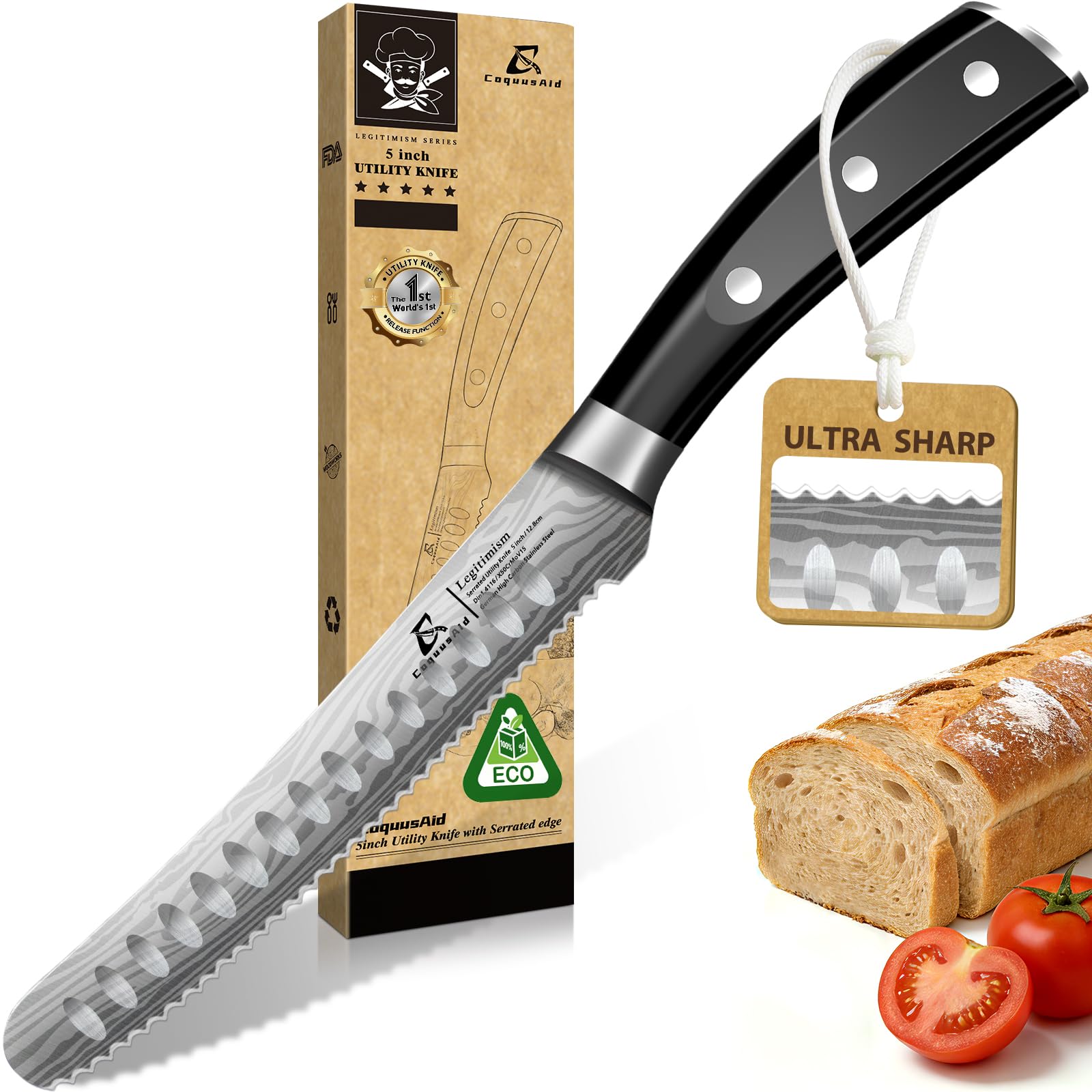
CoquusAid 5-Inch Serrated Utility
Key Features
- Tip: Rounded
- Blade Length: 5 inches
- Construction: Forged
- Handle Material: ABS
- Price: Midrange
The rounded tip is the first thing you notice, and it’s the reason to consider this one. There’s no sharp point to catch a finger when you’re working quickly or passing the knife to someone less experienced, and the last inch of blade still does everything the pointed knives do except core a tomato.
The serrations are cut in smooth arcs rather than sharp sawteeth, so the blade doesn’t snag on a tomato or tear a sandwich, and two shallow dimples above the edge release food instead of letting a cucumber slice ride up the blade. The build is forged high-carbon German steel with a full tang and a triple-riveted ABS handle.
In hand it sits closer to the Cutluxe than to the stamped knives — 5 inches of blade, 9.3 inches overall, a little more mass and a little more stability on a long draw. The ABS handle is plain next to pakkawood, and the gift box suggests this one is bought as often for someone else as for yourself.
For a shared kitchen, a first good knife, or a household where someone is nervous around sharp tips, the rounded end is a real advantage. If you core tomatoes and want a point for it, the Victorinox or the Cutluxe does that job better — this one trades the point for safety.
Pros
- Rounded tip is safer in a shared kitchen
- Smooth serration arcs resist snagging
- Dimples keep food from sticking
- Full tang forged construction
Cons
- ABS handle feels plainer than pakkawood
A smart choice for a shared kitchen: a rounded, snag-free serrated blade that’s forgiving for less experienced hands.
How We Chose and Tested Serrated Utility Knives
We started by gathering every serrated utility knife we could find in the 4- to 6-inch range, roughly 40 of them, then filtered by blade steel, handle construction, and price so the shortlist covered stamped budget blades, forged German steel, and a few full-tang options in between. Twelve made the cut, and each one went into a home kitchen for six months rather than a lab bench.
Sharpness and slicing performance got checked the same way every week: a ripe tomato sliced thin enough to see through, a lemon cut into wedges, a bagel halved, a hard salami peeled. We noted whether the points caught the skin on the first pass or skated across it, whether the slices stayed firm or bled out onto the board, and whether the blade wandered off line. We also looked at each edge after a couple hundred cuts to see where the teeth had rounded.
Handles earned their keep with a wet-hands test — we washed each knife, then sliced a tomato without drying our hands to see if the grip stayed planted or rotated. Versatility was judged by everything beyond tomatoes: citrus, crusty bread, semi-firm cheese, sandwich duty, and clamshell packaging, which almost nothing else in the drawer handles cleanly. Value came down to what the knife cost against how long it kept biting, and we hand-washed every one of them for six months, since a serrated edge that rides the dishwasher comes out duller than it went in.
How to Choose a Serrated Utility Knife
Every knife in this group will get through a tomato; what separates them is how much control the blade and handle give you while it does.
Match Blade Length to the Job and the Hand
Four and a half inches is plenty for tomatoes, citrus, and a sandwich cut in half. Five inches adds reach for salami, cheese, and rolls. Six inches starts to behave like a small bread knife, which is either exactly what you want or a blade that feels clumsy on a plum tomato.
If your hands are small, stay at 5 inches or under — the Victorinox, the OXO, and the Messermeister all sit there, and they’re easier to steer than the Global. If you regularly halve big limes or split a sub, the extra inch earns its keep.
Stamped or Forged, and What the Weight Buys
Stamped blades are cut from sheet steel, which makes them light, thin, and cheap; the Victorinox weighs about 27 grams and steers with your fingertips. Forged blades are thicker and balanced under the palm, and they resist flexing when you lean into a crusty roll. The trade-off is money and a heavier feel for delicate work.
For a knife that mostly meets tomatoes, light and thin is an advantage. For one that also sees cheese, salami, and bread, the forged picks here — the Cutluxe and the Wüsthof — are steadier in the cut.
Read the Serrations Before You Buy
A serrated edge cuts on the draw, not on pressure, which is why it leaves a tomato’s shoulder intact. Deep, pointed scallops grab soft skins and crusty bread; finer, more even scallops make cleaner cuts through citrus and sandwiches and are less likely to tear.
The catch is upkeep. A pull-through sharpener will flatten the teeth, and home sharpening means a tapered rod worked one scallop at a time. Budget for a professional pass every few years, or buy from a maker that includes it — Messermeister covers lifetime sharpening on its tomato knife.
The Handle Decides How It Feels in a Wet Kitchen
Tomato juice is slippery, and the handle is where these knives are won or lost. Textured polypropylene, like the Victorinox’s, grips when wet and shrugs off the sink. Rubberized grips, like the OXO’s, are the most forgiving if your hands are tired or arthritic. Pakkawood looks better than either but wants drying, and all-steel handles are the easiest to clean and the least forgiving if your grip loosens.
Judge any candidate with wet hands in mind, not dry ones. It’s the difference between a knife you reach for daily and one that sits in the block.
Frequently Asked Questions
Can serrated utility knives go in the dishwasher?
Most will survive a cycle, but none of them benefit. Detergent and the heat of a drying cycle dull an edge and can spot high-carbon steel, and a knife rattling against other cutlery chips scallops. Wash by hand in warm soapy water, dry it right away, and store it with the guard or sheath on. If it has to go in, use the top rack and turn off heated dry.
How do you sharpen a serrated utility knife?
Work each scallop individually with a tapered diamond or ceramic rod, matching the angle the maker ground and using one light stroke per scallop from the back of the tooth to the tip. Leave the flat back of the blade alone. Skip pull-through and electric sharpeners, which flatten the teeth; if the scallops are deep and uneven, send it out.
What’s the difference between a tomato knife and a serrated utility knife?
Mostly length. A tomato knife usually runs 4 to 5 inches with a narrow blade built to start a cut in a soft skin; a serrated utility knife stretches to 5 or 6 inches and takes on sandwiches, salami, and cheese as well. If tomatoes are most of the job, buy the shorter blade — it’s easier to aim. For one serrated knife that does everything, buy the 5-inch.
Can a serrated utility knife replace a bread knife?
For rolls, bagels, and sandwiches, yes — the Global’s 6 inches handle all three. For whole crusty loaves you still want a long serrated bread knife, because a short blade saws unevenly and compresses the crumb. If you cut whole loaves weekly, keep both; if you mostly split rolls, this category covers it.
Final Verdict
If you want the one knife that earns its place in the drawer, buy the Victorinox Swiss Classic 4.3-inch: light enough to steer with your fingertips, sharp enough to leave a tomato intact, and inexpensive enough to own two. Choose the Cutluxe instead if you want forged weight and a pakkawood handle, or the Wüsthof if this is the last serrated knife you plan to buy.
And if your hands are large or your sandwiches are, the Global’s 6 inches are the whole decision.