This post contains affiliate links. We may earn a small commission when you buy through our links — at no extra cost to you.
Three summers ago I ran a hose from the gas line on the side of my house to a grill and quit buying propane. No tank to swap mid-party, no Sunday run to the hardware store because the last burger was cooking on fumes. A natural gas grill is simply always full — the fuel errand disappears, and what’s left is the cooking.
The hookup is the easy part. What separates one grill from another shows up once the lid is down: how evenly heat spreads across the grates, whether the sear zone actually crusts a steak, whether the side burner can hold a boil, and how much you have to assemble yourself. We’ve spent nine months cooking on seven of them.
One thing worth knowing: natural gas burners usually run a touch softer than the same grill on propane, so burner layout and grate material matter more than the BTU number printed on the lid. Grills also live outside year-round, and build quality stops being abstract by year two. The picks below earned their permanent spot.
Best for Everyday Natural Gas
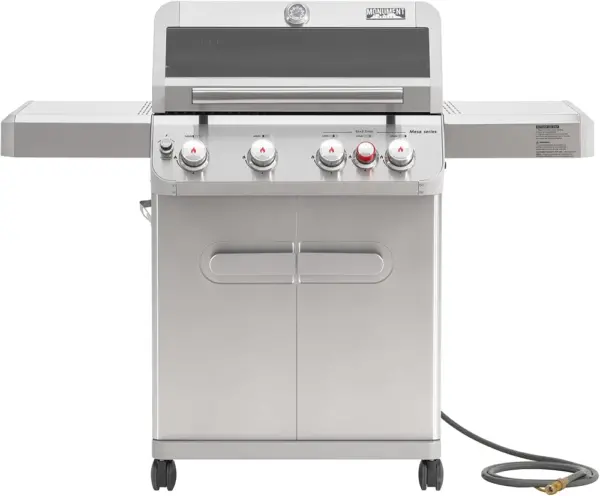
Monument Grills M415BZNG
Key Features
- Total output: 50,000 BTU
- Natural gas hose: Included
- Main cooking area: 450 sq. in.
- Total cooking area: 630 sq. in.
- Price: Midrange
The natural gas hose is in the box, and so are burners already set up for a gas line, which matters more on install day than on any spec sheet. Plenty of grills described as natural gas turn out to be propane carts with a conversion kit sold separately; this one is a natural gas barbecue from the moment you open the carton. That’s the difference between an afternoon with a wrench and a call to a plumber.
Four main burners push 50,000 BTU across 450 square inches of grate, with a broil zone rated to reach 650 degrees in ten minutes. What we appreciate is where that heat lands: a U-shaped flame under a perforated flame tamer gives you one genuinely hot patch for steaks and a cooler side for chicken, so a weeknight dinner doesn’t need every burner lit and a twenty-minute preheat. It climbs quickly, and the knobs have enough travel to hold a low temperature without babysitting.
The details are the ones you notice in month two. A glass window in the lid means you can check a chicken thigh without dumping the heat, the knob lights make an evening cook easier, and the grease tray slides out from the front instead of asking you to reach under the firebox. Budget a second pair of hands for lifting the box and setting the lid; the rest goes together in an order that makes sense.
The 630-square-inch headline counts the warming rack, so the real cooking grate is 450 square inches: comfortable for four, snug for eight. Coverage is where this grill gives ground, too. General coverage runs two years against Weber’s ten, though the 304 stainless burners carry eight years of their own and the money you keep is real.
Pros
- Natural gas hose included, no conversion kit
- 450 sq. in. main grate at the lowest price here
- Broil zone rated to 650 degrees in ten minutes
- Lid window, knob lights, and bottle opener
Cons
- Two-year general warranty trails the other picks
We recommend the M415BZNG to most people: it arrives plumbed for natural gas, heats fast, and gives you more main grate than anything else here for the money.
Best for Small Patios
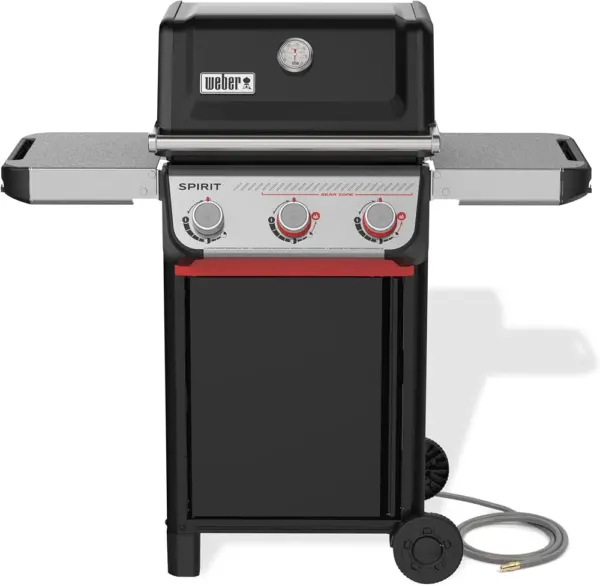
Weber Spirit E-325
Key Features
- Warranty: 10 years limited
- Sear zone: Boost burners, 40% more power
- Main burners: 3
- Main cooking area: 360 sq. in.
- Price: Midrange
Three hundred sixty square inches of grate is the smallest primary cooking area in this group, and the Spirit still costs more than the Monument. What the difference buys is a tighter cart, 48.3 inches wide and 26.6 inches deep, narrow enough to live beside a door on a deck, plus a real sear zone and a parts network that will still be there in year eight. For two people cooking four nights a week, we think that’s a sensible trade. For a family of six, it’s the wrong grill.
The sear zone earns its name. Boost burners push 40% more power into a wide hot section, and the porcelain-enameled cast-iron grates hold enough heat to crust a burger without the whole surface running away from you. Snap-Jet ignition lights each burner individually with one hand, which sounds like a small thing until you’re holding a plate in the other one.
Ten years of limited coverage is the quiet argument for the Spirit, and the Weber Works rails take snap-on hooks, a bottle holder, and a light so the side table stops being a pile of tongs. Those accessories are sold separately, which is worth knowing before you fall for the photograph.
Porcelain-enameled cast iron is also the right call for maintenance: it holds heat through a round of burgers and wipes down without the scrubbing bare iron demands. Between the grates and the ignition, this is a grill you walk up to, light, and cook on, with no ritual and no accessories required.
Pros
- Sear zone adds 40% more burner power
- Snap-Jet ignition lights burners one-handed
- 10-year limited warranty
- Weber Works rails take snap-on accessories
Cons
- Assembly instructions are the weak point
- Top-end heat stops short of infrared
We point small-patio cooks to the Spirit: a narrow three-burner cart with a sear zone that adds real power and ten years of coverage behind it.
Best for Long-Term Ownership
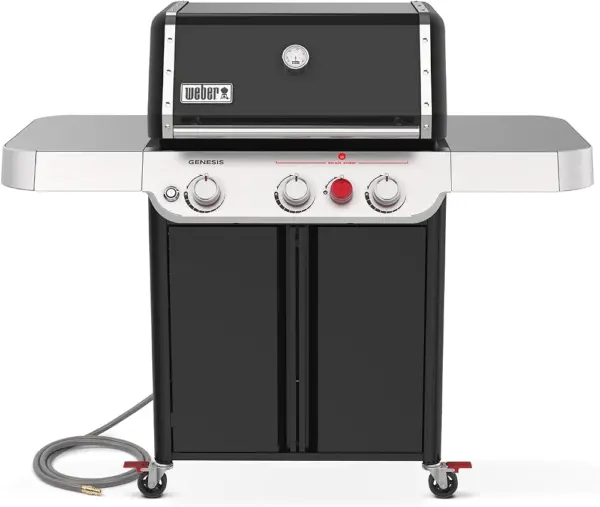
Weber Genesis E-325
Key Features
- Warranty: 12 years limited
- Sear zone: Extra-large
- Cart width: 57.7 in.
- Main burners: 3 PureBlu
- Price: Premium
The Genesis costs a serious step more than the Spirit, and the money goes into parts you can point at: tapered PureBlu burners built to hold a consistent flame across the grate, an extra-large sear zone that takes several steaks without crowding, stainless side tables, and twelve years of coverage instead of ten. The one number Weber doesn’t publish is a cooking area, which is a strange omission on a grill at this level.
Under the grates, FLAVORIZER bars catch drippings and put the smoke back into the food instead of letting it run into the tray. That’s the difference between a grill that tastes like fire and one that tastes like a hot pan, and it’s the part of the design we underrate until we cook on something without it. The grease tray pulls out from under the cookbox, the least glamorous sentence in this review and the one that decides how often you actually clean the thing.
What we like most is how much the grill is built to be added to. The grates take the WEBER CRAFTED frame kit, griddle, and pizza stone, so the same cart does smash burgers at noon and flatbread at eight. You’re buying a system rather than a grate, and that’s the honest case for the price.
Between the three-burner layout and the width of the cookbox there’s a genuine two-zone setup: burners on the right for dinner, burners off on the left to finish it. That’s the arrangement we come back to most weeks, and it’s the reason a three-burner grill doesn’t feel like a compromise.
Pros
- PureBlu burners hold an even flame
- Extra-large sear zone fits several steaks
- 12-year limited warranty
- Grates accept CRAFTED griddle and pizza stone
Cons
- 57.7-inch cart needs a real patio
- Assembly runs long with faint part labels
The Genesis is the pick to keep for a decade: even PureBlu heat, a wide sear zone, and twelve years of coverage standing behind it.
Best for High-Heat Searing
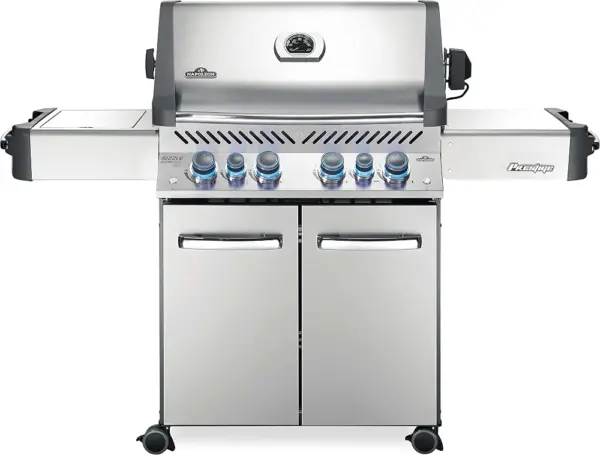
Napoleon Prestige 500 RSIB
Key Features
- Warranty: Limited lifetime
- Warming rack: 260 sq. in.
- Main cooking area: 500 sq. in.
- Infrared side burner: Up to 1,800°F
- Price: Premium
An infrared side burner that reaches 1,800 degrees in thirty seconds is the kind of figure that reads like marketing until you watch it work: a room-temperature steak comes off with a steakhouse crust after about two minutes a side, and the main grate stays free for everything else. That burner is why this grill sits at the top of the range, and it’s the one feature here no other pick can match.
The main cooking surface is four stainless burners at 48,000 BTU over 500 square inches, plus a 260-square-inch warming rack for 760 total, with layered sear plates under the grates to spread heat and catch drippings. Temperature control is the other thing we noticed: this is a grill that settles into a low, lazy heat for a long cook as readily as it climbs for a sear, and the JETFIRE ignition lights each burner individually with a backup if the first attempt doesn’t take.
The rear infrared burner and the rotisserie kit come with the grill, which is rarer than it should be, since most brands sell the spit as an afterthought accessory. A whole chicken becomes an hour of hands-off cooking with a reason to keep the lid down.
Size is the practical catch. At 66.25 inches wide and 196.7 pounds, this is a two-person move and a long afternoon of assembly, with instructions that are the least polished part of the package. Measure the patio before you commit, and measure the path to it.
Pros
- Infrared side burner reaches 1,800 degrees in 30 seconds
- Rotisserie kit and rear infrared burner included
- 760 sq. in. of total cooking space
- Limited lifetime warranty
Cons
- Plastic knobs and lid trim age first
We recommend the Prestige when searing is the point: an infrared side burner that hits 1,800 degrees in 30 seconds and a rotisserie kit in the box.
How We Tested Natural Gas Grills
We built the shortlist from spec sheets and store visits, filtering for burner count and layout, whether a natural gas hose or quick-disconnect came in the box, cart style, and how the warranty read. That narrowed a long field to seven grills, each of which I assembled in my backyard and hooked up to a house line. I timed every assembly solo and kept the manual beside the hardware bag, jotting down where the steps skipped something or where the gas connection was explained vaguely — a real snag for a first-timer.
Then came nine months of cooking. Weeknights meant burgers, chicken thighs, and vegetables; weekends got reverse-seared steaks and a pork shoulder held low for hours. The side burners were put through a stockpot of corn and a kettle of water I timed to a boil. To see how heat actually traveled, I laid slices of white bread across the grates and watched which browned first, and I read surface temperatures at the four corners of each grate with an infrared thermometer. Searing was judged on crust and grill marks, not on what the lid copy claimed.
Temperature control got its own workouts: I dialed each grill down to 275 degrees to see whether it held there or crept, then opened and closed the lid to check how quickly it recovered. Durability came from leaving every grill outdoors through rain and a few windy stretches, inspecting grates, fasteners, and knobs for rust and wobble at the start and end of testing. Value came down to what was actually in the box against what the grill could do.
How to Choose a Natural Gas Grill
The first question with a natural gas grill isn’t burner count or BTU, it’s whether what arrives is already set up for the gas line you have.
Make Sure It’s Actually a Natural Gas Grill
Listings use "convertible" and "natural gas ready" loosely. A true natural gas grill ships with a hose built for a fixed line and burners set up for gas; a propane cart with a conversion option ships with a tank regulator and asks you to buy orifices and a hose separately. That difference shows up on install day, not on the product page, and it’s why the Monument M415BZNG leads this list: the hose is in the box.
If a listing says convertible, find the kit’s part number and price before you order, and confirm the kit includes main burner orifices. If it doesn’t, you’re buying a propane grill with extra steps.
Read the Cooking Area the Way the Listing Doesn’t
Advertised totals almost always fold in the warming rack. The Monument’s 630 square inches is 450 of main grate plus 180 up top, and once you know that, the numbers finally compare. Buy on the main grate figure and treat the warming rack as a bonus shelf.
As a working rule, 350 to 400 square inches of primary grate feeds four people without a second round, 450 handles six, and past 500 you’re cooking for a party. The Spirit’s 360 square inches is a real limit, not a rounding error, if you regularly feed a crowd.
Decide How Much Sear You Actually Need
Burner output numbers don’t travel well between brands, so read the hardware instead of the BTU claim. A defined sear zone with extra burner power is the middle step, and the Spirit’s boost burners are a good example. Layered sear plates under the grate, as on the Prestige, are another route to the same crust.
An infrared side burner is a different tool entirely. It reaches searing heat without heating the main grate at all, which is why the Napoleon can put a steakhouse crust on a steak while the rest of the grill sits idle. For burgers and chicken, a sear zone is plenty. For steak as a habit, budget for infrared.
Measure the Cart Before You Measure the Patio
Widths in this group run from 48.3 to 66.25 inches, and lids swing up rather than back, so depth and side clearance decide placement more than width does. Leave room for the lid, room to wheel the cart out for cleaning, and a clear, gentle path for the hose so it doesn’t kink against the cabinet.
A 57-inch cart on a 60-inch balcony isn’t a grill, it’s a barricade. Walk the route from the gate to the patio before you order anything wider than the gate.
Look at the Burners, the Grates, and the Grease Tray
304 stainless burners resist heat and corrosion better than painted steel, and porcelain-enameled cast-iron grates hold heat better than thin wire. Those two materials are where a cheap grill starts showing its age first, and they’re the reason the Monument’s burner warranty runs to eight years.
Then look at how the grease comes out. A drawer that slides from under the cookbox, like the Genesis’s, empties in thirty seconds. A tray you reach for under the grate is the reason grills get neglected, and neglected grease is what rusts a firebox out.
Frequently Asked Questions
Is a natural gas grill cheaper to run than propane?
Usually, yes. Natural gas is typically priced lower per unit of heat than propane, and you never lose a cook to an empty tank or drive out for a swap. The offset is the connection: you need a stub-out within hose reach of where the grill sits, and running a line if you don’t have one is the real cost of switching.
Can a natural gas grill stay outside all winter?
Leave it out, but shut the gas off at the line and cover it once it’s cool. The parts that suffer are the ones that aren’t stainless: plastic knobs and trim, thermometers, and the hose, which is worth flexing in spring to check for cracks before you light it. Bring the rotisserie spit and any snap-on accessories indoors.
How long should a natural gas grill last?
Read the warranty as the maker’s own estimate. Monument covers the M415BZNG for two years generally and its 304 stainless burners for eight; Weber covers the Spirit for ten and the Genesis for twelve; Napoleon covers the Prestige for life. Cover it and burn it off after each cook to reach the far end of those numbers.
Final Verdict
For most patios, the Monument M415BZNG is the grill we recommend: it’s already set up for natural gas when it arrives, it climbs to searing heat quickly, and its main grate is the largest here for the money. The two-year general warranty is the trade you make for that value, and on a grill at this price we’re willing to make it.
If you cook steak more than burgers, the answer changes. The Napoleon Prestige 500’s infrared side burner and included rotisserie do things none of the others here can, and that’s what the extra money is actually buying.