This post contains affiliate links. We may earn a small commission when you buy through our links — at no extra cost to you.
A combo grill promises you never have to choose between gas speed and charcoal flavor, and it delivers — at the cost of two fuel systems, two heat sources, and sometimes two separate lids crammed onto one cart. Skimp, and you feel every bit of that complexity during assembly and in grates that brown one corner of the yard bird and leave the other raw. Get it right, and Tuesday’s burgers come off the gas side in fifteen minutes while Saturday’s chicken sits over real coals.
My team spent nine months cooking on eight of these, from a compact two-burner sized for a balcony to three-burner rigs with a side burner wide enough for a stockpot. The spec I’d warn a first-time buyer about is total cooking square inches — a sprawling grate that runs hot at the front and cold at the back is worse than a smaller one that holds an even temperature. The other number nobody advertises is assembly time, and the spread there is enormous.
A good combo grill should feel like one grill with two moods, not two grills bolted to a shared frame. The picks below were chosen for how they cook, how they hold up, and how much of your weekend they demand before the first burger.


Best for All-Around Backyard
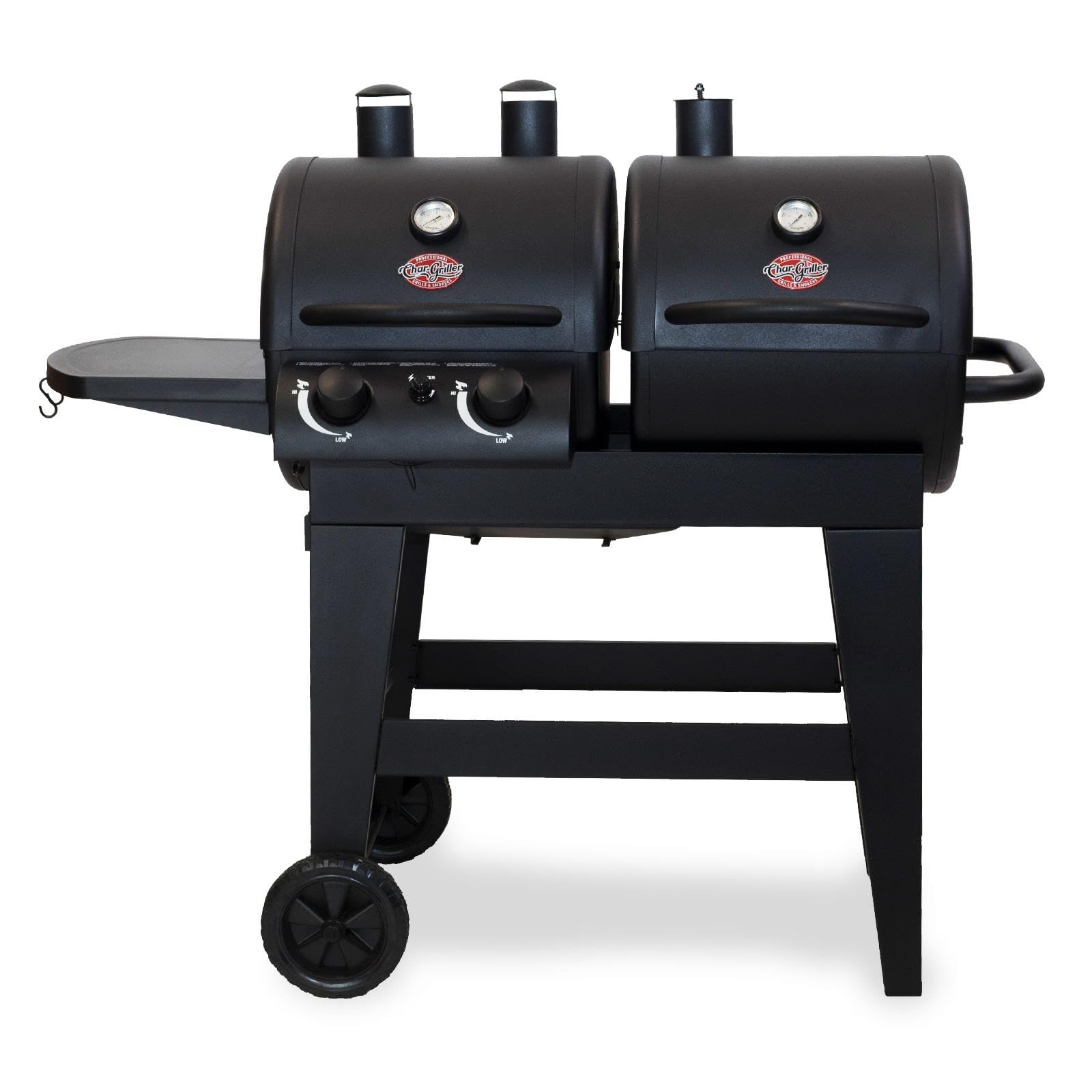
Char-Griller E5030
Key Features
- Weight: 116 lb
- Gas power: 24,000 BTU, 2 burners
- Fuel setup: Gas, charcoal, side burner
- Total cooking area: 870 sq. in.
- Price: Midrange
The night a combo grill proves itself is the night you need all of it: burgers searing over the two gas burners, chicken thighs finishing over coals on the other side, a saucepan of beans parked on the side burner. The E5030 makes that three-way cook feel ordinary, and it does it with more cooking area than anything else here except the Oklahoma Joe’s. That is why it is our pick for most backyards.
The 870 square inches are real rather than a generous count of a warming rack. Two stainless burners with independent control let you sear on one side and hold on the other, and the charcoal half gives you an actual coal bed rather than a token tray. The porcelain-coated cast iron grates hold heat well and clean up with a stiff brush, and the warming rack means a batch of buns or a tray of vegetables isn’t competing for the main grates.
The gas side runs hot. It comes up to searing temperature quickly and keeps a high, hard heat even at its lowest setting — excellent for steaks and chops, less good for finishing delicate fish or holding a pot at a simmer. Think of the charcoal side as the place for anything that needs patience and the gas side as the place for anything that needs speed.
What we appreciate most is the EasyDump ash pan. Charcoal loses its appeal fast when cleanup means lifting grates and scooping cold ash, and this one lets you dump from the front and get on with the evening. What it will not do is smoke like an offset: there is no firebox, so low and slow means a modest coal bed and a close eye rather than a damper you can dial in.
Pros
- 870 sq. in. across gas, charcoal, and a side burner
- EasyDump ash pan empties without dismantling
- Two gas burners give separate heat zones
- Porcelain-coated cast iron grates and warming rack included
Cons
- Gas side stays hot even on low settings
- Assembly takes an afternoon
We point most backyards here: 870 square inches, two fuels, a side burner, and an ash pan you can empty without pulling the grates.
Best for Low-And-Slow Smoking
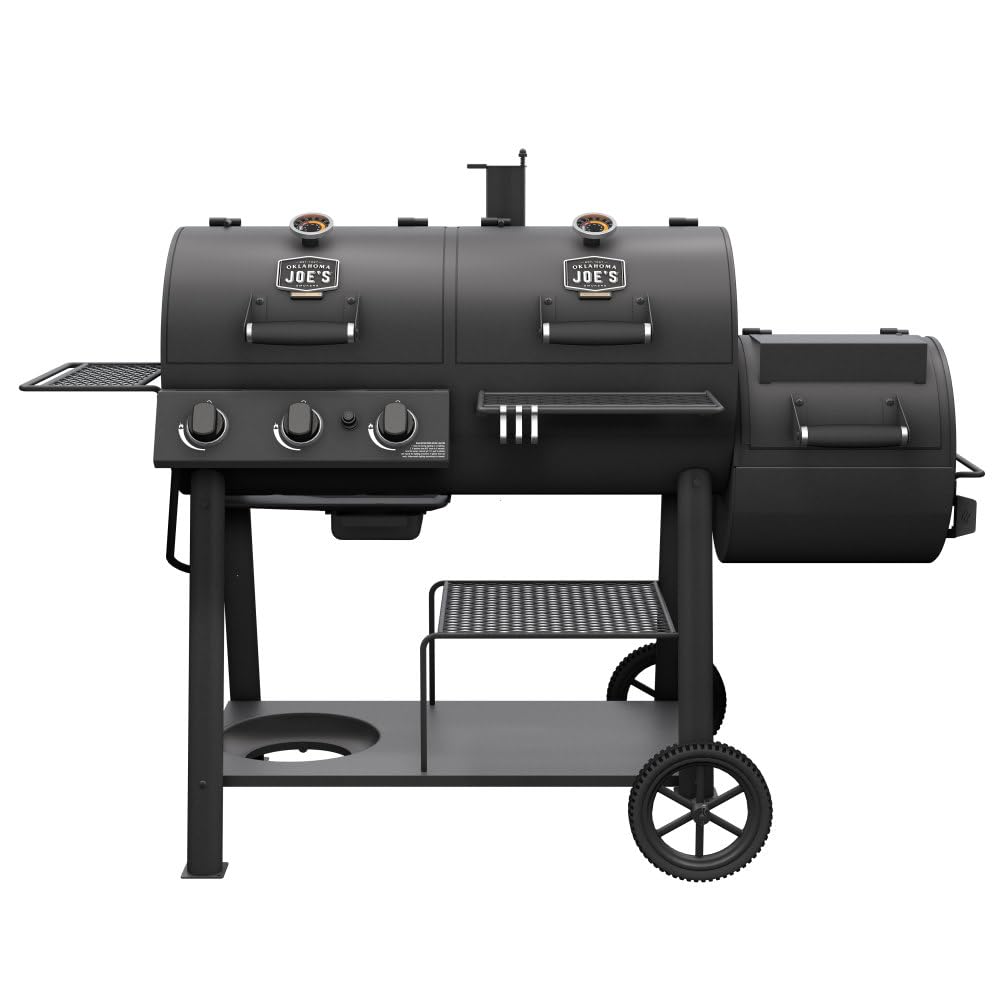
Oklahoma Joe’s Canyon Combo
Key Features
- Width: 68.9 in.
- Gas power: 36,000 BTU, 3 burners
- Charcoal side: Offset firebox with dampers
- Total cooking area: 1,031 sq. in.
Oklahoma Joe’s is the only grill here with an offset firebox, and that changes what the charcoal half is for. You build a fire in the box, pull smoke through the chamber with the stack damper, and hold a pork shoulder at temperature for hours — then light three gas burners on the other side when you want dinner in a hurry.
At 1,031 square inches it is also the largest cooking area in this set, and the split is smart: 750 square inches in the main chamber plus a 281-square-inch grate in the firebox that puts wings or burgers directly over coals. We think that second grate is the sleeper feature, because it turns a smoker into a second grill when the crowd arrives. Dampers on both the firebox and the smokestack adjust, so temperature is a matter of air rather than guesswork.
The cost is footprint. At 68.9 inches wide and 35.6 inches deep, this is by far the biggest cart here, and it wants a long, level stretch of patio with room to work the firebox door. Give the build an afternoon and a second pair of hands. Then check that the firebox door seats tightly: smoke and heat escaping around it will have you chasing the dampers all afternoon.
Compared with our top pick, you trade a narrower, simpler cart for the widest one here, 161 more square inches, and real smoking control. If your charcoal cooking is low and slow rather than hot and fast, that trade is easy to make.
Pros
- Offset firebox adds a 281 sq. in. grate
- Dampers on firebox and smokestack
- 36,000 BTU across three gas burners
- 1,031 sq. in. total cooking area
Cons
- 68.9-inch width needs a long patio
- Firebox door can leak smoke and heat
If smoking is half the reason you want charcoal, this is the one: an offset firebox, dampers you can steer, and the most cooking area here.
Best for Side-By-Side Zones
MFSTUDIO Dual Fuel Combo
Key Features
- Lids: Two independent hoods
- Gas power: 37,000 BTU, 3 burners
- Charcoal control: Height-adjustable charcoal tray
- Total cooking area: 690 sq. in.
- Price: Premium
Two hoods on one cart is the detail that separates the MFSTUDIO from the other 690-square-inch grills here. Lift the gas hood to sauce a steak and the coals under the other lid never notice — no rush of cool air, no temperature drop to chase. On a single-lid combo, checking one side costs you heat on the other.
Under those lids: three stainless burners with 37,000 BTU between them, a 520-square-inch primary grate of porcelain-enameled cast iron, a 170-square-inch warming rack, and a side burner for sauces and sides. Thermometers sit in both hoods, so you can read each zone without lifting anything. The charcoal tray adjusts for height, which does more for weeknight charcoal than any vent.
We rate it near the top of this set on zone control, and the adjustable tray is the other thing we keep coming back to: dropped low with the vents trimmed, a modest coal bed holds without constant feeding, which is what makes charcoal practical on a work night rather than a weekend project. The cart rolls on two swivel casters and two fixed wheels at 115 pounds, so it moves when you want it to and stays put when you don’t.
The twin-hood advantage only pays if you genuinely cook on both sides at once. If you tend to pick one fuel per meal, the second hood is steel you’re paying for and cleaning around. That is the honest boundary on this one: the best dual-zone setup here for cooks who use both, and more grill than a one-fuel-at-a-time cook needs.
Pros
- Independent hoods over each fuel zone
- 37,000 BTU across three stainless burners
- Height-adjustable charcoal tray
- Thermometers built into both lids
Cons
- Priced at the top of this set
Two hoods, two fuels, one cart: we think this is the easiest grill here to run gas and charcoal at once without one side spoiling the other.
Best for Small Patios
Char-Broil Bistro Pro
Key Features
- Width: 32.8 in.
- Fuel setup: Gas plus charcoal rack
- Max temperature: 750 °F
- Total cooking area: 240 sq. in.
- Price: Budget
At 32.8 inches wide and 51 pounds, the Bistro Pro is the only grill on this list you can carry onto a balcony and tuck against a railing. The cooking surface is 240 square inches, there is a single gas burner, and Char-Broil rates the heat up to 750°F — enough for a proper sear on a steak or a smash burger.
Its approach to two fuels differs from everything else here. There are no side-by-side zones: you lay charcoal on a rack built into the gas grate and light it, and the whole surface becomes a coal grill. We think that is the right call for a small patio, since you get real charcoal flavor without a second firebox taking up floor space — and the wrong call for a crowd, because you cannot sear on gas while the coals come up.
Control is where it takes practice. One burner and coals sitting close under the grate is a coarse instrument, and the low end is the hard part: it wants to run hot, so thin cuts, fish, and vegetables need watching and moving. Size is the other honest limit — 240 square inches is a two-to-four-person surface, enough for six steaks and not much else. Feeding eight means stepping up to a 690 or an 870.
What it has that the bigger carts don’t is a two-year warranty on the lid and firebox, longer than the one-year coverage stated on several grills here. On a grill this size, that is most of the value: it is a starter grill you can keep on a balcony, not a rig you’ll hand down.
Pros
- Fits a balcony at 32.8 inches wide
- Charcoal rack converts the whole grate
- Reaches 750°F for searing
- Two-year warranty on lid and firebox
Cons
- Low-end heat control takes practice
- 240 sq. in. suits four, not a party
Buy it when the patio is the constraint: 33 inches wide, 51 pounds, and a charcoal rack that turns the gas grate into a coal bed.
Best for Budget Three-Burner
Sophia & William Combo

Key Features
- Width: 61 in.
- Burners: Three main, one side
- Cooking grates: Porcelain-enameled cast iron
- Total cooking area: 690 sq. in.
- Price: Premium
Three grills in this set share a 61-inch cart, a 690-square-inch cooking surface, and porcelain-enameled cast iron grates. The Sophia & William is the least expensive of the three, which makes it the value play among the full-size three-burner combos — the same footprint and the same primary area for less.
The layout is conventional and sensible: a 520-square-inch primary grate, a 170-square-inch warming rack above it, three main burners plus a side burner, a push-out ash tray for the charcoal side, and a slide-out grease tray. Locking casters keep it put, the handles are stainless, and the side burner is the feature we reached for most — a place to reduce a sauce or boil corn without walking back to the kitchen.
Where it earns less confidence is the sheet metal. Panels and door frames can arrive bent or warped, and the cart is not as stiff as the pricier ones here, which is part of why it costs less. None of that showed up in how it cooked, but it is the difference between a grill that looks finished and one that looks assembled.
Cooking itself holds up. Heat spreads evenly across the cast iron, the gas side sears properly, and the charcoal side does what charcoal should. If you want the big three-burner cart and would rather spend the difference on meat, this is a reasonable buy — provided a slightly imperfect cart doesn’t bother you every time you walk past it.
Pros
- 690 sq. in. for the lowest price of the three
- Three main burners plus a side burner
- Push-out ash tray and slide-out grease tray
- Even heat and good searing on cast iron
Cons
- Panels can arrive bent or warped
The least expensive of the 690-square-inch three-burner combos here, with the cooking to justify it and panel fit that may not.
Best for Group Cooking
Captiva Designs Combo

Key Features
- Width: 61 in.
- Burners: Three main, one side
- Cooking grates: Porcelain-enameled cast iron
- Total cooking area: 690 sq. in.
- Price: Premium
The gas side of the Captiva is the part that impressed us: three burners that come up to heat quickly, spread it evenly across the cast iron, and sear without an obvious hot spot in the middle of the grate. With 520 square inches of primary grate and a 170-square-inch warming rack, a cookout for a dozen doesn’t require Tetris.
The charcoal side does the flavor work, and the cleanup design is better than average: a slide-out ash tray under the coal bed and a slanted grease tray that sends drippings to one corner instead of pooling across the bottom. The side burner earns its keep too — that is where the corn and the sauce went while both grates stayed full.
The steel is what gives us pause. This cart can rust inside within a year — interior panels, the charcoal side, the ledges — and a finish is the one thing you cannot fix later. Our advice is not to skip the grill but to plan around it: a cover, a dry spot, and a look at the seams each spring. Assembly is the other place to set aside time, because the directions leave gaps that a second read and a parts count will close.
The clearest comparison is the MFSTUDIO, which shares this 61-by-23-inch footprint, the same 690 square inches, and similar money. What separates them is the lids — two independent hoods there, one big one here — and how much you’re willing to gamble on the finish. For cooking and capacity alone, this is a capable, comfortable grill.
Pros
- Even heat and fast warm-up on three burners
- Slanted grease tray and separate ash tray
- 690 sq. in. with a side burner
- Three cooking options at once
Cons
- Interior steel can rust within a year
We recommend it for three burners, a side burner, and even heat in a 61-inch cart — and we recommend buying a cover with it.
Best for Tight Budgets
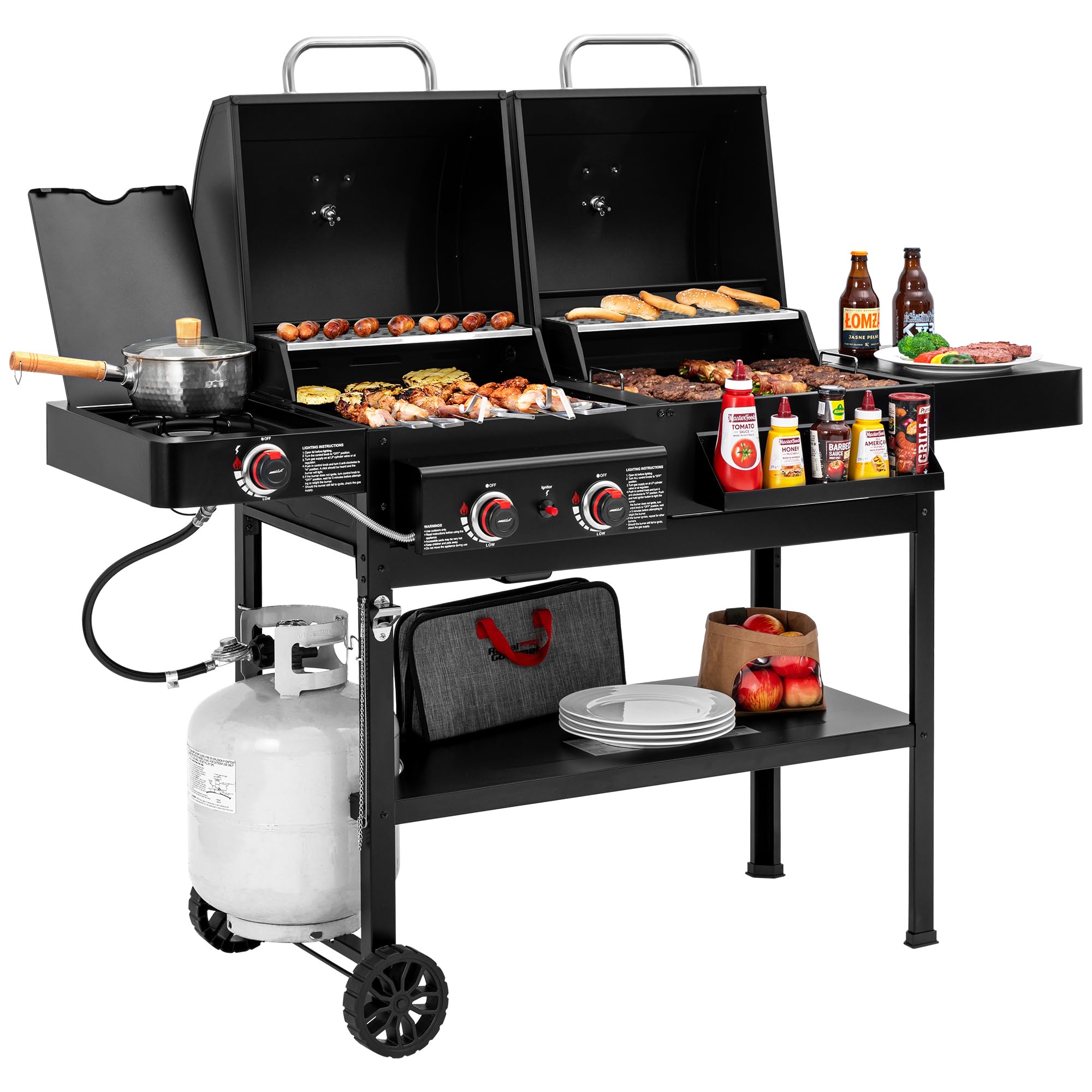
ZH3005 Combo Grill
Key Features
- Weight: 78.3 lb
- Zone split: 333 sq. in. gas, 333 charcoal
- Total gas output: 34,000 BTU
- Total cooking area: 823 sq. in.
- Price: Budget
The ZH3005 divides its 823 square inches almost evenly: 333 on the gas side, 333 on the charcoal side, the rest warming rack. No other two-zone combo here splits the fuels that cleanly, and none of them costs less. That is a strong opening argument for a first combo grill — the caveats arrive afterward.
The spec sheet is generous for the money: two 12,000 BTU stainless main burners, a 10,000 BTU side burner, piezo ignition, a right-hand prep shelf, and thermometers in both lids. The charcoal side is the more interesting half — the pan adjusts for height, and a smokestack and side vent let you move the heat and choke the air instead of just adding more briquettes.
The gas side is the risk. Burners and igniters that won’t light, or quit early, are the weak point, and paint peeling after a season is the other. Then there is assembly: picture-only directions, hardware that doesn’t always line up, and a QR code that leads nowhere useful. Set aside an afternoon, lay the parts out, and count the screws before you start.
For a tight budget and a spot out of the weather, that is still a lot of cooking surface — nearly three times the primary area of the compact Char-Broil, with a charcoal bed of its own. Test both burners and inspect the paint in the first week, while the warranty still has room in it.
Pros
- Even 333 sq. in. split between fuels
- Height-adjustable charcoal pan with vents
- 34,000 BTU including a side burner
- Thermometers in both lids
Cons
- Paint can peel in the first season
- Gas burners and igniters can fail
The least expensive two-zone combo here, with an even split between gas and charcoal and a gas side that deserves a close look.
How We Tested the Gas and Charcoal Combo Grills
We started with every dual-fuel combo we could find from brands with a warranty worth reading, then filtered by fuel setup, cooking area, whether a side burner was included, and price spread across the category. That left eight grills, which we assembled and cooked on for nine months. Each one was built by a single person with a stopwatch running, because we wanted to know how much of a Saturday the box would eat before we ever lit it.
Once assembled, every grill went through the same week: a fast gas-only dinner on a Tuesday, a charcoal session that weekend, and at least one long covered cook. We logged how long the gas side took to reach 400 degrees, then laid slices of bread across the grates to see where they browned first. On the charcoal side we worked the dampers to hold a low temperature for a few hours and noted how often we had to come back and adjust them. We also wheeled each grill across a patio, leaned on the side shelves, and rocked the frame to see how much it gave.
To judge the dual-fuel claim honestly, we cooked the same chicken thighs on gas and over coals and asked whether the two halves behaved like one grill or two strangers sharing a cart. We ran the side burner with a stockpot and a cast iron skillet to see if it could keep up, cleaned the grease tray and ash drawer after every cook, and checked the welds for rust after a few rainstorms left them sitting wet under covers. Value came down to what the money bought rather than the price tag — a compact model that heats evenly beat a big one that doesn’t.
How to Choose a Gas and Charcoal Combo Grill
The decision that matters most isn’t the BTU number or the square footage — it’s whether the two fuels get their own space or take turns.
Two Zones or One Convertible Firebox
Every grill here burns propane and charcoal, but not the same way. Most give each fuel its own bed, and several add a separate hood for each, so a gas-seared steak and a coal-fired chicken can share one cook. The Char-Broil Bistro Pro takes the other route: you load charcoal into a rack sitting in the gas grate, and the whole surface becomes a coal grill.
Choose separate zones if you regularly cook for a group with both fuels going. Choose the convertible if your patio is small and charcoal is an occasional mood. The words ‘dual fuel’ on a box tell you nothing about which arrangement you’re getting — look for a charcoal tray or bed that sits beside the gas burners, not on top of them.
Size the Grate, Then Read What’s in the Number
Advertised cooking area counts everything, including warming racks and, on offset models, the firebox grate. The Oklahoma Joe’s 1,031 square inches includes 281 inches over the fire; the 690-square-inch carts include a 170-square-inch warming rack. Compare primary grates before you compare totals.
For scale: 240 square inches handles four people and a round of leftovers, 520 to 666 square inches is comfortable for a family cookout, and anything past 800 is a party grill. Check whether the listing tells you how the area splits between fuels — the ZH3005 states it plainly at 333 square inches each, and most others leave you to work it out.
Burner Count and What the BTU Number Is Counting
Total BTU is the least trustworthy figure on a grill box. On the ZH3005, the 34,000 BTU total includes a 10,000 BTU side burner, so the two main burners deliver 12,000 each. Divide by main burners before comparing anything.
More important than peak output is how far down the burners turn. A grill that won’t settle below a hard sear is a poor place to finish chicken or hold a pot of beans, and more than one compact here is happiest running hot. If you cook at moderate heat most nights, low-end control matters more than the headline number.
Charcoal Control Lives in the Pan and the Vents
Charcoal is only as adjustable as its air supply and its distance from the grate. A pan that cranks up and down (MFSTUDIO, ZH3005) changes the heat under the food without touching the fire. Dampers on a firebox and stack (Oklahoma Joe’s) let you steer a low-and-slow burn, while a side vent and smokestack do a smaller version of the same job.
Then there’s the ash, which is what decides whether you light charcoal on a Tuesday. The Char-Griller’s EasyDump pan and the slide-out trays on the Sophia & William and Captiva make cleanup a small job rather than a project, and that’s most of the difference between a combo grill you use and one you admire.
Measure the Cart, Then Build It Where It Will Live
Widths here run from 32.8 inches to 68.9, and depth counts as much once the lid is open and you’re standing in front of it. Mark the footprint with tape, allow room for the lid to swing, and check the walkway behind you. Then assemble it on the patio: a 116-pound cart is not something you carry through a door after it’s built.
Budget a cover at the same time as the grill. Painted steel and cast iron are what age first on a combo grill, and the parts that rust are the ones the weather reaches. Expect to lose an afternoon to the build, and don’t be surprised by picture-only directions.
Frequently Asked Questions
Is a combo grill worth it compared with buying a gas grill and a charcoal kettle?
If you light charcoal most weekends and don’t want two grills eating your patio, yes — one cart, one cover, one place to cook. If charcoal is a few times a season, a separate kettle gives you a deeper, wider coal bed than the charcoal half of most combos, and the gas grill stays for weeknights.
Count the charcoal cooks you actually did last summer before you spend on a combo.
Can I add wood for smoke on the gas side?
Yes, and it’s the cheapest upgrade you can make. Put a handful of chips or a couple of chunks in a smoker box or a foil packet poked with holes and set it over a lit burner on low; you’ll get thin smoke within a few minutes. On the charcoal side, drop chunks straight in with the coals.
The Oklahoma Joe’s offset is the one here built to run on splits and chunks as a primary fuel.
Where can I safely use a charcoal and gas combo grill?
Outdoors, on a stable surface, clear of siding, railings, and the roof overhang — and never in a garage, tent, or screened porch, because charcoal gives off carbon monoxide. On an apartment balcony, check the building’s rules first; many prohibit charcoal outright.
Keep the propane tank upright and the hose clear of hot surfaces, and if you smell gas at the connection, shut the valve off before you troubleshoot.
Do I need a chimney starter?
For any of the separate-zone grills, yes. A chimney gets a coal bed ready in about fifteen minutes and lets you dump lit coals where you want them instead of waiting on a pyramid of briquettes.
Skip lighter fluid — it’s the fastest way to make a good cut of meat taste like a gas station. A chimney also lets you add lit coals mid-cook without stalling the whole grill.
Final Verdict
The Char-Griller E5030 is the one we point most people to: 870 square inches, a real side burner, an ash pan you can empty without dismantling anything, and the second-largest cooking area in this set — all without the biggest price tag.
If you want to smoke rather than simply grill over charcoal, the Oklahoma Joe’s Canyon Combo’s offset firebox and 1,031 square inches justify the wider footprint. And if a balcony is the whole point, the Bistro Pro is the only grill here that fits.