This post contains affiliate links. We may earn a small commission when you buy through our links — at no extra cost to you.
Walk into any coffee lover’s kitchen and you’ll likely find a cheap handheld frother tucked in a drawer. They cost under $10, create decent foam, and seem like an easy win. But ask how long it lasted, and the answer is often the same: a few months before the motor gave out or the switch stopped working.
That pattern isn’t bad luck. Most budget wands share a design that prioritizes low cost over longevity. The press-to-activate switch and small motor aren’t built for daily use. The fix isn’t to spend more on another disposable wand — it’s to step up to a rechargeable or automatic model where the components are designed to survive regular mornings.
The right frother for you depends entirely on how often you use it. Occasional frothing? A $7 wand is fine. Daily cappuccinos? That same wand will frustrate you within half a year, making a $30 rechargeable or a $65 automatic a smarter long-term spend.


Best for Budget Occasional
SIMPLETASTE Handheld Frother
Key Features
- Power Source: 2 AA batteries
- Foam Types: Cold foam only
- Cleaning Method: Hand wash, rinse
- Durability: Motor failure within months
- Price: $
The SIMPLETASTE handheld frother blends a surprisingly strong motor with a lightweight, battery-operated design that whips up dense microfoam in seconds. The 304 stainless steel whisk handles hot and cold milk equally well, producing a texture that holds together for latte art or simple topping. Cleaning is as simple as rinsing the whisk under a faucet — no disassembly needed.
In practice, the frother works best with a mug or narrow container — the whisk needs to be fully submerged to avoid splashing. The included stand keeps the wand upright on the counter, making it easy to grab for a quick foam. Unlike automatic frothers that heat and froth in one step, this model requires you to warm your milk separately, but that two-step process keeps the unit simple and the price low.
This frother is a natural fit for anyone who makes one or two coffee drinks per day and wants a budget-friendly tool that hits above its weight. The battery-powered design means you’ll need AA replacements every few weeks with regular use — a minor hassle for occasional frothers but a reason to consider a rechargeable model if you’re whipping foam multiple times daily. Durability also has a boundary: with heavy daily use, some units have shown motor wear or switch inconsistency after a few months, so this is best treated as a cost-effective entry point rather than a long-term investment.
Compared to automatic frothers in the $30–50 range, the SIMPLETASTE sacrifices heating and one-button automation for a fraction of the cost and near-instant cleanup. For those who already have a milk heater or don’t mind heating on the stove, the tradeoff is well worth it — the froth quality matches or exceeds many automated machines at a fraction of the price.
Pros
- Motor delivers thick, consistent foam quickly for a handheld wand.
- Removing and rinsing the whisk under water takes seconds.
- One-button operation with no complicated settings or parts.
- Costs less than a couple of café drinks and outperforms expectations.
Cons
- Batteries need replacement every few weeks with daily use – less noticeable for occasional frothing.
- With repeated daily use, the motor or switch may lose responsiveness over several months – best for light to moderate use.
If you froth one or two drinks per day and want the best value under $10, the SIMPLETASTE handheld is the obvious choice — just keep expectations modest for heavy, long-term use.
Best for Value Auto Frother
SIMPLETASTE 4-in-1 Frother
Key Features
- Power Source: 500W corded
- Froth Capacity: 300 ml foam / 300 ml heat
- Foam Types: Hot & cold foam, hot milk
- Cleaning Method: Hand wash (non-stick)
- Durability: Motor/coating failure months
- Price: $$
The SIMPLETASTE 4-in-1 frother heats milk and creates both warm and cold foam at a budget-friendly price point under $35. It adds automatic operation that handheld wands don’t offer: fill the pitcher, press a button, and walk away while it does the work.
This unit is best for small households (1–2 people) who want hot and cold foam without spending over $50. The non-stick interior requires gentle hand washing to avoid coating wear, and the motor or heating element can stop working after a few months of use — a tradeoff that’s easier to accept for occasional frothing rather than daily heavy use.
Four presets deliver warm dense foam for cappuccinos, warm airy foam for lattes, cold foam for iced drinks, and plain hot milk. The stainless steel exterior looks tidy on a countertop, and the 500W heater brings milk up to temperature quickly. Controls are simple: one button cycles through modes, and the auto shut-off prevents overheating.
Pros
- Four frothing modes cover hot dense, hot airy, cold foam, and hot milk.
- Easy to operate with a single button and auto shut-off.
- Good value for an automatic frother at this price.
- Reliable enough for occasional use with consistent foam quality.
Cons
- Motor or heating element may stop working after a few months of use.
- Non-stick interior coating can peel over time if not handled gently.
If you froth milk a few times a week and want an automatic pitcher that won’t break the bank, this is a capable starter — just keep expectations on longevity realistic.
Best for Variable Speed
Maestri LunaFro 2.0
Key Features
- Power Source: USB-C rechargeable, 1200mAh
- Foam Types: Hot & cold foam
- Cleaning Method: Hand wash, removable whisk
- Durability: Limited long-term data
- Price: $$
The LunaFro 2.0 sets itself apart from single-speed wands with a stepless dial that adjusts RPM from 4,500 to 10,000 — letting you dial in anything from a gentle surface foam to a dense microfoam without splashing. The USB-C rechargeable battery holds charge for weeks, eliminating battery swaps. A stainless steel whisk and included stand add to the polished feel.
This frother suits coffee drinkers who want texture control and appreciate a solid build. The price is higher than basic battery wands, and daily users who run multiple drinks a day should know that long-term durability beyond the first year is still unproven — early units feel robust, but the track record is short. That tradeoff matters less for moderate use or those who value fine-tuning over cost savings.
The 1,200 mAh battery comfortably handles a week of two-drink sessions, and the included stand keeps the whisk off the counter. The plastic handle feels dense, not hollow, and the motor responds immediately — no lag when changing speed mid-frothing. For latte art practice, the lower speeds help avoid large bubbles.
Pros
- Stepless speed control from gentle to powerful for custom foam textures.
- Build quality and premium feel surpass typical handheld frothers.
- USB-C rechargeable with weeks of battery life per charge.
Cons
- Priced higher than basic handhelds – a consideration for those on a tight budget.
- Durability under extended daily use may vary; the design is too new for long-term patterns to be clear.
For coffee drinkers who want adjustable foam texture and a rechargeable design, the LunaFro 2.0 delivers precision that basic wands can’t match – just keep in mind that its long-term track record is still building.
Best for Home Barista
Breville Milk Café Frothe
Key Features
- Power Source: 500W induction heating
- Froth Capacity: 1.6 lbs (approx 750ml)
- Foam Types: Hot & cold foam, microfoam
- Cleaning Method: Dishwasher safe
- Durability: 7+ years reported
- Price: $$$
The Breville Milk Café Frothe uses 500W induction heating and two interchangeable discs to create microfoam that matches what you’d get from a coffee shop steam wand. The brushed stainless steel jug holds enough for multiple drinks, and the auto shut-off adds convenience. This approach stands apart from compact single-serve frothers like the Nespresso Aeroccino 3, which prioritize quick one-cup results over texture depth.
This frother is best suited for daily espresso drinkers who value microfoam quality and are willing to dedicate counter space to a larger appliance. The premium price reflects the build and performance, but occasional use may not justify the investment. Additionally, some units have been noted to stop producing froth after a year — a possibility worth considering for long-term ownership.
The stainless steel jug rinses clean without residue and is dishwasher safe, reducing maintenance effort. Reports indicate the construction holds up under daily use for years, making it a durable option for those who commit to the upfront cost.
Pros
- Produces dense, silky microfoam that rivals espresso shop steam wands.
- Stainless steel body and induction base hold up well under daily use.
- Jug rinses clean easily and is dishwasher safe, simplifying cleanup.
Cons
- Premium price may feel steep for those who only need occasional frothing.
- Brushed stainless steel jug requires dedicated counter space.
- Some units have been reported to stop generating froth after a year of use.
If you make espresso-based drinks daily and want microfoam on par with coffee shop gear, the Breville is worth the investment — just be prepared for occasional unit variance.
Best for Family Size
Morpilot Glass Frother
Key Features
- Power Source: 600W corded
- Froth Capacity: 500ml heat / 250ml froth
- Foam Types: Hot & cold foam, hot chocolate
- Cleaning Method: Dishwasher safe
- Durability: Good early feedback
- Price: $$
The Morpilot stands out in the automatic frother space by pairing a 500ml glass carafe with six functions — hot and cold foam, warm milk, hot milk, hot chocolate, and cold foam. The glass design lets you watch the frothing process, and the capacity handles two to three servings comfortably, which places it above single-serve options like the SIMPLETASTE 4-in-1. It trades the durability of a metal jug for visual appeal and a larger batch size.
Foam texture can vary between settings — some users find the hot thick and hot light foam produce similar results, especially when trying to build stiff peaks for latte art. The glass carafe requires careful handling; while no breakage reports have surfaced yet, glass is inherently more fragile than the metal bodies found on budget alternatives. On the plus side, the dishwasher-safe construction makes cleanup effortless, and the 600W motor heats milk quickly.
This frother suits families or couples who prioritize visible frothing, easy cleaning, and the ability to make multiple drinks at once. It is not ideal for home baristas chasing precise microfoam for latte art — the foam settings lack the fine control needed for that. Similarly, those who prefer the durability of a metal jug should look at other options. The tradeoff is clear: you get a large, clear carafe and dishwasher convenience in exchange for some foam consistency and a more delicate build.
Pros
- 500ml capacity serves two to three servings in one go.
- Glass carafe lets you watch the frothing process from start to finish.
- Dishwasher safe with a non-stick interior for easy cleanup.
- Six functions cover hot and cold foam, heated milk, and hot chocolate.
Cons
- Foam texture can vary between hot thick and hot light settings, limiting latte art potential.
- Glass jug is more fragile than metal alternatives, so careful handling is required.
For families who want a large-serving frother they can watch and easily clean, this is a capable mid-range option — but those after precise microfoam should stick with a dedicated stainless steel unit.
Best for Single Serve
Nespresso Aeroccino 3
Key Features
- Power Source: 550W corded
- Froth Capacity: 4.1 oz froth / 8.1 oz hot milk
- Foam Types: Hot foam, cold foam, hot milk
- Cleaning Method: Dishwasher safe (non-stick)
- Durability: Some failure after months
- Price: $$
The Aeroccino 3 produces consistent, high-quality foam with minimal effort. Its one-touch control cycles through hot foam, cold foam, and hot milk — no settings to dial in, no trial and error. Unlike larger frothers that offer multiple preparation styles, this one sticks to the basics and executes them well.
The non-stick interior rinses clean quickly, and the whole unit is dishwasher safe for deeper cleaning. The 550W motor heats milk evenly, and the foam holds its texture for several minutes. Some units can lose frothing ability after months of use — the heating function may still work but the whisk stops spinning, leaving you with warm milk instead of foam.
This frother suits single coffee drinkers who want a no-fuss addition to their Nespresso setup. The 4.1-ounce froth capacity is enough for one cappuccino — not for couples or for making hot chocolate for two. If you need to serve multiple people regularly, consider a larger model like Nespresso’s Aeroccino 4 instead.
Pros
- One-touch operation with three frothing modes — hot foam, cold foam, and hot milk.
- Consistent microfoam that rivals café quality — dense and stable in hot drinks.
- Non-stick interior rinses clean and is dishwasher safe, reducing daily maintenance.
Cons
- Small 4.1-ounce froth capacity — enough for one cappuccino but not for two servings.
- Occasional loss of frothing function after months of use; the unit still heats milk but the whisk may stop spinning.
If you want a simple, single-serving frother and can accept the possibility of unit variance, the Aeroccino 3 delivers consistent foam with minimal effort.
Best for Daily Use
Maestri LunaFro Rechargeable

Key Features
- Power Source: USB-C rechargeable, 1200mAh
- Foam Types: Hot & cold foam
- Cleaning Method: Hand wash, removable whisk
- Durability: Good reliability reported
- Price: $$
The Maestri House LunaFro offers a straightforward one-speed frothing experience with strong performance on both hot and cold milk, backed by a rechargeable battery that lasts for weeks. Its design prioritizes simplicity and cordless convenience, making it distinct from variable-speed rechargeable models like the brand’s own LunaFro 2.0. It’s a consistent option for daily coffee drinkers who want a cordless frother without paying for adjustable speed.
Pros
- Fast frothing produces thick foam in seconds.
- USB-C rechargeable battery holds charge for weeks, eliminating battery swaps.
Cons
- Single speed may cause splashing when used in narrow cups for gentle mixing.
- Whisk attachment can be difficult to detach for cleaning.
Suitable for those who value cordless convenience and a simple one-speed design over adjustable speed — daily frothing without fuss.
Best for Budget Backup
CIRCLE JOY Rechargeable Frother

Key Features
- Power Source: USB-C rechargeable, 10W
- Foam Types: Cold foam only
- Cleaning Method: Hand wash
- Durability: Motor failure weeks
- Price: $
This frother delivers solid foaming performance for its sub-$10 price, with USB-C rechargeability and a dual-coil whisk that handles milk, matcha, and frothy drinks. The battery holds charge for weeks, making it convenient for travel or office use. However, some units may experience motor or charging issues within weeks of purchase, and the base button can activate accidentally when stored upright — a quirk that’s manageable with careful storage. For occasional use or as a backup, the value is clear, but if you need a daily frothing companion, more established budget options offer better peace of mind.
Pros
- Holds charge for weeks between uses.
- Strong motor delivers power beyond its compact size.
Cons
- Motor or battery issues can develop within the first few weeks for some units.
- Button placement can cause accidental activation when stored on the included stand.
Best suited as a travel companion or occasional-use backup, where the low price outweighs the risk of early wear.
Best for Latte Art
DREO Milk Frother
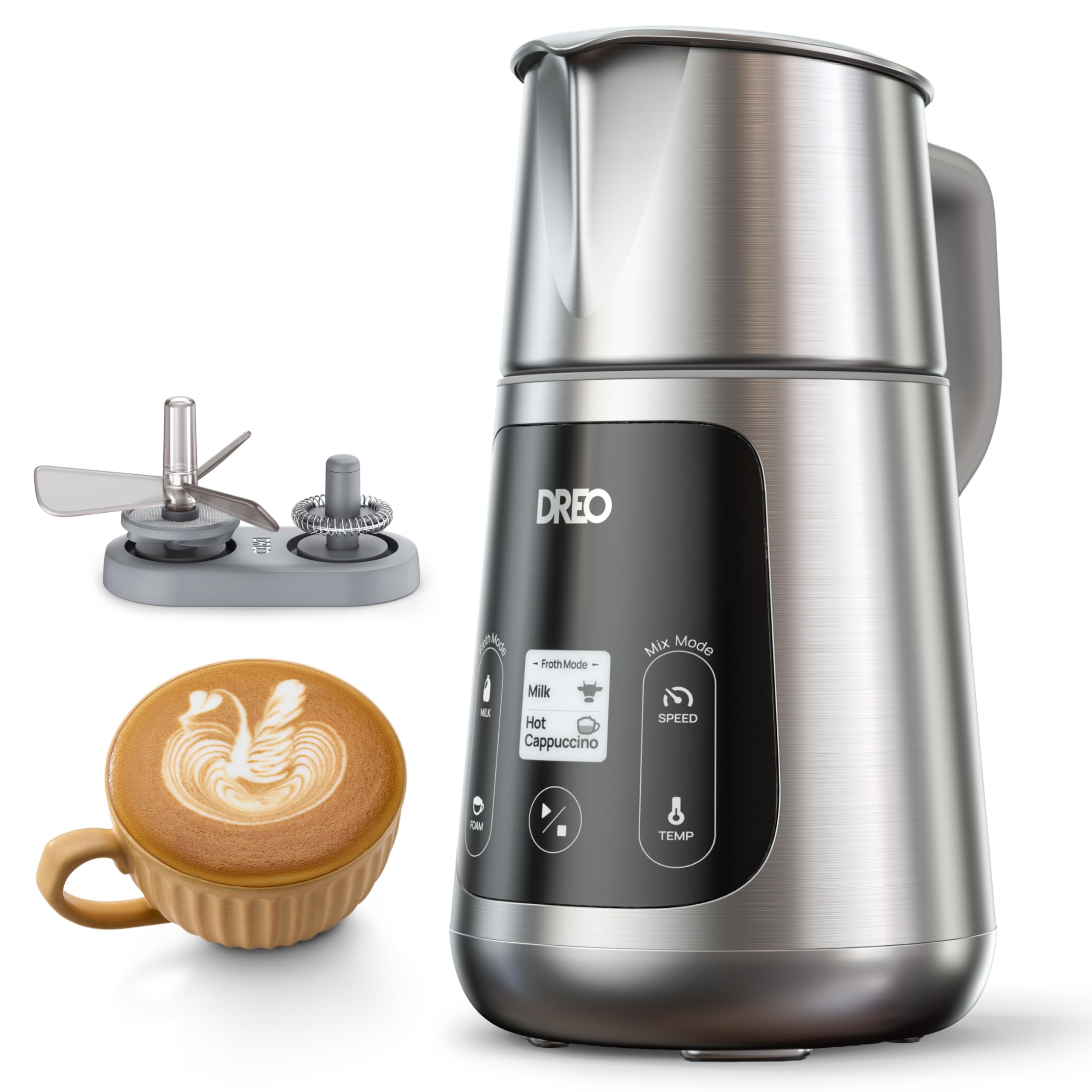
Key Features
- Power Source: 600W corded
- Froth Capacity: 15 oz (450ml) heating
- Foam Types: Hot & cold foam, 3 latte levels
- Cleaning Method: Dishwasher safe
- Durability: Inconsistent frothing reported
- Price: $$
The DREO Milk Frother delivers café-quality microfoam with adjustable density and temperature settings, ideal for latte art practice. Its 15oz heating capacity accommodates multiple servings, and the six heat levels plus three foam options give more control than basic automatics. However, foam output can vary between units – some may produce very little foam, and the milk may only reach warm rather than hot temperatures. This makes it a better fit for those who prioritize fine-tuned foam control over guaranteed consistency.
Pros
- Cafe-quality microfoam with adjustable density for latte art.
- Large 15oz capacity and multiple heat/speed settings for hot and cold foam.
Cons
- Foam production can vary between units – some may produce little to no foam.
- Milk temperature may only reach warm, not hot – insufficient for drinks requiring very hot milk.
Best for latte art enthusiasts who value adjustable foam control and large capacity, but consider other options if you need reliably hot milk or consistent foam from the first use.
Best for Occasional Auto
Capresso froth PRO

Key Features
- Power Source: Corded electric
- Froth Capacity: 8 oz froth / 12 oz heat
- Foam Types: Cold, warm, hot
- Cleaning Method: Dishwasher safe (non-stick)
- Durability: 75% negative reliability
- Price: $$
The Capresso froth PRO produces consistently thick foam across cold, warm, and hot settings, with a straightforward clean-up. For those making occasional lattes or hot chocolate, it offers a level of automatic frothing rarely found at this price point. The tradeoff: some units may see a decline in frothing performance after a few months, and the non-stick coating can peel with regular use. This makes the froth PRO best suited for light, budget-conscious use where a potential early replacement is an acceptable risk.
Pros
- Produces thick, consistent foam across all three temperature settings
- Easy to clean – dishwasher safe and simple design
Cons
- Some units may experience reduced frothing after several months of use
- Non-stick interior coating can peel or scratch over time
Best for occasional use where budget is the primary concern and the possibility of an early replacement is acceptable.
How to Choose
The biggest mistake buyers make is matching a frother’s power source to their daily routine instead of considering the motor’s lifespan.
Power Source: Battery, Rechargeable, or Corded?
Battery-powered wands (usually 2 AA) are the cheapest option but come with a hidden cost. The motor draws significant current, so batteries drain fast with daily use. You’ll either replace them weekly or watch performance drop as voltage fades. Rechargeable models solve this with built-in lithium cells that hold charge for weeks, but they add $15–$20 to the price.
Corded automatic frothers remove all power anxiety — they deliver consistent 500–600W every time. However, they tie you to a countertop outlet. For daily espresso drinkers, corded is the most reliable long-term choice because there’s no battery degradation to worry about after a year.
Froth Capacity: How Much Do You Need?
Handheld wands have no stated capacity — you work with whatever cup you use. That’s fine for a single serving. Automatic frothers are measured in ounces of foam versus heated milk. A 4.1 oz foam capacity (like the Aeroccino 3) makes exactly one cappuccino. A 500ml heating jug (like the Morpilot) handles two large lattes or three small ones.
The trade-off: larger capacities often mean slower heating and more splashing when the jug is less than half full. If you’re only frothing for one, a compact model heats faster and wastes less milk.
Hot vs. Cold Foam Capabilities
Not all frothers heat milk. Handheld wands simply whip air into cold milk, producing a light foam that sits on top. Automatic frothers use a heating element to both warm the milk and create microfoam. Cold foam mode runs the whisk without heat, giving you a dense, creamy top for iced drinks.
If you drink iced lattes or use almond milk (which separates when heated), a machine with a cold foam setting is essential. For hot cappuccinos only, a basic hot-foam-only model will do.
Cleaning Ease: Dishwasher Safe or Hand Wash?
Non-stick interiors are easy to wipe clean but the coating can peel after months of scrubbing or dishwasher cycles. Stainless steel jugs (like Breville) are dishwasher safe indefinitely but require a little more effort to remove milk residue by hand.
Handheld wands are universally hand-wash-only — you simply rinse the whisk under running water. The catch: if the whisk doesn’t detach, water can seep into the handle and corrode the switch, accelerating failure. Look for a detachable whisk head.
Durability: What to Expect
The most common failure point in budget frothers is the press-to-activate switch. It’s a simple mechanical component that wears out after thousands of presses. Mid-range rechargeable models use sealed electronics that last much longer, but they lack the decades of refinement found in Breville or Nespresso units.
Premium automatic frothers with induction heating and metal components have documented 5–7 year lifespans. However, even they occasionally fail — the motor or heating element can burn out. No frother is immune, but a $200 Breville is far more likely to outlast three $70 Capressos.
FAQ
Why does my milk frother stop working after a few months?
The most common cause is a worn-out press-to-activate switch or a burned-out motor. Budget handheld wands use simple mechanical switches rated for a limited number of presses. If you use the frother daily, that switch can fail in 2–6 months. Automatic frothers may stop frothing when the heating element or whisk magnet degrades. The fix is either to choose a rechargeable model with sealed electronics or to plan on replacing cheap wands annually.
Can I use almond milk in an automatic milk frother?
Yes, but results vary by brand and fat content. Almond milk is thin and separates when heated, so it won’t produce the same thick foam as whole milk. Look for a frother that specifically lists non-dairy compatibility — models like the Nespresso Aeroccino 3 and the DREO handle it reasonably well. For the best almond milk foam, use a barista edition that includes a stabilizer.
How do I clean a milk frother with a non-stick coating?
Rinse the jug immediately after use to prevent milk residue from baking on. Use a soft sponge and mild detergent — never abrasive scrubbers that will scratch the coating. Most non-stick frothers are dishwasher safe, but repeated dishwasher cycles can accelerate peeling. Hand washing extends the coating’s life. If you see flakes in your milk, replace the frother to avoid ingesting coating particles.
What is the difference between hot foam and cold foam on an electric frother?
Hot foam is created by heating milk while whisking air into it, producing a dense microfoam that blends with espresso. Cold foam uses the whisk only, without heat, creating a stiff, fluffy foam that sits on top of iced or cold drinks. The texture difference is significant: hot foam adds body to a latte, while cold foam gives a creamy topping without warming the beverage.