This post contains affiliate links. We may earn a small commission when you buy through our links — at no extra cost to you.
Lump charcoal is the shortcut to real wood-fire cooking: pure charred hardwood, no binders, and a hotter, cleaner burn than briquettes. What it doesn’t guarantee is consistency. One bag arrives full of fist-sized chunks that hold heat for hours; the next is half dust and shards that flare up and fade before the steaks are seared. What you’re actually shopping for is predictability — a bag that lights without a fight, holds a steady high heat, doesn’t throw sparks at your sleeves, and leaves a manageable pile of ash.
Here’s what I wish someone had told me sooner: a bag of all jumbo chunks isn’t the prize it looks like. A mix of sizes lights faster and burns more evenly, because the gaps between the big pieces are what feed the fire. My team and I spent the past four months burning through 16 bags on kettles, a kamado, and a weeknight grill, and the ones that earned a spot below got both the heat and the patience right.



Best for All-Round Grilling
Jealous Devil Chunx XL
Key Features
- Wood: South American hardwood
- Bag size: 70 lb (2 × 35 lb)
- Max temp: Above 1,100°F
- Rated burn: 4+ hours open-air, 20+ hours low-and-slow
- Price: Premium
Above 1,100°F at one end and more than 20 hours in a closed cooker at the other is a wide spread for a single bag, and it’s why this is the charcoal we recommend first. What matters day to day sits between those extremes: the fire comes up fast, it answers the vents, and it doesn’t collapse halfway through a long smoke. We’ve used it for both a hard sear over a full chimney and an overnight kamado cook, and it behaved like a different charcoal each time, in the way you want.
Sparking is worth calling out, because it’s what cheap lump does worst. The pitch here is dense South American hardwood with no additives, and the popping and drift of embers over the grate was milder than we brace for with budget bags. On a dry, breezy evening that’s the difference between a relaxed cook and standing back with a hose.
Pieces run big — the XL in the name isn’t decoration. In a deep basket that’s a gift; in a shallow kettle you’ll be cracking the largest lumps with the back of a hatchet before the lid will close. Ash is modest: a long cook leaves a fine gray layer rather than a bed of rubble to shovel out.
The hurdle is the format. It arrives as two 35-pound bags, 70 pounds of fuel to keep dry and out of the way, and that’s a real commitment for a small patio. Split an order with a neighbor, or buy it at the start of a season. Sealed and off a concrete floor, the last scoop lights like the first.
Pros
- Burns hot enough for a hard sear
- Holds steady heat for long, slow cooks
- Resists sparking and popping
- Low ash for the volume of fuel
Cons
- Premium price next to the budget bags
Our pick for anyone who wants one bag to sear hard and still hold a low fire — the hottest, longest-burning, least-sparky charcoal here.
Best for Long, Slow Cooks
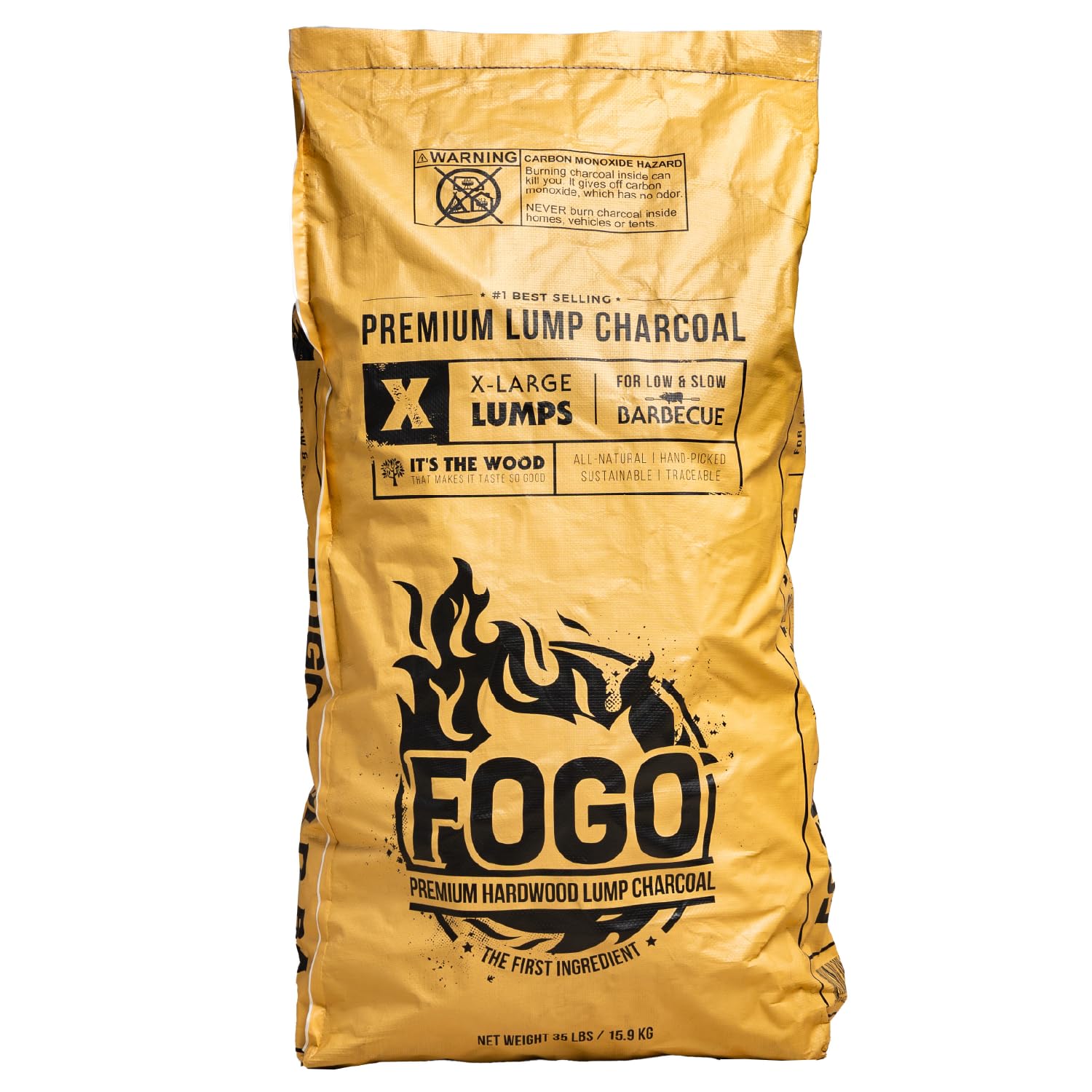
FOGO Super Premium
Key Features
- Wood: Central American hardwood
- Heat-up: About 15 minutes
- Bag size: 35 lb
- Large pieces: About 80% of the bag
- Price: Midrange
Roughly 80% of a FOGO bag is large pieces, cantaloupe down to softball, and that one figure explains both why we rate it and why it isn’t the bag we hand to everyone. Big lumps leave gaps, gaps let air through, and air moving through a deep coal bed is what a long cook runs on.
For smoking and kamado work this is our favorite bag in the group. It lights without a fight, settles into a steady low fire and stays there, and the smoke reads as clean hardwood rather than fuel — no acrid first twenty minutes, no odd edge on the meat. The flavor sits at the mild end, which is what you want under a rub and a sauce.
In a shallow kettle those lumps sit high and crowd the lid, so plan on breaking a few down; in a deep basket they’re exactly right. Dust is where it quietly wins. The bottom of the bag is charcoal, not powder, so you aren’t paying for fines that flash and die in the chimney, and there’s less sweeping up after a cook.
Pros
- Mostly large, dense lumps
- Steady low fire for long smokes
- Clean, mild hardwood smoke
- Little dust or fine debris
Cons
- Sold only as a 35-pound bag
Long, slow cooks are where this earns its keep, and it’s our favorite bag here for a full day of smoking.
Best for Ceramic Grill Cooking
Kamado Joe Big Block XL
Key Features
- Reuse: Up to three times
- Bag size: 20 lb
- Rated burn: Up to 18 hours
- Wood blend: Guayacan, Guayaibi, Mistal, White Quebracho
Eighteen hours on one load, and the leftover lump can be relit up to three times — those are the two claims that set this bag apart, and they’re the two that hold up. The blend is dense South American hardwood cut into genuine blocks, not the mixed rubble some bags call big.
In a kamado the payoff shows up in hold rather than in peak. The fire climbs cleanly to searing heat and then, once the vents come down, sits at smoking temperature without the sawtooth fiddling that softer charcoal demands. Flavor is mild — hardwood smoke with no chemical edge — which suits ceramic cooking, where you’re often protecting delicate food.
Ash is moderate and easy to live with: a long cook leaves a fine layer in the firebox rather than a clogging bed, and the leftover blocks knock clean before the next fire. That’s the practical half of the relight claim — if the coal bed crumbled, there’d be nothing left to light.
For ceramic cookers, this is the one we load for an overnight pork shoulder. The morning after is where the design earns its keep: shut the vents and what’s left in the firebox is still solid enough for a weeknight dinner instead of a pile of ash.
Pros
- Rated for up to 18 hours of burn
- Leftover blocks relight easily
- Steady, controllable heat in ceramic cookers
- Mild smoke that doesn’t mask the meat
Cons
- Pieces run small toward the bottom of the bag
For ceramic cookers, this is the bag we come back to: dense blocks that hold a low fire overnight and relight the next day.
Best for Smoke Flavor Variety
Rockwood Lump Charcoal
Key Features
- Ash: Minimal ash
- Bag size: 80 lb (4 × 20 lb)
- Wood blend: Oak, hickory and cherry
- Price: Premium
Eighty pounds of charcoal is less a purchase than a storage decision. Rockwood arrives as four 20-pound bags at once, which is right for a household that grills three nights a week and wrong for a balcony with a kettle and no closet.
The blend is the interesting part: oak for the coal bed, hickory and cherry for the smoke. In practice that reads as a fire that comes to temperature smoothly, holds through a long cook, and lays a soft, sweet smoke on the food instead of a sharp one. It’s a gentler flavor than a straight oak bag, and it suits pork and poultry better than it suits a steak you want tasting only of beef.
Heat control is where it surprised us. Bulk charcoal has a reputation as the bag you burn through, but this one settles and stays put — the fire holds where you set the vents instead of wandering. Cleanup is unremarkable in the best way: a normal ash layer, nothing clogging the grate.
For a household that cooks over charcoal most weeks, four bags of this is the arrangement we recommend: one order, a season of fuel, and a flavor that flatters everything off the smoker. Store them sealed and off a concrete floor and the last bag will light like the first — more than can be said for a bargain bag that’s spent the summer in a damp shed.
Pros
- Clean, even heat with smooth control
- Oak, hickory and cherry blend gives soft smoke
- Four-bag format suits frequent cooks
Cons
- Piece size varies, with chips in some bags
We recommend it to anyone who burns charcoal most weeks: a season’s fuel in one order, with a blend that flatters pork and chicken.
Best for Small Grills
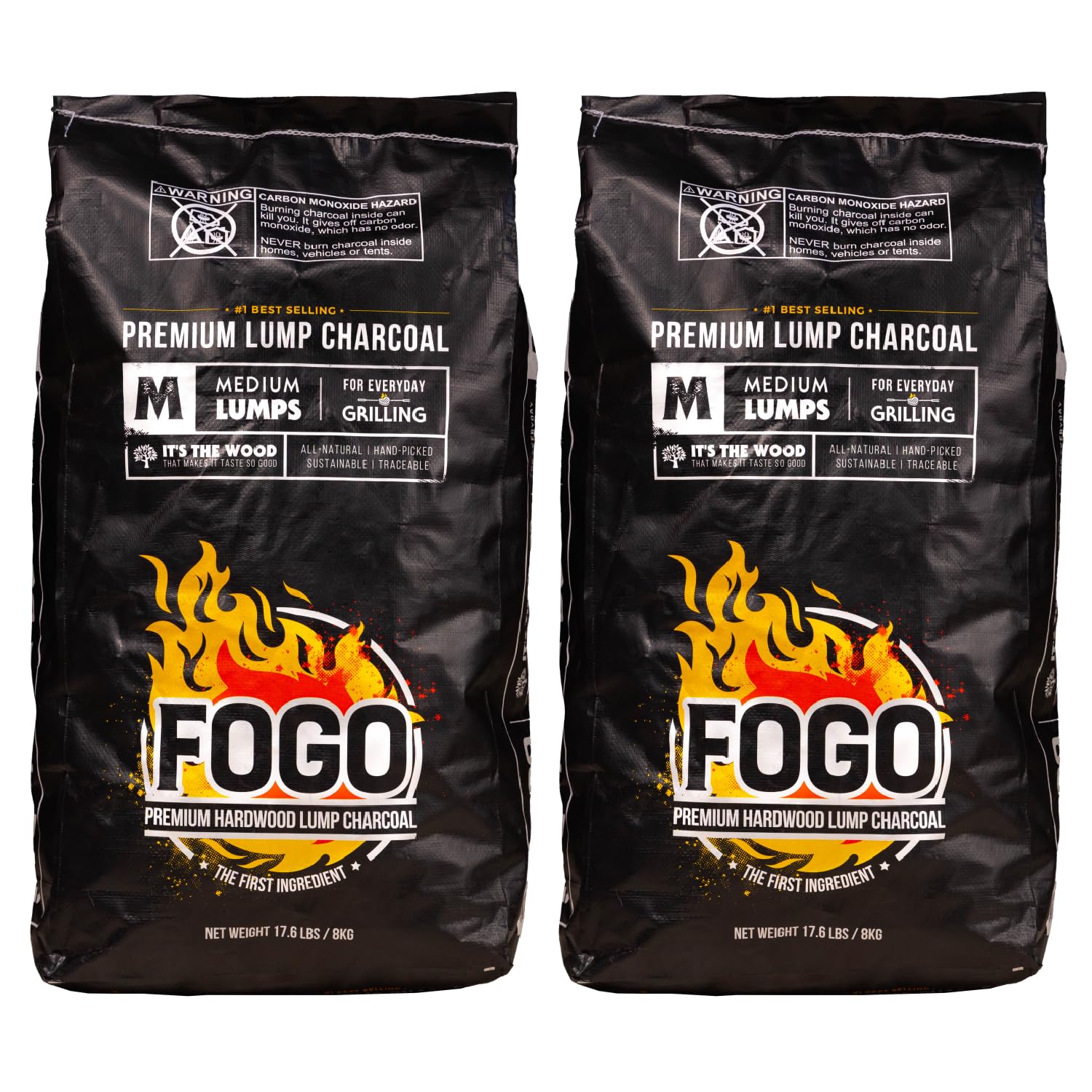
FOGO Premium Medium
Key Features
- Wood: Central American hardwood
- Heat-up: About 15 minutes
- Bag size: 35.2 lb (2 × 17.6 lb)
- Piece size: Medium lumps
- Price: Midrange
Small cookers and jumbo lump are a bad marriage: the blocks bridge the grate, the fire burns in one corner, and you end up splitting fuel with a hatchet before dinner. FOGO’s medium cut solves that, and it’s the bag we point kettle and tabletop-kamado cooks toward. The pieces are consistent, they nest into a basket, and they’re ready in about the time it takes to spatchcock a chicken.
It’s the same dense Central American hardwood as FOGO’s large cut, so the burn is clean and the smoke stays mild; what you give up is some of the long-cook endurance that big blocks buy. The two bags are a manageable size to carry and stack, which matters when your charcoal lives on a shelf rather than in a garage. One habit worth adopting with any lump: empty the bag into a bin rather than pouring straight into a lit chimney, because stones turn up in charcoal and a rock in the firebox is a bad surprise.
Pros
- Medium lumps suit small grates and baskets
- Fast, even light with clean smoke
- Two smaller bags are easy to store
Cons
- Costs more per pound than FOGO’s large cut
Small grills need smaller lumps, and this is the bag we point kettle and tabletop cooks toward: fast, even and clean.
Best for Weeknight Grilling
Masterbuilt Premium Lump

Key Features
- Fits: Gravity Series, barrel, kamado, kettle
- Wood: Hardwood blend
- Bag size: 16 lb
- Price: Budget
Not every cook needs 35 pounds of restaurant-grade hardwood. Sixteen pounds, a hardwood blend and the lowest listed price in this group — this is the bag you keep for burgers on a Tuesday, and it’s sized so you can grab it one-handed.
It burns clean and the flavor is pleasant rather than distinctive: hardwood smoke, no chemical edge, none of the sweet complexity a cherry or hickory blend brings. In a Masterbuilt gravity series it’s the fuel the grill was designed around, and the even draw down the chute is genuinely fuss-free. On a kettle it behaves like a solid mid-tier lump — hot enough for a chimney sear, steady enough for a couple of chickens.
We keep this bag for short cooks where charcoal is a means to an end, and where lifting the bag with one hand matters more than a twelve-hour burn. The one thing to plan for is the fireworks: it pops and throws sparks while it catches, so light it on gravel away from dry grass and off a wooden deck, and give it a few minutes to settle before you walk away.
Pros
- Lowest listed price in this group
- Clean burn with mild, pleasant smoke
- Sized and blended for gravity-fed grills
Cons
- Piece size swings from fist-sized to splinters
We keep this bag for weeknight cooking: the cheapest charcoal here, decent flavor, and a natural fit for Masterbuilt’s gravity-fed grills.
Best for Fast Lighting
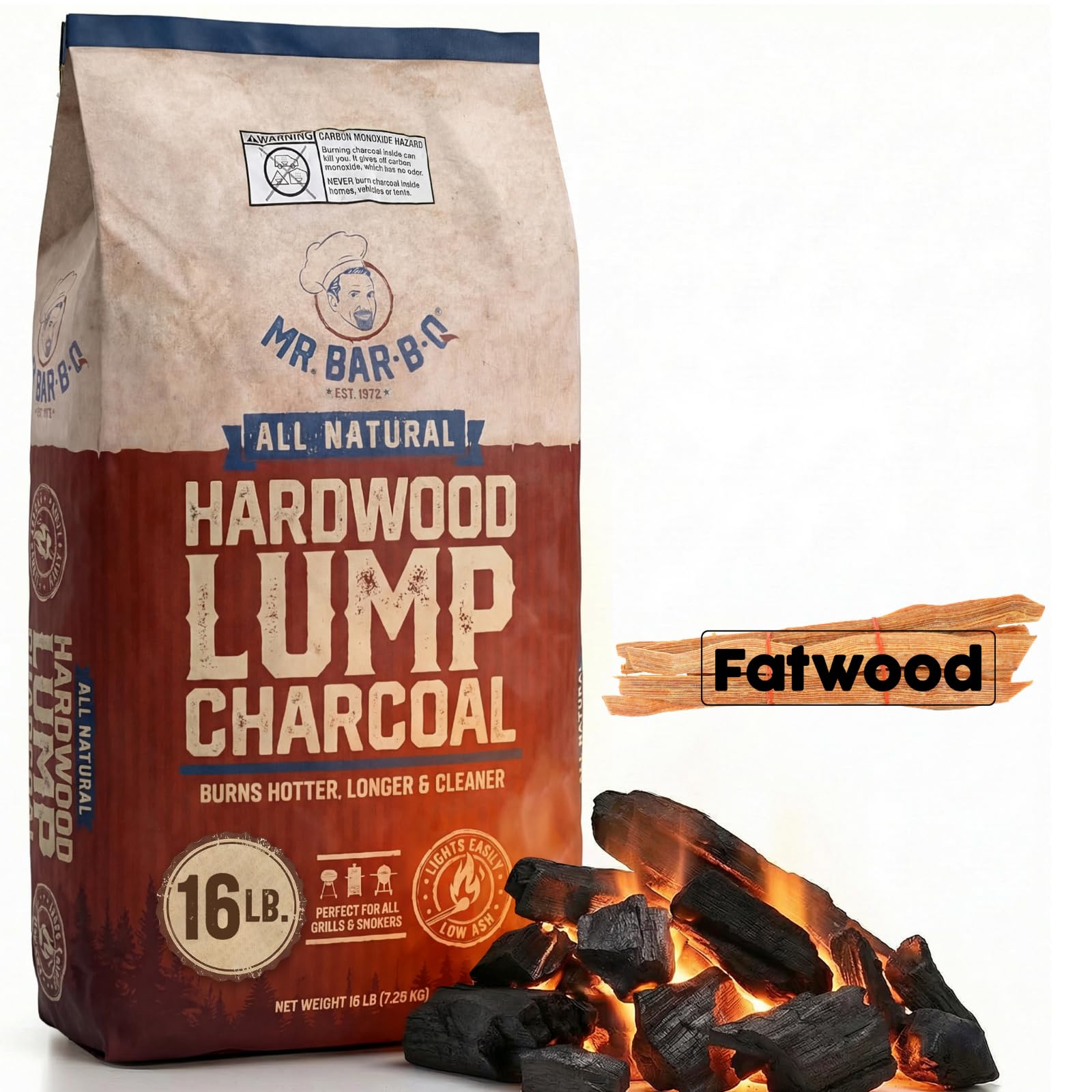
Mr. Bar-B-Q with Fatwood
Key Features
- Wood: Hardwood with fatwood
- Bag size: 16 lb
- Lighting: Fatwood included
- Price: Premium
Fatwood is the resin-soaked heartwood that catches like a candle, and a bag of lump that includes it is a small practical gift. Mr. Bar-B-Q packs fatwood in with the hardwood, which means a couple of sticks, a match and no chimney.
The rest is standard on paper: all-natural hardwood, a low-ash claim, and a hot, long burn promised. What we can speak to is the logic of the design — a fatwood-assisted light gets you to coals fast but runs hot at the start, which is fine for burgers and a chicken and less fine for a slow cook that wants a gentle ramp. While we haven’t put a brisket on this bag, the fast-light approach is the sort of thing that pays off on a weeknight and matters less on a weekend.
That’s where it earns its slot: the bag we reach for when dinner needs to be moving before the kids get hungry, small enough to store under a shelf, simple enough that you don’t think about lighting it. The fire settles into a normal hardwood burn once the fatwood is spent, so what you’re really buying is the first ten minutes.
Pros
- Fatwood makes lighting quick and simple
- All-natural hardwood, no additives
- Compact bag stores easily
Cons
- Premium price for a mid-size bag
This is the bag we grab when we want coals fast: the fatwood lights quickly and the hardwood burns clean and mild.
Best for Searing Small Cuts
B&B Oak Lump Charcoal

Oak is the quiet workhorse of lump charcoal: less perfume than hickory, less sweetness than cherry, and a hot, steady coal bed that lets the meat do the talking. B&B’s bag is straight oak in a ten-pound sack, aimed at cooks who want a hard sear rather than a twelve-hour smoke. It’s also the smallest bag in this group, which makes it an easy first lump charcoal if you’re moving over from briquettes.
That’s exactly what we like it for. The pieces are consistent enough to build an even coal bed, it lights without drama, and the smoke is mild enough to leave a dry rub alone. Sear a steak over it and you get a dark crust without a fuel taste; run a whole cook on it and you’ll notice the fire is hotter and shorter than the big-block bags here. Consistency beats volume for a fast cook, and this bag has it.
Pros
- Hot, clean oak burn for searing
- Consistent piece size
- Mild smoke that leaves rubs alone
Cons
- Small bag that goes quickly
- Oak only, so no smoke variety
We like it for steak nights: oak that burns hot and clean, consistent pieces, and a mild smoke that won’t fight a rub.
How We Tested the Best Lump Charcoal
We started with every bag we could find at grill shops and hardware stores, plus the brands readers keep asking about, then narrowed by what the label actually promised — hardwood species, piece size, bag weight — and dropped anything that showed up mostly as dust. Sixteen bags made the cut. Testing ran about four months, from early spring into summer, on a 22-inch kettle, a ceramic kamado, and a small portable grill.
Every bag got the same first treatment: I emptied it onto a tarp, sorted the pieces into big, medium, and shard piles, and weighed the crumbs. That produced a usable-pound figure instead of the number printed on the bag, which is where value actually lives. Then each bag went into a chimney starter and I timed how long it took to catch and ash over.
In the kettle we ran two cooks per bag — a hot open-lid sear and a covered two-zone cook — and noted how long the coals held temperature before we had to add more. The kamado got an overnight pork shoulder, the honest test of burn time: the fire either held until morning or it didn’t. After each cook, the ash went onto a scale.
Flavor came last and was the hardest to score: the same chicken thighs and the same steaks over each fuel, noting whether the smoke read clean and sweet or harsh and acrid. We also cooked after dark, because sparking matters when you’re leaning over the grate in short sleeves.
How to Choose Lump Charcoal
The bag matters less than the fire you can build with it, and that comes down to three things: how the lumps are sized, how much heat they hold, and how much of the bag is dust.
Match the Lump to Your Cooker
Big chunks are not automatically better. In a deep kamado basket they leave the gaps that air needs to move through a long cook; in a shallow kettle or a hibachi they bridge the grate, burn in one corner and force you to break fuel down before the lid will close. Check the width of your fire basket and the gaps in your grate before you order a bag of jumbo lump.
If you cook on a small grill, a medium cut like FOGO’s is the calmer choice. Loading a kamado for the night is the case where the big blocks earn their space.
Heat, Burn Time and Two Opposite Jobs
Lump charcoal is asked to do two things that pull against each other: a hard sear at high heat, and a low, steady fire that lasts for hours. Dense hardwood does both better than light, soft charcoal, which is why the bags built from South American and Central American hardwood sit near the top of this list.
The trap is assuming a hot bag is a controllable one. A fire that runs away from you when the vents open is worse than one that tops out slightly lower, so look for charcoal described as holding temperature, not just reaching it.
Sparks, Ash and What’s Left Behind
Lump pops. Wood with resin and trapped moisture throws sparks when it catches, and some bags are noticeably livelier than others. Light on gravel or bare ground rather than a wooden deck or dry grass, and stand back for the first few minutes.
Ash matters as much. A gritty, dusty bag leaves a bed that chokes airflow halfway through a long smoke, while a clean-burning bag leaves a light gray layer you can knock through the grate. Shake the bag into a bin before filling a chimney: the chips and dust at the bottom burn hot and fast and are better saved for a quick direct cook.
How Big a Bag Actually Makes Sense
Buying 70 or 80 pounds at once is the cheapest way to burn charcoal and the easiest way to waste it. Lump absorbs moisture, and a bag left open in a humid garage burns flat and smokes dirty.
Four bags are a good deal if you have a dry, sealed place to keep them and you cook most weeks; one 16- to 20-pound bag is better if the grill comes out on weekends. Either way, decant into a lidded bin and keep it off a concrete floor, which wicks damp straight into the paper.
Wood Type and Smoke Flavor
Oak gives a neutral, hot coal bed; hickory and cherry add a sweeter, heavier smoke; dense South American hardwoods tend to burn long with a mild flavor that stays out of the way. None of it is subtle once a rub and a sauce are involved, so don’t pay a premium for flavor notes you won’t taste.
Choose mild for fish, poultry and anything where the meat should lead. Reach for a hickory or cherry blend when the smoke is part of the point.
Frequently Asked Questions
Can you reuse lump charcoal after a cook?
Yes, and it’s one of lump’s advantages over briquettes. Close every vent as soon as the food comes off and the fire starves itself, leaving solid blocks instead of ash. The next day, knock the loose gray off the leftovers, pile them in a chimney with a little fresh charcoal and light as usual.
Charcoal that has gone soft and crumbly isn’t worth keeping.
Can you add charcoal to a grill that’s already cooking?
Yes, but light it first. Fill a chimney with fresh lump, let it ash over completely, then add it to one side of the firebox. Dumping cold charcoal onto lit coals drops the temperature and throws off white smoke while it catches.
On a long smoke, top up before the coal bed falls below the level you need rather than after.
What’s the difference between lump charcoal and briquettes?
Lump is charred wood and nothing else: it lights fast, burns hot and clean, and leaves relatively little ash, but the pieces are irregular and it pops. Briquettes are pressed charcoal with binders and fillers, which makes them uniform, steadier and ashier.
For searing and flavor, lump wins. For a long, low cook where you want zero surprises, some cooks still keep briquettes on hand.
Can you use lump charcoal in a gas grill?
No. Gas grills are built around burners and a regulated fuel supply, and solid fuel inside one can block the burner tubes, damage components and create a fire you can’t control with the knobs.
If you want charcoal flavor from a gas grill, add a smoker box of wood chips instead.
Final Verdict
For most people, the Jealous Devil two-pack is the bag to buy. It sears harder than anything else here, holds a low fire through an overnight cook, and throws far fewer sparks than the budget bags. The compromises are storage space and a premium price, not performance.
If your cooking is mostly long and slow, choose the FOGO Super Premium: bigger lumps, a steadier hold and a much cleaner bag. And if you want a season’s fuel in one order with a sweeter smoke for pork and chicken, the Rockwood four-bag box is the one to put in the garage.