This post contains affiliate links. We may earn a small commission when you buy through our links — at no extra cost to you.
A fridge with no freezer sounds like a compromise until you’ve lived with one. All the space goes to the food you eat every day — milk, produce, leftovers, the backup jar of pickles — instead of a frostbitten ice tray you never touch. I put one in my home office last winter and stopped trekking to the kitchen at lunch.
Over the past eight months we’ve run ten compact freezerless models through the life these fridges actually lead: beside a bed, under a desk, in a shared dorm-style room where the door bangs open twenty times a day. The questions we kept asking were practical ones — will it hum loud enough to hear through a pillow, will the back wall turn to ice, does 3.3 cubic feet really hold a week of groceries, and can the door be flipped to open into a tight corner. We watched the small stuff too, like whether the removable glass shelves come out easily for a wipe-down and whether the door stays shut on its own. The picks below are the ones worth the floor space.


Best for Small Kitchens
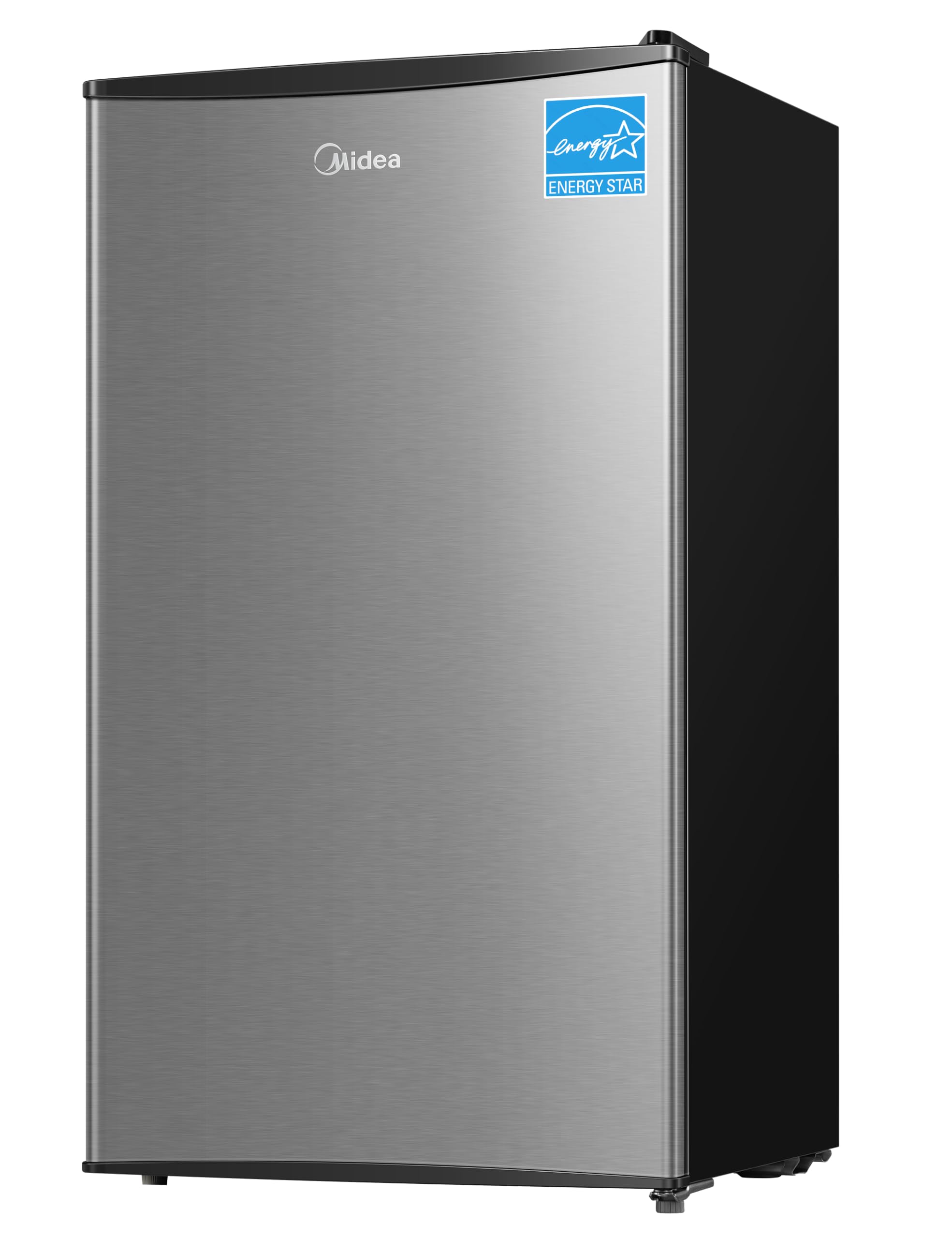
Midea 3.3 Cu. Ft. Mini Fridge
Key Features
- Defrost: Manual
- Capacity: 3.3 cu ft
- Dimensions: 17.7"D x 18.6"W x 33.9"H
- Noise level: Under 42 dB
- Price: Budget
Eighteen and a half inches is the number that decides most small-fridge purchases, and it’s where this Midea gets its edge: at 18.6 inches wide it slips into gaps the wider COWSAR won’t take, and the hinge swaps so the door opens the way your room wants it. The catch is height — 33.9 inches is the tallest cabinet in this group, so look at what’s above the gap before you commit. Narrow, reversible, and easy to live with is the combination that put it at the top of this list.
Inside, all 3.3 cubic feet are fresh food — no chiller box stealing the top shelf, which is the entire point of buying freezerless. Three shelves, three door bins, and a molded 2L bottle rack give you enough zones to keep milk, produce, and cans from becoming one pile, and the dial sweeps 33.8°F to 50°F, so it can run properly cold for food or mild for drinks.
Noise is another detail we paid attention to, because these cabinets end up in bedrooms, dorms, and offices where people take calls. Midea rates it under 42 decibels, the quietest figure in this group. It’s also Energy Star certified at 260 kWh a year, a running cost that won’t announce itself the way a second full-size fridge would.
Two things to know. Defrost is manual, so once or twice a year you unplug it, let the frost melt, and wipe down the rear wall — less of a project in a 3.3-cubic-foot box than in a full cabinet, but not nothing. And the thermostat runs cold at the top of its range, so drinks parked against the back can freeze when the dial sits near its coldest; start a setting lower than you think you need and give it a day before you chase the number. Both are twice-a-year annoyances rather than weekly ones, and neither changes the math on the price.
Pros
- Fits tight gaps at 18.6 inches wide
- Quiet enough for a bedroom at under 42 dB
- Least expensive of our picks
- Reversible door and 2L bottle rack
Cons
- Manual defrost means an occasional thaw
Yes — the Midea is the freezerless fridge we point most people to: quiet, narrow enough for tight gaps, and the least expensive of our picks.
Best for Larger Hauls
COWSAR 4.4 Cu. Ft. Freezerless Fridge
Key Features
- Capacity: 4.4 cu ft
- Shelving: 3 removable glass
- Dimensions: 22.05"D x 20.28"W x 31.5"H
- Annual energy: 252 kWh/yr
- Price: Midrange
Four point four cubic feet in a cabinet 31.5 inches tall is the COWSAR’s whole argument: it holds about a third more than our top pick without asking for more height, though it does want roughly two extra inches of width. If your problem is volume — a dorm, a garage drinks fridge, a household that empties a 3-cubic-foot box in a week — this is the one to measure for.
Removable glass shelves are what make that space usable. Pull one out and a stockpot or a row of 2-liter bottles stands upright; leave all three in and you get four shallow levels that keep cans from avalanching every time you open the door. That flexibility is why we rank it at the top of this group on storage, even though the Midea beats it on footprint and price.
It’s the most efficient of the bigger picks at 252 kWh a year, and COWSAR builds it for bedrooms and dorms — the compressor runs quietly enough that a shared room works. We also like that the thermostat offers seven settings across 32°F to 50°F, which is enough range to hold produce a few degrees above freezing or push drinks down near the bottom of it.
The trade-offs are narrow but real. Defrost is manual, so the rear wall needs a thaw every few months whether you feel like it or not. And at 22.05 inches deep it’s the deepest cabinet here — nearly four and a half inches more than the Midea — which is enough to matter if you’re sliding it into a built-in nook. Measure the depth before you fall for the capacity; that’s the number that decides whether this one fits.
Pros
- Most fresh-food capacity in this group
- Three removable glass shelves
- Most efficient of the larger picks
- Quiet enough for a bedroom or dorm
Cons
- Manual defrost adds upkeep
- 22-inch depth needs a deeper nook
Buy the COWSAR when you need a real second fridge rather than a drinks box — it’s the most fresh-food capacity in this group, in a cabinet short enough to tuck away.
Best for Shared Spaces
Avanti AR44 4.4 Cu. Ft. Refrigerator
Key Features
- Defrost: Automatic
- Capacity: 4.4 cu ft
- Door lock: Yes
- Dimensions: 22"D x 19.25"W x 33"H
- Price: Midrange
A door lock on a compact fridge sounds like a gimmick until you’re the one restocking a shop, a garage, or a shared office kitchen — and the Avanti is the only pick here with one. It’s keyed, and it takes a couple of turns to engage rather than a quarter turn, which is either a habit or a daily nuisance depending on your patience.
Under the lock sits the most complete cabinet in this group. You get 4.4 cubic feet, automatic defrost, three adjustable glass shelves, three door bins, and a stainless door over a black body that reads as a much larger appliance than it is. Automatic defrost is the part we care about most, because it deletes the one chore the manual-defrost picks hand you every few months.
Price lands it in the middle of this group: more than the Midea, less than the COWSAR, a fair trade for a bigger cabinet that doesn’t need thawing. If the lock is what brought you here, you’re also getting the least fuss of any large pick — nothing to scrape, no frost to chase, and a door that stays shut against anyone without the key.
Pros
- Only pick here with a door lock
- Automatic defrost, so no thawing
- 4.4 cu ft with three glass shelves
- Stainless door with a black cabinet
Cons
- Highest energy draw of the larger picks
- Rear wall runs coldest; keep dairy forward
We recommend the Avanti when the fridge has to live where other people can open it — the door lock, automatic defrost, and 4.4-cubic-foot cabinet suit a shop or shared kitchen.
Best for Desk-Side
Danby 1.7 Cu. Ft. Compact Refrigerator
Key Features
- Defrost: Automatic
- Capacity: 1.7 cu ft
- Warranty: 18 months parts and labor
- Dimensions: 20.06"D x 17.69"W x 20.06"H
- Price: Midrange
This is the fridge for the person whose problem isn’t capacity but floor space: 17.7 inches wide, 20.1 inches deep, and just over 20 inches tall, so it goes on a countertop, under a desk, or on top of a filing cabinet. Danby finishes the top as a scratch-resistant worktop, which is the detail that makes those spots work — it’s a surface you can stack a mug and a snack on, not just a lid.
For 1.7 cubic feet it’s well organized: one full-width wire shelf, one half shelf, tall-bottle storage in the door, and a CanStor dispenser that presents a can forward when you pull one out. We like that last feature more than we expected to — in a desk-side fridge, grabbing a soda without rearranging the shelf is most of the point.
Automatic defrost is a genuine advantage at this size, since a small manual-defrost box frosts up quickly and there’s little room to lose. Energy Star certification, R600a refrigerant, and an 18-month parts-and-labor warranty make it more appliance than novelty, which is not something you can say about every counter-top box.
The dial takes learning: it’s sensitive, and a small turn moves the temperature a lot, so set it, wait a day, and adjust from there rather than chasing the number after an hour. Once it’s dialed in for your room, there’s very little left to think about — which is exactly what you want from the fridge under your desk.
Pros
- Counter-top footprint fits under a desk
- Scratch-resistant worktop doubles as shelf
- Automatic defrost with no manual thawing
- 18-month parts-and-labor warranty
Cons
- Only 1.7 cu ft of capacity
- Costs the most per cubic foot here
Buy the Danby if floor space is your bottleneck and capacity isn’t — it’s the smallest all-fridge here, and it never asks you to defrost it.
Best for Low-Maintenance
E-Star 3.3 Cu. Ft. Freezerless Fridge

Key Features
- Defrost: Automatic
- Capacity: 3.3 cu ft
- Warranty: 2 years
- Dimensions: 20"D x 18"W x 33"H
- Price: Premium
The E-Star asks more money than anything else here for 3.3 cubic feet, the same capacity as our top pick, and what the premium buys is automatic defrost, three full-width glass shelves, and a two-year warranty that is the longest coverage in this group.
At 18 inches wide and 33 inches tall it fits where the wider 4.4-cubic-foot picks won’t, and the details are considered: a reversible door, adjustable leveling legs for uneven floors, an interior light, and a dial that covers 32°F to 50°F. Automatic defrost is the headline, though — it’s the difference between owning a fridge and maintaining one.
So why isn’t it higher? The arithmetic doesn’t favor it. The Avanti gives you a bigger 4.4-cubic-foot cabinet, automatic defrost, and a lock for less money, and the COWSAR gives you that same extra cubic foot for a modest step up from the top pick. What the E-Star has that neither offers is coverage: two years against one, which is real value in a rental, a dorm, or a building where swapping a fridge is a hassle.
One caveat that comes with any self-defrosting cabinet: the rear wall is where moisture collects between cycles, so you’ll still wipe it down now and then. That’s a fraction of the work of a manual thaw, and for a fridge nobody wants to think about, it’s the trade worth making.
Pros
- Automatic defrost, no manual thawing
- Two-year warranty, longest in the group
- Three full-width glass shelves
- 18-inch width fits narrow gaps
Cons
- Pricier than bigger, comparably equipped picks
Consider the E-Star if a two-year warranty and hands-off defrost matter more to you than capacity per dollar — it’s the lowest-maintenance pick here.
How We Tested Freezerless Refrigerators
We started by pulling every compact, freezerless refrigerator we could find — roughly 1.8 to 4.4 cubic feet, compressor-cooled, with reversible doors, adjustable thermostats, and either manual or automatic defrost — then narrowed the field to ten models that covered both the plain-black and stainless-steel ends of the category. Each one lived with us for eight months on rotation through three spots: next to a bed, in a home-office corner, and a dorm-style shared room where the door opens constantly.
Noise and temperature retention got the hardest look. We took decibel readings from three feet away each time the compressor kicked on, then slept beside the unit for a week to judge whether the cycling was noticeable at 2 a.m. Twice a day we logged an independent thermometer on the top and bottom shelves, loaded in room-temperature groceries to see how fast they chilled, and cut the power for two hours to watch how quickly the interior warmed and how well it recovered afterward.
For capacity and size, we packed the same haul into every fridge — a gallon of milk, a case of cans, a bag of produce — and measured interior dimensions ourselves to see how much usable space the compressor step ate up, then compared that against each one’s exterior footprint and the clearance its door swing needed. We flipped the hinges on every door advertised as reversible and timed the job. The auto-defrost models ran eight weeks untouched while we checked the back wall for frost and the floor for puddles, and on every unit we tested the door seal with a dollar bill, noted dents or door misalignment on arrival, pulled the shelves out under a full load to see if they bowed, and hooked up a wall meter to see what each one actually drew.
How to Choose a Freezerless Refrigerator
The first decision is whether you can live without ice, because everything after that is a gain: a freezerless cabinet gives its coldest, most reachable shelf to food instead of to an icebox you open twice a month.
Measure the Gap Before the Cubic Feet
Listed capacity tells you how much goes in; the tape measure tells you whether the cabinet goes in at all. Check width, depth, and height against your gap, then leave room for the door to swing — a reversible hinge helps, but it doesn’t shrink the arc. Height is where compact fridges surprise people: the 3.3- and 4.4-cubic-foot picks here stand 31.5 to 33.9 inches tall, while the counter-top Danby is just over 20, which is the difference between fitting under a desk and sitting beside one.
Capacity hides a second trick. On a fridge with a chiller compartment, the number on the box includes the freezer, so a 4.5-cubic-foot combo with a 0.3-cubic-foot icebox is really about 4.3 cubic feet of fresh food. That’s why a freezerless 4.4 can feel roomier inside than a combo claiming more.
Automatic or Manual Defrost
Manual defrost means the frost that builds on the rear wall stays there until you unplug the fridge, let it melt, and wipe it out — usually once or twice a year, more often in a humid room. Automatic defrost runs a short warming cycle to clear it for you. In a garage, a dorm, or an office where nobody wants a chore, automatic is worth paying for; in a kitchen where you’re wiping shelves anyway, manual is cheaper and no hardship at this size.
The Dial, the Cold Spot, and the Thermometer Test
Mechanical dials are standard at this size and they’re approximate. The number on the dial isn’t a temperature — the range usually sweeps roughly 32°F to 50°F — so set it, wait a full day, and check a standalone thermometer on the middle shelf. Expect a cold spot too: the rear wall runs coldest on nearly all of these, which is kind to drinks and unkind to lettuce. Load dairy and produce toward the front and let the back row handle cans.
Noise and Where the Fridge Lives
A compressor fridge in a bedroom has to be quiet, and the only useful number is the decibel rating — Midea publishes under 42 dB, the quietest claim in this group. When a listing gives no figure, treat silence as unproven and buy somewhere with a return window. Placement matters as much: an unconditioned garage or a sun-baked corner makes any of these work harder, and the smaller counter-top boxes are easier to tuck into a climate you control.
Shelves, Door Bins, and the Lock Question
Glass shelves wipe clean and don’t leave rings; removable ones let you drop a level to stand up a stockpot or a row of 2-liters, which is the flexibility you actually use. Door bins hold the tall bottles. A reversible hinge matters more than it sounds, since a fridge that opens into a wall is one you’ll resent. And if the fridge sits where other people can reach it, the Avanti’s keyed lock is the only one in this group.
Frequently Asked Questions
Is a freezerless refrigerator worth it compared with a mini fridge that has a freezer?
If you rarely use the icebox, yes. The freezer compartment on a compact fridge is small, often unsealed, and claims the coldest, most reachable shelf — exactly the space a freezerless cabinet gives back to food. What you give up is ice and anything frozen: no ice cream, no frozen dinners, no ice tray. If you need those, buy a combo and accept the smaller fresh-food compartment.
How much does a freezerless refrigerator cost to run?
Start with the annual energy figure on the listing: the picks here run 252 to 269 kWh a year, and the 1.7-cubic-foot counter-top model draws less than the 4.4-cubic-foot cabinets. Multiply that number by your local electricity rate to get the yearly cost. A fridge in a hot garage will run more than one in a conditioned room, so don’t compare the sticker figure to your last bill without accounting for where it sits.
What should I check when the refrigerator is delivered?
Open the box and look the cabinet over before the delivery window closes. Dented and damaged units turn up across this category, and the fix is much easier before you’ve filled the fridge. Photograph anything you find, keep the packaging through the return period, and let the unit stand upright for a few hours before plugging it in so the compressor oil settles.
Final Verdict
For most people, the Midea is the one to buy: the least expensive pick here, the quietest at under 42 decibels, and the narrowest at 18.6 inches, with 3.3 cubic feet that holds more than the number suggests because no chiller box is eating the top shelf.
If volume is the problem, the COWSAR’s extra cubic foot justifies the step up. If the fridge has to sit where other people can open it, the Avanti’s lock and automatic defrost make it the practical choice. The Danby is for the buyer whose constraint is floor space, not capacity — it’s the most expensive way here to buy cubic feet, and it earns that back in places a bigger box simply won’t go.