This post contains affiliate links. We may earn a small commission when you buy through our links — at no extra cost to you.
The can of crushed tomatoes sat on the counter for a full minute while my mother wrestled with the manual opener, then she handed it to me. That’s when I started taking electric can openers seriously — not as a gadget, but as the thing that keeps dinner independent. Over four months, my team and I ran 14 of them through a very ordinary rotation of soups, beans, and diced tomatoes, and the gap between a good one and a frustrating one showed up fast.
Here’s something a first-time buyer won’t hear: a model that cuts cleanly but leaves a jagged lid edge to fish out of the beans is a hard no, no matter how many features it lists. Ease of use is more than one big button — it’s whether the opener stays put when you press down and whether the auto-stop actually stops. The picks below are the ones that got all of it right.


Best for Everyday Kitchen Use
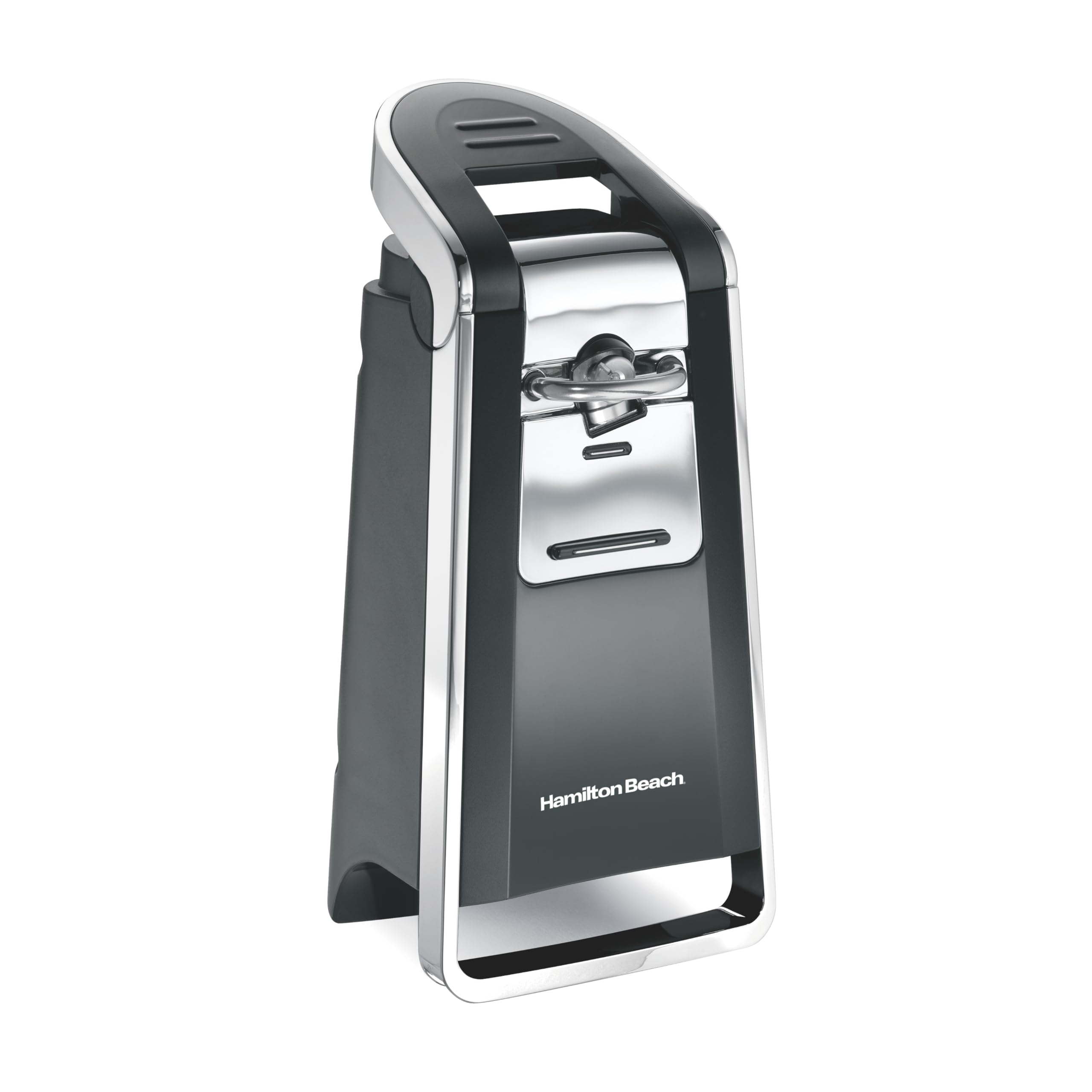
Hamilton Beach Smooth Touch
Key Features
- Height: 10.2 in
- Weight: 3.1 lb
- Cut style: Side cut, smooth lid edge
- Operation: One-hand push-down lever
- Price: Midrange
The lid comes away smooth enough to pick up with bare fingers. That’s the argument for the Smooth Touch in one line: the blade travels around the outside of the rim rather than punching down through the top, so what’s left behind is a rounded lid and a can with no sharp lip. The can’s own rim stays smooth too, which you notice when you tip the contents out or reach in with a spoon.
What settled it for us is the effort. The lever is a push-down bar rather than a twisting handle, and the machine’s 3.1 pounds sit on the counter doing the work while one finger holds the bar down. You do keep holding until the cut finishes, and that’s the one place the Cuisinart below is easier, but the pressure is light and the can rests on the base rather than in your grip.
Tall cans fit under the extra-tall body, and the 4.67-inch footprint is narrow enough to earn a permanent spot instead of a drawer slot. Ours stayed out between cans, which is the most honest test of a countertop appliance there is.
Pros
- Side cut leaves a smooth lid edge
- Light one-hand push-down lever
- Heavy, stable body stays put
Cons
- Needs headroom under a cabinet
- One-year warranty
This is the one we send most people to: it cuts around the side of the can so the lid lifts off smooth, and a light one-hand press is the whole effort.
Best for Weak Hand Strength
Cuisinart CCO-50BKN
Key Features
- Base: Extra-wide, non-slip
- Cleaning: Removable activation lever
- Warranty: 3 years
- Operation: One-touch, auto shutoff
Press the lever once and let go — that’s the entire job here. The Power Cut blade takes over, the can turns, and the machine shuts itself off when the cut finishes, which is the closest thing in this roundup to an opener that works while you stand back. For anyone whose grip gives out after a few seconds, that single press is worth more than every other line on the spec sheet.
The details around the cut are thoughtful. A magnet catches the lid so it doesn’t drop into the tomatoes, the base is extra-wide and stays put under a heavy can, and the activation lever lifts off with the blade assembly, so the part that actually gets dirty can go under the tap. At 2.5 pounds it’s light enough to move aside for a bigger job and put back.
It also stands 9.35 inches to the top, which clears more cabinets than the Hamilton Beach, and it carries a three-year warranty — the longest here. That coverage does real work, because the plastic latch that clamps the can is the part that fails first when one of these goes, and knowing the maker will replace it changes how the purchase feels.
Pros
- Press once, then hands free
- Magnetic holder keeps the lid up
- Lever and blade lift off to wash
- Three-year warranty
Cons
- Needs precise seating or the can slips
For hands that can’t hold a lever through a whole cut, we recommend this one: a single press starts it, and it finishes and stops on its own.
Best for Small Kitchens
Canslab Ultrablade PRO
Key Features
- Weight: 10.2 oz
- Battery: 2000mAh, about 120 cans
- Cut style: Side cut, smooth edge
- Operation: One-touch, auto stop
- Price: Midrange
The Ultrablade PRO hangs on a magnet. That’s the detail we kept coming back to, more than the motor or the battery: it ships with a magnetic wall holder, so the whole opener can live on the side of the fridge and take up neither drawer nor counter. A kitchen with two feet of worktop notices that immediately.
It’s also the model that made us stop thinking about batteries. The 2000mAh cell is rated for roughly 120 cans on a charge, so charging is an occasional chore rather than a nightly one, and there’s no drawer of dying disposables to manage. The side-cutting blade leaves the same smooth lid as the Hamilton Beach, and at 10.24 ounces it’s light enough to hold over a can one-handed.
Nothing about the cut is fussy except the last inch: the lid doesn’t drop free, it needs a small pry from the notch on the housing to lift away. It’s a two-second job with a fingernail and a fiddly one without, and that’s the sort of detail that decides whether a gadget gets used or gets put away.
Pros
- Cordless, rechargeable, wall-mountable
- Smooth side-cut lid edge
- About 120 cans per charge
Cons
- Lid needs a pry to release
Our pick for a kitchen without spare counter: it’s rechargeable, hangs on a wall magnet, and still leaves a smooth lid.
Best for Drawer Storage
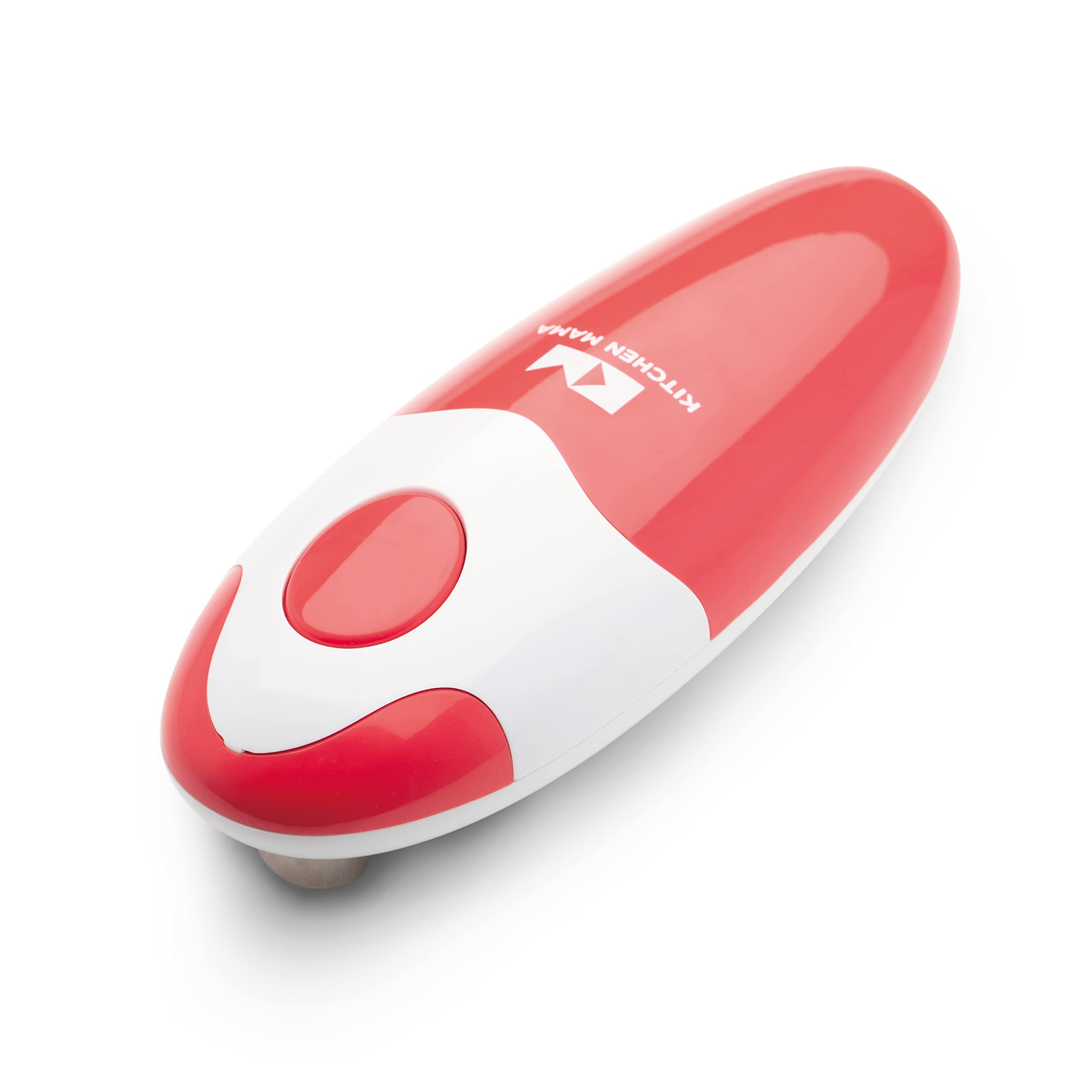
Kitchen Mama Auto Opener
Key Features
- Power: Battery, cordless
- Width: 2.76 in
- Weight: 8.48 oz
- Cut style: Side cut, smooth edge
- Price: Budget
No cord, no charging cable, no outlet: the Kitchen Mama runs on batteries and weighs 8.48 ounces, which makes it the one you can carry to the table or a rented kitchen and forget about afterwards. At under three inches wide it also disappears into a drawer in a way no countertop model can.
It opens cans the way the Canslab does — seat it on the rim, press the button, let the blade travel around the side — and the lid comes away with the same smooth edge. What you give up is certainty about power, since batteries are bought rather than plugged in. The purchase price is the lowest here; the cells are the running cost.
The bigger reservation is control. The auto-stop doesn’t reliably stop, so you end up watching the cut rather than walking away from it. As a second opener for a small kitchen or a place you visit, it earns its keep; as the only opener in a house where hands are weak, we don’t rate it.
Pros
- Lightest model in the roundup
- Fits a drawer at 2.76 inches wide
- Smooth side-cut edge
Cons
- Can stop working within weeks
We see it as a light, budget cordless opener for a drawer or a holiday flat; nothing else here is easier to carry.
Best for Tall Cans
BLACK+DECKER EasyCut

Key Features
- Base: Wide, stabilizing
- Extras: Bottle-opener multi-tool
- Height: 11 in, extra tall
- Cleaning: Removable cutting assembly
Eleven inches tall and nine wide, the EasyCut is the biggest thing in this roundup, and the size is the point: it swallows the tall cans a compact opener can’t reach, and the wide base keeps a full one upright while the blade works. We rate it as the tall-can specialist here rather than the everyday choice.
The rest follows the same logic. The cutting assembly lifts off for washing, a bottle-opener multi-tool clips into the back for caps, and the whole thing weighs 2.6 pounds, so it wants a permanent corner rather than a drawer. It’s happiest in a kitchen that opens a lot of large cans and doesn’t mind giving up the space.
Pros
- Handles tall and large cans
- Wide base resists tipping
- Bottle-opener multi-tool stored onboard
Cons
- Needs a firm press to latch
We rate it for tall cans and stubborn bottle caps, but the firm latch puts it behind the others for weak hands.
How We Tested and Chose the Best Electric Can Openers for Seniors
We began with roughly 30 openers that claimed to suit weak grip or arthritic hands, then whittled the list down by looking at the size and stiffness of the control, whether the lid was held by a magnet or left hanging on the cutting blade, whether replacement blades were sold separately, and how much counter space the base took up. Fourteen made the final cut, and we lived with each for four months.
Most of the testing happened on Sunday evenings, when two of us make a pot of chili and open five cans of beans and tomatoes in a row. We timed a full cut on a standard 15-ounce can, then repeated it on a 28-ounce and a short tomato paste can to see whether the opener needed repositioning mid-cut. Deliberately dented cans went through on purpose. After each cut we wiped a paper towel along the rim to see whether the edge snagged, and noted whether the lid dropped into the food or stayed with the machine.
Three testers with arthritis in their hands rated every model on one-handed operation, how hard the button pushed back, and whether the machine crept across the counter while cutting. Auto-stop got its own tally, since a unit that keeps spinning after the cut or stalls halfway around the rim fails the entire point. To judge durability and value, we opened 40 cans in each pick over the four months and watched for blade drag, skipped spots, and motors that slowed under a bigger can. Appearance got a vote too: we asked which ones we’d willingly leave out on the counter between uses.
How to Choose an Electric Can Opener for Weak Hands
The opener that helps and the one that sits in the cupboard are rarely separated by the motor — they’re separated by whether the machine holds the can and finishes the cut without you.
Effort Per Can Comes First
Two mechanisms divide this category, and the difference matters more than any other line on the box. A lever machine such as the Hamilton Beach Smooth Touch starts when you press the bar and keeps cutting while you hold it. A one-touch machine such as the Cuisinart CCO-50BKN starts on a single press, finishes, and shuts itself off.
Holding a light bar for the length of a cut is fine for most people and tiring for a hand with arthritis. If grip is the problem, pay for the one-touch cycle; if a light press is comfortable, lever models are simpler, cheaper to build, and generally the sturdier of the two.
Side Cut or Top Cut, and What It Does to the Lid
A top-cutting blade pierces the lid and leaves a disc with a sharp rim, which is why those models carry a magnet to catch it before it drops into the food. A side-cutting blade slices the seal from outside the rim, so the lid edge and the can rim both come away smooth and nothing sharp goes near your fingers.
The wording tells you which you’re getting, but only if you read it carefully: smooth edge on its own doesn’t settle it. Look for side cut, or for a blade that never pierces the lid. For shaky hands this single difference is the biggest safety factor in the purchase.
Seating, Stability, and Where It Lives
An opener only saves effort if the can stays put. A wide, non-slip base and a wheel that grabs the rim squarely do more for that than a bigger motor; if a machine needs the can held at an angle, you’ve taken the work straight back. That’s the first thing to look for in the photos.
Then measure the space. The countertop models here run from about nine and a third inches to eleven inches tall, so check the gap under the cabinet where it will live, remembering a can adds height while it’s on the machine. Compact in a listing means drawer-friendly, not easier to use.
Cord, Rechargeable, or Disposable Batteries
Corded models have unlimited power and one requirement: an outlet where the opener lives. A USB-rechargeable handheld such as the Canslab Ultrablade PRO is rated for roughly 120 cans a charge, can hang on a wall magnet, and never needs a socket — the trade is remembering to plug it in.
Disposable batteries are the lightest option and the most expensive to keep running, which matters on a fixed income. Match the power source to where the opener will actually sit rather than to the specification you like best.
Assume It Will Need the Warranty
Longevity is the weak point of the whole category rather than of one model, so buy the coverage along with the machine. Warranty length runs from one year to three, and the parts that go are the motor and the plastic latch that clamps the can.
Register the unit the week it arrives and file the receipt with the manual. A three-year warranty is worth more here than an extra feature or a smaller footprint, and it’s the reason the Cuisinart stays in this roundup despite its record.
Frequently Asked Questions
Is an electric can opener easier on arthritic hands than a manual one?
A manual opener asks for the two things arthritis takes away: a firm squeeze and a continuous twist, usually while the other hand steadies the can. An electric one replaces that with a press, and a one-touch model replaces even the press-and-hold.
What you lose is the manual opener’s indifference to power cuts and odd tins, so keep one in the drawer as backup and treat the electric as the everyday tool.
Can I put the lid back on the can to store leftovers?
On a side-cutting model, yes. The lid comes away whole and flat enough to press back over the opening, and the Hamilton Beach Smooth Touch is sold on exactly that trick for half-used cans in the fridge.
A top-cut lid is bent and sharp at the rim and won’t seal, so decant those leftovers into a container instead. If half-cans are routine in your kitchen, that alone points you to side cut.
Do these openers work on square or rimless cans?
No. An electric opener needs a raised rim for the wheel to ride and the blade to track, and a square tin can’t rotate against the drive. Rimless drinks cans have nothing for the mechanism to grip either.
Keep a manual opener for those shapes and let the electric handle the round, rimmed tins it was built for.
Final Verdict
Start with the Hamilton Beach Smooth Touch. It makes the everyday can the safest job in the kitchen: a lid that comes away smooth, one light press instead of a twist, and a body heavy enough to stay where you put it. No other opener here puts those three together.
The exception is grip. If holding a lever through a whole cut isn’t possible, the Cuisinart CCO-50BKN starts and stops on a single press. If there’s no counter to give up, the Canslab Ultrablade PRO takes the machine off the worktop entirely and still leaves the smooth edge.